Open Now
207 FM 646 Rd, Dickinson, TX 77539
Dickinson sits squarely in FEMA Zone AE along Dickinson Bayou, where Harvey (2017) submerged entire subdivisions and replaced thousands of HVAC systems overnight — yet many of those post-storm replacements are now entering their first major maintenance cycle in aging 1990s-era slab-on-grade homes in Bay Colony and Centerfield Lakes. Between the coastal humidity, recurring flood exposure, R-22 holdovers in pre-2010 bayou-adjacent ranches, and a permit process that runs through the City of Dickinson (not Houston's One-Stop portal), getting AC work right here requires a contractor who understands Galveston County's particular storms, soils, and rules.
Ranked by verified Google rating × review volume × verification tier. How we rank →
Some highly-rated pros serve Dickinson from nearby and may not keep a Dickinson street address. Those are listed under "Also serving Dickinson" with their real city and distance, so you always know where each business is based.
207 FM 646 Rd, Dickinson, TX 77539
5252 FM 517 Rd E, Dickinson, TX 77539
2011 Deats Rd, Dickinson, TX 77539
1000 FM 646 Rd, Dickinson, TX 77539
5114 Casa Grande St, Dickinson, TX 77539
1455 FM 646 Rd suite 211, Dickinson, TX 77539
Highly-rated pros based nearby who cover Dickinson. Distance shown from the Dickinson area.
Serving Dickinson Based in League City · 1.9 mi away
Serving Dickinson Based in League City · 3.1 mi away
Serving Dickinson Based in League City · 3.6 mi away
Serving Dickinson Based in League City · 3.8 mi away
Why it matters to you
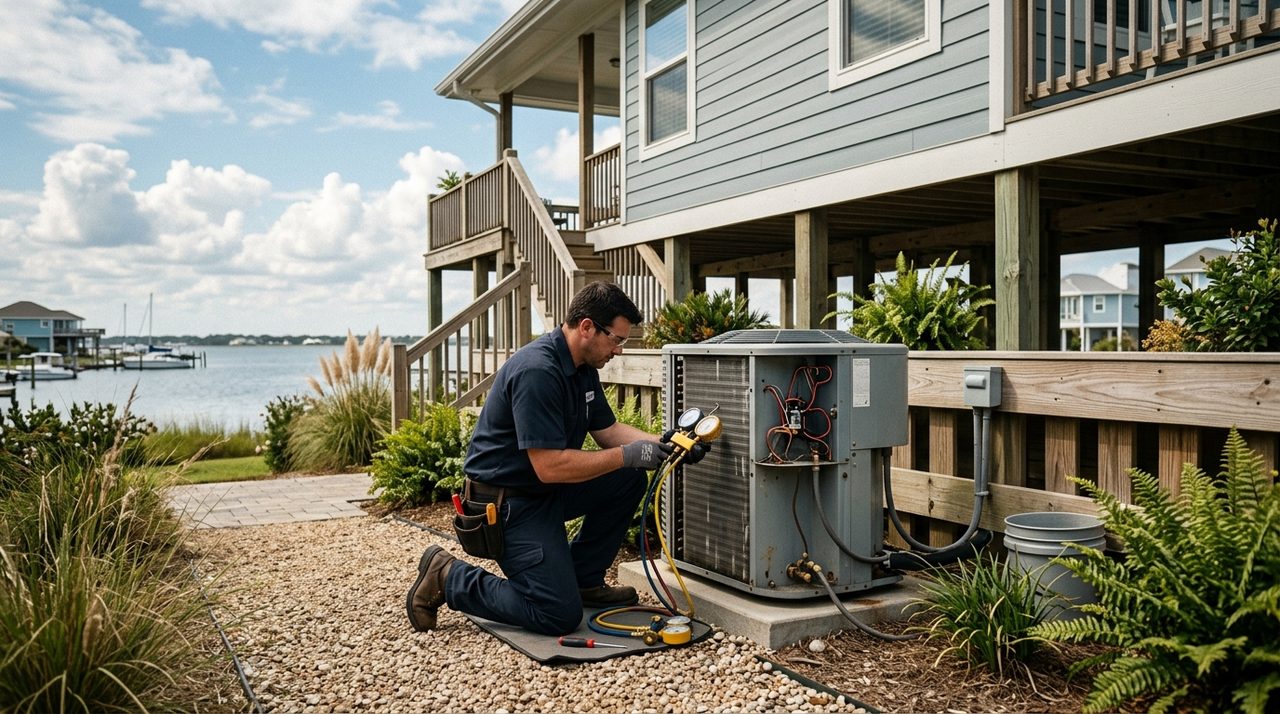
Dickinson's Zone AE designation means outdoor condenser units on the lowest-lying parcels near Dickinson Bayou have been fully submerged — some twice, in Harvey (2017) and again during Tropical Storm Beryl (2024). Saltwater-laden floodwater accelerates coil corrosion and motor bearing failure far faster than inland markets; a unit that appeared to survive a flood event may be running on borrowed time as internal corrosion progresses. Homeowners in Bay Colony and older bayou-adjacent sections who filed TWIA or homeowners insurance claims after Harvey but only replaced the indoor air handler — not the outdoor unit — are particularly at risk of compressor failure now.
What a good pro does
A qualified HVAC contractor should inspect both the coil fin condition and the electrical components of any condenser that was submerged, using a refrigerant leak test and amp-draw test rather than a visual check alone. If replacement is warranted, the new unit's concrete pad should be evaluated for height relative to the property's Base Flood Elevation; elevating the pad or using a wall-bracket mount is a concrete step that protects the investment. Permits for replacement equipment must be pulled through the City of Dickinson Permit Office — not Houston's One-Stop portal — and the contractor must hold a valid TDLR Air Conditioning and Refrigeration Contractor license.
Sources: Texas Windstorm Insurance Association (TWIA), FEMA National Flood Hazard Layer (NFHL), Texas Department of Licensing & Regulation
Why it matters to you
Dickinson's coastal humidity — regularly exceeding 90% relative humidity through much of the year — creates near-constant condensation on evaporator coils, and clogged condensate drain lines are the single most frequent HVAC service call in communities like Centerfield Lakes and Bayou Maison. On slab-on-grade homes (the standard build in Dickinson's 1990s–2010s subdivisions), a backed-up drain pan has nowhere to go but across the slab, migrating into adjacent drywall cavities and flooring — a problem that is especially costly in homes that already underwent post-Harvey mold remediation and drywall replacement. Secondary drain pans and float-switch shutoffs are not universally installed in production-builder homes from this era.
What a good pro does
A thorough annual service visit in Dickinson should include a wet-vac flush of the primary condensate line, an algaecide treatment of the drain pan, and a visual inspection for microbial growth on the coil face — not just a coil rinse. Contractors should also confirm the presence of a secondary drain pan with a float switch; adding one is a modest investment (typically within the $180–$450 component repair range) that prevents a service call from becoming a mold remediation project. All drain-pan modification work on an existing system requires a mechanical permit through the City of Dickinson.
Sources: Municipal permit office (see area profile), FEMA National Flood Hazard Layer (NFHL), Texas Department of Licensing & Regulation
Why it matters to you
Dickinson's older housing stock — the 1950s through 1990s ranch-style and split-level homes on non-HOA lots closest to Dickinson Bayou — has a meaningful share of R-22 (Freon) equipment that was neither destroyed in Harvey nor replaced afterward, either because the unit survived or because owners deferred full replacement. Since the federal EPA phaseout banned new R-22 production as of January 2020, reclaimed R-22 in the Houston market has reached $80–$150 per pound, turning a refrigerant top-off into a $600–$1,500 bill — and that assumes the leak itself is minor. Many of these same homes had deferred repairs after Uri (February 2021) cracked refrigerant lines or damaged TXVs, meaning some units are running with multiple latent failure points simultaneously.
What a good pro does
If a Dickinson home's system still uses R-22 and has had a documented leak or an R-22 recharge in the past two years, the math almost always favors full system replacement over continued repair. A TDLR-licensed contractor should perform a full leak search before quoting a recharge, and homeowners should request an EPA-compliant refrigerant handling summary for any recovered R-22. Drop-in retrofit refrigerants like R-407C require compressor compatibility evaluation before use — this is not a universal swap. Replacement permits are issued by the City of Dickinson Permit Office; budget $75–$250 for permit fees on top of equipment costs.
Sources: Texas Department of Licensing & Regulation, Municipal permit office (see area profile), ENERGY STAR / U.S. Dept. of Energy
Why it matters to you
Homeowners in Bay Colony (managed by Goodwin & Co.) and Centerfield Lakes (mandatory POA) face a parallel approval track on top of the City of Dickinson mechanical permit when replacing or relocating a condenser unit. Both communities have recorded CC&Rs that govern exterior equipment placement and screening requirements — meaning a contractor who pulls the city permit and schedules the work may still be non-compliant if the new unit's location or screening fence doesn't meet the architectural committee's standards. This is a real friction point for post-storm replacements where a surviving condenser pad is no longer in the ideal location after flood mitigation work or pad elevation.
What a good pro does
Before any exterior condenser work in an HOA-governed section of Dickinson, homeowners should request a copy of the relevant CC&R section on mechanical equipment and submit to the architectural review committee before the contractor orders equipment. Good contractors familiar with Dickinson will ask about HOA status at the quoting stage — not after installation. Note that the City of Dickinson permit and the HOA architectural approval are independent processes; receiving one does not satisfy the other, and neither can substitute for a TDLR-licensed contractor pulling the mechanical permit.
Sources: Local HOA / deed restrictions (see area profile), Municipal permit office (see area profile), Texas Department of Licensing & Regulation
Hiring ac repair in Dickinson? Dickinson is an incorporated Galveston County city with a wide mix of housing stock—from 1950s–1970s bayou-adjacent homes to 1990s–2010s master-planned subdivisions like Bay Colony and Centerfield Lakes. Situated along Dickinson Bayou in FEMA Zone AE, flood mitigation, foundation repair, and post-storm restoration are central to the home services landscape. Contractors must navigate a patchwork of HOA-governed subdivisions with strict CC&Rs alongside older, unrestricted lots with different structural and regulatory demands.
Building era
1950s–1970s in older bayou-adjacent areas; 1990s–2010s in master-planned subdivisions (Bay Colony, Centerfield Lakes, Bayou Maison, Bayou Park).
Typical style
Production-builder traditional brick veneer in HOA subdivisions (1- and 2-story); ranch-style, split-level, and elevated structures in older bayou-adjacent areas; some manufactured homes and cottages in non-HOA sections.
Foundations
Mixed — concrete slab-on-grade dominates in modern subdivisions; pier-and-beam and elevated pier foundations more common in older bayou-adjacent and lower-lying areas.
Common systems
Modern subdivisions: central A/C with gas or electric furnace, copper or PEX plumbing, 200-amp electrical panels. Older homes: may have original galvanized or cast-iron plumbing, window units or aging central HVAC, and 100- to 150-amp electrical service. Post-Harvey replacements are common across both eras.
What that means for repairs
Post-Harvey flood restoration drove massive renovation activity including full drywall replacement, mold remediation, HVAC replacement, and re-flooring. Ongoing renovation focuses on flood-proofing measures such as foundation elevation, installation of flood vents, and upgraded drainage systems. Older homes near the bayou frequently undergo full gut renovations or elevation projects.
Permit jurisdiction
City of Dickinson Permit Office (incorporated city in Galveston County; does not use Houston Permitting Center).
HOA & deed restrictions
No city-wide HOA. Many subdivisions have mandatory HOAs with recorded CC&Rs, including Bay Colony Community Association (managed by Goodwin & Co.), Centerfield Lakes HOA Inc. (mandatory POA), Bayou Maison HOA (mandatory), and Bayou Park III HOA. Hundreds of homes in Dickinson have no HOA at all, particularly in older areas and individual lots.
Historic districts
No historic district designation confirmed for Dickinson. The city does not have a Houston-style HAHC review process.
Contractor note
Contractors must pull permits through the City of Dickinson and should verify whether the property is in an HOA-governed subdivision with architectural review requirements before beginning exterior work. Flood zone AE designation triggers additional FEMA compliance requirements for substantial improvements or new construction.
FEMA flood zone
FEMA Zone AE (high flood risk) — source: fema_nfhl. Dickinson Bayou runs through the heart of the city, and extensive areas along the bayou and its tributaries are within the AE regulatory floodway and 100-year floodplain.
Hurricane Harvey impact
Dickinson was one of the hardest-hit communities in the entire Houston region during Hurricane Harvey (2017). Dickinson Bayou overflowed massively, inundating large portions of the city. Thousands of homes flooded and the city became a national example of Harvey's devastation. Both HOA subdivisions and older bayou-adjacent neighborhoods experienced severe damage. Many homes required full gut renovations, and some were demolished or elevated post-storm.
Heat & humidity load
High heat and extreme humidity accelerate mold growth in flood-damaged or poorly ventilated structures, a persistent concern given the neighborhood's flood history. Slab foundations in clay soils can shift during summer drought cycles, and aging HVAC systems in older homes are heavily stressed. Coastal proximity adds salt-air corrosion risk to outdoor HVAC condensers, metal roofing, and exterior fixtures.
Working with contractors here
Flood damage restoration and prevention dominate the contractor landscape in Dickinson—mold remediation, drywall replacement, foundation repair, and home elevation projects are consistently in demand due to the AE flood zone designation and Harvey's lasting impact. Plumbing contractors frequently encounter corroded galvanized lines in older bayou-adjacent homes and post-flood pipe replacement needs. HVAC replacement is common across both eras of housing, as many systems were destroyed in Harvey or are aging out in 1990s-era subdivisions. Contractors working in HOA communities like Bay Colony or Centerfield Lakes should obtain architectural approval before exterior modifications. Job scoping in Dickinson must always account for flood history—checking for prior water intrusion, assessing foundation elevation relative to base flood elevation, and confirming whether the property triggers FEMA substantial improvement thresholds.
Local Tip
Always ask for a written estimate before work begins. Texas contractors are required to provide one on jobs over $1,000.
Dickinson is an incorporated Galveston County city with a wide mix of housing stock—from 1950s–1970s bayou-adjacent homes to 1990s–2010s master-planned subdivisions like Bay Colony and Centerfield Lakes. Situated along Dickinson Bayou in FEMA Zone AE, flood mitigation, foundation repair, and post-storm restoration are central to the home services landscape. Contractors must navigate a patchwork of HOA-governed subdivisions with strict CC&Rs alongside older, unrestricted lots with different structural and regulatory demands.
Source: U.S. Census Bureau, ACS 5-Year 2023
Much of Dickinson maps to FEMA Zone AE (high flood risk), so flood-resilient detailing -- elevated equipment, water-tolerant materials, and drainage-first thinking -- is essential here, not optional; risk climbs sharply on blocks nearest Dickinson Bayou, where it varies parcel to parcel.
Source: FEMA National Flood Hazard Layer (NFHL). Flood zones vary by parcel — verify your individual FIRM panel.
In Dickinson, TX, where FEMA Zone AE inside the 100-year floodplain and proximity to Dickinson Bayou from both surge and tropical rainfall converge, consider relocating ground-mounted condensers to a rooftop or elevated mechanical platform as a permanent resilience upgrade. Marine-grade electrical disconnects and corrosion-resistant condenser cabinets are not optional accessories on the coast — they are the baseline standard any licensed HVAC contractor should follow for new installs. Confirm the current FEMA panel for your Dickinson parcel — the area maps to Zone AE, but adjacent lots can differ.
Coastal Dickinson, TX sits in the most exposed corridor for the Gulf-moisture-fed severe thunderstorms that produce large hail and extreme wind gusts; marine-grade condenser cabinets with reinforced panels resist hail denting better than standard residential units and are worth specifying on any replacement. Confirm with your TDLR-licensed HVAC contractor that the unit's wind rating matches your coastal exposure category under ASCE 7. Confirm the current FEMA panel for your Dickinson parcel — the area maps to Zone AE, but adjacent lots can differ.
Coastal Dickinson, TX rarely experiences extended hard freezes, but Uri 2021 demonstrated that even barrier-island HVAC systems can lock up when heat-pump defrost cycles fail in sustained sleet — the combination of salt air corrosion on defrost sensors and sub-freezing temps caused widespread coastal outages that dragged on for the entire freeze event. A pre-winter salt-wash of outdoor coils and replacement of any corroded defrost sensors gives your system its best chance during the next anomalous freeze. With a median build year of 1984, the older building stock here is more exposed to hard-freeze damage than newer construction. Because Dickinson drains toward Dickinson Bayou, block-level runoff can differ sharply from the mapped zone.
Sources: FEMA National Flood Hazard Layer (NFHL), Ready.gov -- Hurricanes, CenterPoint Energy -- Storm Center, City of Houston -- Emergency Preparedness, Ready.gov -- Winter Weather, Harris County Flood Control District
Houston-specific estimators to plan your project before you call a pro. All results are planning estimates — a licensed local pro confirms the details on site.
Living space you want cooled (400–10,000 sq ft).
Recommended nominal size
Estimated cooling load
This is a planning estimate only — actual requirements depend on an on-site assessment by a licensed Houston pro. Houston's humidity and long cooling season make an oversized unit a common, costly mistake — it short-cycles and never dehumidifies. A licensed contractor confirms sizing with a full Manual J calculation.
Disconnect & drain every outdoor hose bib
Remove hoses, drain the spigots, and cover each with an insulated faucet sock. Un-drained hose bibs are the #1 burst point in a Houston freeze.
Insulate exposed pipes in the attic & garage
Wrap any pipe in an unconditioned space (attic runs, garage walls) with foam sleeves. Houston homes rarely insulate these because they only matter a few nights a year — which is exactly why they burst.
Open cabinet doors & keep a pencil-width drip
On hard-freeze nights, open kitchen/bath cabinets so warm air reaches the pipes and let faucets on exterior walls drip to relieve pressure.
Protect the attic/garage water heater & its lines
An attic or garage tank sits in unconditioned space. Insulate the cold-inlet and hot-outlet lines and confirm the emergency drain pan is clear so a leak doesn't reach the ceiling.
This is a planning estimate only — actual requirements depend on an on-site assessment by a licensed Houston pro. If a pipe has already burst, shut off your main water supply and call a licensed Houston plumber immediately — freeze bursts flood fast.
Sources: Municipal permit office (see area profile)Texas Department of Licensing & Regulation
Sources: FEMA National Flood Hazard Layer (NFHL)Municipal permit office (see area profile)
Sources: Municipal permit office (see area profile)Local HOA / deed restrictions (see area profile)
Sources: Texas Windstorm Insurance Association (TWIA)FEMA National Flood Hazard Layer (NFHL)