702 Freeport St, Houston, TX 77015
Best AC Repair in Galena Park, TX
Galena Park's mid-century ship-channel bungalows — most built between 1940 and 1960, with a Census median year built of 1956 — were designed for a different era of cooling: window units, not ducted central air. When owners upgraded to split systems over the decades, they often did so piecemeal, leaving aging air handlers in tight closets, improvised line sets, and equipment that has absorbed every humid Buffalo Bayou summer since installation. Knowing which problems are native to this ZIP code, and which permit office to call, is the difference between a quick repair and a dragged-out ordeal.
Verified against Google Business data
Updated 2026
See the 10 AC Repair Serving Galena Park 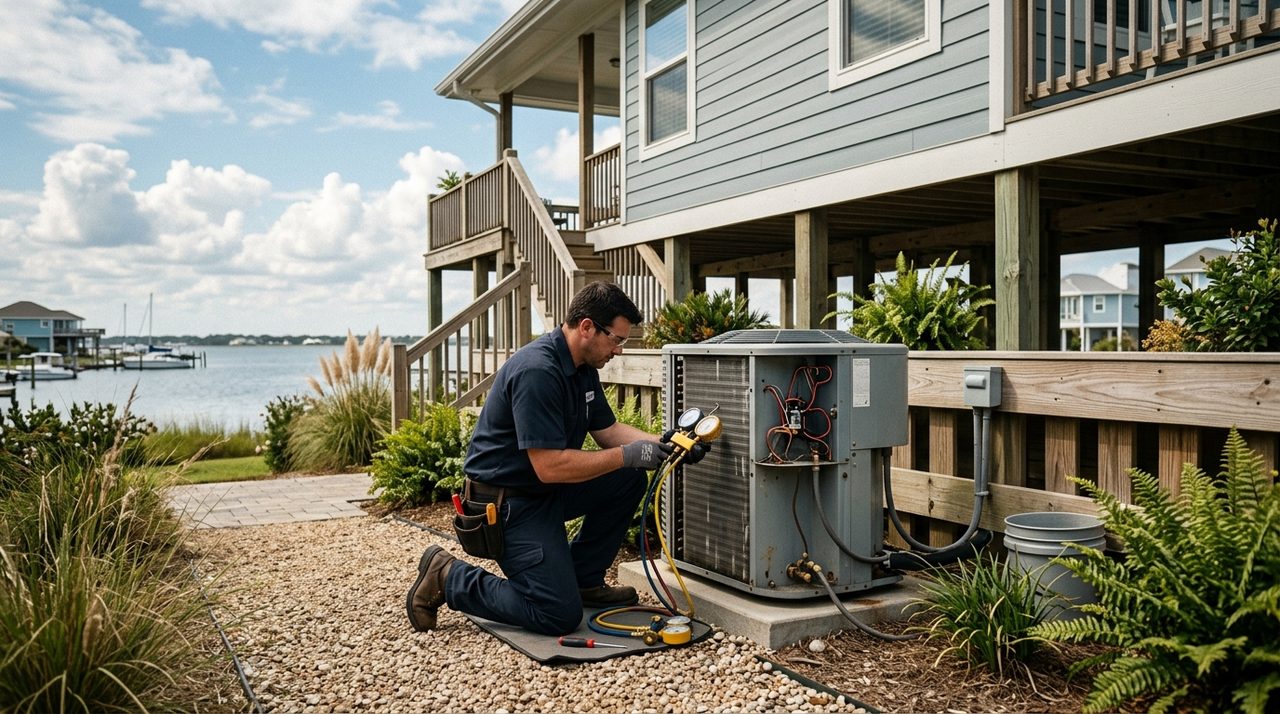
- Median home built
- 1956
- Median home value
- $116,400
- FEMA flood zone
- X500 (moderate)
- Typical AC repair cost (est.)
- $180–$650 for component repairs; $5,500–$9,500 for full system replacement
- Most common local issue
- Clogged condensate drains and mold in retrofit air handlers installed in original 1950s-era closet spaces
Ranked by verified Google rating × review volume × verification tier. How we rank →
Some highly-rated pros serve Galena Park from nearby and may not keep a Galena Park street address. Those are listed under "Also serving Galena Park" with their real city and distance, so you always know where each business is based.
Min rating:
10 resultsBased in Galena Park
Open Now
13502 Utica St, Houston, TX 77015
Open Now
1401 Clinton Dr #234, Galena Park, TX 77547
Open Now
12605 East Fwy #421, Houston, TX 77015
Closed
10814 East Fwy, Houston, TX 77029
9009 N Loop E Fwy # 150, Houston, TX 77029
Also serving Galena Park
Highly-rated pros based nearby who cover Galena Park. Distance shown from the Galena Park area.
Open Now
Serving Galena Park Based in Pasadena · 2.6 mi away
Closed
Serving Galena Park Based in Pasadena · 2.7 mi away
Serving Galena Park Based in Pasadena · 4 mi away
Serving Galena Park Based in EaDo · 4.2 mi away
AC Repair in Galena Park: What You Should Know
Retrofit Central Systems Crammed into Mid-Century Closets Are Drowning in Humidity
Why it matters to you
Galena Park's 1940s–1960s bungalows were never built with central HVAC in mind, so when split systems were added, air handlers frequently ended up in original linen closets or utility corners with no floor drain and minimal clearance. Houston's near-constant 90%+ relative humidity means evaporator coils stay wet for months at a stretch, and condensate drain lines in these cramped retrofits clog with algae far faster than in purpose-built mechanical rooms. On slab-on-grade homes (common from the 1960s onward in Galena Park), an overflowing drain pan has nowhere to go but under the slab, where it can cause persistent moisture problems.
What a good pro does
A qualified HVAC technician should inspect the condensate drain line and secondary pan every season — not just when it backs up. Proper service includes flushing the line with a biocide, confirming the pan's float-switch cutoff is functional, and verifying there is a compliant secondary drain or safety switch in place. Any replacement of an air handler in Galena Park requires a mechanical permit pulled through the City of Galena Park permit office, not Houston's One-Stop portal, and must be done by a TDLR-licensed contractor. Drain clearing alone typically runs $95–$225 (est.).
Sources: Municipal permit office (see area profile), Texas Department of Licensing & Regulation
Pre-2010 R-22 Equipment Is Everywhere in a 1956 Housing Stock
Why it matters to you
Because so many Galena Park homes were originally cooled by window units and only converted to central air in the 1980s or 1990s, a meaningful share of the neighborhood's split systems predate the 2010 R-22 phaseout and still run on refrigerant that is now federally banned from new production. Reclaimed R-22 is fetching $80–$150 per pound or more on the Houston spot market, which means topping off a leaking R-22 system can cost $600–$1,500 (est.) — often more than the refrigerant is worth relative to the equipment's remaining life. The area's 70.1% owner-occupancy rate and modest median home value of $116,400 mean many owners have deferred the conversation about full replacement.
What a good pro does
Before authorizing another R-22 recharge, ask the technician to conduct a documented leak test and provide a written cost comparison between recharge, retrofit refrigerant conversion (which requires compressor compatibility evaluation), and full system replacement. A TDLR-licensed contractor can pull the required mechanical permit through Galena Park's own permit office for any replacement unit. The EPA's R-22 phaseout rules are clear: new production is prohibited, and the economics of repeated top-offs rarely pencil out against a modern R-410A or R-32 system.
Sources: Texas Department of Licensing & Regulation, Municipal permit office (see area profile), ENERGY STAR / U.S. Dept. of Energy
Outdoor Condenser Pads Shifting on Mixed Foundations in Buffalo Bayou's Shadow
Why it matters to you
Galena Park sits in FEMA Zone X500 — outside the 100-year floodplain but inside the 500-year — and heavy rain events still push water across yards and driveways here with regularity. On homes where pier-and-beam construction (common in the 1940s–1950s builds) transitions to adjacent concrete condenser pads, differential settling is common: the pad sinks or tilts while the house stays put, stressing the refrigerant line set and pulling the electrical disconnect out of alignment. Even on slab homes, Houston's expansive clay soil swells and contracts seasonally, and a condenser unit sitting on a pad that has crept two inches out of level creates compressor oil return problems that shorten equipment life.
What a good pro does
Any HVAC service call on a Galena Park home older than 30 years should include a visual check of condenser pad level — a simple bubble-level assessment takes two minutes and can flag a problem before it becomes a refrigerant leak or seized compressor. If the pad needs resetting or the line set shows kinking, the contractor should document the condition and quote the repair separately. For replacement installations, a properly poured and leveled pad with adequate ground clearance is required under the City of Galena Park's permitting process; confirm the inspecting municipality before scheduling the inspection.
Sources: Municipal permit office (see area profile), FEMA National Flood Hazard Layer (NFHL)
Winter Storm Uri Damage Hiding in 1950s-Era Air Handlers
Why it matters to you
The February 2021 freeze hit Galena Park's older housing stock especially hard: original-era air handlers with thin-gauge drain pans cracked under ice expansion, refrigerant lines in uninsulated attic chases split, and many homeowners made only the minimum repair to restore cooling before the next summer. With a median year built of 1956 and a stock of homes that have changed hands under deferred-maintenance conditions, latent Uri damage — hairline refrigerant leaks at coil joints, drain pans with stress fractures that weep slowly rather than flood — is still surfacing in routine service calls years later. Mold growth inside the air handler cabinet is a frequent result when a cracked pan has been weeping undetected.
What a good pro does
If your Galena Park home has not had a full evaporator coil and drain pan inspection since winter 2021, request one explicitly — not just a filter change. A technician should pressure-test the refrigerant circuit, visually inspect coil fins for freeze damage, and check the drain pan for hairline cracks by running water directly into it. Air handlers showing mold growth should be treated with an EPA-registered coil cleaner and, if contamination is significant, replaced. Any replacement air handler triggers a mechanical permit through the City of Galena Park; verify the contractor is pulling the correct jurisdiction's permit, not defaulting to Houston's system.
Sources: Municipal permit office (see area profile), Texas Department of Licensing & Regulation, EPA Lead Renovation, Repair and Painting (RRP) Rule
AC Repair in Galena Park: What You Should Know
Hiring ac repair in Galena Park? Galena Park is an incorporated city in Harris County with aging mid-century housing stock built primarily for ship channel workers. Homeowners here contend with older plumbing, mixed foundation types, and proximity to Buffalo Bayou and industrial infrastructure. Permits go through the City of Galena Park rather than Houston, and HOA presence varies by subdivision.
- Housing era
- 1940s–1960s, with scattered later infill
- Foundation
- Mixed — pier-and-beam common in 1940s–1950s builds, slab-on-grade more common from 1960s onward
- Flood zone
- FEMA Zone X500 (moderate flood risk) — source
- Permits
- City of Galena Park permit office (independent incorporated city — not City of Houston…
Housing stock & systems
Building era
1940s–1960s, with scattered later infill.
Typical style
Small one-story bungalows, ranch-style homes, and cottages on traditional street grids with modest lot sizes.
Foundations
Mixed — pier-and-beam common in 1940s–1950s builds, slab-on-grade more common from 1960s onward. Precise split not publicly documented; verify on individual parcels.
Common systems
Older galvanized or cast-iron plumbing in pre-1960s homes; window units or aging central HVAC retrofits; original 60–100 amp electrical panels in many older homes, often needing upgrades to modern 200 amp service.
What that means for repairs
Plumbing replacements (galvanized-to-PEX or copper), electrical panel upgrades, and foundation leveling on pier-and-beam homes are the most common renovation drivers. Many homes are candidates for full gut renovations given age and modest original construction quality.
Permits & restrictions
Permit jurisdiction
City of Galena Park permit office (independent incorporated city — not City of Houston Permitting Center). Harris County may have jurisdiction over floodplain and certain regional permits.
HOA & deed restrictions
No single mandatory master HOA covers all of Galena Park. HOA presence is subdivision-by-subdivision. Galena Oaks Property Owners Association serves that specific subdivision; other areas such as the Woodland subdivision have no mandatory HOA. City code enforcement handles property maintenance standards citywide.
Historic districts
No City of Houston historic district designation — Galena Park is a separate incorporated city. No local historic district designation confirmed.
Contractor note
Contractors must permit through the City of Galena Park, not Houston. Familiarity with Galena Park's code of ordinances and inspection processes is essential, as procedures differ from both Houston and unincorporated Harris County.
Flood & weather
FEMA flood zone
FEMA Zone X500 (moderate flood risk) — source: fema_nfhl. Galena Park sits north of the Houston Ship Channel along Buffalo Bayou, with low-lying and drainage-adjacent parcels carrying higher localized risk. Property-level flood zone verification is recommended.
Hurricane Harvey impact
Harvey brought extreme rainfall across east Harris County, and low-lying or drainage-adjacent properties in and around Galena Park experienced flooding. However, specific citable evidence of widespread or unique devastation in Galena Park's residential neighborhoods compared to other east-side areas was not located. Scattered flood claims exist near bayou and drainage ditch areas. Individual property flood-loss history should be checked through FEMA and Harris County Flood Control District records.
Heat & humidity load
Older homes with original insulation and aging HVAC systems face extreme cooling loads during Houston summers. Pier-and-beam crawl spaces can trap moisture, promoting mold and pest issues. Galvanized plumbing in pre-1960s homes is vulnerable to corrosion accelerated by heat and humidity.
Working with contractors here
Contractors in Galena Park most commonly handle foundation leveling on pier-and-beam homes, full plumbing re-pipes replacing galvanized lines, and electrical panel upgrades from outdated 60-amp service. The aging 1940s–1960s housing stock means whole-house renovation and weatherization projects are frequent, often including HVAC replacement with modern central systems. Proximity to industrial facilities and Buffalo Bayou means drainage improvements and moisture mitigation are recurring job scopes. Contractors should note that Galena Park is its own incorporated city with a separate permitting process, and job scoping should account for the possibility of encountering original mid-century materials including lead paint and outdated wiring.
Local Tip
Always ask for a written estimate before work begins. Texas contractors are required to provide one on jobs over $1,000.
About Galena Park
Galena Park is an incorporated city in Harris County with aging mid-century housing stock built primarily for ship channel workers. Homeowners here contend with older plumbing, mixed foundation types, and proximity to Buffalo Bayou and industrial infrastructure. Permits go through the City of Galena Park rather than Houston, and HOA presence varies by subdivision.
- Median year built
- 1956
- Median home value
- $116,400
- Owner-occupied
- 70.1%
- Population
- 10,527
- Housing units
- 3,292
- Median income
- $54,167
Source: U.S. Census Bureau, ACS 5-Year 2023
Flood & storm risk
FEMA Zone X500Moderate flood riskGalena Park carries FEMA Zone X500 (moderate flood risk): outside the 100-year floodplain but inside the 500-year, so heavy-rain events still reach homes and flood-aware work pays off.
Source: FEMA National Flood Hazard Layer (NFHL). Flood zones vary by parcel — verify your individual FIRM panel.
Houston Storm Readiness in Galena Park
Hurricane & flooding
Schedule a duct-seal inspection before hurricane season in Galena Park, TX; tropical humidity combined with FEMA Zone X500 in the 500-year floodplain potential can drive moisture into leaky ductwork, spiking indoor humidity past 70 percent and launching mold growth within 48 hours. A TDLR-licensed HVAC contractor applying mastic sealant to attic duct joints is the most effective preventive step. Much of the housing stock predates modern wind codes (median build year 1956), so retrofits matter more here. Confirm the current FEMA panel for your Galena Park parcel — the area maps to Zone X500, but adjacent lots can differ.
Severe storms & hail
The May 2024 derecho left widespread power-quality issues across the Houston metro long after the winds subsided; in Galena Park, TX a whole-home surge protector at the main panel combined with a dedicated HVAC disconnect-level surge device protects the variable-speed drives and communicating thermostats that modern systems rely on. CenterPoint restoration events are well-documented triggers for control-board failures, and replacement boards can have weeks-long lead times. As a Harris County community, Galena Park may follow county rather than City of Houston storm rebuild rules.
Ice storms & freezes
Ice loading on refrigerant line sets and duct boots in unconditioned attics caused subtle refrigerant leaks in numerous Galena Park, TX homes after Uri 2021 — schedule a post-freeze refrigerant pressure test and attic duct inspection each winter to catch slow leaks before the summer cooling season. Catching a quarter-pound refrigerant loss costs far less than the compressor damage that follows two months of running low on charge. With a median build year of 1956, the older building stock here is more exposed to hard-freeze damage than newer construction. Confirm the current FEMA panel for your Galena Park parcel — the area maps to Zone X500, but adjacent lots can differ.
Sources: FEMA National Flood Hazard Layer (NFHL), Ready.gov -- Hurricanes, CenterPoint Energy -- Storm Center, City of Houston -- Emergency Preparedness, Ready.gov -- Winter Weather, Harris County Flood Control District
Free Galena Park Tools & Calculators
Houston-specific estimators to plan your project before you call a pro. All results are planning estimates — a licensed local pro confirms the details on site.
Houston AC Tonnage & Sizing Estimator
Open full tool & FAQ →Living space you want cooled (400–10,000 sq ft).
5.0tons
Recommended nominal size
60,000 BTU/hr
Estimated cooling load
This is a planning estimate only — actual requirements depend on an on-site assessment by a licensed Houston pro. Houston's humidity and long cooling season make an oversized unit a common, costly mistake — it short-cycles and never dehumidifies. A licensed contractor confirms sizing with a full Manual J calculation.
Houston Freeze Prep & Pipe Insulation Checklist
Open full tool & FAQ →Your freeze checklist — 4 tasks
- 1
Disconnect & drain every outdoor hose bib
Remove hoses, drain the spigots, and cover each with an insulated faucet sock. Un-drained hose bibs are the #1 burst point in a Houston freeze.
- 2
Insulate exposed pipes in the attic & garage
Wrap any pipe in an unconditioned space (attic runs, garage walls) with foam sleeves. Houston homes rarely insulate these because they only matter a few nights a year — which is exactly why they burst.
- 3
Open cabinet doors & keep a pencil-width drip
On hard-freeze nights, open kitchen/bath cabinets so warm air reaches the pipes and let faucets on exterior walls drip to relieve pressure.
- 4
Protect the attic/garage water heater & its lines
An attic or garage tank sits in unconditioned space. Insulate the cold-inlet and hot-outlet lines and confirm the emergency drain pan is clear so a leak doesn't reach the ceiling.
This is a planning estimate only — actual requirements depend on an on-site assessment by a licensed Houston pro. If a pipe has already burst, shut off your main water supply and call a licensed Houston plumber immediately — freeze bursts flood fast.
Frequently Asked Questions
Do I need to pull a permit for AC replacement in Galena Park, and can my contractor use their City of Houston mechanical permit instead?
No — Galena Park is its own incorporated city, so all mechanical permits must go through the City of Galena Park permit office, not the City of Houston Permitting Center. A contractor holding only a Houston-issued permit cannot legally cover work inside Galena Park's city limits. Before signing any contract, ask your HVAC contractor to confirm they have pulled — or will pull — a Galena Park mechanical permit; your TDLR-licensed contractor is required to do this, not you as the homeowner.
Sources: Municipal permit office (see area profile)Texas Department of Licensing & Regulation
My Galena Park home was built in the 1950s and has no existing ductwork — how long does a first-time central AC installation typically take, and what complications should I expect?
In a Galena Park 1940s–1950s bungalow with no existing duct infrastructure, a full duct-and-system install typically takes three to five days for the physical work, plus permit inspection time that varies by the City of Galena Park's scheduling — budget one to two additional weeks from permit submittal to final inspection sign-off as a realistic estimate. The main complications in this housing era are tight attic clearances in low-pitch rooflines, the need to identify and work around original knob-and-tube or early aluminum wiring, and the strong likelihood that your electrical panel is the original 60–100 amp service, which may need upgrading before a modern air handler can be safely fed. Always have the contractor assess panel capacity before quoting ductwork.
Sources: Municipal permit office (see area profile)
Galena Park is listed as FEMA Zone X500 — does that moderate flood risk affect my outdoor condenser unit, and should I elevate it?
Zone X500 means you're outside the 100-year floodplain but inside the 500-year boundary, so heavy-rain events from storms like Harvey or Beryl can still push standing water into your yard and briefly inundate a ground-level condenser pad. Elevating the condenser on a raised concrete pad or equipment risers (typically 4–6 inches) is an inexpensive precaution — estimate $100–$250 extra at installation — that can prevent saltwater-and-silt corrosion of the coil and electrical connections after high-water events. Ask your contractor explicitly whether they will elevate the pad given your neighborhood's drainage context; it is not automatic.
With Galena Park's median home value around $116,000, does it make financial sense to replace a full HVAC system rather than keep repairing it?
Full system replacement in Galena Park typically runs $5,500–$9,500 installed — a significant share of the median home value — so the repair-vs-replace math matters more here than in higher-value suburbs. A practical rule of thumb is to replace if the repair cost exceeds one-third of the replacement cost and the unit is over 12–15 years old; a 1950s-era home that had central AC retrofitted in the early 2000s is likely right at that crossover. Keep in mind that an aging R-22 system in particular can burn through $600–$1,500 per recharge event, which accelerates the payback calculation on a new R-410A or R-32 system.
Is there any HOA approval process I need to go through before replacing or repositioning my condenser unit in Galena Park?
Most of Galena Park is not covered by a mandatory master HOA — the Galena Oaks Property Owners Association applies only to that specific subdivision, and many other Galena Park streets have no HOA at all. If you are in Galena Oaks or another subdivision with its own deed restrictions, check your CC&Rs for any equipment-screening or placement language before your contractor positions the condenser; otherwise, City of Galena Park code enforcement standards are the primary constraint on equipment placement. When in doubt, a quick call to the City of Galena Park permits office will confirm whether your parcel falls under any additional local ordinance on mechanical equipment siting.
Sources: Local HOA / deed restrictions (see area profile)Municipal permit office (see area profile)
When is the worst time to schedule a non-emergency AC repair in Galena Park, and how far out should I book in summer?
June through August is peak demand season for HVAC technicians across all of SE Houston, and Galena Park's aging housing stock — dense with retrofit systems that haven't been serviced in years — means local demand spikes hard when temperatures hit the mid-90s for stretches of a week or more. For non-emergency repairs or tune-ups, booking in March or April gives you the best chance at next-day or same-week appointments and may allow more thorough diagnostics before condensate and refrigerant issues compound in the humidity. If your system fails during peak summer, expect one-to-three day waits for non-emergency slots and same-day premium service charges that can add $75–$150 to standard repair rates — plan maintenance proactively to avoid that window.