4001 Kendrick Plaza Dr, Houston, TX 77032
Best AC Repair in Greenspoint
Greenspoint's single-family subdivisions—built mostly between 1975 and 1995 along the Greens Bayou corridor—are home to some of the oldest active HVAC equipment in Harris County, with a census median build year of 1985 and owner-occupancy just above 43 percent pointing to a high proportion of long-held or rental properties where system replacement has been deferred for decades. That aging stock, planted on Houston Black clay soil and permitted through the Houston Permitting Center, creates a specific set of AC problems that generic advice won't solve. This page walks Greenspoint homeowners through the four issues that actually show up on service calls here—and what a qualified contractor should do about each one.
Verified against Google Business data
Updated 2026
See the 10 AC Repair Serving Greenspoint 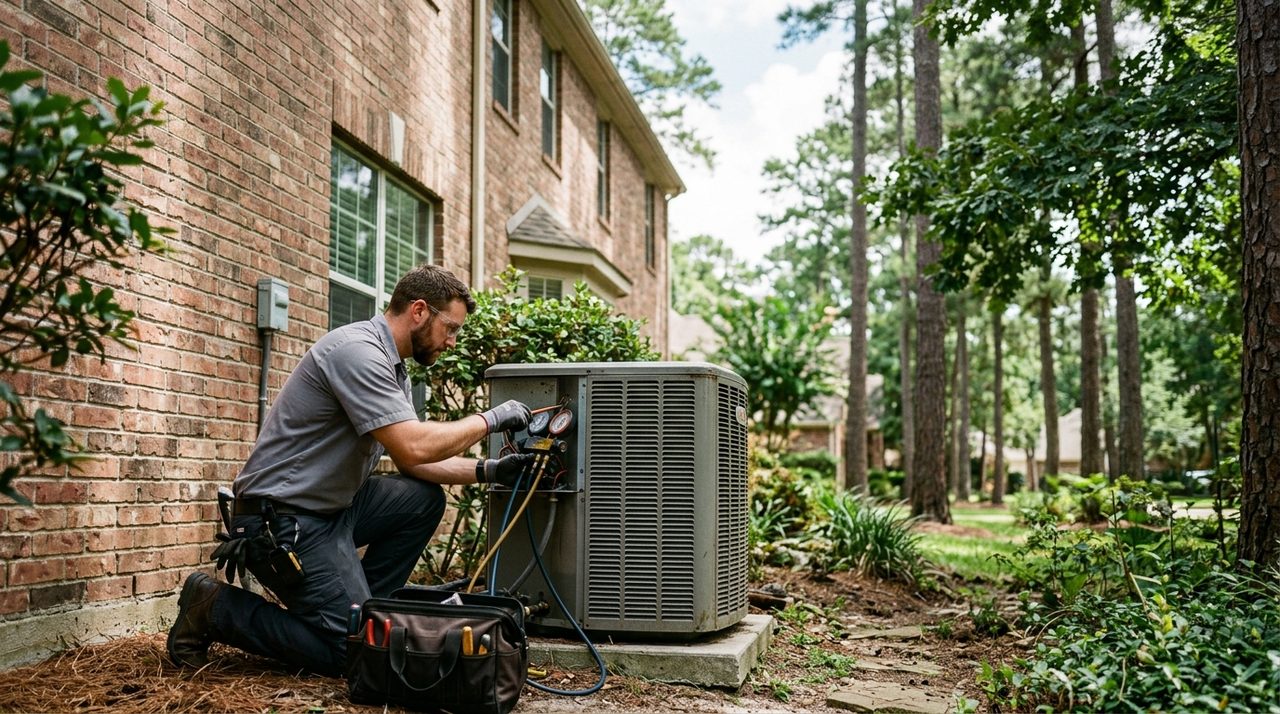
- Median home built
- 1985
- Median home value
- $167,179
- FEMA flood zone
- X (low)
- Typical AC repair or replacement cost (est.)
- $180–$9,500 depending on scope
- Most common local issue
- End-of-life R-22 systems on 30–40-year-old equipment
Ranked by verified Google rating × review volume × verification tier. How we rank →
Min rating:
10 results Open Now
4250 N Sam Houston Pkwy E Suite 130, Houston, TX 77032
Closed
5502 Northington St, Houston, TX 77039
Open Now
12941 North Fwy Suite 406, Houston, TX 77060
Open Now
11704 Trickey Rd #523, Houston, TX 77067
Closed
14226 Sunwick St, Houston, TX 77060
Closed
440 Benmar Dr #1017, Houston, TX 77060
Open Now
15711 W Hardy Rd Suite 6, Houston, TX 77060
14420 Sylvanfield Dr, Houston, TX 77014
Open Now
51 Esplanade Blvd #100, Houston, TX 77060
AC Repair in Greenspoint: What You Should Know
R-22 Systems Built in the Reagan Era Are Now a Financial Trap
Why it matters to you
Greenspoint's 1975–1995 tract homes contain a disproportionate share of original or near-original central AC equipment still running R-22 refrigerant. With the federal EPA ban on new R-22 production now fully in effect, reclaimed R-22 in the Houston market routinely runs $80–$150 per pound, meaning a single refrigerant top-off on a leaking system can cost $600–$1,500 or more—often exceeding the repair value on a system already 30-plus years old. At a census median home value of roughly $167,000, an undersized repair bill that kicks the can two years is money poorly spent.
What a good pro does
A TDLR-licensed contractor should perform a full leak search before adding any refrigerant to a pre-2010 system—not just top it off—and present a side-by-side cost comparison of a drop-in retrofit refrigerant (which requires compressor compatibility testing) versus full system replacement with a modern R-410A or R-32 unit. Replacement requires a mechanical permit pulled through the City of Houston's One-Stop portal by the licensed contractor; homeowners cannot self-pull HVAC permits in Houston jurisdiction.
Sources: Texas Department of Licensing & Regulation, City of Houston Permitting Center
Condensate Drain Overflow Is a Slow Disaster on Slab Foundations
Why it matters to you
Greenspoint homes are almost universally slab-on-grade, and many of the original air handlers were installed in tight interior closets without secondary drain pans or floor drains—a setup that turns a clogged condensate line (the single most common AC service call in Houston's 90-percent-humidity summers) into a water intrusion event that soaks the slab edge directly. On Beaumont clay soils, that repeated wetting and drying accelerates differential slab movement, which can then pull duct connections loose or stress the refrigerant line set running through or beneath the foundation.
What a good pro does
A thorough technician will flush and treat the primary condensate line, inspect the secondary drain pan for cracks or absence, and install a float-switch shutoff if one is not already present—cutting power to the air handler before an overflow starts. Drain line clearing and pan treatment typically runs $95–$225 in the Houston market. If slab movement has already kinked a line set, the contractor must pressure-test the refrigerant circuit and document the repair for the City of Houston mechanical permit record.
Sources: City of Houston Permitting Center, Texas Department of Licensing & Regulation
Latent Winter Storm Uri Damage Still Surfacing in Older Air Handlers
Why it matters to you
Greenspoint's 43-percent owner-occupancy rate and investor-heavy rental market meant that many Uri (February 2021) HVAC failures received patchwork fixes—cracked evaporator coil drain pans taped, refrigerant recharged without replacing split copper line sections, seized fan motors swapped without checking the full refrigerant circuit. Three-plus years later those deferred repairs are showing up as persistent refrigerant leaks, visible mold growth inside air handlers in cramped hallway closets, and thermostatic expansion valves (TXVs) that fail mid-summer. Homes with original 1980s equipment that filed an insurance claim in 2021 but did not replace the full system are the highest-risk properties.
What a good pro does
Ask the contractor to pull up any prior service history and perform a nitrogen pressure test on the evaporator coil before the cooling season begins—not just an electronic refrigerant leak search, which can miss micro-fractures in older copper. If mold is visible on the coil or in the drain pan, coil cleaning and pan replacement are necessary before recharging; ignoring it circulates spores through the duct system. All replacement components must be installed under a City of Houston mechanical permit if the scope constitutes equipment replacement rather than minor repair.
Sources: Texas Department of Licensing & Regulation, City of Houston Permitting Center
Fragmented POA Rules Mean Your Condenser Location Needs a Double-Check
Why it matters to you
Greenspoint has no single area-wide HOA—instead, at least eight separate Property Owners Associations govern specific subdivisions (Northborough POA, Greens Crossing POA, Rankin Park POA, and others), while some lots have no deed restrictions at all. This fragmentation creates real risk: a contractor who installs a replacement condenser on the side yard of a Northpoint POA-governed property without checking that subdivision's covenants could trigger an architectural violation requiring relocation at the homeowner's expense, even if the City of Houston mechanical permit was properly issued.
What a good pro does
Before scheduling equipment placement, ask your contractor—or confirm yourself—whether your specific lot falls under one of Greenspoint's active POAs and whether that POA requires architectural committee approval for exterior mechanical equipment. Pull the recorded deed restrictions through the Harris County Clerk's deed records if the POA does not respond promptly. The City of Houston mechanical permit addresses code compliance, not deed restrictions; both tracks must clear independently.
Sources: Local HOA / deed restrictions (see area profile), City of Houston Permitting Center
AC Repair in Greenspoint: What You Should Know
Hiring ac repair in Greenspoint? Greenspoint is a sprawling North Houston area with a mix of single-family subdivisions, multifamily complexes, and commercial properties developed primarily from the 1970s through the 1990s. Homeowners face aging infrastructure concerns typical of that era—original HVAC systems, galvanized or polybutylene plumbing, and slab foundation movement—compounded by proximity to Greens Bayou and associated flood risk. The fragmented POA landscape means deed restrictions and exterior modification rules vary subdivision by subdivision, so contractors should verify requirements before starting work.
- Housing era
- 1970s–1990s, with some later infill
- Foundation
- Predominantly slab-on-grade (inferred from Houston-area building practices for this era
- Flood zone
- FEMA Zone X (low flood risk) per official NFHL data
- Permits
- Houston Permitting Center (City of Houston jurisdiction)
Housing stock & systems
Building era
1970s–1990s, with some later infill.
Typical style
One- and two-story ranch and contemporary suburban tract homes with brick veneer and attached garages (inferred from broader Houston north-side patterns; no Greenspoint-specific architectural survey located).
Foundations
Predominantly slab-on-grade (inferred from Houston-area building practices for this era; not confirmed by a Greenspoint-specific source).
Common systems
Original homes likely have central AC with R-22 refrigerant systems nearing or past end of life, galvanized steel or polybutylene supply lines, copper or cast-iron waste lines, and 100–150 amp electrical panels. Many systems are 30–50 years old and due for replacement.
What that means for repairs
HVAC replacement, re-plumbing to PEX or CPVC, and electrical panel upgrades are common due to system age. Foundation repair is frequent given expansive clay soils and slab-on-grade construction. Kitchen and bath remodels are typical value-add projects in this price-accessible market.
Permits & restrictions
Permit jurisdiction
Houston Permitting Center (City of Houston jurisdiction).
HOA & deed restrictions
No single area-wide HOA. Multiple mandatory Property Owners Associations govern specific subdivisions, including Greenspoint Property Owners' Association Inc., Greenspoint Landing POA, Greenbriar North POA, Northborough POA, Northpoint POA, Town Center POA, Greens Crossing POA, and Rankin Park POA. Some properties in the broader area have no HOA at all. Deed restrictions are subdivision-specific; no unified set exists for 'Greenspoint' as a whole.
Historic districts
No City of Houston historic district designation confirmed.
Contractor note
Because POA governance is fragmented, contractors should confirm which POA (if any) governs a specific property and whether exterior work requires POA architectural review before commencing. Some lots have no HOA restrictions at all, while adjacent ones may have strict covenants.
Flood & weather
FEMA flood zone
FEMA Zone X (low flood risk) per official NFHL data. However, the Greenspoint area sits along Greens Bayou and its tributaries, and properties closer to the bayou channel may carry higher-risk designations. Homeowners should verify individual lot flood zone status, as Zone X designation may not apply uniformly across all parcels in the area.
Hurricane Harvey impact
Research sources did not include Harvey-specific damage reports or high-water-mark data for Greenspoint. The area's proximity to Greens Bayou makes it plausible that sections near the bayou and its tributaries experienced flooding during Harvey, but street-level impact cannot be confirmed from available sources. Homeowners should check Harris County Flood Control District records and FEMA repetitive loss data for their specific address.
Heat & humidity load
Aging 1970s–1990s HVAC systems in this area are heavily stressed during Houston's extreme summer heat and humidity. Original insulation levels are often inadequate by modern standards, driving up cooling costs and accelerating compressor failure. Slab-on-grade foundations on expansive clay soils are vulnerable to differential settlement during summer drought cycles, making foundation monitoring essential.
Working with contractors here
Contractors in Greenspoint most commonly handle HVAC replacement, foundation repair, and whole-house re-plumbing—all driven by the 30–50 year age of the housing stock. Slab foundation leveling with pressed piers is a frequent job given the clay-heavy soils and decades of seasonal moisture cycling. Electrical panel upgrades from original 100-amp service to 200-amp are common as homeowners modernize. Because the area includes a wide range of property conditions and price points, thorough scoping and upfront material cost discussions are important. Contractors should also verify whether the property falls under a POA with architectural review requirements before beginning any exterior work.
Local Tip
Always ask for a written estimate before work begins. Texas contractors are required to provide one on jobs over $1,000.
About Greenspoint
Greenspoint is a sprawling North Houston area with a mix of single-family subdivisions, multifamily complexes, and commercial properties developed primarily from the 1970s through the 1990s. Homeowners face aging infrastructure concerns typical of that era—original HVAC systems, galvanized or polybutylene plumbing, and slab foundation movement—compounded by proximity to Greens Bayou and associated flood risk. The fragmented POA landscape means deed restrictions and exterior modification rules vary subdivision by subdivision, so contractors should verify requirements before starting work.
- Median year built
- 1985
- Median home value
- $167,179
- Owner-occupied
- 43.3%
- Population
- 186,176
- Housing units
- 63,567
- Median income
- $46,300
Source: U.S. Census Bureau, ACS 5-Year 2023
Flood & storm risk
FEMA Zone XLow flood riskMost of Greenspoint maps to FEMA Zone X (low mapped flood risk), but Houston's flash-flood reality means even low-risk blocks benefit from smart drainage and storm-hardened installs; risk climbs sharply on blocks nearest Greens Bayou, where it varies parcel to parcel.
Source: FEMA National Flood Hazard Layer (NFHL). Flood zones vary by parcel — verify your individual FIRM panel.
Houston Storm Readiness in Greenspoint
Hurricane & flooding
Power-surge damage to HVAC control boards is one of the costliest hurricane aftermaths in Greenspoint; install a dedicated whole-system surge protector rated for your unit's tonnage at the disconnect box before the season opens. CenterPoint's distribution lines in lower-risk areas often restore power with significant voltage spikes, and an unprotected board can fail the moment the grid comes back. Confirm the current FEMA panel for your Greenspoint parcel — the area maps to Zone X, but adjacent lots can differ.
Severe storms & hail
The May 2024 derecho proved that even lower-risk areas like Greenspoint are not immune to structural damage: flying debris punctured condenser coil cabinets on streets with no flooding history at all. Inspect your condenser cabinet panels for dents or breaches after any significant storm, and cover exposed refrigerant components with UV-stable foam insulation before a technician can arrive. Confirm the current FEMA panel for your Greenspoint parcel — the area maps to Zone X, but adjacent lots can differ.
Ice storms & freezes
Heat-pump outdoor units in Greenspoint are vulnerable to ice bridging under the base pan during sleet events like Uri 2021, which blocks airflow and triggers safety lockouts — elevating the unit on a taller pad with drainage channels keeps the base clear and lets the defrost cycle do its job. A TDLR-licensed HVAC technician can assess whether your current pad height is adequate before the next winter freeze. With a median build year of 1985, the older building stock here is more exposed to hard-freeze damage than newer construction. Confirm the current FEMA panel for your Greenspoint parcel — the area maps to Zone X, but adjacent lots can differ.
Sources: FEMA National Flood Hazard Layer (NFHL), Ready.gov -- Hurricanes, CenterPoint Energy -- Storm Center, City of Houston -- Emergency Preparedness, Ready.gov -- Winter Weather, Harris County Flood Control District
Free Greenspoint Tools & Calculators
Houston-specific estimators to plan your project before you call a pro. All results are planning estimates — a licensed local pro confirms the details on site.
Houston AC Tonnage & Sizing Estimator
Open full tool & FAQ →Living space you want cooled (400–10,000 sq ft).
5.0tons
Recommended nominal size
60,000 BTU/hr
Estimated cooling load
This is a planning estimate only — actual requirements depend on an on-site assessment by a licensed Houston pro. Houston's humidity and long cooling season make an oversized unit a common, costly mistake — it short-cycles and never dehumidifies. A licensed contractor confirms sizing with a full Manual J calculation.
Houston Freeze Prep & Pipe Insulation Checklist
Open full tool & FAQ →Your freeze checklist — 4 tasks
- 1
Disconnect & drain every outdoor hose bib
Remove hoses, drain the spigots, and cover each with an insulated faucet sock. Un-drained hose bibs are the #1 burst point in a Houston freeze.
- 2
Insulate exposed pipes in the attic & garage
Wrap any pipe in an unconditioned space (attic runs, garage walls) with foam sleeves. Houston homes rarely insulate these because they only matter a few nights a year — which is exactly why they burst.
- 3
Open cabinet doors & keep a pencil-width drip
On hard-freeze nights, open kitchen/bath cabinets so warm air reaches the pipes and let faucets on exterior walls drip to relieve pressure.
- 4
Protect the attic/garage water heater & its lines
An attic or garage tank sits in unconditioned space. Insulate the cold-inlet and hot-outlet lines and confirm the emergency drain pan is clear so a leak doesn't reach the ceiling.
This is a planning estimate only — actual requirements depend on an on-site assessment by a licensed Houston pro. If a pipe has already burst, shut off your main water supply and call a licensed Houston plumber immediately — freeze bursts flood fast.
Frequently Asked Questions
Do I need a permit to replace my AC unit in Greenspoint, and can I pull it myself?
Yes — because Greenspoint falls entirely within City of Houston jurisdiction, any HVAC equipment replacement requires a mechanical permit pulled through the Houston Permitting Center's One-Stop portal. Homeowners cannot self-pull a mechanical permit for HVAC work in Houston; the permit must be obtained by a TDLR-licensed AC contractor on your behalf. Skipping the permit puts you at risk when selling, since title companies and buyers increasingly check permit history on older Greenspoint homes.
Sources: City of Houston Permitting CenterTexas Department of Licensing & Regulation
My Greenspoint home was built in the mid-1980s and still has the original air handler. Is it worth repairing, or should I plan for full replacement?
A 1980s-era air handler in Greenspoint is almost certainly running R-22 refrigerant, and reclaimed R-22 on the Houston market has been running $80–$150 per pound (estimate), making any significant leak repair economically irrational compared to replacement cost. At 30-plus years old, these units also have evaporator coils and drain pans that have endured decades of Greenspoint's near-constant humidity cycling, which accelerates corrosion and microbial buildup. Most HVAC contractors working this corridor will recommend a full system assessment before investing in repairs on equipment this age.
My Greenspoint home is in FEMA Zone X, so am I safe to keep the condenser unit on a standard ground pad without worrying about flood damage?
Zone X indicates low mapped flood risk at the parcel level, but Greenspoint's proximity to Greens Bayou means flood risk climbs sharply on blocks closest to the waterway, sometimes varying parcel-to-parcel rather than subdivision-to-subdivision. Even on a Zone X lot, Houston's documented flash-flood behavior during events like Harvey (2017) and Beryl (2024) has inundated condenser units well outside official flood zones, and a submerged outdoor coil in the metro's saline-humid air corrodes rapidly. Raising a new condenser pad four to six inches and ensuring yard drainage routes away from the unit is inexpensive insurance regardless of your flood zone designation.
I'm in the Northborough subdivision — do I need POA approval before my AC contractor installs the new condenser unit in the side yard?
Greenspoint has no single area-wide HOA; whether you need architectural review depends entirely on which of the multiple subdivision-level POAs governs your specific lot — Northborough POA, Greenspoint Landing POA, Greens Crossing POA, and others each maintain their own deed restrictions. Your contractor should request a copy of your subdivision's CC&Rs and confirm condenser placement and screening requirements before the job starts, since adjacent lots can have completely different rules or none at all. Getting POA sign-off in writing before installation avoids forced relocations later.
Sources: Local HOA / deed restrictions (see area profile)
What time of year is hardest to get an AC repair appointment in Greenspoint, and how far out should I book a system replacement?
June through August is peak demand across North Houston, and Greenspoint contractors serving a mix of single-family and multifamily inventory get backed up quickly — emergency repair waits of two to four days are common during heat waves (estimate based on typical Houston metro patterns). If you know your system is aging, scheduling a replacement in March, April, or October-November typically gets you faster install windows and can improve your leverage on equipment pricing. Permitting through the Houston Permitting Center generally adds two to five business days to the project timeline once a contractor submits the mechanical permit application.
Sources: City of Houston Permitting Center
Can a Greenspoint HVAC contractor install a higher-efficiency system to qualify for federal tax credits, and does the Houston Permitting Center inspection cover that?
Yes — a replacement system meeting ENERGY STAR efficiency thresholds (currently 15.2 SEER2 or higher for split systems in the South climate region) can qualify for up to a $2,000 federal tax credit under the Inflation Reduction Act's 25C provision; your contractor should provide equipment documentation specifying the SEER2 rating. The Houston Permitting Center mechanical inspection covers code compliance for the installation itself but does not certify tax credit eligibility — that documentation comes from the equipment manufacturer's ENERGY STAR certification and your contractor's invoice, which you submit with IRS Form 5695. Given Greenspoint's high cooling load, a properly sized high-efficiency unit also pays back in lower monthly bills faster than the Houston average.
Sources: ENERGY STAR / U.S. Dept. of EnergyCity of Houston Permitting Center