Open Now
903 Gurney Ln, Houston, TX 77037
Acres Homes sits entirely within Houston city limits, meaning every electrical permit runs through the Houston Permitting Center and must be supervised by a TDLR-licensed Master Electrician — but the real challenge here is the block-by-block gap between 1950s cottages still running 60-amp fused services and 2020-era infill homes with 200-amp panels next door. The census median build year of 1979 masks a bimodal housing stock where the oldest tier is overdue for upgrades that have compounded since Winter Storm Uri. This page explains which electrical problems are most prevalent in Acres Homes and what qualified local electricians should actually do about them.
Ranked by verified Google rating × review volume × verification tier. How we rank →
Some highly-rated pros serve Acres Homes from nearby and may not keep a Acres Homes street address. Those are listed under "Also serving Acres Homes" with their real city and distance, so you always know where each business is based.
903 Gurney Ln, Houston, TX 77037
Highly-rated pros based nearby who cover Acres Homes. Distance shown from the Acres Homes area.
Serving Acres Homes Based in Lazybrook / Timbergrove · 1.2 mi away
Serving Acres Homes Based in Independence Heights · 2.6 mi away
Serving Acres Homes Based in Lazybrook / Timbergrove · 2.7 mi away
Serving Acres Homes Based in Lazybrook / Timbergrove · 2.8 mi away
Serving Acres Homes Based in Lazybrook / Timbergrove · 3 mi away
Serving Acres Homes Based in Lazybrook / Timbergrove · 3.2 mi away
Serving Acres Homes Based in Lazybrook / Timbergrove · 3.5 mi away
Serving Acres Homes Based in Brookhollow · 3.5 mi away
Serving Acres Homes Based in Brookhollow · 3.7 mi away
Why it matters to you
A significant share of Acres Homes's 1950s and 1960s wood-frame cottages were originally wired with 60-amp fused main services — adequate for the era's load but dangerously undersized once window-unit AC, electric water heaters, or space heaters added after Winter Storm Uri are running simultaneously. The census median home value here is roughly $189,000, meaning many owners have deferred upgrades, and nuisance tripping or scorched fuse holders are warning signs that should not be ignored.
What a good pro does
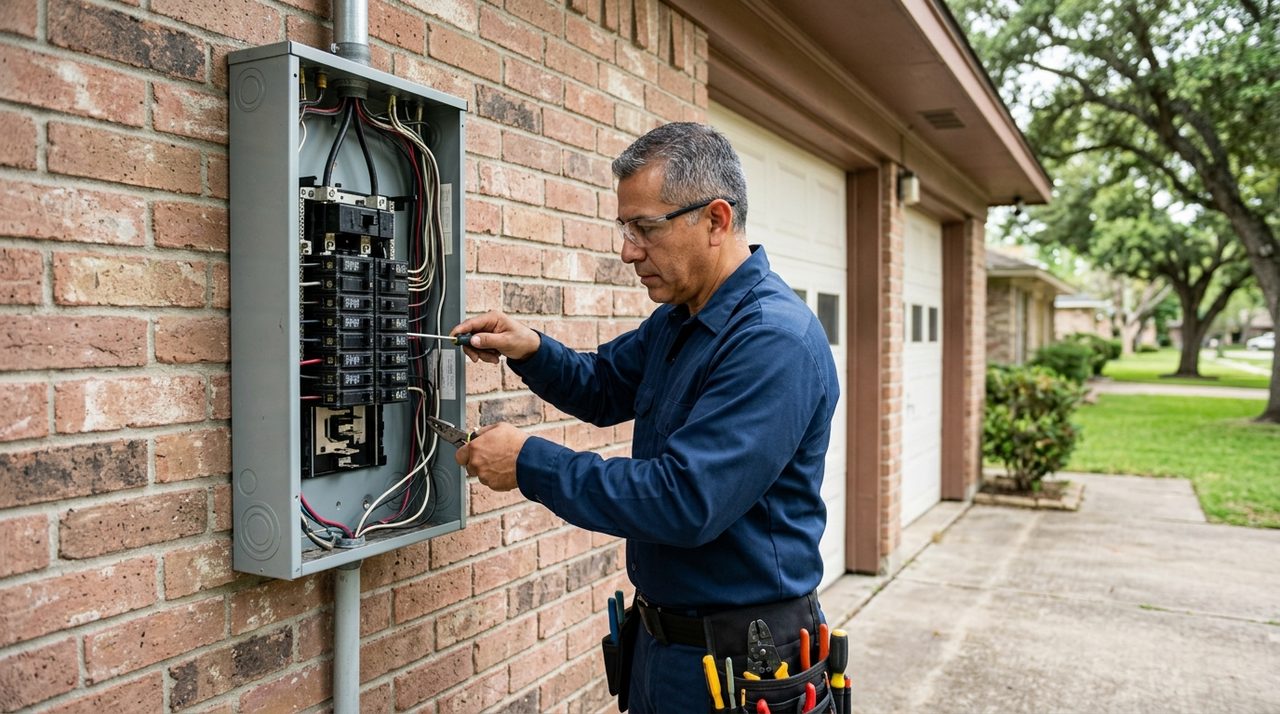
A TDLR-licensed Master Electrician pulls a City of Houston electrical permit through the Houston Permitting Center, upgrades the service to at least 200 amps, replaces the meter base if CenterPoint Energy requires it, and schedules the city inspection before CenterPoint reconnects the drop. Estimated cost for a 100A-to-200A upgrade in this area runs $1,800–$3,200 installed including permit fees — confirm the exact permit fee schedule with the Houston Permitting Center at time of application, as fees are subject to change.
Sources: Texas Department of Licensing & Regulation, City of Houston Permitting Center
Why it matters to you
Acres Homes has a meaningful number of homes built between 1965 and 1975 — squarely within the decade when single-strand aluminum branch-circuit wiring was standard practice nationwide. These circuits oxidize at every receptacle, switch, and fixture termination, generating resistance heat that is a documented fire hazard. Because Acres Homes has no mandatory HOA or design-review process, homes in this era have often changed hands multiple times without a full electrical inspection surfacing the issue.
What a good pro does
Proper remediation is not a coat of anti-oxidant paste: a qualified electrician must install CO/ALR-rated devices and AlumiConn connectors at every termination, or replace the branch circuits entirely with copper. Whole-home remediation in a typical Acres Homes cottage (800–1,400 sq ft) is estimated at $3,500–$8,000 depending on circuit count and accessibility — a City of Houston permit is required, and the Master Electrician on record is responsible for ensuring every termination is addressed before inspection.
Sources: Texas Department of Licensing & Regulation, City of Houston Permitting Center, International Residential Code (as adopted by City of Houston)
Why it matters to you
Acres Homes's older pier-and-beam wood-frame cottages frequently have shallow attic cavities with minimal ventilation, and Houston's average relative humidity exceeds 75% year-round while attic temperatures regularly exceed 140°F in summer. This combination corrodes wire-nut connections, degrades the insulation on older THHN wiring routed through attic spaces, and can oxidize aluminum neutral conductors on homes that have a mix of wiring generations — a condition that causes intermittent breaker trips that are frustratingly hard to trace without thermal imaging.
What a good pro does
An electrician performing an attic inspection on a pre-1990 Acres Homes cottage should use a thermal camera to locate hot spots before opening junction boxes, then re-terminate corroded connections with rated connectors and replace degraded wire segments rather than simply re-twisting and re-capping. Any new junction boxes added during the repair must remain accessible per code — a City of Houston inspection will flag buried boxes, so the repair scope should be documented on the permit application.
Sources: City of Houston Permitting Center, International Residential Code (as adopted by City of Houston)
Why it matters to you
Most of Acres Homes's mid-century cottages receive power via overhead service drops rather than underground laterals, making the weatherhead, mast riser, and meter base directly exposed to the kind of wind events that struck Houston in the May 2024 derecho and Hurricane Beryl 2024, which brought gusts exceeding 80 mph across Harris County. When a mast is sheared or a weatherhead is pulled away, CenterPoint Energy will restore the utility-side drop only after the homeowner's electrician has repaired and re-inspected the customer-side equipment — a sequence that can leave a household without power for days if the permit and inspection are not expedited.
What a good pro does
After storm damage, the homeowner's first call is to a TDLR-licensed electrician to assess the weatherhead, mast, and meter base — not CenterPoint directly, since the utility will not reconnect until the customer side passes inspection. The electrician files an emergency electrical permit with the Houston Permitting Center, makes repairs to code (including upgrading a degraded mast to current height and gauge requirements), and coordinates the CenterPoint reconnect appointment. Keeping a record of the electrician's license number and permit number speeds the utility reconnect request.
Sources: Texas Department of Licensing & Regulation, City of Houston Permitting Center
Hiring electricians in Acres Homes? Acres Homes presents a uniquely diverse housing stock ranging from mid-century pier-and-beam cottages to post-2015 slab-on-grade infill homes, often on the same block. Most of the area has no mandatory HOA or formal deed restrictions, giving homeowners wide latitude on repairs and renovations but also creating a patchwork of building conditions. Contractors working here must be comfortable with both legacy wood-frame structural repairs and modern systems found in newer affordable construction.
Building era
1950s–1970s (legacy stock) with significant post-2015 infill construction; secondary wave from 1990s–2000s.
Typical style
Older homes are one-story wood-frame cottages, bungalows, and modest ranch-style houses; newer infill is contemporary traditional single-family with Hardie siding or brick-and-Hardie exteriors.
Foundations
Mixed — older homes are commonly pier-and-beam; newer infill construction is predominantly concrete slab-on-grade.
Common systems
Older homes often have galvanized or cast-iron plumbing, older electrical panels (60–100 amp), and window-unit or aging central HVAC systems. Newer infill homes typically have PEX or CPVC plumbing, 200-amp electrical panels, and modern split-system HVAC with SEER 14+ ratings.
What that means for repairs
Extensive infill and revitalization activity driven by the City of Houston's New Home Development Program (NHDP) and private developers replacing or renovating aging frame houses. Common renovation work includes pier-and-beam leveling, plumbing repipes on older homes, electrical panel upgrades, and full gut-rehabs of mid-century cottages.
Permit jurisdiction
City of Houston — Houston Permitting Center (Acres Homes is within Houston city limits).
HOA & deed restrictions
No mandatory master HOA for most of Acres Homes. Voluntary civic clubs and community organizations exist (e.g., Acres Home Super Neighborhood #6) but do not impose dues or design controls. Some newer small infill plats may carry private deed restrictions governing minimum square footage and use, but these vary lot by lot.
Historic districts
No City of Houston historic district designation confirmed.
Contractor note
With no overarching HOA design review, contractors typically need only City of Houston permits. However, some newer infill plats may have private deed restrictions with architectural standards — confirm with the property owner and check Harris County Clerk records before beginning exterior work.
FEMA flood zone
FEMA Zone X (low flood risk) per official NFHL data. However, portions of Acres Homes adjacent to Vogel Creek and its tributary channels fall within 100-year and 500-year floodplains per Harris County Flood Control District mapping. Flood risk varies significantly by proximity to these waterways and local low points along drainage ditches.
Hurricane Harvey impact
Acres Homes experienced structural flooding during Hurricane Harvey (2017), but it was not among the highest-profile disaster zones like Meyerland or Greenspoint. Areas near Vogel Creek and low-lying drainage channels were most affected. The exact extent of damage is not clearly quantified in public summaries. Harris County Flood Control District has undertaken channel improvement and detention projects along Vogel Creek in this area, indicating recognized recurring drainage issues.
Heat & humidity load
Older pier-and-beam cottages with aging HVAC systems and limited insulation are especially vulnerable to Houston's extreme summer heat and humidity. Condensation under pier-and-beam homes can accelerate subfloor rot and encourage mold growth. Newer slab-on-grade infill homes perform better thermally but still demand regular HVAC maintenance during peak cooling season.
Working with contractors here
The most common contractor work in Acres Homes includes foundation leveling and pier-and-beam repair on mid-century frame houses, full plumbing repipes replacing galvanized lines, and electrical panel upgrades from 60-amp to 200-amp service. The active infill development market also generates steady demand for new construction trades, demolition, and site prep. Because housing stock varies dramatically from block to block — a 1950s cottage may sit next to a 2020 build — contractors must scope each job individually and cannot assume uniform conditions. Drainage and grading work is important near Vogel Creek tributaries, and properties in low-lying areas may need additional moisture mitigation measures.
Local Tip
Always ask for a written estimate before work begins. Texas contractors are required to provide one on jobs over $1,000.
Acres Homes presents a uniquely diverse housing stock ranging from mid-century pier-and-beam cottages to post-2015 slab-on-grade infill homes, often on the same block. Most of the area has no mandatory HOA or formal deed restrictions, giving homeowners wide latitude on repairs and renovations but also creating a patchwork of building conditions. Contractors working here must be comfortable with both legacy wood-frame structural repairs and modern systems found in newer affordable construction.
Source: U.S. Census Bureau, ACS 5-Year 2023
Most of Acres Homes maps to FEMA Zone X (low mapped flood risk), but Houston's flash-flood reality means even low-risk blocks benefit from smart drainage and storm-hardened installs.
Source: FEMA National Flood Hazard Layer (NFHL). Flood zones vary by parcel — verify your individual FIRM panel.
A TDLR-licensed electrician can install a generator interlock on your existing panel in a single day, giving you a code-legal way to run your refrigerator, window units, and medical equipment without risking a lineworker's life. Even in lower-mapped-risk areas of Acres Homes, post-storm outages routinely stretch five to ten days after a major Gulf hurricane makes landfall west of Galveston. Confirm the current FEMA panel for your Acres Homes parcel — the area maps to Zone X, but adjacent lots can differ.
After the May 2024 derecho left parts of Acres Homes dark for four days, homeowners without transfer switches had no safe way to connect a generator — a TDLR-licensed electrician can install an interlock kit on most existing panels in four hours, making it one of the most time-effective storm-prep investments available. Book the work now, before the next round of severe weather puts every licensed electrician in Houston on a three-week waiting list. Confirm the current FEMA panel for your Acres Homes parcel — the area maps to Zone X, but adjacent lots can differ.
Frozen tree limbs brought down distribution lines across Acres Homes during Uri 2021, and when power was restored in stages the resulting surges destroyed control boards in variable-speed HVAC systems, refrigerators, and smart panels. A whole-house surge arrester installed by a licensed electrician at the meter base is the most cost-effective way to protect those components before the next hard freeze. With a median build year of 1979, the older building stock here is more exposed to hard-freeze damage than newer construction. Confirm the current FEMA panel for your Acres Homes parcel — the area maps to Zone X, but adjacent lots can differ.
Sources: FEMA National Flood Hazard Layer (NFHL), Ready.gov -- Hurricanes, CenterPoint Energy -- Storm Center, City of Houston -- Emergency Preparedness, Ready.gov -- Winter Weather, Harris County Flood Control District
Houston-specific estimators to plan your project before you call a pro. All results are planning estimates — a licensed local pro confirms the details on site.
Disconnect & drain every outdoor hose bib
Remove hoses, drain the spigots, and cover each with an insulated faucet sock. Un-drained hose bibs are the #1 burst point in a Houston freeze.
Insulate exposed pipes in the attic & garage
Wrap any pipe in an unconditioned space (attic runs, garage walls) with foam sleeves. Houston homes rarely insulate these because they only matter a few nights a year — which is exactly why they burst.
Open cabinet doors & keep a pencil-width drip
On hard-freeze nights, open kitchen/bath cabinets so warm air reaches the pipes and let faucets on exterior walls drip to relieve pressure.
Protect the attic/garage water heater & its lines
An attic or garage tank sits in unconditioned space. Insulate the cold-inlet and hot-outlet lines and confirm the emergency drain pan is clear so a leak doesn't reach the ceiling.
This is a planning estimate only — actual requirements depend on an on-site assessment by a licensed Houston pro. If a pipe has already burst, shut off your main water supply and call a licensed Houston plumber immediately — freeze bursts flood fast.
Sources: City of Houston Permitting CenterTexas Department of Licensing & Regulation
Sources: City of Houston Permitting CenterTexas Department of Licensing & Regulation
Sources: FEMA National Flood Hazard Layer (NFHL)International Residential Code (as adopted by City of Houston)
Sources: City of Houston Permitting CenterLocal HOA / deed restrictions (see area profile)
Sources: Texas Department of Licensing & RegulationCity of Houston Permitting Center