18930 Kz Rd, Cypress, TX 77433
Best Electricians in Cypress, TX
Cypress is a sprawling patchwork of unincorporated Harris County subdivisions where electrical work is permitted through the Harris County Engineering Department — not the City of Houston — and where nearly every exterior job triggers an HOA architectural committee review before a contractor can touch a wire. With a median year built of 2007 and housing ranging from late-1970s ranch homes near FM 1960 to brand-new Grand Parkway construction, electricians here encounter everything from aging 100-amp builder panels in 1980s slab homes to fresh 200-amp services in master-planned communities now being stretched by EV chargers and solar systems. Understanding which decade your Cypress home was built tells you which electrical vulnerabilities to prioritize — and this page maps exactly that.
Verified against Google Business data
Updated 2026
See the 10 Electricians Serving Cypress 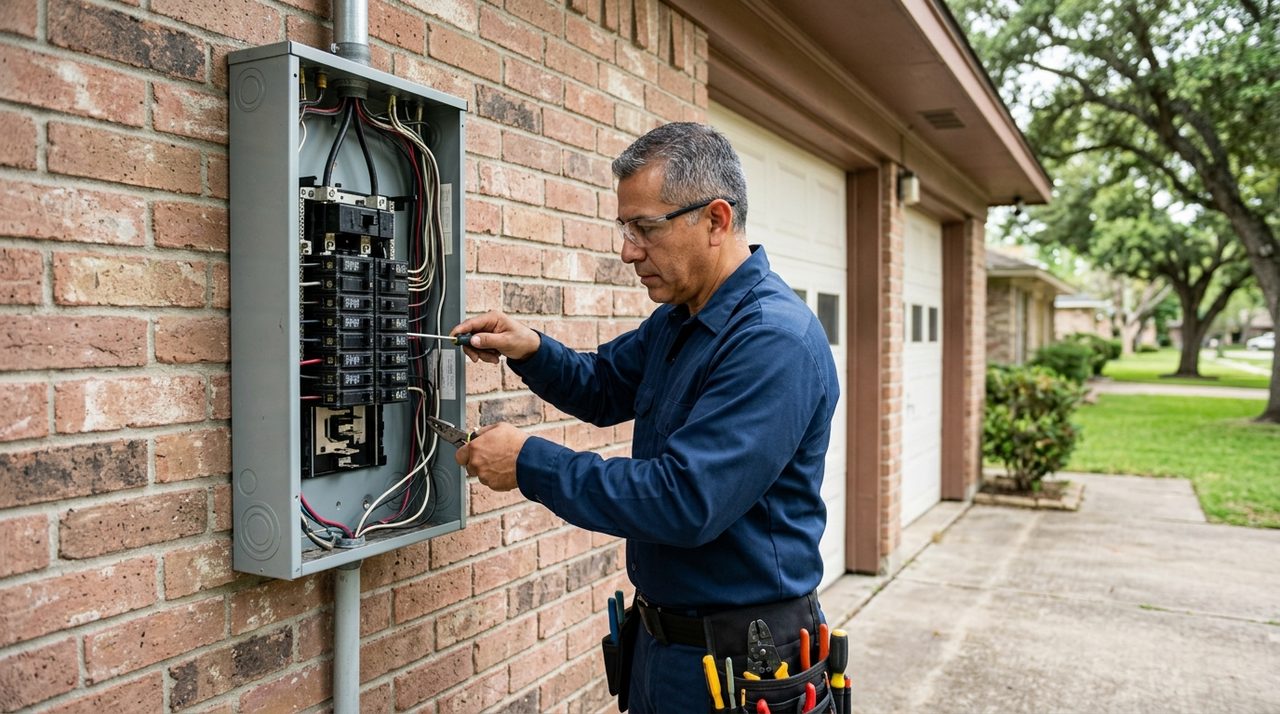
- Median home built
- 2007
- Median home value
- $363,750
- FEMA flood zone
- X (low)
- Typical cost (est.)
- $400–$6,000 depending on scope (EVSE circuit to full panel upgrade)
- Most common local issue
- 100-amp panels in 1980s–1990s builder homes overloaded by post-Uri heat additions and EV chargers
Ranked by verified Google rating × review volume × verification tier. How we rank →
Some highly-rated pros serve Cypress from nearby and may not keep a Cypress street address. Those are listed under "Also serving Cypress" with their real city and distance, so you always know where each business is based.
Min rating:
10 resultsBased in Cypress
13407 Huffmeister Rd, Cypress, TX 77429
Open Now
13310 Telge Rd Suite 105, Cypress, TX 77429
Open Now
14802 Grant Rd, Cypress, TX 77429
Closed
16129 Cypress Rose Hill Rd, Cypress, TX 77429
Closed
15811 Randall Ridge Ln, Cypress, TX 77429
Closed
12320 Barker Cypress Rd, Cypress, TX 77429
13121 Louetta Rd #440, Cypress, TX 77429
Also serving Cypress
Highly-rated pros based nearby who cover Cypress. Distance shown from the Cypress area.
Open Now
Serving Cypress Based in Jersey Village · 3.9 mi away
Serving Cypress Based in Jersey Village · 4.2 mi away
Electricians in Cypress: What You Should Know
1980s–1990s Builder Panels Buckling Under Post-Uri Electrical Loads
Why it matters to you
A large portion of Cypress's housing stock dates to the 1980s and 1990s, when builder-grade 100-amp panels were standard for all-gas homes. After Winter Storm Uri in February 2021, many Cypress homeowners added electric space heaters, heat-pump water heaters, or mini-split systems as backup heat — often without upgrading the main service. That 100-amp panel that once handled lights and a gas furnace now has to contend with electric heat loads that can consume 30–50 amps on their own, causing nuisance tripping, overheated conductors, and worn breaker contacts. Homes approaching sale are especially exposed, as home inspectors routinely flag undersized services.
What a good pro does
A TDLR-licensed Master Electrician (the credential required to pull permits and supervise work in Texas) should perform a full load calculation before adding any new circuit. If the service is undersized, a panel upgrade from 100A to 200A runs an estimated $1,800–$3,200 installed including the Harris County Engineering Department permit; stepping up to 400A for homes also adding an EV charger runs an estimated $3,500–$6,000. The Master Electrician pulls the permit through Harris County — not the Houston Permitting Center — so confirm your contractor is familiar with that distinction.
Sources: Texas Department of Licensing & Regulation, Municipal permit office (see area profile)
EV Charger Installs Caught Between Harris County Permits and HOA Rules
Why it matters to you
Cypress's newer master-planned subdivisions — Bridgeland, Towne Lake, and comparable communities along the Grand Parkway corridor — have some of the highest EV adoption rates in the NW Houston suburbs, yet installing a Level 2 charger here involves two separate approval tracks. Harris County Engineering requires an electrical permit for the EVSE supply circuit, while each subdivision's HOA architectural committee independently governs where conduit can be routed on an exterior wall and whether the charger itself is visible from the street. Skipping either step can result in a stop-work notice or a demand to remove visible conduit after installation.
What a good pro does
Before scheduling any electrical work, submit an architectural review request to your specific subdivision's HOA — Bridgeland Community Association, Towne Lake HOA, or whichever entity governs your plat — and obtain written approval for the conduit routing and charger location. Once that is in hand, a licensed electrician pulls the Harris County permit and schedules the county inspection. A Level 2 EVSE supply circuit alone (when the panel already has capacity) runs an estimated $400–$900 installed; if a panel upgrade is needed concurrently, budget accordingly. Your electrician's Master Electrician license number must appear on the Harris County permit application.
Sources: Local HOA / deed restrictions (see area profile), Texas Department of Licensing & Regulation, Municipal permit office (see area profile)
Underground Conduit Stressed by Cypress's Expansive Black Clay
Why it matters to you
Cypress sits on the same Beaumont/Houston Black clay belt that plagues the broader Houston metro, and slab-on-grade construction — essentially universal in Cypress subdivisions built after 1970 — places underground conduit and service laterals directly in soil that swells several inches during wet seasons and shrinks during drought. Homes from the 1980s built before post-tension slab standards became widespread are especially vulnerable: direct-burial feeders and older PVC conduit fittings can shear or crack as the slab shifts, creating intermittent faults that are expensive to localize and reroute without trenching. Foundation repair contractors active in Cypress frequently document measurable slab movement in these older ranch-style homes near FM 1960.
What a good pro does
If your 1980s or early-1990s Cypress home shows recurring ground-fault breaker trips, unexplained voltage drop to a subpanel, or a recent foundation repair involving underpinning, ask your electrician to perform a conduit continuity and insulation-resistance test before assuming the panel is at fault. If a conduit run is compromised, a licensed electrician can reroute the feeder above-grade through the attic or garage, avoiding further soil contact. All rerouting work requires a Harris County electrical permit regardless of whether the repair involves the main service.
Sources: Texas Department of Licensing & Regulation, International Residential Code (as adopted by City of Houston), Municipal permit office (see area profile)
Attic Wiring Degraded by Cypress's Extreme Heat and Humidity Cycle
Why it matters to you
Houston's average relative humidity exceeds 75%, and Cypress attic spaces routinely top 140°F in July and August — a combination that accelerates oxidation at wire-nut connections, degrades THHN insulation on older wiring runs, and corrodes aluminum neutral conductors where they terminate at attic junction boxes. In Cypress homes built in the 1990s and early 2000s, attic-run branch circuits serving second-floor bedrooms and bonus rooms are common and often lack conduit protection, leaving conductors exposed to decades of thermal cycling. Homeowners typically discover the problem only after a breaker trips repeatedly or a thermal-imaging inspection during a home sale reveals a hot spot.
What a good pro does
A qualified electrician should inspect all accessible attic junction boxes for corrosion, verify that wire nuts are UL-listed for the conductor types present, and check for any aluminum neutral conductors that may have loosened under thermal expansion. Replacing degraded connections, adding proper junction box covers (required by the NEC and referenced in IRC electrical chapters), and installing conduit protection on long attic runs are standard corrective steps. If your Cypress home is approaching its 20-to-30-year mark and has never had an attic electrical inspection, scheduling one before the next summer cooling season is a sound investment.
Sources: International Residential Code (as adopted by City of Houston), Texas Department of Licensing & Regulation
Electricians in Cypress: What You Should Know
Hiring electricians in Cypress? Cypress is an unincorporated area composed of dozens of separately platted subdivisions, each with its own HOA and deed restrictions. The housing stock spans from late-1970s ranch-style homes near FM 1960 to brand-new construction along the Grand Parkway, meaning contractors encounter a wide range of system ages and maintenance needs. Slab foundations, production-style builds, and HOA-regulated exteriors define the home services landscape here.
- Housing era
- Late 1970s through 2020s, with concentrations in the 1980s–2000s era
- Foundation
- Slab-on-grade (overwhelmingly dominant given post-1960s suburban construction
- Flood zone
- FEMA Zone X (low flood risk) per official NFHL data
- Permits
- Harris County Engineering Department (unincorporated area - not within City of Houston or any…
Housing stock & systems
Building era
Late 1970s through 2020s, with concentrations in the 1980s–2000s era.
Typical style
Production suburban traditional and ranch-influenced one- and two-story homes; newer master-planned communities feature transitional and modern traditional facades with brick or brick-and-siding exteriors.
Foundations
Slab-on-grade (overwhelmingly dominant given post-1960s suburban construction; pier-and-beam is rare and limited to custom builds).
Common systems
Older 1980s–1990s homes: original builder-grade HVAC (10–15 SEER), copper or CPVC plumbing, and 100–200 amp electrical panels. 2000s–2010s homes: higher-efficiency HVAC, PEX plumbing, 200 amp panels. Homes from the 1970s–1980s may still have galvanized drain lines or polybutylene supply lines.
What that means for repairs
Kitchen and bath remodels are common in 1980s–1990s homes as original finishes age out. HVAC replacements are frequent in homes over 15 years old. Exterior updates often require HOA architectural review and approval before work begins.
Permits & restrictions
Permit jurisdiction
Harris County Engineering Department (unincorporated area - not within City of Houston or any incorporated city limits).
HOA & deed restrictions
Mandatory HOAs are the norm in most platted subdivisions. Each subdivision operates independently (e.g., Lakewood Forest Fund, Cypress Creek Crossing HOA, Cypress Oaks North HOA, Villages of Cypress Lakes West). Older rural pockets and acreage tracts may have voluntary civic clubs or no organized association. Approximately 77% of Houston metro listings carry a mandatory HOA fee, and Cypress is explicitly cited as a high-HOA area.
Historic districts
No City of Houston historic district designation confirmed. Cypress is unincorporated Harris County with no known historic preservation overlays.
Contractor note
Contractors must pull permits through Harris County for structural, electrical, plumbing, and mechanical work. Nearly all subdivisions require HOA architectural committee approval for exterior modifications, fencing, roofing material changes, and paint colors before work begins.
Flood & weather
FEMA flood zone
FEMA Zone X (low flood risk) per official NFHL data. Cypress Creek and its tributaries run through portions of the area, and specific parcels near waterways may carry higher flood designations — property-level FEMA lookups are recommended for homes near Cypress Creek, Faulkey Gully, or retention basins.
Hurricane Harvey impact
Not confirmed from provided research with subdivision-level specificity. Cypress Creek corridor flooding during Harvey (2017) impacted portions of the area, particularly homes in low-lying sections near creeks and bayous. Homeowners should check individual property flood claim history through FEMA and Harris County Flood Control District records.
Heat & humidity load
Prolonged 95°F+ heat and high humidity stress HVAC systems heavily; older 1980s–1990s units frequently fail during peak summer. Slab-on-grade foundations on expansive clay soils experience seasonal movement during summer drought cycles, leading to crack repair and foundation leveling demand. Exterior caulking and weatherproofing degrade quickly in UV and humidity.
Working with contractors here
Contractors in Cypress most commonly handle HVAC replacements and repairs, as the wide range of home ages means systems from the 1980s through the 2010s are cycling through end-of-life. Roof replacements are a major category, driven by storm damage and aging composition shingles, with HOA requirements often dictating material and color specifications. Plumbing repipes — especially replacing polybutylene or aging CPVC in 1980s–1990s homes — are a steady source of work. Foundation repair is common given the expansive clay soils and slab construction. Contractors should budget time for HOA architectural review submissions and Harris County permitting, as both processes can add lead time before work can commence.
Local Tip
Always ask for a written estimate before work begins. Texas contractors are required to provide one on jobs over $1,000.
About Cypress
Cypress is an unincorporated area composed of dozens of separately platted subdivisions, each with its own HOA and deed restrictions. The housing stock spans from late-1970s ranch-style homes near FM 1960 to brand-new construction along the Grand Parkway, meaning contractors encounter a wide range of system ages and maintenance needs. Slab foundations, production-style builds, and HOA-regulated exteriors define the home services landscape here.
- Median year built
- 2007
- Median home value
- $363,750
- Owner-occupied
- 81.1%
- Population
- 208,149
- Housing units
- 67,557
- Median income
- $127,824
Source: U.S. Census Bureau, ACS 5-Year 2023
Flood & storm risk
FEMA Zone XLow flood riskMost of Cypress maps to FEMA Zone X (low mapped flood risk), but Houston's flash-flood reality means even low-risk blocks benefit from smart drainage and storm-hardened installs.
Source: FEMA National Flood Hazard Layer (NFHL). Flood zones vary by parcel — verify your individual FIRM panel.
Houston Storm Readiness in Cypress
Hurricane & flooding
A TDLR-licensed electrician can install a generator interlock on your existing panel in a single day, giving you a code-legal way to run your refrigerator, window units, and medical equipment without risking a lineworker's life. Even in lower-mapped-risk areas of Cypress, TX, post-storm outages routinely stretch five to ten days after a major Gulf hurricane makes landfall west of Galveston. Confirm the current FEMA panel for your Cypress parcel — the area maps to Zone X, but adjacent lots can differ.
Severe storms & hail
In Cypress, TX, severe thunderstorm season runs nearly year-round, and repeated lightning strikes on the distribution grid gradually degrade unprotected electronics in your home — have a TDLR-licensed electrician install whole-house surge protection and verify that your panel's main breaker is torqued to specification, since loose connections are a documented cause of post-storm arc fires. The May 2024 derecho's surge damage hit homes miles from the actual storm track, confirming that low-mapped-flood areas are not low-risk when it comes to electrical hazards. Confirm the current FEMA panel for your Cypress parcel — the area maps to Zone X, but adjacent lots can differ.
Ice storms & freezes
In Cypress, TX, the primary ice-storm electrical risk is the same one that paralyzed Houston during Uri 2021: extended outage combined with unsafe generator use inside or near the home. A TDLR-licensed electrician can install a transfer switch or interlock kit that lets you run your furnace blower, well pump, and essential circuits from a portable generator safely, without the back-feed risk that puts CenterPoint lineworkers in danger during restoration. Confirm the current FEMA panel for your Cypress parcel — the area maps to Zone X, but adjacent lots can differ.
Sources: FEMA National Flood Hazard Layer (NFHL), Ready.gov -- Hurricanes, CenterPoint Energy -- Storm Center, City of Houston -- Emergency Preparedness, Ready.gov -- Winter Weather, Harris County Flood Control District
Free Cypress Tools & Calculators
Houston-specific estimators to plan your project before you call a pro. All results are planning estimates — a licensed local pro confirms the details on site.
Houston Freeze Prep & Pipe Insulation Checklist
Open full tool & FAQ →Your freeze checklist — 4 tasks
- 1
Disconnect & drain every outdoor hose bib
Remove hoses, drain the spigots, and cover each with an insulated faucet sock. Un-drained hose bibs are the #1 burst point in a Houston freeze.
- 2
Insulate exposed pipes in the attic & garage
Wrap any pipe in an unconditioned space (attic runs, garage walls) with foam sleeves. Houston homes rarely insulate these because they only matter a few nights a year — which is exactly why they burst.
- 3
Open cabinet doors & keep a pencil-width drip
On hard-freeze nights, open kitchen/bath cabinets so warm air reaches the pipes and let faucets on exterior walls drip to relieve pressure.
- 4
Protect the attic/garage water heater & its lines
An attic or garage tank sits in unconditioned space. Insulate the cold-inlet and hot-outlet lines and confirm the emergency drain pan is clear so a leak doesn't reach the ceiling.
This is a planning estimate only — actual requirements depend on an on-site assessment by a licensed Houston pro. If a pipe has already burst, shut off your main water supply and call a licensed Houston plumber immediately — freeze bursts flood fast.
Frequently Asked Questions
Do I need a permit for an electrical panel upgrade in Cypress, TX, and who issues it?
Because Cypress is unincorporated Harris County, electrical permits are issued by the Harris County Engineering Department — not the City of Houston Permitting Center, which has no jurisdiction here. Your electrician must hold a Texas TDLR Master Electrician license to pull the permit, and Harris County will schedule its own inspection before the work is considered complete and CenterPoint can restore service. Confirm your subdivision boundaries before starting, because a handful of parcels near Cypress's edges may fall within an incorporated city limit with its own permit office.
Sources: Texas Department of Licensing & RegulationMunicipal permit office (see area profile)
My Cypress HOA says I need architectural committee approval before my electrician can install an EV charger outlet on the exterior garage wall — is that really required?
Yes, and skipping that step can result in a stop-work order or a mandatory removal at your expense. Most platted Cypress subdivisions — including communities like Lakewood Forest and Cypress Creek Crossing — have mandatory HOAs whose architectural committees review any visible exterior modifications, including conduit runs, outlet boxes, and charger mounting hardware on garage facades. Submit your electrician's proposed routing diagram and charger specs to the HOA before Harris County permit work begins, since approval timelines can add two to four weeks to your project schedule.
Sources: Local HOA / deed restrictions (see area profile)
How long does an electrical service upgrade typically take in Cypress, from permit application to final inspection?
As a rough estimate, homeowners in Cypress should budget two to four weeks from permit application through Harris County Engineering to final inspection and CenterPoint reconnect, though that window can stretch if the county inspection queue is backed up after a major storm event like the May 2024 derecho. The electrician submits permit documents, Harris County schedules an inspection after rough-in, and CenterPoint must then re-energize the meter — each step is a separate coordination point. If your upgrade also triggers an HOA exterior approval (new meter can location, exposed conduit), add that review time before the permit application even starts.
Sources: Municipal permit office (see area profile)
My 1985 Cypress home still has its original 100-amp panel. Is that enough to add a heat-pump water heater and a generator interlock, or do I need a service upgrade first?
A 100-amp service on a 1980s-era Cypress slab home is almost certainly too small to safely absorb both a 240V heat-pump water heater (typically a 30-amp dedicated circuit) and a 50-amp generator inlet without a load calculation confirming spare capacity. The electrician should perform a NEC-compliant load calculation; if the result shows demand above roughly 80 amps, a panel upgrade to 200 amps is the responsible path before adding those loads. Upgrading to 200-amp service in the Houston metro is estimated at $1,800–$3,200 installed including permit fees, though your specific Harris County permit fee and site conditions will affect the final number.
Sources: Texas Department of Licensing & RegulationInternational Residential Code (as adopted by City of Houston)
Cypress is in FEMA Zone X, so should I be worried about flood-related electrical damage after heavy rain?
FEMA Zone X means Cypress carries a low mapped flood risk, so the strict panel-elevation requirements that apply in AE high-risk zones generally do not apply here. However, Harris County's clay soils and impervious-surface development mean that localized sheet flooding and garage intrusion are still real events — the May 2024 derecho produced standing water in many Cypress neighborhoods even though they are Zone X. If your garage subpanel, EV charger outlet, or generator transfer switch sits near grade level, ask your electrician whether raising those components is practical as a precaution.
What should I ask a Cypress electrician before hiring them for a solar-plus-battery installation in my master-planned community?
Confirm that the electrician holds a TDLR Master Electrician license and ask whether they have completed CenterPoint Energy interconnection applications for previous Cypress or Harris County jobs, since that utility coordination is a separate process from the Harris County electrical permit and can delay your permission to operate by weeks if handled incorrectly. Ask whether NABCEP certification covers the solar-specific scope, as that credential signals training beyond the general electrical license for photovoltaic work. Also verify that your subdivision HOA has approved the roof equipment and any visible conduit or disconnect hardware before the permit application is filed, since some Cypress master-planned communities have detailed rules on inverter placement and conduit color.
Sources: Texas Department of Licensing & RegulationNorth American Board of Certified Energy Practitioners (NABCEP)Local HOA / deed restrictions (see area profile)