Open Now
2114 Lou Ellen Ln, Houston, TX 77018
Lazybrook and Timbergrove's 1950s–1960s ranch homes inside the 610 Loop are hitting the age where 60-amp and 100-amp panels, original aluminum branch wiring, and attic junction boxes corroded by decades of Gulf humidity are no longer marginal concerns—they're active safety and code issues surfacing during sales, renovations, and the growing wave of whole-home remodels in the area. Every electrical permit here flows through the City of Houston Permitting Center, and contractors working on new construction or major renovations must clear Timbergrove Manor Civic Club design review before Houston will issue that permit—a sequencing detail that can delay projects by weeks if not planned for. Read on to understand the three or four electrical realities specific to these mid-century ranches before you hire or sign a contract.
Ranked by verified Google rating × review volume × verification tier. How we rank →
2114 Lou Ellen Ln, Houston, TX 77018
1208 N Post Oak Rd Suite #130, Houston, TX 77055
2500 E T C Jester Blvd Ste 243, Houston, TX 77008
1300 W 19th St #7234, Houston, TX 77008
409 Oriole St, Houston, TX 77018
3828 Pinemont Dr, Houston, TX 77018
2210 W 34th St Suite 700, Houston, TX 77018
1500 N Post Oak Rd #140, Houston, TX 77055
811 Yale St, Houston, TX 77007
11413 Todd St, Houston, TX 77055
Why it matters to you
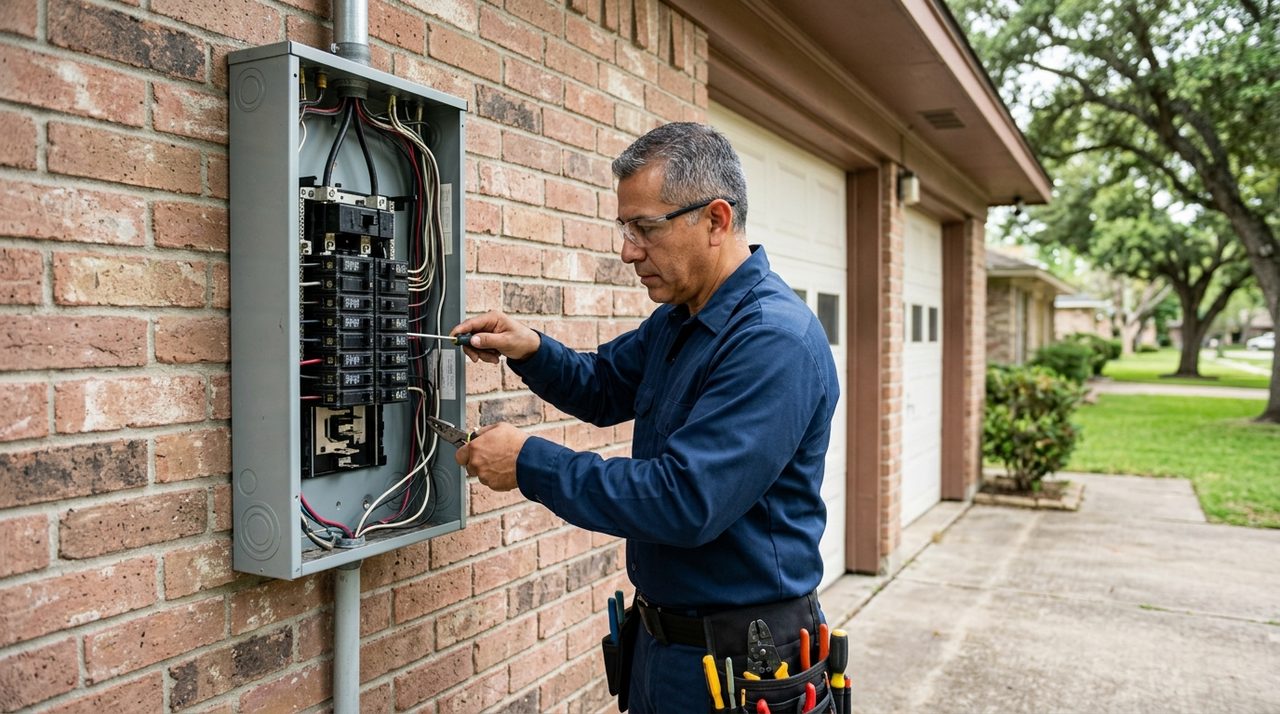
Lazybrook and Timbergrove's ranch homes were wired in an era when a 60-amp or 100-amp service was considered adequate—long before central air conditioning, tankless water heaters, and home offices became standard. After Winter Storm Uri in February 2021, many owners in the neighborhood added portable electric space heaters or heat-pump equipment as gas-supply backups, loading these already-tight panels further. Nuisance tripping, warm breakers, and humming panels in these homes are warning signs, not minor annoyances.
What a good pro does
A licensed Master Electrician (required by TDLR to pull permits in Texas) performs a full load calculation before specifying a panel size—200A is now the practical floor for a renovated ranch, and homes adding EV charging or a heat pump should model 320A or 400A service. The City of Houston Permitting Center requires an electrical permit and inspection for any service upgrade; estimated cost for a 100A-to-200A upgrade in the Houston metro runs $1,800–$3,200 installed, permit included, though site conditions in these older homes can affect that range.
Sources: Texas Department of Licensing & Regulation, City of Houston Permitting Center
Why it matters to you
A meaningful portion of Lazybrook and Timbergrove's housing stock was built during or just before the aluminum branch-circuit wiring era (roughly 1965–1975), and some original homes that were not updated carry single-strand aluminum circuits that oxidize at switch and receptacle terminations over time. This oxidation increases resistance, generates heat, and creates fire risk—a concern that routinely surfaces during home-sale inspections on these 60-year-old ranches as land values inside the Loop have pushed buyer scrutiny higher.
What a good pro does
Proper remediation is not a coat of anti-oxidant paste—it requires either full replacement of aluminum conductors with copper or installation of CO/ALR-rated devices and UL-listed AlumiConn connectors at every termination throughout the home. A TDLR-licensed Master Electrician should verify which circuits are affected before scoping the job; whole-home remediation in the Houston metro typically runs $3,500–$8,000 depending on square footage and number of circuits, and the work requires a City of Houston electrical permit.
Sources: Texas Department of Licensing & Regulation, City of Houston Permitting Center, International Residential Code (as adopted by City of Houston)
Why it matters to you
Houston's average relative humidity exceeds 75% year-round, and the unventilated attics of Lazybrook and Timbergrove's low-pitched ranch rooflines regularly reach 140°F in summer. Decades of thermal cycling in these conditions degrade wire-nut connections, corrode aluminum neutral conductors, and crack the insulation on older wiring runs—problems that typically remain invisible until a breaker trips without explanation or a thermal-imaging scan finds a hot spot. Ranch-style homes with long, open attic spans and original knob-and-tube or early THHN wiring are especially exposed.
What a good pro does
When scoping a renovation or panel upgrade in one of these ranches, a thorough electrician inspects accessible attic junction boxes and pull points as part of the same mobilization rather than treating them as a separate job. Replacing corroded wire nuts with rated lever-nut connectors, re-securing loose attic runs, and confirming that any added insulation doesn't bury junction boxes (a code violation under IRC) are concrete deliverables to request in writing. A City of Houston permit covers attic wiring work done as part of a broader electrical scope.
Sources: International Residential Code (as adopted by City of Houston), City of Houston Permitting Center
Why it matters to you
Homeowners and contractors in Timbergrove planning a whole-home remodel or teardown-and-rebuild—the dominant project type in this neighborhood as land values inside the Loop have climbed—often don't realize that Timbergrove Manor Civic Club design review approval must be obtained before the City of Houston Permitting Center will issue permits for new construction and major renovations. Skipping or overlapping this sequence delays the electrical permit, which in turn holds up every downstream trade.
What a good pro does
Plan the TMCC design review submission as the first milestone in any project schedule, not a parallel track. Your electrician should be prepared to supply the load calculation, service size, and any exterior conduit or meter-can location details that the civic club's review may flag against recorded deed restrictions, which vary by section in Lazybrook and Timbergrove. Once TMCC approval is in hand, the City of Houston electrical permit application through the Houston Permitting Center can proceed without interruption.
Sources: City of Houston Permitting Center, Local HOA / deed restrictions (see area profile)
Hiring electricians in Lazybrook / Timbergrove? Lazybrook/Timbergrove is defined by 1950s–1960s ranch-style brick homes inside the 610 Loop, many of which are now reaching the age where major systems need replacement or full renovation. Proximity to White Oak Bayou introduces flood-risk considerations for any ground-level work, and the Timbergrove Manor Civic Club requires design review approval before permitting for new construction and renovations, adding a step contractors must plan for.
Building era
1950s–1960s, with ongoing infill and teardown rebuilds.
Typical style
One-story, mid-century ranch-style brick homes; newer two-story infill construction is increasing.
Foundations
Not confirmed from available sources - both slab-on-grade and pier-and-beam are common in 1950s–1960s Houston construction. Verify on a per-property basis.
Common systems
Original homes likely have galvanized or cast-iron drain lines, copper supply lines, older electrical panels (60–100 amp), and aging central HVAC systems. Many have undergone partial updates over the decades.
What that means for repairs
Teardowns and full rebuilds are common as land values inside the Loop have risen. Whole-home remodels of original ranches are also frequent, including kitchen and bath modernizations, re-plumbing, and electrical panel upgrades. Timbergrove Manor Civic Club requires design review before City of Houston permitting for new construction and major renovations.
Permit jurisdiction
City of Houston Permitting Center (neighborhood is within Houston city limits, inside the 610 Loop).
HOA & deed restrictions
No mandatory master HOA. Governance is through civic clubs: Timbergrove Manor Civic Club (TMCC, 501(c)(4)) and Lazybrook Civic Club. Deed restrictions are enforced at the subdivision level and vary by section. Whether civic club dues are legally mandatory varies by section and is not definitively documented in public-facing materials.
Historic districts
No City of Houston historic district designation confirmed. HAHC Certificates of Appropriateness are not required for exterior work based on available research.
Contractor note
Contractors working in Timbergrove must obtain civic club design review approval before applying for City of Houston permits for new construction and major renovations. Deed restrictions vary by section, so scope of work and exterior modifications should be verified against the specific lot's recorded restrictions.
FEMA flood zone
FEMA Zone X (low flood risk) per official NFHL data. However, the neighborhood borders White Oak Bayou, and properties closer to the bayou may carry higher effective flood risk. Individual properties should be checked against HCFCD inundation maps and may require elevation certificates.
Hurricane Harvey impact
Specific Harvey 2017 impact data for Lazybrook/Timbergrove is not available from the sources reviewed. The neighborhood's adjacency to White Oak Bayou suggests some homes near the bayou likely experienced flooding, but street-level or block-level inundation data was not confirmed. Check HCFCD Harvey inundation maps and Harris County Repetitive Loss/Severe Repetitive Loss lists for property-specific history.
Heat & humidity load
Original 1950s–1960s homes with aging HVAC systems face heavy summer cooling loads. Older ductwork in attics or crawlspaces may be poorly insulated, driving up energy costs. Pier-and-beam homes (where present) may see moisture-related issues under the house during Houston's humid summers. Bayou-adjacent lots may experience increased mosquito pressure and standing water concerns.
Working with contractors here
The dominant work in Lazybrook/Timbergrove involves either full teardown-and-rebuild projects or deep renovations of 60–70-year-old ranch homes. Re-plumbing (replacing galvanized or cast-iron lines), electrical panel upgrades, and HVAC replacement are among the most common system jobs. Foundation evaluation is important given the age of the housing stock, though the predominant foundation type is not uniformly documented. Contractors should budget time for Timbergrove Manor Civic Club design review when scoping exterior-facing or new construction work, as this approval is required before the City of Houston will issue permits. Flood risk near White Oak Bayou should be assessed before any ground-level or below-grade scope, including foundation work and landscaping drainage.
Local Tip
Always ask for a written estimate before work begins. Texas contractors are required to provide one on jobs over $1,000.
Lazybrook/Timbergrove is defined by 1950s–1960s ranch-style brick homes inside the 610 Loop, many of which are now reaching the age where major systems need replacement or full renovation. Proximity to White Oak Bayou introduces flood-risk considerations for any ground-level work, and the Timbergrove Manor Civic Club requires design review approval before permitting for new construction and renovations, adding a step contractors must plan for.
Source: U.S. Census Bureau, ACS 5-Year 2023
Most of Lazybrook / Timbergrove maps to FEMA Zone X (low mapped flood risk), but Houston's flash-flood reality means even low-risk blocks benefit from smart drainage and storm-hardened installs.
Source: FEMA National Flood Hazard Layer (NFHL). Flood zones vary by parcel — verify your individual FIRM panel.
Beryl 2024 demonstrated that Houston's above-ground distribution grid fails even in areas well away from surge zones, leaving Lazybrook / Timbergrove residents in dangerous July heat without a way to power fans or refrigeration. Protect your home's sensitive electronics — smart panels, EV chargers, and variable-speed HVAC controls — with a whole-house surge protector installed by a licensed electrician before the next storm forms in the Gulf. In-city Lazybrook / Timbergrove work falls under City of Houston floodplain and permitting rules.
After the May 2024 derecho left parts of Lazybrook / Timbergrove dark for four days, homeowners without transfer switches had no safe way to connect a generator — a TDLR-licensed electrician can install an interlock kit on most existing panels in four hours, making it one of the most time-effective storm-prep investments available. Book the work now, before the next round of severe weather puts every licensed electrician in Houston on a three-week waiting list. In-city Lazybrook / Timbergrove work falls under City of Houston floodplain and permitting rules.
After a hard freeze, check every outdoor GFCI receptacle and reset it before assuming the circuit is dead — thermal cycling can trip GFCI devices without triggering the breaker, and in Lazybrook / Timbergrove that can leave your garage door opener, exterior lighting, and holiday-season outdoor circuits mysteriously dark. If a GFCI won't reset after a freeze, call a TDLR-licensed electrician rather than bypassing it, because moisture intrusion from the freeze may have compromised the device or the wiring behind it. In-city Lazybrook / Timbergrove work falls under City of Houston floodplain and permitting rules.
Sources: FEMA National Flood Hazard Layer (NFHL), Ready.gov -- Hurricanes, CenterPoint Energy -- Storm Center, City of Houston -- Emergency Preparedness, Ready.gov -- Winter Weather, Harris County Flood Control District
Houston-specific estimators to plan your project before you call a pro. All results are planning estimates — a licensed local pro confirms the details on site.
Disconnect & drain every outdoor hose bib
Remove hoses, drain the spigots, and cover each with an insulated faucet sock. Un-drained hose bibs are the #1 burst point in a Houston freeze.
Insulate exposed pipes in the attic & garage
Wrap any pipe in an unconditioned space (attic runs, garage walls) with foam sleeves. Houston homes rarely insulate these because they only matter a few nights a year — which is exactly why they burst.
Open cabinet doors & keep a pencil-width drip
On hard-freeze nights, open kitchen/bath cabinets so warm air reaches the pipes and let faucets on exterior walls drip to relieve pressure.
Protect the attic/garage water heater & its lines
An attic or garage tank sits in unconditioned space. Insulate the cold-inlet and hot-outlet lines and confirm the emergency drain pan is clear so a leak doesn't reach the ceiling.
This is a planning estimate only — actual requirements depend on an on-site assessment by a licensed Houston pro. If a pipe has already burst, shut off your main water supply and call a licensed Houston plumber immediately — freeze bursts flood fast.
Sources: City of Houston Permitting CenterLocal HOA / deed restrictions (see area profile)
Sources: City of Houston Permitting CenterTexas Department of Licensing & RegulationLocal HOA / deed restrictions (see area profile)
Sources: City of Houston Permitting Center
Sources: City of Houston Permitting CenterTexas Department of Licensing & Regulation