Closed
Serving Seabrook Based in Kemah · 1.8 mi away
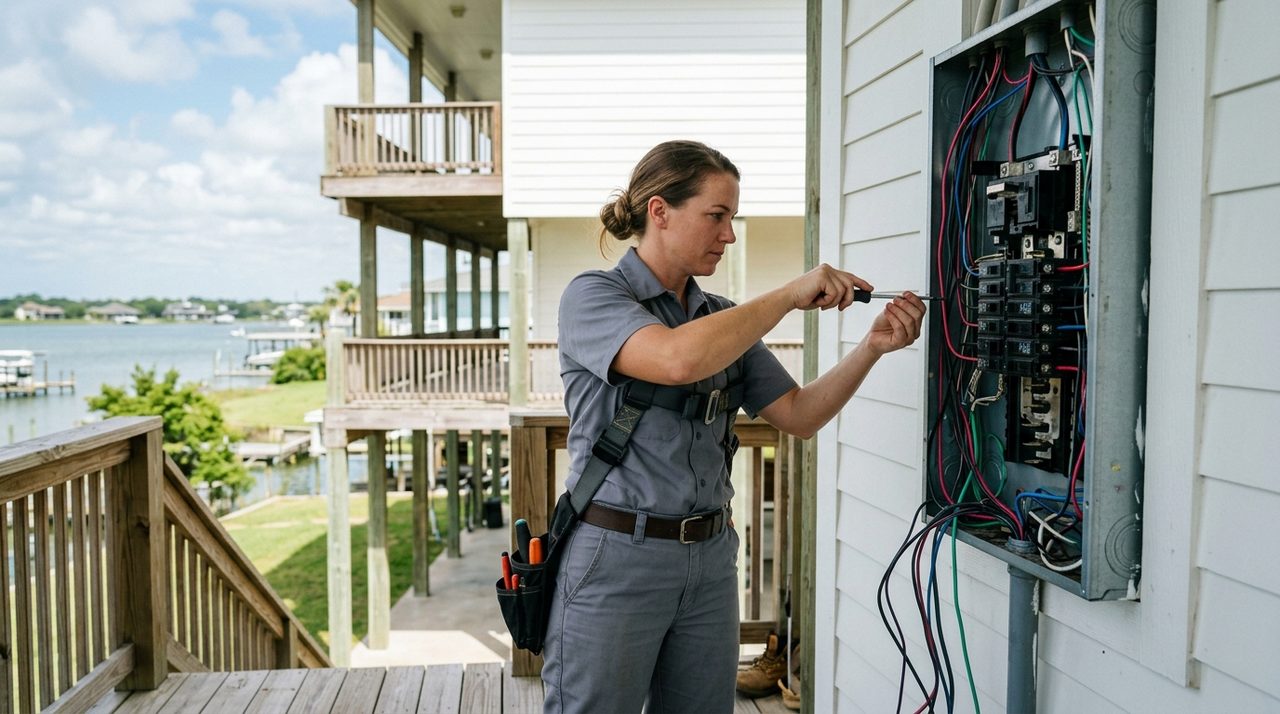
Seabrook sits on the edge of Galveston Bay inside FEMA Zone AE, which means electrical work here carries a layer of floodplain compliance that most inland Houston homeowners never encounter — from mandatory equipment elevation requirements on permitted panel replacements to post-flood recertification of submerged meter bases. The housing stock runs from 1960s pier-and-pile waterfront cottages to 2000s slab-on-grade subdivisions, so the electrical challenges vary sharply by block, and all permits route through the City of Seabrook Building/Permits Department, not Houston Permitting Center. This page breaks down the four electrical problems Seabrook homeowners actually face and what a properly licensed electrician should do about each one.
Ranked by verified Google rating × review volume × verification tier. How we rank →
Some highly-rated pros serve Seabrook from nearby and may not keep a Seabrook street address. Those are listed under "Also serving Seabrook" with their real city and distance, so you always know where each business is based.
Highly-rated pros based nearby who cover Seabrook. Distance shown from the Seabrook area.
Serving Seabrook Based in Kemah · 1.8 mi away
Serving Seabrook Based in Kemah · 2.5 mi away
Serving Seabrook Based in League City · 5 mi away
Serving Seabrook Based in League City · 5.6 mi away
Serving Seabrook Based in League City · 5.7 mi away
Serving Seabrook Based in League City · 5.7 mi away
Serving Seabrook Based in League City · 5.9 mi away
Serving Seabrook Based in Dickinson · 6 mi away
Serving Seabrook Based in La Porte · 6.3 mi away
Serving Seabrook Based in Dickinson · 6.9 mi away
Why it matters to you
Seabrook's FEMA Zone AE designation means that when a submerged panel, subpanel, or meter base is replaced after inundation — as many were following Harvey in 2017 and again after Beryl's 2024 storm surge — the City of Seabrook's floodplain management rules require the new equipment to be elevated above the Base Flood Elevation, not simply swapped in place. A corroded breaker box that dried out and 'seems fine' has compromised breaker ratings and a voided UL listing, and installers who skip the elevation step will fail inspection at the City of Seabrook permit office.
What a good pro does
A licensed Master Electrician (required under TDLR to pull the permit) should pull the elevation certificate for the parcel, confirm the required finished-floor or equipment elevation, and design the panel relocation accordingly before any material is ordered. The City of Seabrook issues its own electrical permit — budget for their fee schedule and inspection pipeline, which differs from Harris County or Houston Permitting Center timelines.
Sources: FEMA National Flood Hazard Layer (NFHL), Municipal permit office (see area profile), Texas Department of Licensing & Regulation
Why it matters to you
Seabrook's bayfront position means ambient salt-laden air accelerates oxidation far faster than inland Houston neighborhoods — attic wire nuts, aluminum neutral conductors, and breaker lug connections in homes within a half-mile of Galveston Bay can show measurable corrosion within a few years of installation. Combined with attic temperatures that routinely exceed 140°F in summer and Houston's average relative humidity above 75%, older homes in areas like Lake Cove or Searidge subdivisions see insulation degradation and connection failures that rarely show up until a circuit goes intermittent or a thermal-imaging scan reveals a hot spot.
What a good pro does
A qualified electrician should perform a thermal-imaging inspection of attic junction boxes and the main panel on any Seabrook home over 15 years old, especially those within canal-front or bay-adjacent sections. Corroded connections require full re-termination with corrosion-inhibiting compound rated for the conductor type; simply re-tightening a salt-oxidized lug is not an adequate repair. All replacement devices and enclosures specified for exposed or semi-exposed coastal locations should carry a NEMA 3R or better rating.
Sources: International Residential Code (as adopted by City of Houston), Municipal permit office (see area profile)
Why it matters to you
The 1960s and 1970s waterfront homes in Seabrook — many on pier-and-pile construction along the bay and canals — were largely served by overhead utility drops rather than underground laterals, and the May 2024 derecho's 80-plus mph winds and Beryl's gusts tore mast risers and weatherheads off wood-framed structures across the coastal SE Houston corridor. CenterPoint Energy restores the utility drop, but the homeowner owns the weatherhead, mast, meter base, and service entrance conductors — and CenterPoint will not reconnect until an electrician repairs the homeowner's side and the City of Seabrook issues a reconnect approval after inspection.
What a good pro does
After any major wind event, homeowners with overhead service should have a TDLR-licensed Master Electrician inspect the mast-to-eave connection, weatherhead seal, and meter base for pull-out or impact damage before requesting a CenterPoint reconnect appointment. Upgrading to a galvanized rigid steel mast and a sealed, corrosion-resistant meter can at the time of repair adds meaningful longevity in Seabrook's salt-air environment. The City of Seabrook permit is required for this work — it is not a 'like-for-like swap' exemption.
Sources: Municipal permit office (see area profile), Texas Department of Licensing & Regulation
Why it matters to you
Seabrook's older bay-cottage and canal-side homes built in the 1960s and early 1970s often retain their original 100-amp service — an ampacity that was designed for an all-gas home with window A/C. Winter Storm Uri in February 2021 pushed many of these homeowners to add plug-in electric space heaters or portable heat-pump units as emergency backup, and some permanently wired in electric resistance heat strips. A 100-amp service cannot safely carry simultaneous loads from aging central HVAC, electric water heating, and supplemental resistance heat, leading to nuisance tripping and thermally stressed conductors inside the panel.
What a good pro does
A Master Electrician should perform a full load calculation per NEC Article 220 before specifying a service upgrade size — in Seabrook's coastal climate, where summer cooling loads are heavy and electrification additions are common, a 200-amp upgrade is often the minimum prudent choice, and some pier-and-beam waterfront homes being renovated are going to 400-amp service to accommodate future EV charging and solar-plus-storage. The City of Seabrook Building/Permits Department issues the electrical permit; budget $1,800–$3,200 for a 100A-to-200A upgrade or $3,500–$6,000 for a 400A installation, both figures being estimates that vary with site conditions and current material costs.
Sources: Municipal permit office (see area profile), Texas Department of Licensing & Regulation, International Residential Code (as adopted by City of Houston)
Hiring electricians in Seabrook? Seabrook is an incorporated city on Galveston Bay with housing ranging from 1960s waterfront homes to 2000s subdivision development, creating a wide spectrum of home service needs. The coastal location and FEMA AE flood zone designation mean that flood mitigation, elevation considerations, and storm-hardening are central to nearly every major home project. Homeowners should expect subdivision-level HOA requirements that vary block by block and plan for salt-air corrosion on exterior systems.
Building era
1970s–2000s, with some 1960s waterfront homes and ongoing infill.
Typical style
Production suburban traditional (one- and two-story brick or brick-and-siding) with coastal/contemporary elevated homes along waterfront and canal-front areas.
Foundations
Mixed — predominantly slab-on-grade in newer subdivisions; pier-and-beam or pier-and-pile construction common in older waterfront and canal-front homes due to floodplain and storm-surge requirements.
Common systems
Central HVAC systems typical of 1980s–2000s construction (aging units in older homes); copper and CPVC plumbing in newer builds, galvanized possible in 1960s–1970s stock; standard 200-amp electrical panels in newer homes, potential 100-amp in older homes.
What that means for repairs
Flood damage repair and mitigation retrofits are common drivers of renovation activity. Waterfront homes frequently undergo elevation projects, foundation reinforcement, and storm-resistant window/door upgrades. Older homes often need full plumbing repipes and HVAC replacements due to age and salt-air corrosion.
Permit jurisdiction
City of Seabrook Building/Permits Department (incorporated city — not Houston Permitting Center or Harris County).
HOA & deed restrictions
Subdivision-by-subdivision. Many subdivisions have mandatory HOAs/POAs including Seabrook Island HOA, Lake Cove Community Association (managed by Goodwin & Company), Seascape POA, and Searidge. Approximately 16 HOA/condo communities are registered in Seabrook. Some older or fringe areas may have no active HOA but may still have recorded deed restrictions.
Historic districts
No City of Houston historic district designation confirmed. Seabrook is an independent incorporated city and not subject to HAHC oversight.
Contractor note
Contractors must pull permits through the City of Seabrook and should verify subdivision-specific HOA architectural review requirements before starting exterior work. Coastal building codes and floodplain management regulations apply and may require elevation certificates.
FEMA flood zone
FEMA Zone AE (high flood risk) — source: fema_nfhl. Seabrook sits directly on Galveston Bay and is subject to both riverine flooding and coastal storm surge, contributing to its very high hazard risk rating.
Hurricane Harvey impact
The Clear Lake/Bay area of southeast Harris County experienced significant flooding during Hurricane Harvey. Seabrook-specific community hazard data rates overall risk as 'Very High.' However, no publicly available subdivision-level or street-level Harvey flood-extent map for Seabrook was identified. Exact street-by-street impact should be verified through Harris County Flood Control District records and individual property seller's disclosures.
Heat & humidity load
Extreme humidity and salt-air proximity accelerate corrosion on HVAC condensers, metal roofing components, and exterior hardware. HVAC systems run at near-continuous capacity May through September, shortening equipment lifespan. Mold and moisture intrusion in slab-on-grade and pier-and-beam homes require proactive dehumidification and ventilation strategies.
Working with contractors here
Contractors working in Seabrook most commonly handle flood damage restoration, foundation repairs (especially on older pier-and-beam waterfront homes), and HVAC replacements accelerated by salt-air corrosion and heavy summer usage. Roofing and exterior siding projects require wind-rated materials compliant with coastal building codes, and many jobs trigger City of Seabrook floodplain management requirements including elevation certificates. The wide range of housing ages — from 1960s waterfront cottages to 2000s subdivision homes — means scoping should always begin with a thorough assessment of existing systems, as plumbing and electrical standards vary significantly across eras. HOA architectural review adds a layer of approval in many subdivisions, so contractors should confirm HOA requirements before beginning visible exterior modifications.
Local Tip
Always ask for a written estimate before work begins. Texas contractors are required to provide one on jobs over $1,000.
Seabrook is an incorporated city on Galveston Bay with housing ranging from 1960s waterfront homes to 2000s subdivision development, creating a wide spectrum of home service needs. The coastal location and FEMA AE flood zone designation mean that flood mitigation, elevation considerations, and storm-hardening are central to nearly every major home project. Homeowners should expect subdivision-level HOA requirements that vary block by block and plan for salt-air corrosion on exterior systems.
Source: U.S. Census Bureau, ACS 5-Year 2023
Much of Seabrook maps to FEMA Zone AE (high flood risk), so flood-resilient detailing -- elevated equipment, water-tolerant materials, and drainage-first thinking -- is essential here, not optional; risk climbs sharply on blocks nearest Galveston Bay, where it varies parcel to parcel.
Source: FEMA National Flood Hazard Layer (NFHL). Flood zones vary by parcel — verify your individual FIRM panel.
GFCI protection on every first-floor and garage circuit is the minimum code requirement, but in Seabrook, TX the combination of FEMA Zone AE inside the 100-year floodplain and proximity to Galveston Bay and hurricane rainfall makes whole-panel surge protection equally critical. Have a licensed electrician add a whole-house surge arrester at the meter base so that when Beryl 2024-style power surges hit upon grid restoration, your appliances and HVAC controls survive intact. As a Harris County community, Seabrook may follow county rather than City of Houston storm rebuild rules.
Heavy thunderstorm cells that produce the flash flooding common in Seabrook, TX also drive ground-level water into unprotected electrical boxes; ask a licensed electrician to inspect all exterior j-boxes, weatherheads, and low-mounted outdoor receptacles for water intrusion after any storm that drops more than three inches in an hour. Even in a 500-year mapped zone, repeated severe-storm flooding erodes conduit seals and creates shock and fire hazards that aren't visible to the homeowner. Because Seabrook drains toward Galveston Bay, block-level runoff can differ sharply from the mapped zone.
Winter Storm Uri 2021 exposed a critical vulnerability for Seabrook, TX homeowners in FEMA Zone AE inside the 100-year floodplain and proximity to Galveston Bay zones: sump pumps and flood-mitigation circuits that had never been tested under load failed when the freeze hit, leaving homes unprotected when pipes burst. Before the next hard freeze, have a TDLR-licensed electrician load-test your sump-pump circuits, verify GFCI functionality in below-grade spaces, and confirm your panel is rated for the draw of any portable heat source you plan to use. Confirm the current FEMA panel for your Seabrook parcel — the area maps to Zone AE, but adjacent lots can differ.
Sources: FEMA National Flood Hazard Layer (NFHL), Ready.gov -- Hurricanes, CenterPoint Energy -- Storm Center, City of Houston -- Emergency Preparedness, Ready.gov -- Winter Weather, Harris County Flood Control District
Houston-specific estimators to plan your project before you call a pro. All results are planning estimates — a licensed local pro confirms the details on site.
Disconnect & drain every outdoor hose bib
Remove hoses, drain the spigots, and cover each with an insulated faucet sock. Un-drained hose bibs are the #1 burst point in a Houston freeze.
Insulate exposed pipes in the attic & garage
Wrap any pipe in an unconditioned space (attic runs, garage walls) with foam sleeves. Houston homes rarely insulate these because they only matter a few nights a year — which is exactly why they burst.
Open cabinet doors & keep a pencil-width drip
On hard-freeze nights, open kitchen/bath cabinets so warm air reaches the pipes and let faucets on exterior walls drip to relieve pressure.
Protect the attic/garage water heater & its lines
An attic or garage tank sits in unconditioned space. Insulate the cold-inlet and hot-outlet lines and confirm the emergency drain pan is clear so a leak doesn't reach the ceiling.
This is a planning estimate only — actual requirements depend on an on-site assessment by a licensed Houston pro. If a pipe has already burst, shut off your main water supply and call a licensed Houston plumber immediately — freeze bursts flood fast.
Sources: Municipal permit office (see area profile)Texas Department of Licensing & RegulationLocal HOA / deed restrictions (see area profile)
Sources: FEMA National Flood Hazard Layer (NFHL)Municipal permit office (see area profile)
Sources: Municipal permit office (see area profile)
Sources: Municipal permit office (see area profile)Texas Department of Licensing & Regulation
Sources: Municipal permit office (see area profile)Texas Department of Licensing & RegulationFEMA National Flood Hazard Layer (NFHL)Local HOA / deed restrictions (see area profile)North American Board of Certified Energy Practitioners (NABCEP)
Sources: Municipal permit office (see area profile)FEMA National Flood Hazard Layer (NFHL)Texas Department of Licensing & Regulation