Closed
Serving Memorial Based in Tanglewood · 1.1 mi away
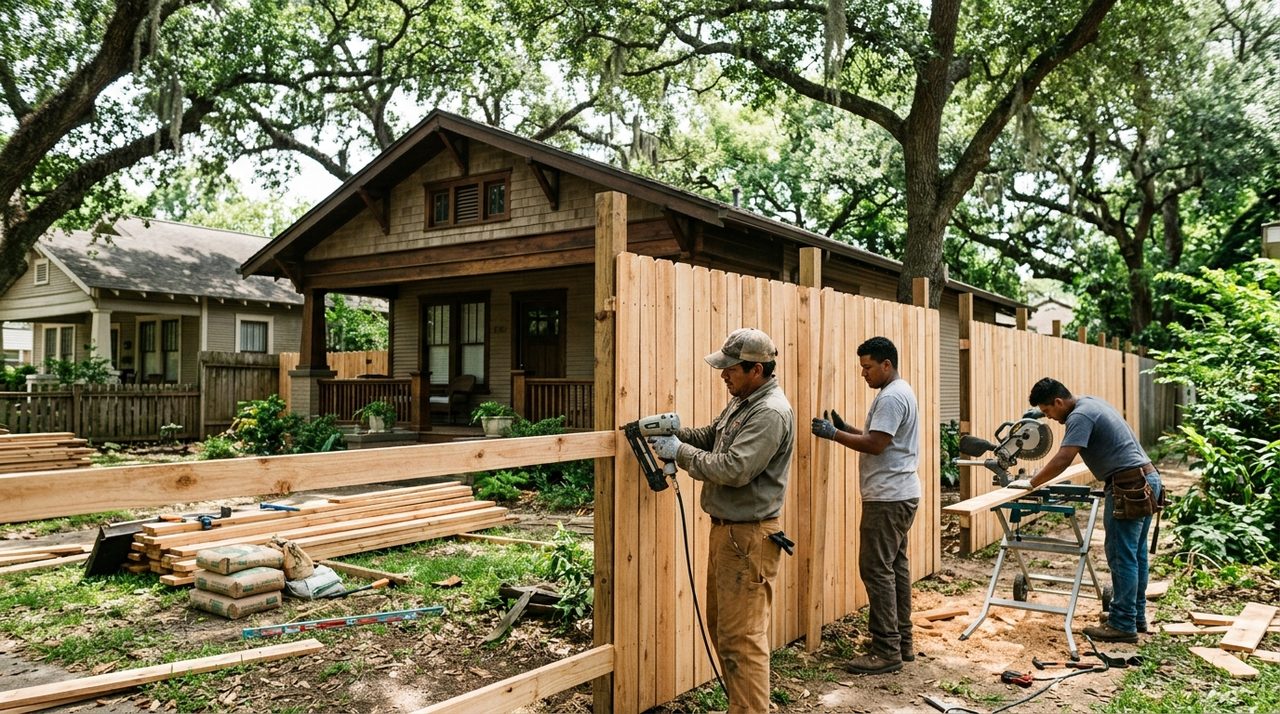
Memorial inside the Loop is not one neighborhood but a corridor of distinct deed-restricted subdivisions — some with active Architectural Control Committees, others governed only by voluntary civic clubs — built on Houston Black clay that has watched 1950s ranch homes give way to large custom rebuilds since the 1990s. Installing a fence here means navigating City of Houston permit rules, soil that heaves posts seasonally, and subdivision-level deed restrictions that can differ from one block to the next, sometimes mandating specific materials or post orientations. Understanding exactly which rules apply to your subdivision before the first post goes in is the difference between a fence that stands and one that gets a removal notice.
Ranked by verified Google rating × review volume × verification tier. How we rank →
Some highly-rated pros serve Memorial from nearby and may not keep a Memorial street address. Those are listed under "Also serving Memorial" with their real city and distance, so you always know where each business is based.
Highly-rated pros based nearby who cover Memorial. Distance shown from the Memorial area.
Serving Memorial Based in Tanglewood · 1.1 mi away
Serving Memorial Based in Tanglewood · 1.2 mi away
Serving Memorial Based in Tanglewood · 1.9 mi away
Serving Memorial Based in Spring Branch · 2.6 mi away
Serving Memorial Based in Bellaire · 3.3 mi away
Serving Memorial Based in Bellaire · 3.4 mi away
Serving Memorial Based in Bellaire · 3.6 mi away
Serving Memorial Based in Lazybrook / Timbergrove · 3.7 mi away
Serving Memorial Based in Sharpstown · 3.8 mi away
Serving Memorial Based in Bellaire · 3.9 mi away
Why it matters to you
Memorial inside the Loop is a patchwork of independently governed subdivisions — some with mandatory HOAs and active Architectural Control Committees, others with only recorded deed restrictions and no formal enforcement body — and material rules, height limits, and setback requirements vary block by block. A cedar board-on-board fence that is fully acceptable in one Memorial subdivision may violate a neighboring subdivision's deed restriction mandating wrought iron or prohibiting wood facing the street. Because there is no single area-wide HOA, confirming which restrictions apply to your specific parcel requires pulling the recorded deed restrictions through Harris County Clerk records before any contractor bids the job.
What a good pro does
A qualified fence contractor working in Memorial should request the specific subdivision's recorded deed restriction document — not just ask a neighbor — before finalizing a material or height specification. Contractors must also scope ACC approval requirements separately from City of Houston permit requirements, since both obligations can apply simultaneously and neither satisfies the other. Budget extra lead time for ACC review if your subdivision requires it, as approval cycles can run two to four weeks.
Sources: Local HOA / deed restrictions (see area profile), City of Houston Permitting Center
Why it matters to you
Memorial's original 1950s–1970s housing stock sits on native Beaumont and Houston Black clay that shrinks significantly in dry summers and swells with rain, and the corridor's mature tree canopy means root systems are competing with fence posts for the same soil. Standard concrete footings poured shallow — a common practice in Houston — provide minimal resistance to seasonal soil movement, and posts on clay-heavy lots in this corridor can lean or crack footings within a few years of installation, particularly at corners where tension loads are highest. The teardown-and-rebuild activity throughout Memorial also means some lots have disturbed fill soil of variable compaction alongside native clay, compounding post stability problems.
What a good pro does
Contractors should specify deeper footings — at minimum 36 inches in Memorial's clay conditions, with diameter sizing appropriate to post gauge — and consider surface-drainage grading around each post base to reduce standing water that accelerates both clay swelling and wood rot. On lots with documented mature tree proximity, post placement should be evaluated against root zones before digging. Wood post replacement after heave damage typically runs $150–$300 per post including concrete repouring, so investing in correct embedment depth upfront is materially less expensive than repeated repair cycles.
Sources: International Residential Code (as adopted by City of Houston), Harris County Flood Control District
Why it matters to you
The May 2024 derecho and Beryl 2024 both tracked across Harris County with gusts documented well above standard fence design thresholds, and Memorial's tall 6-foot cedar privacy fences — common on the larger lots throughout the corridor — act as solid wind sails with no pressure-relief gaps. Fences installed to minimum standards, with posts set only 18–24 inches deep in concrete that has already been compromised by clay movement, are the ones that failed wholesale in these events. Full storm-damage replacement for an average Memorial suburban lot can run $3,000–$8,000 depending on linear footage and material choice.
What a good pro does
Wind-resilient fence construction in Memorial means setting corner and gate posts at a minimum 42–48 inches deep, specifying 4x4 or larger posts at no more than 6-foot spacing, and — where deed restrictions allow — incorporating board-on-board gaps or staggered picket designs that reduce solid surface area during high-wind events. Homeowners replacing storm-damaged fences should also verify TWIA wind coverage applicability and document pre-replacement condition with photos before disposal, as insurers increasingly require this documentation for claims on fence losses from named events.
Sources: Texas Windstorm Insurance Association (TWIA), International Residential Code (as adopted by City of Houston), City of Houston Permitting Center
Why it matters to you
Memorial's 1950s–1970s original plats frequently recorded drainage and utility easements along rear and side lot lines exactly where homeowners want fence posts — a problem that resurfaces when teardown-and-rebuild projects install new fencing on lots that haven't had a current survey reviewed against the original plat in decades. The City of Houston requires permits for fences exceeding 6 feet in height, and while most Memorial privacy fences hit exactly the 6-foot standard and technically skirt the permit threshold, any fence on a lot with a recorded easement can draw enforcement attention if the installation encroaches on that easement regardless of height. Underground utility conflicts are an additional risk given the density of buried infrastructure throughout the inner-loop corridor.
What a good pro does
Before post locations are marked, contractors must call 811 (Texas One-Call) for utility locates — this is a legal requirement, not optional — and the homeowner should pull the current plat from Harris County to identify recorded drainage or utility easements that restrict structure placement. If an easement runs through the planned fence line, post spacing or fence alignment may need to be adjusted to straddle rather than block the easement. For any fence at or near the 6-foot threshold, confirming current City of Houston permit requirements directly with the Houston Permitting Center is the correct step, as enforcement interpretations on exact-height fences can vary by inspector.
Sources: City of Houston Permitting Center, Harris County Flood Control District, Municipal permit office (see area profile)
Hiring fence builders in Memorial? Memorial inside the Loop is a corridor of multiple smaller subdivisions rather than one unified neighborhood, meaning deed restrictions, HOA rules, and housing conditions vary block by block. Homeowners deal with a mix of original 1950s–70s ranch homes needing major system updates and newer custom construction from the 1990s–2020s. Proximity to Buffalo Bayou makes drainage management and foundation monitoring critical home service priorities.
Building era
1950s–1970s original stock with significant 1990s–2020s teardown-and-rebuild activity.
Typical style
Original ranch and mid-century traditional homes alongside newer traditional brick, Mediterranean, soft contemporary, modern farmhouse, and fee-simple townhomes.
Foundations
Predominantly slab-on-grade; some pier-and-beam in the oldest remaining structures.
Common systems
Original homes often have galvanized or early copper plumbing, aging R-22 HVAC systems, and 100–150 amp electrical panels; newer rebuilds feature modern PEX plumbing, high-efficiency HVAC, and 200+ amp panels.
What that means for repairs
Teardown-and-rebuild is the dominant renovation pattern, driven by lot values exceeding the value of original structures. Where original homes are retained, whole-house repiping, electrical panel upgrades, and HVAC replacement are the most common major projects.
Permit jurisdiction
City of Houston — Houston Permitting Center.
HOA & deed restrictions
No single area-wide mandatory HOA. The corridor is governed by multiple subdivision-level organizations—some with mandatory HOAs (e.g., specific townhome and condo developments), others with voluntary civic clubs or property owners associations. Deed restrictions are common but must be confirmed per subdivision through Harris County Clerk records.
Historic districts
No City of Houston historic district designation confirmed for the Memorial inside-the-Loop corridor.
Contractor note
Contractors must verify deed restrictions and architectural review requirements on a per-subdivision basis before exterior work begins. Some subdivisions require Architectural Control Committee (ACC) approval for additions, fencing, and material changes.
FEMA flood zone
FEMA Zone X (low flood risk) per official NFHL data. However, the corridor's proximity to Buffalo Bayou means individual parcels closer to the bayou may carry higher risk; homeowners should verify flood zone status at the parcel level, as conditions vary significantly within the corridor.
Hurricane Harvey impact
Specific block-by-block Harvey impact data for the Memorial inside-the-Loop corridor was not confirmed in research. Buffalo Bayou experienced historic flooding during Harvey, and properties nearest the bayou along Memorial Drive were likely affected. Homeowners should check individual property flood history through Harris County Flood Control District records.
Heat & humidity load
Original 1950s–70s homes with aging insulation and single-pane windows place heavy demands on HVAC systems during Houston summers. Slab-on-grade foundations on the expansive clay soils near Buffalo Bayou are susceptible to shifting during summer drought cycles, making foundation monitoring and consistent watering programs important.
Working with contractors here
Contractors working in Memorial inside the Loop most commonly handle full teardown-and-rebuild projects on lots where original ranch homes are being replaced with larger custom homes. For retained original structures, whole-house repiping (replacing galvanized lines), electrical panel upgrades from 100 to 200 amps, and HVAC system replacements are the highest-demand services. The subdivision-by-subdivision deed restriction landscape means contractors must scope exterior projects carefully—confirming setbacks, height limits, and material requirements with the specific neighborhood association before bidding. Drainage and grading work is common given proximity to Buffalo Bayou, and foundation repair contractors see steady demand due to the clay soil conditions and mature tree root systems throughout the corridor.
Local Tip
Always ask for a written estimate before work begins. Texas contractors are required to provide one on jobs over $1,000.
Memorial inside the Loop is a corridor of multiple smaller subdivisions rather than one unified neighborhood, meaning deed restrictions, HOA rules, and housing conditions vary block by block. Homeowners deal with a mix of original 1950s–70s ranch homes needing major system updates and newer custom construction from the 1990s–2020s. Proximity to Buffalo Bayou makes drainage management and foundation monitoring critical home service priorities.
Source: U.S. Census Bureau, ACS 5-Year 2023
Most of Memorial maps to FEMA Zone X (low mapped flood risk), but Houston's flash-flood reality means even low-risk blocks benefit from smart drainage and storm-hardened installs; risk climbs sharply on blocks nearest Buffalo Bayou, where it varies parcel to parcel.
Source: FEMA National Flood Hazard Layer (NFHL). Flood zones vary by parcel — verify your individual FIRM panel.
Sources: City of Houston Permitting CenterLocal HOA / deed restrictions (see area profile)
Sources: FEMA National Flood Hazard Layer (NFHL)Harris County Flood Control District
Sources: Municipal permit office (see area profile)
Sources: Local HOA / deed restrictions (see area profile)