Closed
6931 Windfern Rd, Houston, TX 77040
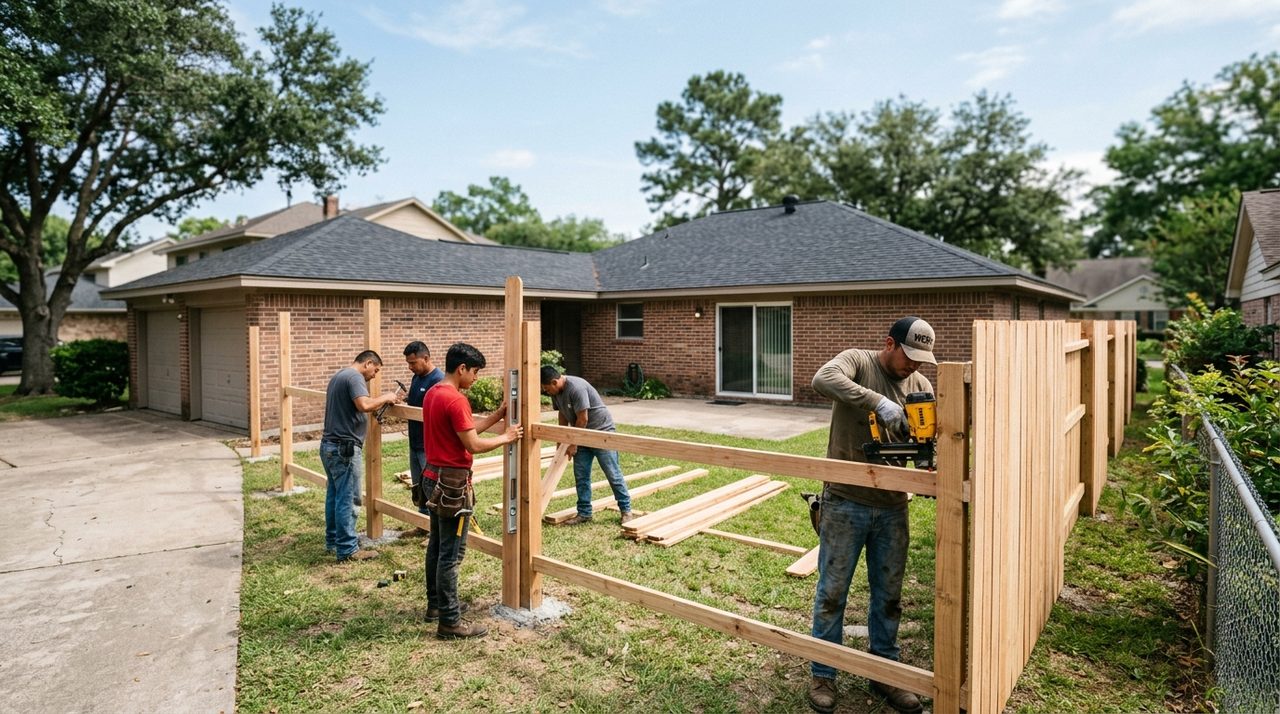
NW Houston's patchwork of 1980s–1990s tract subdivisions — each sitting on Houston Black clay and governed by its own mandatory HOA — makes fence replacement and new installation more complicated than it looks from the curb. Between split permit jurisdiction (some parcels fall under Houston Permitting Center, others under Harris County Engineering), active architectural review committees, and clay soils that heave fence posts seasonally, homeowners here face a different set of hurdles than anywhere else in the metro. This page breaks down what actually drives fence problems in these subdivisions and what to demand from any contractor you hire.
Ranked by verified Google rating × review volume × verification tier. How we rank →
Some highly-rated pros serve NW Houston from nearby and may not keep a NW Houston street address. Those are listed under "Also serving NW Houston" with their real city and distance, so you always know where each business is based.
6931 Windfern Rd, Houston, TX 77040
13621 Ann Louise Rd, Houston, TX 77086
12239 Mosielee St, Houston, TX 77086
Highly-rated pros based nearby who cover NW Houston. Distance shown from the NW Houston area.
Serving NW Houston Based in Jersey Village · 1.8 mi away
Serving NW Houston Based in Jersey Village · 2.3 mi away
Serving NW Houston Based in Jersey Village · 2.3 mi away
Serving NW Houston Based in Jersey Village · 2.4 mi away
Serving NW Houston Based in Jersey Village · 3.1 mi away
Serving NW Houston Based in Jersey Village · 3.6 mi away
Serving NW Houston Based in Jersey Village · 3.8 mi away
Why it matters to you
The native Beaumont/Houston Black clay underlying NW Houston's 1980s–1990s slab-on-grade subdivisions shrinks dramatically during summer drought and expands when heavy rain arrives — a cycle that leverages concrete post footings upward and out of level over time. A fence installed in spring can be visibly leaning by the following July. Homeowners on these tracts frequently see boards warping and gate frames racking within a few years of a standard install, not because the fence itself is defective but because shallow or narrow concrete footings give the expanding clay enough mechanical advantage to displace posts.
What a good pro does
A knowledgeable contractor on NW Houston clay should set posts a minimum of 36 inches deep and use a tapered or belled concrete footing — not a simple tube-form pour — to resist upward clay pressure. Some installers also use gravel backfill around the bottom 12 inches of the footing hole to allow water to drain away from the base rather than saturate the surrounding clay. Ask any bidder specifically how they address clay heave; a vague answer is a red flag.
Sources: International Residential Code (as adopted by City of Houston), Harris County Flood Control District
Why it matters to you
The vast majority of platted NW Houston subdivisions — including Memorial Northwest and Meadows of Northwest Park — carry mandatory HOA deed restrictions that dictate fence material, height, color, and sometimes which direction the finished face must point. In many of these 1980s–1990s communities, chain-link is prohibited along street-facing sides, and some architectural committees require cedar-only wood construction with the smooth side facing the neighbor. Submitting for a permit or scheduling installation before receiving written HOA architectural committee approval can result in a stop-work demand and forced removal at the homeowner's expense.
What a good pro does
Before any contractor pulls a permit or orders materials, request your subdivision's current fence standards document directly from the HOA management company — not from a neighbor's memory of what was approved in 2012. HOA architectural review in NW Houston subdivisions can take two to six weeks, so build that lead time into your project schedule. Keep the written approval letter on file; it protects you if the committee composition changes and a new board disputes the approved design.
Sources: Local HOA / deed restrictions (see area profile)
Why it matters to you
NW Houston is one of the few areas in the metro where two property addresses on the same block can fall under completely different permit authorities — one inside Houston city limits (routed through the Houston Permitting Center), the other in unincorporated Harris County (handled by Harris County Engineering). The City of Houston requires a permit for fences exceeding 6 feet in height and has specific inspection processes; Harris County has its own separate requirements. A contractor who pulls the wrong permit — or none at all — puts the homeowner at risk of a failed inspection or forced removal, with no recourse on the contractor because Texas issues no state license for fence work.
What a good pro does
Before signing a contract, ask the contractor to confirm your parcel's municipal status by address and show you which permit office they plan to use. You can verify this yourself at the Houston Permitting Center's address-lookup tool or by calling Harris County Engineering directly. A reputable NW Houston fence contractor does this as a standard first step on every job — it is not optional and it is not your burden to figure out after the fence is up.
Sources: City of Houston Permitting Center, Municipal permit office (see area profile)
Why it matters to you
The May 2024 derecho and Hurricane Beryl in 2024 both produced damaging gusts across the NW Houston suburbs, and the fences most likely to have failed were 6-foot cedar board-on-board panels with posts embedded only 18–24 inches — the shallow-footing standard common to production fence installs of the 1980s and 1990s when much of this housing stock was originally fenced. A solid 6-foot privacy panel acts like a sail in a derecho corridor; without adequate embedment depth and post-diameter, the entire fence section can blow over as a unit rather than flexing and surviving. Replacing a full fence run after storm damage typically costs $3,000–$8,000 for an average NW Houston suburban lot — estimates only.
What a good pro does
When replacing storm-damaged fence sections or installing new, specify posts embedded at least one-third of total post length (so a 9-foot post for a 6-foot fence) and set in concrete that extends below the seasonal moisture-change zone. Some contractors in wind-exposed NW Houston runs are also specifying spaced pickets or adding wind-relief gaps between boards near the top of the fence to reduce the sail effect. If you carry homeowners or wind insurance through TWIA or a private carrier, document post embedment depth at installation — photos before concrete pour can matter at claim time.
Sources: Texas Windstorm Insurance Association (TWIA), International Residential Code (as adopted by City of Houston)
Hiring fence builders in NW Houston? NW Houston encompasses dozens of separate subdivisions spanning construction eras from the 1960s through the 2010s, each with its own HOA and deed restrictions. Homeowners here typically manage aging slab-on-grade foundations on expansive clay soils, production-era HVAC systems, and roofing exposed to severe summer heat. Permit jurisdiction varies between the City of Houston and Harris County depending on whether the specific parcel falls inside or outside city limits.
Building era
1970s–2000s, with the largest concentration in the 1980s–1990s.
Typical style
Traditional suburban brick or brick-and-siding one- and two-story homes, Texas traditional with gables and attached garages.
Foundations
Concrete slab-on-grade (predominant for post-1960 tract housing in Harris County).
Common systems
Central A/C with forced-air gas furnaces typical of 1980s–1990s production builds; copper or CPVC supply lines with cast iron or PVC drains; 200-amp electrical panels in newer sections, 100-amp in older 1970s-era homes.
What that means for repairs
Kitchen and bath remodels are common in 1970s–1980s homes reaching 40+ years. Foundation repair due to expansive clay soils is frequent. Roof replacements cycle every 15–20 years due to hail and heat exposure. HOA architectural review is typically required before exterior modifications.
Permit jurisdiction
Mixed — parcels within Houston city limits use the Houston Permitting Center; unincorporated Harris County parcels (common in NW Houston) use Harris County Engineering Department. Verify annexation status per address.
HOA & deed restrictions
Most platted subdivisions have mandatory HOAs or POAs. Notable examples include Memorial Northwest Homeowners Association (mandatory for all property owners) and Meadows of Northwest Park HOA (mandatory). Older unplatted acreage tracts may lack formal HOAs. Confirm HOA status per property via deed records and the TREC HOA Management Certificate Database.
Historic districts
No City of Houston historic district designation confirmed.
Contractor note
Contractors must verify whether a specific address is inside Houston city limits or unincorporated Harris County, as permit requirements and inspection processes differ. Most subdivision HOAs require architectural committee approval before exterior work begins.
FEMA flood zone
FEMA Zone X500 (moderate flood risk) — source: fema_nfhl. Portions of NW Houston near Cypress Creek, White Oak Bayou tributaries, and low-lying creek corridors may carry higher localized flood risk; confirm zone by specific address.
Hurricane Harvey impact
Harvey impact varied significantly across NW Houston. Areas near Cypress Creek and low-lying bayou tributaries experienced serious structural flooding, while higher-ground subdivisions saw little to no flooding. No single characterization applies area-wide. Some NW Houston subdivisions faced post-Harvey HOA disputes including foreclosure actions over unpaid dues and legal costs.
Heat & humidity load
Prolonged 95°F+ heat and high humidity stress aging HVAC systems in 1980s–1990s homes, accelerating compressor failures and ductwork degradation in unconditioned attic spaces. Slab movement peaks during summer drought cycles on expansive clay soils, causing doors to stick and drywall cracks to appear.
Working with contractors here
The most common service calls in NW Houston involve foundation leveling and pier installation on expansive clay soils, HVAC system replacement in 1980s–1990s production homes, and composition shingle roof replacements after hail events. Plumbing repiping is increasingly common as original polybutylene and CPVC lines in 1980s–1990s homes reach end of life. Contractors should plan for HOA architectural review timelines before scheduling exterior work—approval can take two to six weeks depending on the subdivision. Because permit jurisdiction is split between Houston and Harris County, job scoping must begin with confirming the property's municipal status to ensure correct permits and inspections.
Local Tip
Always ask for a written estimate before work begins. Texas contractors are required to provide one on jobs over $1,000.
NW Houston encompasses dozens of separate subdivisions spanning construction eras from the 1960s through the 2010s, each with its own HOA and deed restrictions. Homeowners here typically manage aging slab-on-grade foundations on expansive clay soils, production-era HVAC systems, and roofing exposed to severe summer heat. Permit jurisdiction varies between the City of Houston and Harris County depending on whether the specific parcel falls inside or outside city limits.
Source: U.S. Census Bureau, ACS 5-Year 2023
NW Houston carries FEMA Zone X500 (moderate flood risk): outside the 100-year floodplain but inside the 500-year, so heavy-rain events still reach homes and flood-aware work pays off.
Source: FEMA National Flood Hazard Layer (NFHL). Flood zones vary by parcel — verify your individual FIRM panel.
Sources: Municipal permit office (see area profile)City of Houston Permitting Center
Sources: International Residential Code (as adopted by City of Houston)
Sources: Local HOA / deed restrictions (see area profile)
Sources: Harris County Flood Control DistrictFEMA National Flood Hazard Layer (NFHL)
Sources: Municipal permit office (see area profile)Local HOA / deed restrictions (see area profile)