Closed
13004 Murphy Rd #222, Stafford, TX 77477
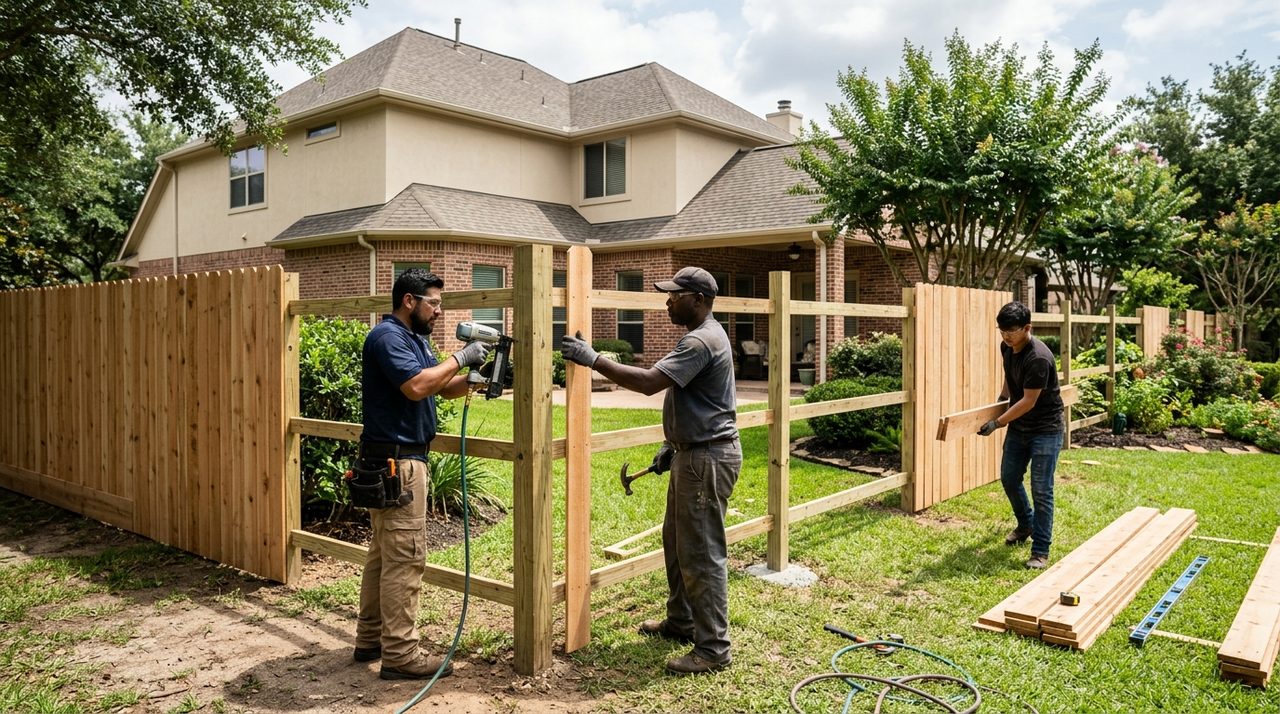
Stafford's patchwork of 1970s–1990s slab-on-grade subdivisions, each with its own HOA deed restrictions and the City of Stafford's independent permitting office, makes fence work here more layered than in unincorporated parts of the metro. The expansive Beaumont clay underneath most of these lots has been heaving and contracting for 30–50 years, and older cedar fences installed on original post-and-concrete footings often show the evidence. Whether you're replacing storm-damaged boards after Beryl 2024 or putting up a first fence on a 1985 ranch home lot, this page cuts through what actually applies in Stafford.
Ranked by verified Google rating × review volume × verification tier. How we rank →
Some highly-rated pros serve Stafford from nearby and may not keep a Stafford street address. Those are listed under "Also serving Stafford" with their real city and distance, so you always know where each business is based.
13004 Murphy Rd #222, Stafford, TX 77477
2719 5th St Suite E, Stafford, TX 77477
12747 Antonia St, Stafford, TX 77477
2503 S Main St B, Stafford, TX 77477
435 B1 FM1092, Stafford, TX 77477
926 Robinwood Dr, Stafford, TX 77477
12930 Sugar Ridge Blvd, Stafford, TX 77477
Highly-rated pros based nearby who cover Stafford. Distance shown from the Stafford area.
Serving Stafford Based in Missouri City · 1.9 mi away
Serving Stafford Based in Missouri City · 3.3 mi away
Serving Stafford Based in Alief · 4.1 mi away
Why it matters to you
The Beaumont/Houston Black clay under virtually every slab-on-grade home in Stafford — most built between 1970 and 1999 — shrinks and swells dramatically between dry summers and wet Gulf-season rain events. Standard concrete footings poured back when these subdivisions were first built often sit only 18–24 inches deep, and decades of clay cycling have caused fence posts throughout the city to heave, tilt, and crack at the footing collar. If your fence looks like it's leaning outward on sunny days and partly corrects itself after heavy rain, clay movement is almost certainly the cause, not just age.
What a good pro does
A knowledgeable fence pro working in Stafford will set replacement posts deeper than standard Houston practice — typically 30 inches or more — and use a tube-form concrete pour that limits direct soil-to-concrete contact at the frost/moisture zone. On badly heaved corner posts under line tension, the footing itself must often be broken out and fully replaced rather than shimmed. Expect post replacement alone to run roughly $150–$300 per post including concrete as an estimate; reusing a cracked footing shell is a false economy on Stafford clay.
Sources: International Residential Code (as adopted by City of Houston)
Why it matters to you
Stafford sits in the SW Houston corridor that took repeated wind damage from the May 2024 derecho and Hurricane Beryl in July 2024 — events that destroyed 6-foot board-on-board privacy panels across Fort Bend County neighborhoods in a matter of hours. The problem is compounded by aging cedar that has spent 20–30 years on Stafford lots: wood that has rotted at the ground line or dried out at the picket tops offers almost no wind resistance. Homeowners with original fencing from 1980s or 1990s production-builder installs are working with lumber that was never designed to outlast multiple major Houston wind events.
What a good pro does
Wind-resilient installation for Stafford's exposure means 4x4 pressure-treated posts embedded at least 1/3 of their total length in concrete, pickets fastened with ring-shank or screw-type nails rather than smooth box nails, and ideally a small gap between pickets or a shadowbox layout to allow wind relief. For full replacements after storm damage, get a written materials spec before signing — 'cedar board-on-board' can mean very different things in terms of lumber grade, post size, and fastener type. Estimated cost for full storm-damage replacement on a typical Stafford suburban lot runs $3,000–$8,000 depending on total linear footage.
Sources: Texas Windstorm Insurance Association (TWIA), International Residential Code (as adopted by City of Houston)
Why it matters to you
Stafford is an independent incorporated city with its own building department and permitting process, completely separate from the City of Houston and from Fort Bend County. Homeowners who assume Houston's permit rules apply — or who hire a contractor who does the same — can end up with unpermitted work subject to code enforcement or forced removal. The City of Stafford requires permits for fences exceeding certain height thresholds, and inspection schedules are run on Stafford's own calendar, not coordinated with any surrounding jurisdiction.
What a good pro does
Before any fence post goes in the ground, your contractor should pull the applicable permit through the City of Stafford Permits Department and confirm current height limits and setback requirements directly with that office, since local fence ordinances can be updated independently of state codes. This is a brief step that prevents costly forced-removal situations — Stafford's code enforcement does respond to neighbor complaints on unpermitted exterior work. Texas has no state licensing requirement for fence installers, so permit compliance is genuinely the primary accountability mechanism available to Stafford homeowners.
Sources: Municipal permit office (see area profile), City of Houston Permitting Center
Why it matters to you
There is no city-wide HOA in Stafford, but many of the individual subdivisions platted across the city — including active associations like Grove West Community Association, Inc. — have recorded deed restrictions that mandate specific fence materials, heights, colors, and sometimes even which face of the boards must be visible from the street. These restrictions are legally binding and enforced independently of city permits. A fence that passes a Stafford building inspection can still be ordered removed or altered by an architectural review committee if it violates the subdivision's deed covenants, and with Stafford's housing stock spanning from 1970s builds to 2010s production homes, the restrictions vary significantly from one street to the next.
What a good pro does
Before signing any fence contract, confirm your specific property's deed restrictions through Fort Bend County Clerk records or your subdivision's HOA management company — do not rely on what a neighbor's fence looks like, since HOA enforcement is inconsistent and a prior non-compliant installation is not legal precedent. HOA architectural approval is a separate and independent requirement from the City of Stafford building permit; both must be obtained before work begins. Your fence contractor should ask for your HOA contact and current ARC guidelines as part of the initial site visit, not as an afterthought.
Sources: Local HOA / deed restrictions (see area profile), Municipal permit office (see area profile)
Hiring fence builders in Stafford? Stafford is an incorporated city in Fort Bend County composed of many individual subdivisions, each with its own HOA rules, deed restrictions, and housing characteristics. The housing stock spans from 1970s ranch homes to 2010s production builds, predominantly slab-on-grade construction on expansive clay soils. Homeowners should verify their specific subdivision's HOA requirements and flood status before scoping any exterior or structural project.
Building era
1970s–1990s (bulk of existing stock), with newer infill and subdivisions from the 2000s–2010s.
Typical style
One- and two-story brick veneer ranch homes, traditional and neo-eclectic production builder homes, with some townhomes and garden homes in newer phases.
Foundations
Slab-on-grade (overwhelmingly standard for the era and region; pier-and-beam limited to rare older or custom structures).
Common systems
Central AC with gas furnace; copper or CPVC supply plumbing in older homes transitioning to PEX in newer builds; 1970s–1980s homes may have original galvanized drain lines; electrical panels range from 100-amp in older homes to 200-amp in newer construction.
What that means for repairs
Kitchen and bathroom remodels are common in the 1970s–1990s stock as homeowners update finishes and fixtures. Foundation repair due to expansive clay soil movement is a recurring need. HVAC system replacements are frequent in pre-2000 homes reaching end of equipment life.
Permit jurisdiction
City of Stafford Permits Department (Stafford is an incorporated city with its own permitting authority).
HOA & deed restrictions
No city-wide HOA exists. Many individual subdivisions have mandatory HOAs/POAs (e.g., Grove West Community Association, Inc.) that enforce deed restrictions and architectural standards. Some properties may have no HOA or minimal deed restrictions. Must be confirmed per property via deed records and Fort Bend County Clerk.
Historic districts
No historic district designation confirmed for any area within Stafford.
Contractor note
Contractors must pull permits through the City of Stafford, not Harris County or the City of Houston. Subdivision-level HOA architectural review committees may require pre-approval for exterior modifications, so contractors should confirm HOA requirements before beginning work.
FEMA flood zone
FEMA Zone X (low flood risk) per official NFHL data. While the broader Fort Bend County area includes Brazos River floodplain zones, the Stafford city center area generally falls outside high-risk flood designations. Property-level verification via FEMA FIRM panels and Fort Bend County floodplain GIS is recommended.
Hurricane Harvey impact
Stafford was not identified as one of the hardest-hit cities during Hurricane Harvey (2017). While Fort Bend County experienced substantial flooding along the Brazos River, the worst-documented impacts were south and southwest of Stafford in Missouri City, Sugar Land, and Richmond/Rosenberg. Specific Stafford streets or subdivisions with repetitive flood losses could not be confirmed from available public records. Buyers and contractors should still check NFIP claims history and seller flood disclosures for individual properties.
Heat & humidity load
Extended Houston-area heat and humidity stress HVAC systems in the aging 1970s–1990s housing stock, making seasonal tune-ups and refrigerant checks essential. Slab foundations on expansive clay soils are vulnerable to differential movement during summer drought cycles, requiring homeowners to maintain consistent watering around foundations. Attic temperatures in single-story ranch homes can exceed 150°F, accelerating roof underlayment and radiant barrier degradation.
Working with contractors here
Foundation monitoring and repair is among the most common contractor engagements in Stafford due to the expansive clay soils and the age of the 1970s–1990s slab-on-grade housing stock. HVAC replacement is a high-demand service as original equipment in older homes reaches 20–30 years of age. Whole-home repiping is increasingly needed in pre-1990s homes with galvanized drain lines or deteriorating copper supply lines. Contractors should note that Stafford is an independent city with its own permitting process, inspection schedules, and code enforcement — not governed by the City of Houston or Fort Bend County for permitting purposes. Job scoping for exterior work must account for subdivision-level HOA architectural standards, which vary significantly across the city.
Local Tip
Always ask for a written estimate before work begins. Texas contractors are required to provide one on jobs over $1,000.
Stafford is an incorporated city in Fort Bend County composed of many individual subdivisions, each with its own HOA rules, deed restrictions, and housing characteristics. The housing stock spans from 1970s ranch homes to 2010s production builds, predominantly slab-on-grade construction on expansive clay soils. Homeowners should verify their specific subdivision's HOA requirements and flood status before scoping any exterior or structural project.
Source: U.S. Census Bureau, ACS 5-Year 2023
Most of Stafford maps to FEMA Zone X (low mapped flood risk), but Houston's flash-flood reality means even low-risk blocks benefit from smart drainage and storm-hardened installs.
Source: FEMA National Flood Hazard Layer (NFHL). Flood zones vary by parcel — verify your individual FIRM panel.
Sources: Municipal permit office (see area profile)
Sources: Local HOA / deed restrictions (see area profile)
Sources: FEMA National Flood Hazard Layer (NFHL)Harris County Flood Control District
Sources: Municipal permit office (see area profile)
Sources: Municipal permit office (see area profile)Local HOA / deed restrictions (see area profile)