Closed
12018 Louetta Rd, Houston, TX 77070
Champions Forest's mid-1970s through late-1980s slab-on-grade homes sit on Harris County's expansive Beaumont clay, and decades of wet-dry cycling — punctuated by Hurricane Harvey's multi-day inundation in 2017 and Hurricane Beryl's renewed saturation in 2024 — have stressed foundations that were already approaching 40–50 years of age. Add cast-iron under-slab drain lines from that era, Cypress Creek's FEMA AE flood zone designation, and Harris County Engineering permit requirements (not City of Houston), and foundation repair here involves more moving parts than in younger subdivisions. This page breaks down exactly which soil, flood, plumbing, and HOA factors drive the most costly mistakes for Champions Forest homeowners.
Ranked by verified Google rating × review volume × verification tier. How we rank →
Some highly-rated pros serve Champions Forest from nearby and may not keep a Champions Forest street address. Those are listed under "Also serving Champions Forest" with their real city and distance, so you always know where each business is based.
12018 Louetta Rd, Houston, TX 77070
16727 Mackenzie Mesa Dr, Spring, TX 77379
15602 Cypress Gdns Dr, Houston, TX 77069
15815 Champion Forest Dr #184, Spring, TX 77379
Highly-rated pros based nearby who cover Champions Forest. Distance shown from the Champions Forest area.
Serving Champions Forest Based in Jersey Village · 2.8 mi away
Serving Champions Forest Based in Tomball · 3.8 mi away
Serving Champions Forest Based in Tomball · 4.4 mi away
Serving Champions Forest Based in NW Houston · 5 mi away
Serving Champions Forest Based in Tomball · 5.1 mi away
Why it matters to you
Champions Forest homes built in the late 1970s and 1980s have endured multiple full drought-flood cycles on Harris County's Beaumont clay. The 2022–2023 La Niña drought baked perimeter soils away from slab edges; when Harvey (2017) and Beryl (2024) arrived, water rushed into those voids rather than soaking in gradually, directly undermining the exterior beam. Homes in the AE flood zone near Cypress Creek saw prolonged standing water that reconsolidated already-stressed clay, causing post-event settlement sometimes weeks after water receded — a pattern that repeats with each major storm.
What a good pro does
A qualified contractor should probe perimeter void depth with a moisture meter and manual inspection before proposing any repair method. For homes with confirmed AE flood zone designations, the contractor should also review FEMA floodplain development permit requirements with Harris County Engineering before trenching the perimeter, since exterior grade changes in a floodplain can require additional review. Soaker-hose irrigation along the foundation perimeter during future dry seasons is the most cost-effective prevention after repairs are complete.
Sources: FEMA National Flood Hazard Layer (NFHL), Harris County Flood Control District
Why it matters to you
Virtually every Champions Forest home built before 1990 was plumbed with cast-iron under-slab drain lines — and Winter Storm Uri in February 2021 froze and cracked thousands of them across northwest Harris County. Many homeowners had walls and floors patched but never addressed the under-slab pipe. Three-plus years later, slow leaks from these cracked lines are saturating the clay directly beneath the slab, creating localized heave on one side and settlement on another in a pattern that mimics simple soil movement. Misdiagnosis leads to pier work that doesn't solve the actual problem.
What a good pro does
Before signing any foundation repair contract on a pre-1990 Champions Forest home, insist on a hydrostatic plumbing test — it costs an estimated $250–$400 and confirms whether under-slab drain lines are holding pressure. If a leak is found, a plumber licensed through the Texas State Board of Plumbing Examiners must perform or oversee the under-slab repair; this is a separate Harris County permit scope from the foundation work itself. Only after confirmed plumbing integrity should pier placement and counts be finalized.
Sources: Texas State Board of Plumbing Examiners, Municipal permit office (see area profile)
Why it matters to you
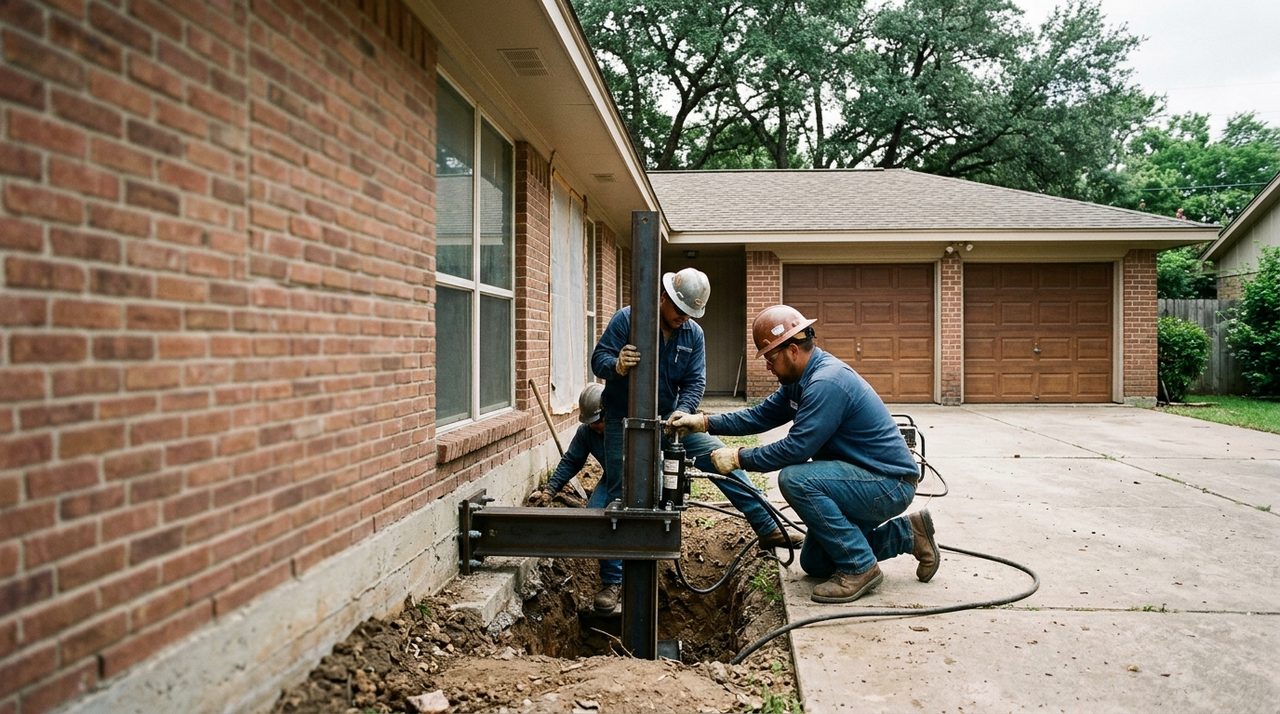
Champions Forest's original 1970s–80s construction era coincides precisely with the peak of pressed concrete piling use in Houston. If your home has had prior foundation work, there is a real possibility that 10–30 pressed pilings are already under the slab — and pressed pilings installed on Harris County's heavy clay have a documented history of punching through soft soil and losing bearing over time. Receiving two wildly different proposals — one recommending 12 steel push piers and another recommending 22 pressed pilings — is common here, and contractor preference rather than soil analysis often explains the gap.
What a good pro does
Ask each contractor whether existing pilings are visible at the perimeter and request a written explanation of why they are recommending their chosen method given the soil conditions on your specific lot. Steel push piers driven to bedrock or dense load-bearing strata are generally more reliable on Beaumont clay than new pressed pilings. Harris County Engineering requires a permit for structural underpinning work; confirm the contractor will pull that permit and schedule the required inspections through Harris County — not through the City of Houston, which has no jurisdiction here.
Sources: Municipal permit office (see area profile), International Residential Code (as adopted by City of Houston)
Why it matters to you
Champions Forest is governed by multiple mandatory property owners associations — Champion Forest Fund, Inc. for Sections 1–10, plus section-specific HOAs for Sections 11, 12, and Villas — each with an Architectural Control Committee that must approve visible exterior work. Foundation repair almost always requires perimeter trenching, which disturbs landscaping and the visible slab edge. Starting work without ACC approval can result in a stop-work notice, required restoration of landscaping at your expense, and delayed resale disclosure complications, since Texas TREC forms require disclosure of known foundation movement and repairs.
What a good pro does
Before scheduling a repair crew, submit your contractor's written scope and pier placement diagram to the applicable section's ACC and build a two-to-four-week approval window into your project timeline. The contractor should document the approved scope, Harris County permit number, and repair completion in writing — this paperwork protects you on the TREC seller's disclosure form and prevents disputes if a buyer's inspector flags perimeter evidence of prior work. Confirm with Harris County Engineering whether your lot's AE flood zone status triggers any additional floodplain development permit requirements before the ACC submission.
Sources: Local HOA / deed restrictions (see area profile), FEMA National Flood Hazard Layer (NFHL), Municipal permit office (see area profile)
Hiring foundation repair in Champions Forest? Champions Forest is a large, multi-section subdivision in the Klein ISD area of northwest Harris County, built primarily from the mid-1970s through the late 1980s. Homeowners here deal with aging slab-on-grade foundations, original-era HVAC and plumbing systems that are reaching or past their expected lifespan, and FEMA AE flood zone designations that affect insurance requirements and exterior renovation planning. Multiple mandatory HOAs with architectural control committees govern exterior modifications, so contractors must factor in ACC approval timelines.
Building era
Primarily mid-1970s through late 1980s, with some later sections extending into the early 1990s.
Typical style
Traditional brick two-story homes with Colonial and Georgian influences; some single-story ranch-style homes and occasional Tudor and French traditional elevations.
Foundations
Slab-on-grade (regional inference for 1970s–1980s production homes in NW Harris County; confirm via HCAD or individual inspection).
Common systems
Original homes likely have R-22 refrigerant HVAC systems nearing or past replacement age, copper or galvanized steel supply plumbing transitioning to PEX in renovated homes, and 100–200 amp electrical panels that may need upgrading for modern loads.
What that means for repairs
Kitchen and bathroom remodels are common as homes from this era are updated to modern standards. HVAC full-system replacements are frequent due to age. Foundation repair and re-leveling are periodic needs given expansive clay soils and slab-on-grade construction. Post-Harvey flood damage repairs drove significant interior renovation activity in affected sections.
Permit jurisdiction
Harris County Engineering (unincorporated Harris County, Klein area — not within City of Houston limits).
HOA & deed restrictions
Mandatory property owners associations govern all sections. Sections 1–10 are governed by Champion Forest Fund, Inc. (Champion Forest HOA). Additional mandatory HOAs include Champion Forest Eleven HOA (161 lots), Champion Forest Twelve Homeowners Association Inc., and Champion Forest Villas HOA. All require Architectural Control Committee (ACC) approval for exterior modifications.
Historic districts
No City of Houston historic district designation confirmed.
Contractor note
Contractors must obtain Harris County permits for structural, mechanical, and electrical work and should coordinate ACC approval from the applicable section's HOA before beginning any exterior modifications. Work in the FEMA AE flood zone may require elevation certificates and floodplain development permits.
FEMA flood zone
FEMA Zone AE (high flood risk) — source: fema_nfhl. Champions Forest is situated in northwest Harris County near Cypress Creek, a major drainage corridor that has historically been associated with significant flooding events.
Hurricane Harvey impact
No official neighborhood-wide flood impact summary was found in available HOA or public records. Areas near Cypress Creek in northwest Harris County experienced significant Harvey flooding and subsequent buyout activity, but specific street-level impact within Champions Forest is not clearly documented in available sources. Homeowners should check Harris County Flood Control District records and individual property flood history for confirmation.
Heat & humidity load
Homes from the 1970s–80s with original insulation and single-pane windows face high cooling costs during Houston summers. Aging HVAC systems are under maximum stress from May through September, making this the peak period for emergency AC repair calls. Humidity management is critical to prevent mold in homes that experienced prior flooding or have insufficient attic ventilation.
Working with contractors here
Contractors working in Champions Forest most commonly handle HVAC replacements, foundation leveling, and plumbing re-pipes — all driven by the 40–50-year age of the housing stock. Kitchen and bath remodels are a strong secondary market as homeowners modernize dated interiors. Flood mitigation work, including elevated electrical panels, moisture barriers, and drainage improvements, is relevant given the AE flood zone designation. All exterior work requires ACC approval from the applicable section's HOA (Champion Forest Fund for Sections 1–10, or the respective section HOA), so contractors should build approval lead time into project schedules. Harris County permitting applies rather than City of Houston permits, which affects inspection scheduling and code requirements.
Local Tip
Always ask for a written estimate before work begins. Texas contractors are required to provide one on jobs over $1,000.
Champions Forest is a large, multi-section subdivision in the Klein ISD area of northwest Harris County, built primarily from the mid-1970s through the late 1980s. Homeowners here deal with aging slab-on-grade foundations, original-era HVAC and plumbing systems that are reaching or past their expected lifespan, and FEMA AE flood zone designations that affect insurance requirements and exterior renovation planning. Multiple mandatory HOAs with architectural control committees govern exterior modifications, so contractors must factor in ACC approval timelines.
Source: U.S. Census Bureau, ACS 5-Year 2023
Much of Champions Forest maps to FEMA Zone AE (high flood risk), so flood-resilient detailing -- elevated equipment, water-tolerant materials, and drainage-first thinking -- is essential here, not optional.
Source: FEMA National Flood Hazard Layer (NFHL). Flood zones vary by parcel — verify your individual FIRM panel.
Harvey 2017 demonstrated that prolonged inundation in high-floodplain areas like Champions Forest causes Houston's expansive clay soils to swell unevenly beneath slabs, so scheduling a post-storm elevation survey before re-occupying your home is essential. A TDLR-licensed foundation contractor can document differential movement with a Zip-Level survey and determine whether interior piers or pressed pilings need re-driving after FEMA Zone AE inside the 100-year floodplain subsides. Confirm the current FEMA panel for your Champions Forest parcel — the area maps to Zone AE, but adjacent lots can differ.
Heavy rainfall from a single Houston thunderstorm cell can deposit four to six inches in under an hour, and in Champions Forest that runoff can temporarily surround your slab and trigger localized clay heave that later reverses as soil dries. Have a foundation repair contractor assess your perimeter drain system and confirm downspout extensions are intact and unblocked after each significant storm season. In-city Champions Forest work falls under City of Houston floodplain and permitting rules.
Ice accumulation on a roof during an event like Uri adds significant live load to your structure, and that compressive force transfers to your foundation piers and slab corners — in Champions Forest where subgrade soils are near saturation, the bearing capacity margin is already reduced. After any ice-loading event, check for new diagonal cracks at door corners and schedule an elevation survey if more than one new crack appears. In-city Champions Forest work falls under City of Houston floodplain and permitting rules.
Sources: FEMA National Flood Hazard Layer (NFHL), Ready.gov -- Hurricanes, CenterPoint Energy -- Storm Center, City of Houston -- Emergency Preparedness, Ready.gov -- Winter Weather, Harris County Flood Control District
Houston-specific estimators to plan your project before you call a pro. All results are planning estimates — a licensed local pro confirms the details on site.
Grouped by mature root aggression & water demand.
Trunk center to the nearest exterior wall.
The root zone likely reaches your foundation's soil during Houston's dry summers, when clay shrinks most. Watch for sticking doors and diagonal cracks, keep soil moisture even with a soaker hose during drought, and have a foundation pro evaluate if you see any movement.
Find a Houston foundation pro →This is a planning estimate only — actual requirements depend on an on-site assessment by a licensed Houston pro. Guidance is based on general species root behavior in expansive clay, not a soil test.
Disconnect & drain every outdoor hose bib
Remove hoses, drain the spigots, and cover each with an insulated faucet sock. Un-drained hose bibs are the #1 burst point in a Houston freeze.
Insulate exposed pipes in the attic & garage
Wrap any pipe in an unconditioned space (attic runs, garage walls) with foam sleeves. Houston homes rarely insulate these because they only matter a few nights a year — which is exactly why they burst.
Open cabinet doors & keep a pencil-width drip
On hard-freeze nights, open kitchen/bath cabinets so warm air reaches the pipes and let faucets on exterior walls drip to relieve pressure.
Protect the attic/garage water heater & its lines
An attic or garage tank sits in unconditioned space. Insulate the cold-inlet and hot-outlet lines and confirm the emergency drain pan is clear so a leak doesn't reach the ceiling.
This is a planning estimate only — actual requirements depend on an on-site assessment by a licensed Houston pro. If a pipe has already burst, shut off your main water supply and call a licensed Houston plumber immediately — freeze bursts flood fast.
Sources: Municipal permit office (see area profile)
Sources: Local HOA / deed restrictions (see area profile)