Open Now
409 This Way, Lake Jackson, TX 77566
Lake Jackson sits on Brazoria County's Gulf Coastal Plain, where Beaumont and Houston Black clay soils underlie the slab-on-grade homes built from the 1940s through the 1980s to house Dow Chemical workers and their families — a housing stock with a Census median year built of 1983 and a median value of $248,900. That clay shrinks and swells with every wet-dry cycle, and because Lake Jackson is an independent incorporated city, any underpinning or structural repair requires a permit through the City of Lake Jackson's own permitting office, not Houston's Development Services Department or Brazoria County. If you are seeing stair-step cracks in brick, sticky interior doors, or gaps at your slab perimeter, this page explains exactly what is driving the movement and what Lake Jackson homeowners specifically need to ask for.
Ranked by verified Google rating × review volume × verification tier. How we rank →
Some highly-rated pros serve Lake Jackson from nearby and may not keep a Lake Jackson street address. Those are listed under "Also serving Lake Jackson" with their real city and distance, so you always know where each business is based.
409 This Way, Lake Jackson, TX 77566
Highly-rated pros based nearby who cover Lake Jackson. Distance shown from the Lake Jackson area.
Serving Lake Jackson Based in Clute · 1.5 mi away
Serving Lake Jackson Based in Angleton · 4.7 mi away
Serving Lake Jackson Based in Clute · 5.1 mi away
Serving Lake Jackson Based in Clute · 5.2 mi away
Serving Lake Jackson Based in Clute · 5.5 mi away
Serving Lake Jackson Based in Angleton · 7.3 mi away
Why it matters to you
The Beaumont clay formation that underlies most of Lake Jackson is among the most expansive in the Gulf Coast region, swelling when Gulf moisture arrives and shrinking hard during dry spells and La Niña drought years like 2022–2023. For homes built in the Dow-era neighborhoods from the 1950s through the 1980s — the bulk of Lake Jackson's Census median 1983 housing stock — decades of repeated wet-dry cycles gradually widen the differential movement between the slab's interior and its perimeter beam, producing the classic pattern of diagonal drywall cracks at door corners and brick veneer gaps that Lake Jackson homeowners often first notice in late summer.
What a good pro does
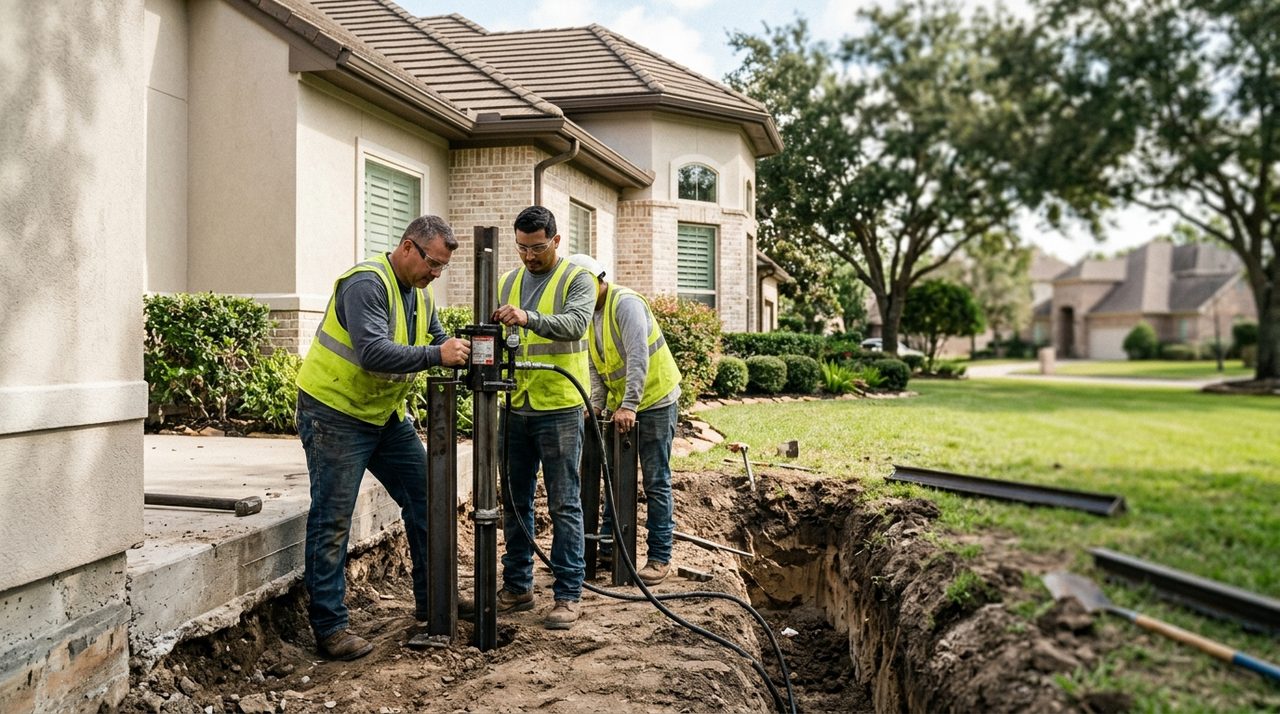
A qualified foundation contractor should probe the perimeter for voids with a moisture meter and visual inspection before recommending any repair method, and then distinguish active movement from stabilized historical cracking. For homes showing active differential settlement, steel push piers driven to a stable bearing stratum are generally more reliable on Brazoria County clay than the pressed concrete pilings common in Lake Jackson's older repairs from the 1980s and 1990s — push pier jobs here typically run $10,000–$25,000 (est.) for 8–16 piers at $1,200–$1,800 each. The contractor must pull a structural or building permit through the City of Lake Jackson's permitting office before work begins.
Sources: Municipal permit office (see area profile), International Residential Code (as adopted by City of Houston)
Why it matters to you
Lake Jackson's subtropical climate cycles between high-rainfall tropical events and multi-month dry stretches, and many of the city's post-1980 subdivisions were built with in-ground spray irrigation systems sized for lawn coverage rather than foundation perimeter soaking. When those systems underwater the 18–24 inches of soil directly against the slab beam — as is typical during Stage 2 or Stage 3 Brazoria County outdoor watering restrictions — the clay pulls away from the edge and creates a void that loses bearing support. The problem is especially pronounced on lots with minimal shade canopy, which are common in Lake Jackson's newer subdivisions where mature tree cover has not yet established.
What a good pro does
The single most cost-effective intervention before any pier work is installing a drip or soaker hose loop six to twelve inches from the foundation edge and running it on a timer during dry months to maintain even soil moisture. A foundation pro assessing a Lake Jackson home should document whether differential settlement is concentrated on the south or west (sun-exposed) side of the slab — a strong indicator of perimeter void rather than uniform soil subsidence, which changes the repair approach. Mudjacking to fill existing voids costs $800–$2,500 per section (est.) and can stabilize minor perimeter drop without full underpinning if movement is caught early.
Sources: International Residential Code (as adopted by City of Houston), Municipal permit office (see area profile)
Why it matters to you
Winter Storm Uri in February 2021 cracked cast-iron and PVC under-slab drain lines across the Houston metro, and Lake Jackson's pre-1990 Dow-era neighborhoods — with homes built on slab-on-grade before modern PVC became standard — saw a significant share of those failures. Many homeowners repaired visible interior damage but left cracked under-slab pipes in place, and slow ongoing leaks from those lines have been saturating the clay directly beneath the slab for three-plus years since. Localized heave followed by settlement as soil structure breaks down is the signature pattern, and it can mimic the appearance of routine clay shrink-swell while actually being a plumbing-driven problem that no amount of pier work will permanently resolve.
What a good pro does
Before signing any foundation repair contract for a Lake Jackson home built before 1990, insist on a hydrostatic plumbing test — a licensed plumber caps the drain system and pressurizes it to identify drops — which costs $250–$400 (est.) and must be performed by a plumber licensed by the Texas State Board of Plumbing Examiners (TSBPE). If the test reveals active under-slab leaks, re-routing the lines through the walls or tunneling under the slab to repair them must happen before piers are set, otherwise the new piers will be working against an actively changing soil moisture environment. The City of Lake Jackson requires its own plumbing permit for under-slab work, separate from any structural foundation permit.
Sources: Texas State Board of Plumbing Examiners, Municipal permit office (see area profile), International Residential Code (as adopted by City of Houston)
Why it matters to you
Because Lake Jackson is an independent incorporated city in Brazoria County, foundation underpinning permits are issued through the City of Lake Jackson's own Planning and Permitting office — not through the City of Houston's Development Services Department and not through Brazoria County. Contractors who regularly work in the broader Houston metro may default to pulling permits through the wrong jurisdiction or, worse, skip permits entirely, leaving the homeowner liable for unpermitted structural work that will surface on a TREC disclosure form at resale. Additionally, Lake Jackson's subdivision landscape includes a mix of mandatory HOAs managed by firms like Graham Management and Spectrum Association Management, deed-restriction-only neighborhoods, and unrestricted lots — and some of those HOAs require written architectural approval before any exterior trenching or perimeter work begins.
What a good pro does
Before any contract is signed, verify the contractor's permit history directly with the City of Lake Jackson permitting office and confirm whether your specific subdivision has an active HOA or deed restriction that covers exterior foundation work — pull that information from Brazoria County deed records or the TREC HOA Management Certificate database, not just the contractor's assurance. Get three written proposals with explicit pier counts, pier depths, and the specific permit number once issued, and confirm that the City of Lake Jackson inspection schedule aligns with the contractor's proposed work sequence so inspections are not skipped during the repair. Texas does not issue a standalone state license for foundation repair contractors, so insurance verification — general liability and workers' compensation — and permit compliance are the primary quality controls available to Lake Jackson homeowners.
Sources: Municipal permit office (see area profile), Local HOA / deed restrictions (see area profile), Texas Department of Licensing & Regulation
Hiring foundation repair in Lake Jackson? Lake Jackson is an incorporated city in Brazoria County, originally developed as a residential community for the Dow Chemical complex. Homeowners here deal with city-level permitting rather than Houston or county jurisdiction, and HOA requirements vary widely by subdivision. The housing stock spans several decades, and Gulf Coast climate conditions drive ongoing maintenance needs for roofing, HVAC, and moisture management.
Building era
Mid-20th century onward; specific dominant decade not confirmed in available records.
Typical style
Not confirmed - no authoritative city-wide architectural style survey available; likely a mix of ranch, traditional, and newer construction.
Foundations
Likely predominantly slab-on-grade consistent with Gulf Coast construction practices, but not confirmed by Lake Jackson-specific documentation.
Common systems
Expect a range of HVAC systems from older central units to modern high-efficiency systems; older homes may have galvanized or copper plumbing; electrical panels in mid-century homes may need updating.
What that means for repairs
Older mid-century homes near the original Dow-era neighborhoods are candidates for electrical panel upgrades, plumbing replacement, and HVAC modernization. Kitchen and bathroom remodels are common as homeowners update aging interiors.
Permit jurisdiction
City of Lake Jackson Permitting (independent incorporated city with its own Planning Commission and development review process).
HOA & deed restrictions
No single city-wide mandatory HOA. Some subdivisions have mandatory HOAs/POAs managed by firms such as Graham Management and Spectrum Association Management, while other properties have only deed restrictions or no formal association. Confirm HOA status through Brazoria County deed records and TREC HOA Management Certificate database for any specific property.
Historic districts
No City of Houston historic district designation applies; Lake Jackson is a separate incorporated city. No local historic district designation confirmed in available research.
Contractor note
Contractors must obtain permits through the City of Lake Jackson, not the City of Houston or Brazoria County. Verify subdivision-specific deed restrictions before beginning exterior modifications, as enforcement varies by neighborhood.
FEMA flood zone
FEMA Zone X (low flood risk) per official NFHL data. Brazoria County experienced significant Harvey-era flooding along the Brazos River and low-lying areas; site-specific flood risk should still be evaluated using Brazoria County FIRMs and city floodplain maps.
Hurricane Harvey impact
Brazoria County experienced significant flooding during Hurricane Harvey, particularly along the Brazos River corridor. However, no publicly available source was found that itemizes specific Lake Jackson neighborhoods or streets that flooded. Property-level Harvey impact should be verified through seller's disclosure, insurance claim history, and Brazoria County flood records.
Heat & humidity load
Extreme Gulf Coast heat and humidity place heavy demands on HVAC systems and increase risk of moisture intrusion, mold, and wood rot. Older homes without modern vapor barriers or adequate attic ventilation are especially vulnerable. Roof inspections and HVAC maintenance are critical before each summer season.
Working with contractors here
Contractors in Lake Jackson most commonly work on HVAC replacement and maintenance due to the demanding Gulf Coast climate and aging systems in mid-century homes. Plumbing repairs and re-pipes are frequent in older subdivisions where original galvanized lines have deteriorated. Roofing work is steady, driven by hurricane season exposure and general weathering. Because Lake Jackson is an independent city, contractors must navigate its own permitting process, which differs from both Houston and unincorporated Brazoria County procedures. Job scoping should always include verification of HOA or deed restriction requirements, as these vary significantly between subdivisions.
Local Tip
Always ask for a written estimate before work begins. Texas contractors are required to provide one on jobs over $1,000.
Lake Jackson is an incorporated city in Brazoria County, originally developed as a residential community for the Dow Chemical complex. Homeowners here deal with city-level permitting rather than Houston or county jurisdiction, and HOA requirements vary widely by subdivision. The housing stock spans several decades, and Gulf Coast climate conditions drive ongoing maintenance needs for roofing, HVAC, and moisture management.
Source: U.S. Census Bureau, ACS 5-Year 2023
Most of Lake Jackson maps to FEMA Zone X (low mapped flood risk), but Houston's flash-flood reality means even low-risk blocks benefit from smart drainage and storm-hardened installs; as a Brazoria County coastal community, tropical surge and wind add a layer generic guidance misses.
Source: FEMA National Flood Hazard Layer (NFHL). Flood zones vary by parcel — verify your individual FIRM panel.
Houston's flash-flood reality means even low-mapped-risk areas like Lake Jackson, TX can see sheet flow accumulate against a foundation during a slow-moving Gulf system, so verify that your perimeter drainage is clear and properly sloped before hurricane season opens. A TDLR-licensed foundation contractor can add or reposition surface drains to intercept runoff before it softens the clay bearing layer beneath your slab. As a Brazoria County community, Lake Jackson may follow county rather than City of Houston storm rebuild rules.
Even with low mapped flood risk, Lake Jackson, TX is not immune to the localized sheet flow that accompanies a Houston severe thunderstorm, and repeated minor inundation at the foundation perimeter sustains the clay moisture that drives slow heave cycles. A pre-storm season inspection confirming that soil grade, splash blocks, and downspout extensions all direct water away from the slab is the most cost-effective foundation repair step you can take. Confirm the current FEMA panel for your Lake Jackson parcel — the area maps to Zone X, but adjacent lots can differ.
Ice loading from roof accumulation during a hard freeze transfers compressive stress to your foundation corners, and in Lake Jackson, TX that added load on clay subgrade that has stiffened from cold can create corner settlement that persists after the thaw. A TDLR-licensed foundation contractor should inspect visible brick-to-foundation transitions and interior door frames after any multi-day freeze event, even if no pipe damage occurred. With a median build year of 1983, the older building stock here is more exposed to hard-freeze damage than newer construction. As a Brazoria County community, Lake Jackson may follow county rather than City of Houston storm rebuild rules.
Sources: FEMA National Flood Hazard Layer (NFHL), Ready.gov -- Hurricanes, CenterPoint Energy -- Storm Center, City of Houston -- Emergency Preparedness, Ready.gov -- Winter Weather, Harris County Flood Control District
Houston-specific estimators to plan your project before you call a pro. All results are planning estimates — a licensed local pro confirms the details on site.
Grouped by mature root aggression & water demand.
Trunk center to the nearest exterior wall.
The root zone likely reaches your foundation's soil during Houston's dry summers, when clay shrinks most. Watch for sticking doors and diagonal cracks, keep soil moisture even with a soaker hose during drought, and have a foundation pro evaluate if you see any movement.
Find a Houston foundation pro →This is a planning estimate only — actual requirements depend on an on-site assessment by a licensed Houston pro. Guidance is based on general species root behavior in expansive clay, not a soil test.
Disconnect & drain every outdoor hose bib
Remove hoses, drain the spigots, and cover each with an insulated faucet sock. Un-drained hose bibs are the #1 burst point in a Houston freeze.
Insulate exposed pipes in the attic & garage
Wrap any pipe in an unconditioned space (attic runs, garage walls) with foam sleeves. Houston homes rarely insulate these because they only matter a few nights a year — which is exactly why they burst.
Open cabinet doors & keep a pencil-width drip
On hard-freeze nights, open kitchen/bath cabinets so warm air reaches the pipes and let faucets on exterior walls drip to relieve pressure.
Protect the attic/garage water heater & its lines
An attic or garage tank sits in unconditioned space. Insulate the cold-inlet and hot-outlet lines and confirm the emergency drain pan is clear so a leak doesn't reach the ceiling.
This is a planning estimate only — actual requirements depend on an on-site assessment by a licensed Houston pro. If a pipe has already burst, shut off your main water supply and call a licensed Houston plumber immediately — freeze bursts flood fast.
Sources: Municipal permit office (see area profile)
Sources: Local HOA / deed restrictions (see area profile)Municipal permit office (see area profile)
Sources: Municipal permit office (see area profile)