Closed
7103 Peerless St, Houston, TX 77021
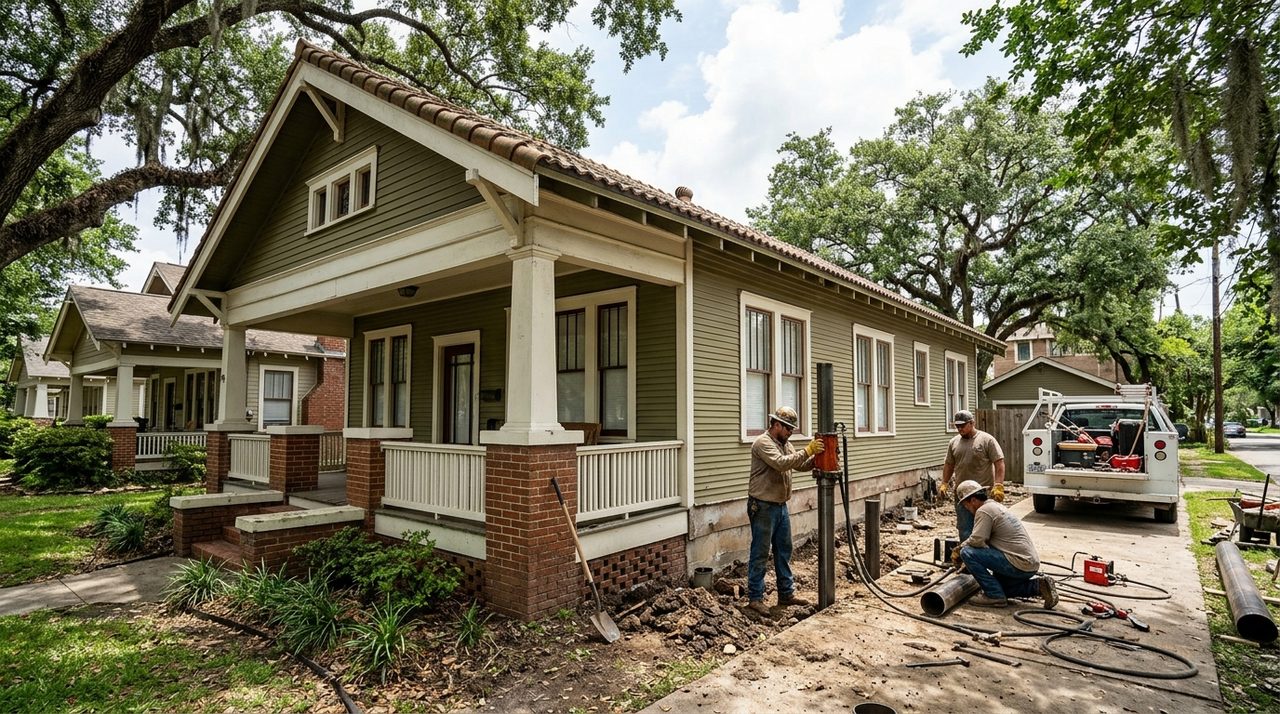
Medical Center's residential patchwork — 1960s–1980s garden-style condos, mid-century single-family homes in Southgate and Old Braeswood, and a growing stock of 1990s–2020s three-story townhomes — all sit on Houston Black clay in FEMA Zone AE, directly in Brays Bayou's flood shadow. That combination of expansive soil, repeated flood saturation from events like Harvey (2017) and Beryl (2024), and aging under-slab plumbing makes foundation repair here more layered than in most Inner Loop neighborhoods. This page explains which failure modes actually show up in this area, what repairs cost, and what City of Houston permit and HOA coordination looks like before you sign anything.
Ranked by verified Google rating × review volume × verification tier. How we rank →
Some highly-rated pros serve Medical Center from nearby and may not keep a Medical Center street address. Those are listed under "Also serving Medical Center" with their real city and distance, so you always know where each business is based.
7103 Peerless St, Houston, TX 77021
2646 S Loop W, Houston, TX 77054
Highly-rated pros based nearby who cover Medical Center. Distance shown from the Medical Center area.
Serving Medical Center Based in Upper Kirby · 1.9 mi away
Serving Medical Center Based in Upper Kirby · 2.3 mi away
Serving Medical Center Based in River Oaks · 3.5 mi away
Serving Medical Center Based in Braeswood · 3.8 mi away
Serving Medical Center Based in Bellaire · 4 mi away
Serving Medical Center Based in Bellaire · 4.2 mi away
Serving Medical Center Based in Midtown · 4.4 mi away
Serving Medical Center Based in Meyerland · 4.6 mi away
Why it matters to you
Blocks closest to Brays Bayou in Old Braeswood and Southgate flooded for multiple days during both Harvey (2017) and Beryl (2024), and FEMA Zone AE designation here is parcel-specific — some properties flooded repeatedly while neighbors did not. Prolonged saturation reconsolidates Houston Black clay, stripping bearing capacity and triggering settlement that can appear weeks or even months after water recedes. A mid-century slab that looked fine in the first year after Harvey may now be showing corner drop, sticking doors, or diagonal drywall cracks as the soil continues to reconsolidate beneath it.
What a good pro does
A qualified contractor should pull HCFCD flood-inundation maps for the specific parcel before diagnosing settlement as purely drought-driven, because the saturation mechanism calls for a different pier spacing and depth strategy than seasonal dry-cycle voids. Steel push piers or helical piers reaching competent load-bearing soil well below the clay are appropriate; mudjacking alone is insufficient where the soil structure itself has been compromised by repeated saturation. City of Houston foundation repair permits are required and are issued through the Houston Permitting Center — confirm the permit is pulled before work begins.
Sources: Harris County Flood Control District, FEMA National Flood Hazard Layer (NFHL), City of Houston Permitting Center
Why it matters to you
Medical Center's garden-style condo complexes — many built between 1965 and 1985 — commonly have original cast-iron under-slab drain lines that were already brittle before Winter Storm Uri (2021) accelerated cracking across the metro. In a multi-unit building, a slow drain-line leak under one unit's slab saturates the shared clay subgrade for neighboring units as well, causing localized heave in one area and settlement in another simultaneously. Because the building's census median year built is 1980 and owner-occupancy is only 33%, many units have had multiple tenants and deferred maintenance, making undisclosed under-slab plumbing damage especially likely.
What a good pro does
Before any foundation contractor proposes piering, insist on a hydrostatic plumbing pressure test — estimated at $250–$400 — performed or overseen by a plumber licensed through the Texas State Board of Plumbing Examiners. In a condo setting, the HOA or property manager controls access to shared mechanical areas, so schedule the test through building management and document the results in writing. If the test fails, the plumbing must be remediated first; piering over an active leak will not stabilize the slab and will void most contractor warranties.
Sources: Texas State Board of Plumbing Examiners, Local HOA / deed restrictions (see area profile), City of Houston Permitting Center
Why it matters to you
The surge of three-story townhomes built across the Medical Center area in the 2000s–2020s introduced narrow-footprint slabs on lots that were already carrying mature water oak and Chinese tallow root systems from earlier single-family demolitions. During the La Niña-driven drought years of 2022–2023, those root systems aggressively extracted moisture from the perimeter clay, pulling the soil away from the slab beam and creating perimeter voids. Townhome buyers who purchased in 2021–2022 may now be seeing the first signs: exterior brick cracking at corners, garage doors racking slightly out of plumb, or interior tile grout lines separating near the front or rear of the unit.
What a good pro does
The fix typically involves perimeter steel push piers ($1,200–$1,800 per pier, estimated) at the affected corners, combined with a soaker-hose irrigation protocol along the slab perimeter during dry months to prevent recurrence. Because townhomes in this area almost universally belong to mandatory HOA associations, the contractor must obtain written architectural approval from the association before trenching around the exterior — trench access strips across common landscaping areas may require separate HOA board sign-off. City of Houston permits are required through the Houston Permitting Center for pier underpinning on any single-family or townhome structure.
Sources: City of Houston Permitting Center, Local HOA / deed restrictions (see area profile), Municipal permit office (see area profile)
Why it matters to you
With owner-occupancy at only 33% in the Medical Center area, a significant share of properties are investor-held or frequently resold. Texas TREC disclosure forms require sellers to disclose known foundation movement and any prior repairs — and unpermitted or undocumented work discovered during a buyer's inspection routinely kills deals or triggers renegotiation. In condo buildings, the individual unit owner is responsible for disclosing slab conditions in their unit even though the slab itself may be a common element governed by the condo association's documents, creating a legal gray zone that surprises sellers at closing.
What a good pro does
Every repair should be permitted through the City of Houston Houston Permitting Center, with the permit and inspection records kept with the property file — not just the contractor's copy. For condo owners, obtain a written determination from the association's property manager or attorney about whether the slab under your unit is a limited common element or true common area, because that determines who is financially responsible and who must sign off on the repair scope. A written, itemized proposal specifying pier count, depth, and method gives you documentation that satisfies both TREC disclosure requirements and future buyer due diligence.
Sources: City of Houston Permitting Center, Local HOA / deed restrictions (see area profile), Municipal permit office (see area profile)
Hiring foundation repair in Medical Center? The Medical Center area is a patchwork of mid-century condos, newer townhome infill, and older single-family subdivisions, each with its own HOA or civic club governance. Situated in FEMA Zone AE high-flood-risk territory near Brays Bayou, flood mitigation and water damage remediation are recurring service needs. Contractors must navigate property-specific association rules, aging building systems in 1960s–1980s multifamily complexes, and modern code requirements for newer infill construction.
Building era
1960s–1980s multifamily and condo stock predominates, with significant 1990s–2020s townhome and infill construction; some pre-1950s single-family homes in adjacent subdivisions like Southgate and Old Braeswood.
Typical style
Garden-style condominiums (2–3 story brick/stucco), contemporary 3-story townhomes, mid-century ranch and traditional single-family homes, with newer large-lot replacement builds.
Foundations
Predominantly slab-on-grade; some older single-family homes may have pier-and-beam foundations.
Common systems
Older condos and apartments typically have original or once-updated central HVAC, copper or galvanized plumbing, and aging electrical panels; newer townhomes feature modern high-efficiency systems, PEX plumbing, and 200-amp electrical service.
What that means for repairs
Older 1970s–1980s condo units are frequently gut-renovated with updated kitchens, bathrooms, and HVAC systems. Mid-century single-family homes are either extensively remodeled or torn down for new construction. Flood damage repair and elevation projects are common given the area's flood history.
Permit jurisdiction
City of Houston — Houston Permitting Center.
HOA & deed restrictions
No single overarching HOA exists. The area is a patchwork of mandatory condo/townhome associations for individual complexes and voluntary civic clubs or property owners associations for single-family subdivisions (e.g., Braeswood Place HOA, Southgate Civic Club). Virtually all condos and townhomes have mandatory associations with dues. Specific HOA details should be verified via hoa.texas.gov or deed restriction filings.
Historic districts
No City of Houston historic district designation confirmed for the core Medical Center residential area.
Contractor note
Contractors working on condos and townhomes must coordinate with the specific building's HOA or condo association for architectural approvals, insurance requirements, and common-area access. In the absence of citywide zoning, deed restrictions govern land use and exterior modifications on single-family lots.
FEMA flood zone
FEMA Zone AE (high flood risk) — source: fema_nfhl. The Medical Center area sits in close proximity to Brays Bayou, which is the primary flood driver for the surrounding residential areas. Harris County Flood Control District projects have addressed some capacity issues, but the zone designation reflects ongoing significant flood risk.
Hurricane Harvey impact
Not confirmed with specific block-level Medical Center data from research provided. The broader Brays Bayou watershed experienced severe flooding during Hurricane Harvey (2017), and neighborhoods immediately surrounding the Medical Center — particularly those south and east near Holly Hall, Almeda, and Old Spanish Trail — are widely reported to have sustained significant flood damage. Check Harris County Flood Control District records for address-specific Harvey inundation data.
Heat & humidity load
Aging 1970s–1980s condo HVAC systems are stressed by sustained 95°F+ summer heat, making AC failures and refrigerant issues common peak-season calls. Flat-roof condo buildings are vulnerable to ponding and thermal expansion leaks. High humidity accelerates mold growth in flood-prone ground-floor units and older construction with poor vapor barriers.
Working with contractors here
Contractors in the Medical Center area most frequently handle HVAC replacement and repair in aging condo and apartment complexes, where original 1970s–1980s systems have reached or exceeded their useful life. Plumbing repiping is common in older buildings still running galvanized supply lines. Flood damage restoration — including drywall, flooring, and mold remediation — is a recurring need given the FEMA AE designation and Brays Bayou proximity. Newer townhome and infill work tends to involve finish-out customization and warranty repairs. Job scoping must account for HOA approval timelines, limited parking and staging areas in dense condo complexes, and coordination with building management for access to shared mechanical systems and common areas.
Local Tip
Always ask for a written estimate before work begins. Texas contractors are required to provide one on jobs over $1,000.
The Medical Center area is a patchwork of mid-century condos, newer townhome infill, and older single-family subdivisions, each with its own HOA or civic club governance. Situated in FEMA Zone AE high-flood-risk territory near Brays Bayou, flood mitigation and water damage remediation are recurring service needs. Contractors must navigate property-specific association rules, aging building systems in 1960s–1980s multifamily complexes, and modern code requirements for newer infill construction.
Source: U.S. Census Bureau, ACS 5-Year 2023
Much of Medical Center maps to FEMA Zone AE (high flood risk), so flood-resilient detailing -- elevated equipment, water-tolerant materials, and drainage-first thinking -- is essential here, not optional; risk climbs sharply on blocks nearest Brays Bayou, where it varies parcel to parcel.
Source: FEMA National Flood Hazard Layer (NFHL). Flood zones vary by parcel — verify your individual FIRM panel.
Before hurricane season, have a licensed foundation repair contractor assess your pier-and-beam or slab foundation for existing cracks or settlement, because FEMA Zone AE inside the 100-year floodplain and proximity to Brays Bayou can turn minor movement into major structural failure. In Medical Center, the saturated soils that accompany Gulf storm flooding cause rapid, uneven heave that widens pre-existing gaps at door frames and brick veneer within days of water receding. Because Medical Center drains toward Brays Bayou, block-level runoff can differ sharply from the mapped zone.
Hail impact does not directly damage a concrete slab, but the intense, short-duration rainfall that accompanies large-cell storms in Medical Center saturates expansive clay rapidly and unevenly, particularly if your landscape grade has shifted since your last inspection. A TDLR-licensed foundation specialist can evaluate whether existing interior piers are still making full contact after a significant storm cluster moves through the area. In-city Medical Center work falls under City of Houston floodplain and permitting rules.
Burst water pipes during a hard freeze release hundreds of gallons beneath or around your slab, and in Medical Center that sudden localized saturation of already-wet clay is one of the most direct causes of post-freeze foundation movement. Coordinate with your plumber on any post-freeze pipe repair to ensure the repair process documents where water escaped, then schedule a foundation inspection at the 60-day mark when soil moisture has partially redistributed. With a median build year of 1980, the older building stock here is more exposed to hard-freeze damage than newer construction. Because Medical Center drains toward Brays Bayou, block-level runoff can differ sharply from the mapped zone.
Sources: FEMA National Flood Hazard Layer (NFHL), Ready.gov -- Hurricanes, CenterPoint Energy -- Storm Center, City of Houston -- Emergency Preparedness, Ready.gov -- Winter Weather, Harris County Flood Control District
Houston-specific estimators to plan your project before you call a pro. All results are planning estimates — a licensed local pro confirms the details on site.
Grouped by mature root aggression & water demand.
Trunk center to the nearest exterior wall.
The root zone likely reaches your foundation's soil during Houston's dry summers, when clay shrinks most. Watch for sticking doors and diagonal cracks, keep soil moisture even with a soaker hose during drought, and have a foundation pro evaluate if you see any movement.
Find a Houston foundation pro →This is a planning estimate only — actual requirements depend on an on-site assessment by a licensed Houston pro. Guidance is based on general species root behavior in expansive clay, not a soil test.
Disconnect & drain every outdoor hose bib
Remove hoses, drain the spigots, and cover each with an insulated faucet sock. Un-drained hose bibs are the #1 burst point in a Houston freeze.
Insulate exposed pipes in the attic & garage
Wrap any pipe in an unconditioned space (attic runs, garage walls) with foam sleeves. Houston homes rarely insulate these because they only matter a few nights a year — which is exactly why they burst.
Open cabinet doors & keep a pencil-width drip
On hard-freeze nights, open kitchen/bath cabinets so warm air reaches the pipes and let faucets on exterior walls drip to relieve pressure.
Protect the attic/garage water heater & its lines
An attic or garage tank sits in unconditioned space. Insulate the cold-inlet and hot-outlet lines and confirm the emergency drain pan is clear so a leak doesn't reach the ceiling.
This is a planning estimate only — actual requirements depend on an on-site assessment by a licensed Houston pro. If a pipe has already burst, shut off your main water supply and call a licensed Houston plumber immediately — freeze bursts flood fast.
Sources: City of Houston Permitting CenterMunicipal permit office (see area profile)
Sources: Local HOA / deed restrictions (see area profile)
Sources: Harris County Flood Control District
Sources: City of Houston Permitting CenterMunicipal permit office (see area profile)