8433 Northern St, Houston, TX 77071
Best Foundation Repair in Missouri City, TX
Missouri City's slab-on-grade homes sit on Fort Bend County's expansive Beaumont clay — some of the most movement-prone soil in the Houston metro — and the city's wide span of construction eras, from 1960s core neighborhoods near Fondren Road to 2010s master-planned subdivisions off Sienna Parkway, means foundation problems look very different depending on which decade your house was built. Add Missouri City's own permitting process through the City's Building & Standards Department (separate from Houston and Fort Bend County), plus more than 24 subdivision-level HOAs that each set their own exterior-work rules, and a foundation repair project here requires more pre-job homework than almost anywhere else in the SW Houston corridor. This page explains the specific soil, drainage, plumbing, and permit realities that drive foundation movement in Missouri City so you can evaluate proposals with clear eyes.
Verified against Google Business data
Updated 2026
See the 10 Foundation Repair Serving Missouri City 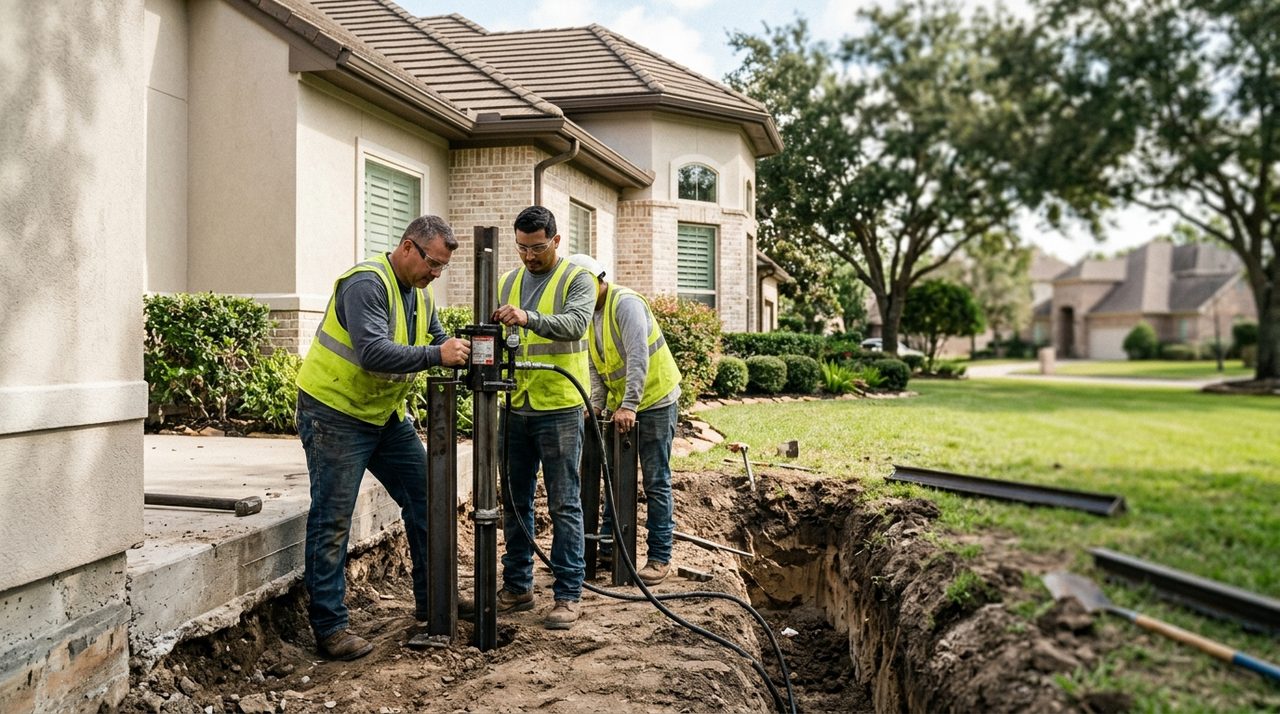
- Median home built
- 1993
- Median home value
- $281,600
- FEMA flood zone
- X (low)
- Typical cost (est.)
- $3,500–$25,000 depending on method and pier count
- Most common local issue
- Drought-cycle perimeter voids in Fort Bend expansive clay under 1970s–1990s slabs
Ranked by verified Google rating × review volume × verification tier. How we rank →
Some highly-rated pros serve Missouri City from nearby and may not keep a Missouri City street address. Those are listed under "Also serving Missouri City" with their real city and distance, so you always know where each business is based.
Min rating:
10 resultsBased in Missouri City
9618 S Petersham Dr, Houston, TX 77031
Closed
12402 Copperfield Dr, Houston, TX 77031
Also serving Missouri City
Highly-rated pros based nearby who cover Missouri City. Distance shown from the Missouri City area.
Serving Missouri City Based in Stafford · 2.1 mi away
Closed
Serving Missouri City Based in Westbury · 2.4 mi away
Serving Missouri City Based in Westbury · 2.8 mi away
Closed
Serving Missouri City Based in Sugar Land · 3.2 mi away
Serving Missouri City Based in Westbury · 3.2 mi away
Closed
Serving Missouri City Based in Sharpstown · 3.6 mi away
Closed
Serving Missouri City Based in Sugar Land · 3.9 mi away
Foundation Repair in Missouri City: What You Should Know
Fort Bend Expansive Clay Behaves Differently Across Missouri City's Two Housing Eras
Why it matters to you
Missouri City's census median build year of 1993 masks a wide split: 1960s–1980s slabs in the older core have decades of accumulated wet-dry movement, while 1990s–2010s production-builder slabs in sections like Quail Green or The Manors are often just now entering the phase where seasonal differential movement becomes noticeable — typically around the 20–30 year mark. Fort Bend County's Beaumont clay swells when saturated and shrinks during drought, lifting one corner of a slab while another settles, cracking brick veneer and door frames in patterns that repeat every wet-dry cycle. The 2022–2023 La Niña drought was particularly severe in Fort Bend, baking perimeter soils away from slab edges and setting up the void conditions that accelerate erosion when rain returns.
What a good pro does
A qualified contractor should probe the perimeter with a moisture meter and, on older slabs, a dial-indicator survey at every door threshold to map differential elevation before recommending a repair method. For homes where voids have already formed, polyurethane foam injection ($2,000–$5,000 estimated for a moderate job) can fill perimeter gaps without the vibration risk of mudjacking on older slabs. Long-term, a properly zoned soaker-hose system run 30–45 minutes per zone three times weekly during dry months is the most cost-effective prevention. Confirm the contractor files a permit with Missouri City's Building & Standards Department — not Harris County, not Houston — before any underpinning work begins.
Sources: Municipal permit office (see area profile), International Residential Code (as adopted by City of Houston)
Older Core Homes Face a Double Threat: Cast-Iron Drain Lines and Foundation Movement Working Together
Why it matters to you
Missouri City's 1960s–1980s homes were typically built with cast-iron under-slab drain lines, and Winter Storm Uri (February 2021) cracked thousands of those lines across Fort Bend County. Many owners patched interior walls without testing the under-slab pipe network, leaving slow leaks that continuously saturate the clay directly beneath the slab. That chronic saturation causes localized heave followed by settlement as soil structure breaks down — a pattern that looks identical to ordinary clay-shrink movement on a surface inspection but won't be corrected by piers alone. This is a genuine risk in the Fondren Road corridor and other pre-1985 Missouri City neighborhoods where galvanized and cast-iron plumbing are still common.
What a good pro does
Before signing any foundation repair contract on a pre-1990 Missouri City home, insist on a hydrostatic plumbing test — expect to pay $250–$400 estimated — performed or overseen by a plumber licensed through the Texas State Board of Plumbing Examiners. If the test fails, the under-slab line must be repaired or re-routed before foundation work begins; otherwise the new piers or void-fill will be fighting a continuing moisture source. Steel push piers ($1,200–$1,800 per pier estimated, typically 8–16 piers for an average slab) installed after confirmed dry conditions offer a more durable solution than pressed concrete pilings, which have higher documented failure rates on Fort Bend clay.
Sources: Texas State Board of Plumbing Examiners, Municipal permit office (see area profile), International Residential Code (as adopted by City of Houston)
Missouri City's 24+ Subdivision HOAs Add an Approval Step That Can Delay — or Invalidate — Your Repair
Why it matters to you
Unlike many Houston neighborhoods, Missouri City homeowners face subdivision-level HOA architectural review committees that operate independently of city permits — and their requirements are not standardized. The Manors Owners Association, Quail Green HOA, and dozens of other recorded CCR communities each set their own rules on exterior work, including perimeter trenching, soil excavation, and even contractor parking during a foundation job. A permit from Missouri City's Building & Standards Department does not satisfy HOA approval, and starting work without ARC sign-off can trigger fines or mandatory restoration. Fort Bend County Clerk records are the authoritative source to confirm whether your lot carries a recorded CCR that has an active HOA enforcing it.
What a good pro does
Before scheduling a foundation inspection, pull your property's deed restrictions from the Fort Bend County Clerk's online records portal and contact the HOA management company directly to request the ARC submittal requirements for foundation repair. Most committees need a written scope of work, a site plan showing pier locations, and contractor insurance certificates — allow 10–30 days for review. Verify that your contractor is familiar with Missouri City's own permit process through the Building & Standards Department and can document both the city permit number and HOA approval in writing before the first shovel goes in. Undocumented work creates a disclosure liability under Texas TREC seller disclosure requirements if you sell within a few years of the repair.
Sources: Local HOA / deed restrictions (see area profile), Municipal permit office (see area profile)
Pressing vs. Pushing vs. Helical: Choosing the Right Pier for Fort Bend Clay
Why it matters to you
Missouri City homeowners frequently receive dramatically different repair proposals — one contractor recommends 20 pressed concrete pilings at $5,000 total, another quotes 12 steel push piers at $16,000, a third suggests helical piers at $20,000-plus. Pressed concrete pilings were the dominant Houston-area method through the 1990s and many still perform adequately, but they have a documented record of punch-through failure in highly plastic Fort Bend clay when the load bearing layer is inconsistent. The newer master-planned sections of Missouri City, where fill was used to grade homesites, may have variable bearing depth that makes standard push pier depth specifications unreliable without a soil boring.
What a good pro does
Request that any proposal include the target bearing depth and the method used to establish it — a reputable contractor should be able to cite local soil borings or cone penetration test data for your area, not just a general 'we go to refusal' statement. For homes in Missouri City's newer fill-graded subdivisions, helical piers ($1,500–$2,200 per pier estimated) may be appropriate because torque monitoring during installation confirms actual bearing capacity in real time. Texas has no standalone state license specifically for foundation repair contractors under TDLR, so the most reliable vetting tools are verified general liability and workers' comp certificates, a City of Missouri City permit pulled in advance, and at least three written proposals with explicit pier counts and depth specs — not just a total dollar figure.
Sources: Texas Department of Licensing & Regulation, Municipal permit office (see area profile), International Residential Code (as adopted by City of Houston)
Foundation Repair in Missouri City: What You Should Know
Hiring foundation repair in Missouri City? Missouri City spans decades of development, from 1960s-era core neighborhoods to 2010s master-planned communities, creating a wide range of home service needs. Contractors must navigate subdivision-specific deed restrictions and HOA rules that vary significantly across the city. The municipal permitting process is independent from Houston, and Fort Bend County drainage infrastructure differs from Harris County systems.
- Housing era
- Mixed
- Foundation
- Predominantly slab-on-grade, consistent with post-1960s Fort Bend County suburban construction standards
- Flood zone
- FEMA Zone X (low flood risk) per official NFHL data
- Permits
- City of Missouri City Building & Standards Department for properties within city limits
Housing stock & systems
Building era
Mixed: 1960s–1980s in older core areas; 1990s–2010s in newer master-planned sections.
Typical style
One- and two-story brick veneer traditional suburban, with some stucco and siding accents in newer sections; production-builder plans predominate.
Foundations
Predominantly slab-on-grade, consistent with post-1960s Fort Bend County suburban construction standards.
Common systems
Older areas (1960s–1980s): original copper or galvanized plumbing, R-22 HVAC systems nearing or past end of life, older electrical panels (potentially Federal Pacific or Zinsco in 1970s homes). Newer areas (1990s–2010s): PEX or CPVC plumbing, R-410A HVAC, 200-amp electrical service.
What that means for repairs
Older core neighborhoods see significant HVAC replacements, re-plumbing from galvanized to PEX, and kitchen/bath remodels. Newer master-planned homes are beginning first-cycle roof replacements and cosmetic updates. Foundation repair is common in older slab-on-grade homes due to Fort Bend County expansive clay soils.
Permits & restrictions
Permit jurisdiction
City of Missouri City Building & Standards Department for properties within city limits. Some ETJ areas may fall under Fort Bend County engineering.
HOA & deed restrictions
No city-wide mandatory HOA. At least 24 separate HOA/POA/community associations operate at the subdivision level. Many subdivisions (e.g., The Manors Owners Association, Quail Green HOA) have mandatory membership with recorded CCRs. Some older areas may have only recorded deed restrictions with no active HOA. Check Fort Bend County Clerk records for specific lot restrictions.
Historic districts
No historic district designation confirmed. Missouri City is an incorporated city in Fort Bend County, not subject to Houston's HAHC jurisdiction.
Contractor note
Missouri City has its own permitting process separate from Houston and Fort Bend County. Contractors must verify whether the property is inside city limits or in the ETJ, as permit requirements and inspection processes differ. Individual HOA architectural review committees may impose additional approval requirements beyond city permits.
Flood & weather
FEMA flood zone
FEMA Zone X (low flood risk) per official NFHL data. However, Missouri City is large and individual subdivisions may have different flood zone designations, particularly near Oyster Creek and its tributaries. Property-specific FIRMettes should be checked for parcels near waterways.
Hurricane Harvey impact
No specific Harvey 2017 flood impact data was confirmed for Missouri City neighborhoods in the available research. Fort Bend County experienced significant flooding during Harvey, particularly along the Brazos River corridor, but subdivision-level impact in Missouri City varies. Homeowners should check Fort Bend County Drainage District records and individual property disclosure histories for Harvey-specific flood data.
Heat & humidity load
Fort Bend County's expansive clay soils undergo significant seasonal movement, making foundation monitoring critical during prolonged summer drought. Older HVAC systems in 1960s–1980s homes face extreme strain during Houston summers, and R-22 refrigerant phase-out makes replacement more cost-effective than repair. Newer homes with builder-grade HVAC may still underperform in extreme heat if ductwork was poorly sealed during construction.
Working with contractors here
Missouri City's mixed housing stock creates two distinct contractor markets: older core neighborhoods needing whole-system replacements (HVAC, plumbing re-pipes, electrical panel upgrades, and foundation repair) and newer master-planned communities entering their first major maintenance cycle with roof replacements, water heater swaps, and cosmetic remodels. Foundation work is a consistently high-demand service due to expansive clay soils across Fort Bend County, affecting both old and new construction. Contractors should be prepared for subdivision-specific HOA architectural review requirements that may dictate exterior material choices, fence styles, and even work hours. Job scoping should always include a check with the specific HOA management company, as restrictions vary widely between Missouri City's 24+ organized associations.
Local Tip
Always ask for a written estimate before work begins. Texas contractors are required to provide one on jobs over $1,000.
About Missouri City
Missouri City spans decades of development, from 1960s-era core neighborhoods to 2010s master-planned communities, creating a wide range of home service needs. Contractors must navigate subdivision-specific deed restrictions and HOA rules that vary significantly across the city. The municipal permitting process is independent from Houston, and Fort Bend County drainage infrastructure differs from Harris County systems.
- Median year built
- 1993
- Median home value
- $281,600
- Owner-occupied
- 81.4%
- Population
- 75,234
- Housing units
- 27,906
- Median income
- $96,746
Source: U.S. Census Bureau, ACS 5-Year 2023
Flood & storm risk
FEMA Zone XLow flood riskMost of Missouri City maps to FEMA Zone X (low mapped flood risk), but Houston's flash-flood reality means even low-risk blocks benefit from smart drainage and storm-hardened installs.
Source: FEMA National Flood Hazard Layer (NFHL). Flood zones vary by parcel — verify your individual FIRM panel.
Houston Storm Readiness in Missouri City
Hurricane & flooding
Houston's flash-flood reality means even low-mapped-risk areas like Missouri City, TX can see sheet flow accumulate against a foundation during a slow-moving Gulf system, so verify that your perimeter drainage is clear and properly sloped before hurricane season opens. A TDLR-licensed foundation contractor can add or reposition surface drains to intercept runoff before it softens the clay bearing layer beneath your slab. Confirm the current FEMA panel for your Missouri City parcel — the area maps to Zone X, but adjacent lots can differ.
Severe storms & hail
Even with low mapped flood risk, Missouri City, TX is not immune to the localized sheet flow that accompanies a Houston severe thunderstorm, and repeated minor inundation at the foundation perimeter sustains the clay moisture that drives slow heave cycles. A pre-storm season inspection confirming that soil grade, splash blocks, and downspout extensions all direct water away from the slab is the most cost-effective foundation repair step you can take. Confirm the current FEMA panel for your Missouri City parcel — the area maps to Zone X, but adjacent lots can differ.
Ice storms & freezes
Ice loading from roof accumulation during a hard freeze transfers compressive stress to your foundation corners, and in Missouri City, TX that added load on clay subgrade that has stiffened from cold can create corner settlement that persists after the thaw. A TDLR-licensed foundation contractor should inspect visible brick-to-foundation transitions and interior door frames after any multi-day freeze event, even if no pipe damage occurred. Confirm the current FEMA panel for your Missouri City parcel — the area maps to Zone X, but adjacent lots can differ.
Sources: FEMA National Flood Hazard Layer (NFHL), Ready.gov -- Hurricanes, CenterPoint Energy -- Storm Center, City of Houston -- Emergency Preparedness, Ready.gov -- Winter Weather, Harris County Flood Control District
Free Missouri City Tools & Calculators
Houston-specific estimators to plan your project before you call a pro. All results are planning estimates — a licensed local pro confirms the details on site.
Houston Soil & Tree Proximity Risk Calculator
Open full tool & FAQ →Grouped by mature root aggression & water demand.
Trunk center to the nearest exterior wall.
Moderate risk
The root zone likely reaches your foundation's soil during Houston's dry summers, when clay shrinks most. Watch for sticking doors and diagonal cracks, keep soil moisture even with a soaker hose during drought, and have a foundation pro evaluate if you see any movement.
Find a Houston foundation pro →This is a planning estimate only — actual requirements depend on an on-site assessment by a licensed Houston pro. Guidance is based on general species root behavior in expansive clay, not a soil test.
Houston Freeze Prep & Pipe Insulation Checklist
Open full tool & FAQ →Your freeze checklist — 4 tasks
- 1
Disconnect & drain every outdoor hose bib
Remove hoses, drain the spigots, and cover each with an insulated faucet sock. Un-drained hose bibs are the #1 burst point in a Houston freeze.
- 2
Insulate exposed pipes in the attic & garage
Wrap any pipe in an unconditioned space (attic runs, garage walls) with foam sleeves. Houston homes rarely insulate these because they only matter a few nights a year — which is exactly why they burst.
- 3
Open cabinet doors & keep a pencil-width drip
On hard-freeze nights, open kitchen/bath cabinets so warm air reaches the pipes and let faucets on exterior walls drip to relieve pressure.
- 4
Protect the attic/garage water heater & its lines
An attic or garage tank sits in unconditioned space. Insulate the cold-inlet and hot-outlet lines and confirm the emergency drain pan is clear so a leak doesn't reach the ceiling.
This is a planning estimate only — actual requirements depend on an on-site assessment by a licensed Houston pro. If a pipe has already burst, shut off your main water supply and call a licensed Houston plumber immediately — freeze bursts flood fast.
Frequently Asked Questions
Do I need a permit from Missouri City to repair my foundation, and is the process different from what Houston requires?
Yes — foundation underpinning work requires a permit through the City of Missouri City Building & Standards Department, which operates completely independently from the City of Houston Permitting Center and Fort Bend County. You or your contractor must confirm whether your property sits inside city limits or in the ETJ, because the inspection schedule, fee structure, and required documentation differ between those jurisdictions. Any contractor who tells you Missouri City follows Houston's process is working from outdated information — verify permit status directly with Missouri City's Building & Standards office before work begins.
Sources: Municipal permit office (see area profile)
My 1970s home in the older core near Fondren Road already had pressed concrete pilings installed years ago. Can I just add more pilings if the foundation is moving again?
Pressed pilings installed in 1970s–1980s Missouri City homes frequently reach the end of their service life or were installed too shallow to begin with, so adding more of the same method on top of a failing system is rarely the right answer. A reputable contractor should probe existing pilings for integrity, commission a soil report if the initial repair history is unknown, and determine whether steel push piers or helical piers reaching deeper, more stable Fort Bend clay layers are a better long-term solution. Because this is also a common era for cast-iron under-slab drain lines vulnerable to post-Uri damage, insist on a hydrostatic plumbing test (estimated $250–$400) before any new piers are quoted or installed.
Missouri City maps mostly to FEMA Zone X, so do I still need to worry about flood-related foundation settlement after a heavy storm like Beryl in 2024?
FEMA Zone X means your lot carries low mapped flood risk, but it does not mean your slab is immune to saturation-driven settlement — Fort Bend County's Beaumont clay can lose significant bearing capacity after prolonged standing water even in nominally low-risk areas, and flash flooding from events like Beryl can pool for days even outside the floodplain boundary. If your yard held water for more than 24–48 hours after a major storm, watch for new door or window sticking and interior drywall cracks in the weeks that follow, because post-event settlement sometimes lags the storm by four to eight weeks as waterlogged clay reconsolidates. This is not a reason to panic, but it is a reason to document and monitor rather than dismiss early warning signs.
My subdivision in Missouri City is part of one of the 24+ HOAs. Do I need HOA approval before the foundation contractor can start trenching around my perimeter?
Almost certainly yes if your subdivision has an active architectural review committee — exterior trenching, soil excavation, and equipment staging in the yard are typically categorized as structural alterations that require written HOA approval before work begins, not just before it's completed. Approval timelines vary widely across Missouri City's associations; some committees meet monthly and can take three to six weeks to process a request, which should factor into your repair scheduling. Pull your recorded CCRs from the Fort Bend County Clerk's records to identify exactly what your specific HOA requires, because the rules in Quail Green or The Manors, for example, are not the same as those in a Sienna Parkway-area association.
Sources: Local HOA / deed restrictions (see area profile)
What's the best time of year to schedule foundation repair in Missouri City, and does Houston's wet season affect the outcome?
Late fall through early spring — roughly October through March — is generally the most favorable window for foundation repair in Missouri City because Fort Bend's expansive clay is closer to equilibrium moisture content after summer's bake-and-dry cycle and before the spring rain season fully saturates the soil again. Attempting to level and pier a slab during an active dry spell in July or August can lock in an artificially low moisture state, meaning the slab may shift again once fall rains arrive and the clay re-expands. Contractors should perform a perimeter moisture check at the time of evaluation and may recommend a soaker-hose pre-soak program for several weeks before pier installation if the soil is abnormally dry.
When I get quotes from foundation companies in Missouri City, what specific information should I be asking for beyond just the total price?
Ask each contractor for the proposed pier type, individual pier depth, and total pier count in writing — a vague quote that says 'foundation repair' with a lump sum price gives you no basis for comparison when three contractors recommend different methods for Fort Bend clay. Confirm that the contractor will pull a City of Missouri City permit and provide you with the permit number before any work starts, and ask who is responsible for scheduling the required city inspection. Finally, ask directly whether the scope includes or excludes a hydrostatic plumbing test to rule out under-slab leaks, because omitting that step on an older Missouri City home — especially pre-1990 construction — can mean repairing the foundation while a cracked drain line continues destabilizing the soil underneath.
Sources: Municipal permit office (see area profile)Texas State Board of Plumbing Examiners