Closed
1235 W Clay St, Houston, TX 77019
River Oaks presents a foundation challenge unlike anywhere else in Houston: the neighborhood's oldest surviving 1920s–1940s estates sit on pier-and-beam systems that have spent a century responding to Houston's expansive Beaumont clay, oversized live oak canopies, and now-aging cast-iron under-slab drain lines that Winter Storm Uri quietly fractured in 2021. Add mandatory ROPO deed-restriction review on top of City of Houston permit requirements, and a foundation repair project here demands more pre-work coordination than a comparable job in any newer suburb. This page explains what that actually means for a River Oaks homeowner before you sign a single proposal.
Ranked by verified Google rating × review volume × verification tier. How we rank →
Some highly-rated pros serve River Oaks from nearby and may not keep a River Oaks street address. Those are listed under "Also serving River Oaks" with their real city and distance, so you always know where each business is based.
1235 W Clay St, Houston, TX 77019
Highly-rated pros based nearby who cover River Oaks. Distance shown from the River Oaks area.
Serving River Oaks Based in Upper Kirby · 1.1 mi away
Serving River Oaks Based in Upper Kirby · 1.5 mi away
Serving River Oaks Based in Lazybrook / Timbergrove · 2.1 mi away
Serving River Oaks Based in Lazybrook / Timbergrove · 2.4 mi away
Serving River Oaks Based in Lazybrook / Timbergrove · 3 mi away
Serving River Oaks Based in Bellaire · 3.3 mi away
Serving River Oaks Based in Midtown · 3.6 mi away
Serving River Oaks Based in Bellaire · 3.7 mi away
Serving River Oaks Based in Tanglewood · 3.9 mi away
Why it matters to you
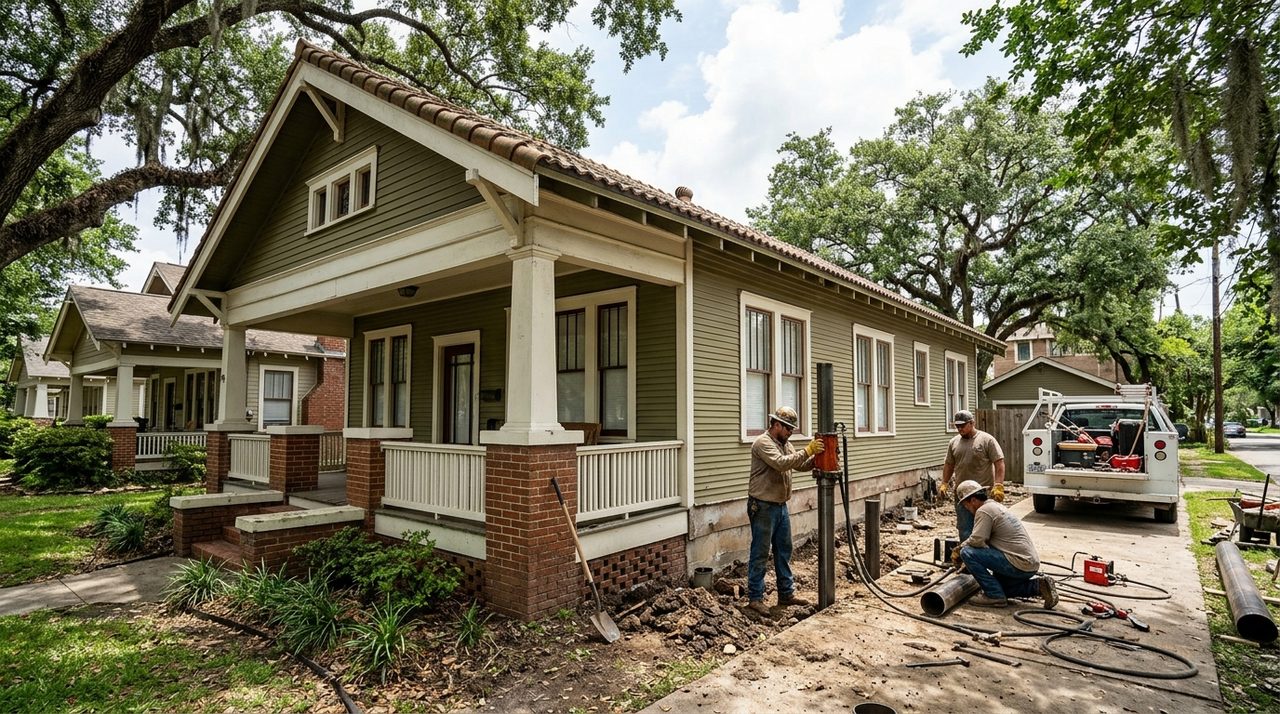
The majority of River Oaks's surviving pre-1950 estates were built on pier-and-beam foundations — not slab-on-grade — meaning decades of differential movement in Houston's expansive clay have progressively racked the wood-frame superstructure. Unlike a slab failure, pier-and-beam problems show up as sloping floors, sticking doors inside the home's interior, and visible beam rot or termite damage when a contractor crawls the underspace. Because many of these homes have changed hands through estate sales, repair histories are often undocumented.
What a good pro does
A qualified contractor will measure floor elevations across every room with a digital level, photograph all accessible piers and beams from the crawl space, and identify whether movement is ongoing or historic. Shimming or replacing individual wood piers is a code-regulated structural repair in the City of Houston, and a permit through the Houston Permitting Center is required before work begins; homeowners should verify the permit is pulled in their name or the contractor's, not skipped entirely. ROPO's deed restrictions do not govern sub-grade structural work, but any exterior soil disturbance or drainage modification visible from the street should be reviewed with ROPO before mobilizing equipment.
Sources: City of Houston Permitting Center, Local HOA / deed restrictions (see area profile), International Residential Code (as adopted by City of Houston)
Why it matters to you
River Oaks's signature canopy of heritage live oaks and water oaks — many with root systems extending 40–60 feet from the trunk — relentlessly extract clay moisture during Houston's dry summers, causing the soil beneath one side of a foundation to contract faster than the other. On a large River Oaks estate, this can mean several inches of differential movement between the tree-side corners and the street-side corners of the same structure. After Hurricane Beryl's widespread canopy damage in July 2024 forced emergency tree removal across the neighborhood, some lots lost the very trees that had been stabilizing moisture gradients for decades, introducing a new cycle of soil rebound.
What a good pro does
Before attributing sloping floors or cracked brick veneer solely to soil shrinkage, a reputable contractor will map the root zones of all major trees on and adjacent to the lot relative to the measured low points in the foundation. Targeted perimeter soaker-hose irrigation — run on a timer during drought months — is the most cost-effective preventive step, maintaining consistent clay moisture and reducing seasonal differential movement. If active movement is confirmed, pier underpinning options on a pier-and-beam structure differ from slab repair: additional interior piers or sister beams are typically the repair path, not the helical or push piers marketed for slab-on-grade homes.
Sources: Local HOA / deed restrictions (see area profile), International Residential Code (as adopted by City of Houston)
Why it matters to you
River Oaks's oldest surviving homes frequently still carry original cast-iron drain lines routed under or through the crawl space. Winter Storm Uri (February 2021) burst pipes across Houston, and many River Oaks repair projects addressed walls and fixtures but left cracked under-floor cast-iron lines draining slowly into the crawl space soil. Continuous moisture under a pier-and-beam foundation accelerates wood rot at the base of wood posts, corrodes steel adjustable piers added in prior repairs, and can cause long-term soil consolidation that mimics — but is not — differential clay movement. A foundation estimate that skips a plumbing check in a pre-1970 home in this neighborhood is an incomplete estimate.
What a good pro does
Insist on a hydrostatic plumbing test (estimated $250–$400) performed by a Texas State Board of Plumbing Examiners–licensed plumber before you accept any foundation repair proposal. If a leak is confirmed, the plumbing must be remediated first — re-routing cast-iron to PVC or re-piping through walls — before foundation leveling is performed; otherwise the repair will continue to degrade. City of Houston permits are required for both the plumbing scope and the structural foundation scope, and both should appear on separate permit cards pulled through the Houston Permitting Center.
Sources: Texas State Board of Plumbing Examiners, City of Houston Permitting Center, Municipal permit office (see area profile)
Why it matters to you
River Oaks's platted sections are governed by River Oaks Property Owners, Inc. (ROPO), whose recorded deed restrictions require pre-approval for exterior modifications visible from the street — including drainage alterations, grading changes, and equipment access routes through landscaped front yards that may be necessary for foundation work. Separately, the City of Houston requires a structural repair permit through the Houston Permitting Center for underpinning, pier replacement, and related scope. These are two entirely independent approval tracks, and a contractor who pulls the City permit but skips ROPO notification exposes the homeowner to deed-restriction enforcement and potential fines from the POA.
What a good pro does
Before any foundation contractor mobilizes, confirm the City of Houston permit application has been submitted and check with ROPO's architectural review process for any exterior scope — grading, drainage, visible equipment access, or soil disposal — even if the primary work is sub-grade. Texas law requires sellers to disclose known foundation movement and all repair work on the TREC disclosure form, so keeping complete permit and ROPO correspondence records is also a direct financial interest at resale. Note that adjacent streets near the River Oaks Shopping Area (Huldy Street Terrace, Shepherd Crest) fall outside ROPO's jurisdiction, so homeowners in those pockets deal only with City of Houston permitting.
Sources: Local HOA / deed restrictions (see area profile), City of Houston Permitting Center, Municipal permit office (see area profile)
Hiring foundation repair in River Oaks? River Oaks is Houston's premier residential neighborhood, featuring 1920s–1930s estate homes alongside modern luxury rebuilds on large lots. Homeowners face a unique combination of mandatory HOA oversight from River Oaks Property Owners, Inc. (ROPO), strict deed restrictions, and the maintenance demands of aging pier-and-beam foundations, mature tree root systems, and historic-era plumbing and electrical. Contractors working here must navigate both high client expectations and the regulatory requirements of the City of Houston permitting process.
Building era
1920s–1930s (original build-out), with significant post-1980 and 2000s-present luxury infill and teardown rebuilds.
Typical style
English Tudor, Spanish Colonial Revival, Georgian, Colonial, and contemporary custom luxury homes.
Foundations
Mixed — older homes predominantly pier-and-beam; newer construction and rebuilds typically slab-on-grade with post-tension or drilled piers.
Common systems
Original homes may retain cast-iron drain lines, galvanized supply piping, and older panel boxes requiring upgrades. Newer builds feature modern PEX/copper plumbing, 200+ amp electrical panels, and high-efficiency zoned HVAC systems. Mature-era homes often have outdated ductwork and window-unit retrofits.
What that means for repairs
Teardown-and-rebuild activity is extremely common on original lots, as land values far exceed structure values for many older homes. Whole-house gut renovations of surviving 1920s–1940s estates are also frequent, typically involving foundation leveling, full re-plumbing, electrical panel upgrades, and HVAC modernization while preserving architectural character.
Permit jurisdiction
Houston Permitting Center (City of Houston).
HOA & deed restrictions
Core River Oaks platted sections (e.g., River Oaks Sec 01) are governed by River Oaks Property Owners, Inc. (ROPO) — a mandatory HOA/POA with recorded deed restrictions. Adjacent pockets such as Huldy Street Terrace / Shepherd Crest near the River Oaks Shopping Area have no HOA. Condominiums like River Oaks Gardens are governed by their own condo associations (e.g., River Oaks Gardens Council of Co-Owners). Related civic organizations in the broader super neighborhood include Avalon Property Owners Association and West Lane Place Civic Association.
Historic districts
No City of Houston historic district designation confirmed. River Oaks is deed-restricted through its original master-planned community covenants, but this is a private restriction, not a Houston Archaeological and Historical Commission (HAHC) overlay.
Contractor note
ROPO and section POAs actively monitor and may require pre-approval for exterior modifications, fencing, and new construction visible from the street. Contractors should verify both City of Houston permit requirements and HOA/deed restriction compliance before beginning any exterior or structural work.
FEMA flood zone
FEMA Zone X (low flood risk) per official NFHL data. However, the neighborhood's western edge borders Buffalo Bayou, and localized street flooding can occur during extreme rainfall events despite the low-risk designation.
Hurricane Harvey impact
Not confirmed with specific damage data from research — River Oaks experienced some flooding during Hurricane Harvey (2017), particularly in areas closest to Buffalo Bayou. The neighborhood's elevation and drainage infrastructure offered relative protection to many homes, but properties along the bayou corridor and lower-lying lots did sustain water damage. Check Harris County Flood Control District records for property-specific Harvey inundation data.
Heat & humidity load
Houston's extreme summer heat and humidity place heavy demands on HVAC systems in River Oaks' large-footprint homes, especially older estates with poor insulation and aging ductwork. Mature tree canopy provides shade but contributes to foundation movement through root-driven soil moisture changes. Pier-and-beam crawl spaces in original homes require ventilation monitoring to prevent moisture-related wood damage.
Working with contractors here
The most common contractor work in River Oaks includes foundation repair and leveling on 1920s–1940s pier-and-beam structures, whole-house re-plumbing to replace cast-iron and galvanized lines, electrical panel upgrades from 100-amp to 200+ amp service, and full HVAC system replacements with zoned systems for 5,000–16,000+ square foot homes. Teardown-and-rebuild projects are a significant portion of new construction activity, requiring demolition, site engineering, and ground-up custom builds. Contractors should expect extended project timelines due to ROPO architectural review, City of Houston permitting for demolitions and new construction, and the high-end finish expectations of River Oaks homeowners. Job scoping must account for mature tree preservation ordinances, potential asbestos and lead paint in pre-1980 structures, and limited staging space on densely landscaped lots.
Local Tip
Always ask for a written estimate before work begins. Texas contractors are required to provide one on jobs over $1,000.
River Oaks is Houston's premier residential neighborhood, featuring 1920s–1930s estate homes alongside modern luxury rebuilds on large lots. Homeowners face a unique combination of mandatory HOA oversight from River Oaks Property Owners, Inc. (ROPO), strict deed restrictions, and the maintenance demands of aging pier-and-beam foundations, mature tree root systems, and historic-era plumbing and electrical. Contractors working here must navigate both high client expectations and the regulatory requirements of the City of Houston permitting process.
Source: U.S. Census Bureau, ACS 5-Year 2023
Most of River Oaks maps to FEMA Zone X (low mapped flood risk), but Houston's flash-flood reality means even low-risk blocks benefit from smart drainage and storm-hardened installs; risk climbs sharply on blocks nearest Buffalo Bayou, where it varies parcel to parcel.
Source: FEMA National Flood Hazard Layer (NFHL). Flood zones vary by parcel — verify your individual FIRM panel.
Beryl 2024 reminded Houston homeowners that even neighborhoods with low FEMA flood designations experience localized ponding when storm-sewer inlets back up, and that standing water against a foundation for even 12 hours can trigger clay heave in River Oaks. Before the season, confirm your gutters discharge at least five feet from the foundation and that splash blocks direct water toward the street, keeping clay moisture content consistent beneath the slab. Confirm the current FEMA panel for your River Oaks parcel — the area maps to Zone X, but adjacent lots can differ.
Hail itself does not crack a concrete foundation, but the insurance repair process — contractors dropping equipment, vibrating compactors near the structure — can disturb marginally stable piers in River Oaks. Coordinate a brief foundation check with a TDLR-licensed contractor before and after any major roof or exterior repair project that involves heavy equipment operating near your home. Confirm the current FEMA panel for your River Oaks parcel — the area maps to Zone X, but adjacent lots can differ.
Ice loading from roof accumulation during a hard freeze transfers compressive stress to your foundation corners, and in River Oaks that added load on clay subgrade that has stiffened from cold can create corner settlement that persists after the thaw. A TDLR-licensed foundation contractor should inspect visible brick-to-foundation transitions and interior door frames after any multi-day freeze event, even if no pipe damage occurred. In-city River Oaks work falls under City of Houston floodplain and permitting rules.
Sources: FEMA National Flood Hazard Layer (NFHL), Ready.gov -- Hurricanes, CenterPoint Energy -- Storm Center, City of Houston -- Emergency Preparedness, Ready.gov -- Winter Weather, Harris County Flood Control District
Houston-specific estimators to plan your project before you call a pro. All results are planning estimates — a licensed local pro confirms the details on site.
Grouped by mature root aggression & water demand.
Trunk center to the nearest exterior wall.
The root zone likely reaches your foundation's soil during Houston's dry summers, when clay shrinks most. Watch for sticking doors and diagonal cracks, keep soil moisture even with a soaker hose during drought, and have a foundation pro evaluate if you see any movement.
Find a Houston foundation pro →This is a planning estimate only — actual requirements depend on an on-site assessment by a licensed Houston pro. Guidance is based on general species root behavior in expansive clay, not a soil test.
Disconnect & drain every outdoor hose bib
Remove hoses, drain the spigots, and cover each with an insulated faucet sock. Un-drained hose bibs are the #1 burst point in a Houston freeze.
Insulate exposed pipes in the attic & garage
Wrap any pipe in an unconditioned space (attic runs, garage walls) with foam sleeves. Houston homes rarely insulate these because they only matter a few nights a year — which is exactly why they burst.
Open cabinet doors & keep a pencil-width drip
On hard-freeze nights, open kitchen/bath cabinets so warm air reaches the pipes and let faucets on exterior walls drip to relieve pressure.
Protect the attic/garage water heater & its lines
An attic or garage tank sits in unconditioned space. Insulate the cold-inlet and hot-outlet lines and confirm the emergency drain pan is clear so a leak doesn't reach the ceiling.
This is a planning estimate only — actual requirements depend on an on-site assessment by a licensed Houston pro. If a pipe has already burst, shut off your main water supply and call a licensed Houston plumber immediately — freeze bursts flood fast.
Sources: City of Houston Permitting CenterLocal HOA / deed restrictions (see area profile)
Sources: City of Houston Permitting Center
Sources: City of Houston Permitting CenterLocal HOA / deed restrictions (see area profile)
Sources: Texas Department of Licensing & RegulationCity of Houston Permitting Center