Closed
19419 I-45 Ste A, Spring, TX 77388
Spring's sprawling unincorporated subdivisions — most built between the mid-1970s and early 2000s on Harris County's expansive Beaumont clay — have logged decades of seasonal swelling and shrinking that shows up as stair-step brick cracks, sticking doors, and sloped floors in homes whose median build year is 1991. Because nearly all of Spring falls under Harris County Engineering Department jurisdiction rather than the City of Houston, the permit process, inspection protocols, and fee structure differ from what most online foundation-repair guides describe — and dozens of subdivision HOAs layer architectural-review requirements on top of that. This page cuts through the confusion with information specific to Spring's housing stock, soil reality, and county permit rules.
Ranked by verified Google rating × review volume × verification tier. How we rank →
Some highly-rated pros serve Spring from nearby and may not keep a Spring street address. Those are listed under "Also serving Spring" with their real city and distance, so you always know where each business is based.
19419 I-45 Ste A, Spring, TX 77388
2129 Farm to Market 2920 #190, Spring, TX 77388
4750 Farm to Market 2920 SUITE 404, Spring, TX 77388
22820 I-45 #6E, Spring, TX 77373
1601 Louetta Rd Unit 502, Spring, TX 77388
2509 Sciaaca Rd, Spring, TX 77373
3634 El James Dr, Spring, TX 77388
403 E Richey Rd, Houston, TX 77090
Highly-rated pros based nearby who cover Spring. Distance shown from the Spring area.
Serving Spring Based in The Woodlands · 4 mi away
Serving Spring Based in The Woodlands · 4.2 mi away
Why it matters to you
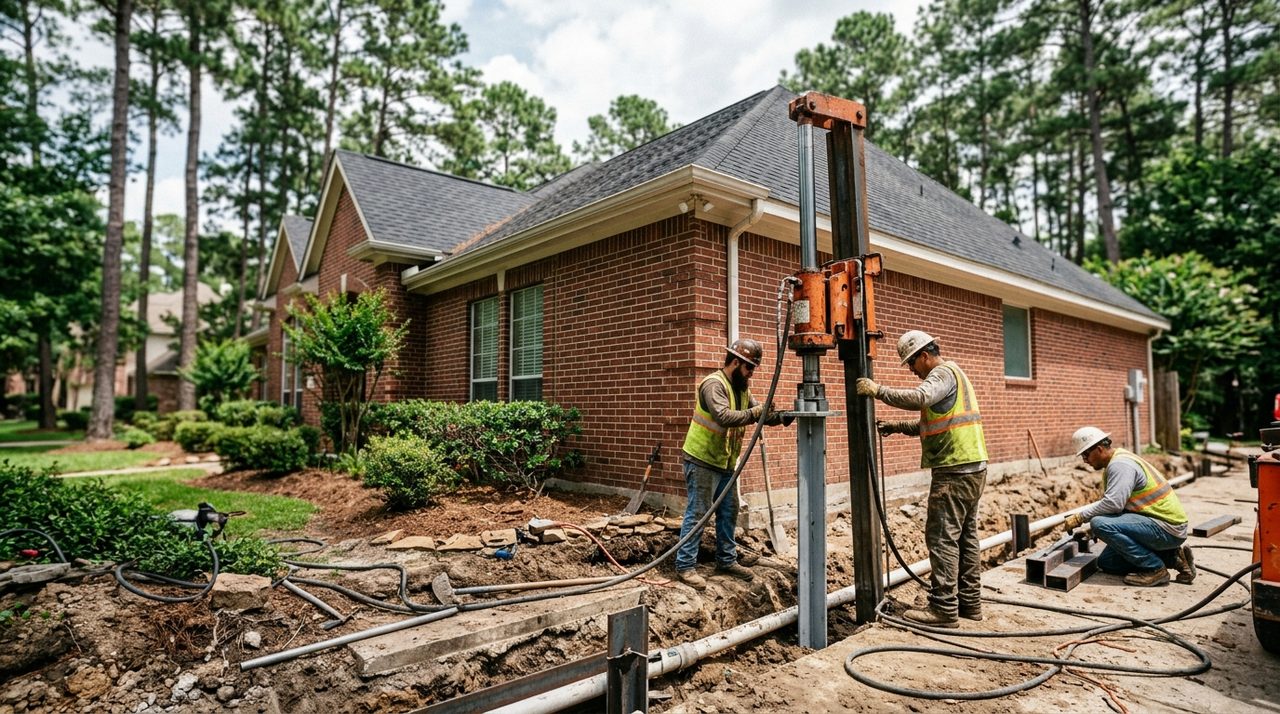
The majority of Spring's owner-occupied homes — 74.8% ownership rate, median year built 1991 — sit on slab-on-grade foundations poured directly on Houston Black and Beaumont clay formations. These clays swell measurably when wet and contract sharply during dry stretches, a cycle that repeats every year and accumulates damage over decades. In Spring's ranch-style and two-story brick-veneer homes, the signature damage shows up as diagonal stair-step mortar cracks at corners, doors that jam seasonally, and interior drywall cracks that reopen each summer even after patching — all signs that the slab is moving differentially rather than uniformly.
What a good pro does
A qualified foundation contractor working in Spring should perform a level survey across multiple interior points to map the direction and magnitude of movement before recommending any method. For homes showing recurring seasonal cracking without progressive settlement, a structured soaker-hose irrigation program around the slab perimeter — maintaining consistent soil moisture — often stabilizes movement before expensive underpinning becomes necessary. If piering is warranted, get at least three written proposals specifying pier count, depth to bearing stratum, and the method (pressed piling versus steel push pier), because contractor preference often drives recommendations more than soil conditions alone.
Sources: International Residential Code (as adopted by City of Houston), Harris County Flood Control District
Why it matters to you
Most online guides and even some contractors default to City of Houston permit procedures, but the vast majority of Spring addresses fall within unincorporated Harris County, meaning permits for foundation underpinning work go through the Harris County Engineering Department, not the Houston Permitting Center. The inspection timelines, submittal requirements, and fee schedules differ, and a contractor who routinely pulls Houston permits may be unfamiliar with the county's process — leaving you with unpermitted work that surfaces as a liability during a resale inspection. A small number of Spring properties near incorporated city boundaries may fall in ETJ zones requiring coordination with Houston, so jurisdiction must be confirmed at the property level before any contract is signed.
What a good pro does
Before signing a foundation repair contract, ask the contractor to identify the specific permit jurisdiction for your address — Harris County Engineering Department versus any ETJ overlap — and confirm they have pulled permits under that office before. Texas does not issue a standalone state license for foundation repair contractors, so the permit record is one of the few objective accountability mechanisms available to you. Request the permit number and confirm inspection scheduling directly with the county rather than relying solely on the contractor's word.
Sources: Municipal permit office (see area profile), Texas Department of Licensing & Regulation, City of Houston Permitting Center
Why it matters to you
Spring has no single area-wide HOA — instead, most post-1970 subdivisions carry deed-tied mandatory property owners' associations, each with its own architectural review board and approval timeline. Exterior foundation work — perimeter trenching, pier installation, mudjacking equipment access — is routinely classified as an exterior modification requiring prior written HOA approval. Skipping that step risks a violation notice, forced remediation of landscaping disturbed during the repair, or fines, all of which add cost and stress to what is already a significant project. Identifying the correct HOA requires checking Harris County Clerk deed records or the TREC HOA Management Certificate Database, since subdivision names and HOA corporate names frequently differ.
What a good pro does
Before scheduling any contractor site visit, pull your deed from the Harris County Clerk's records to confirm your POA's name and contact, then request the architectural review application and timeline in writing. Many Spring HOAs complete exterior reviews within 15–30 days if the application is complete, so initiating this process in parallel with getting contractor quotes adds no net delay. A reputable foundation contractor familiar with Spring subdivisions will ask about HOA requirements during the initial inspection rather than treating them as an afterthought.
Sources: Local HOA / deed restrictions (see area profile), Municipal permit office (see area profile)
Why it matters to you
Winter Storm Uri in February 2021 burst under-slab cast-iron and older PVC drain lines across thousands of Harris County homes, including many of Spring's 1970s and 1980s subdivisions where cast-iron was the standard drain material. A significant number of those repairs were limited to above-slab wall patches, leaving cracked under-slab lines intact. Three-plus years later, slow leaks from those lines are still saturating clay directly beneath slabs — causing localized heave followed by settlement as soil structure deteriorates. Homeowners in Spring homes built before 1990 who are now seeing new interior cracks or sloped floors should not assume soil movement alone is the cause.
What a good pro does
Before any foundation repair contract is signed on a pre-1990 Spring home — particularly one that had significant interior water damage in February 2021 — insist on a hydrostatic plumbing test of the under-slab drain system. This test, which runs roughly $250–$400 as a standalone service, pressurizes the drain lines to reveal active leaks; it must be performed or overseen by a plumber licensed through the Texas State Board of Plumbing Examiners. If a leak is confirmed, the plumbing must be repaired first — otherwise, any foundation work done over a still-leaking line will be compromised within a few years.
Sources: Texas State Board of Plumbing Examiners, International Residential Code (as adopted by City of Houston)
Hiring foundation repair in Spring? Spring is a large, mostly unincorporated area of Harris County comprising dozens of distinct subdivisions, each with its own HOA rules and deed restrictions. Homeowners here primarily deal with maintaining 1970s–2000s era slab-on-grade suburban homes, with common needs including HVAC replacement, foundation monitoring on expansive clay soils, and roof repairs. Proximity to Spring Creek and Cypress Creek tributaries means flood risk varies dramatically by subdivision, making property-specific flood zone verification essential before any major renovation.
Building era
1970s–2000s, with continued new construction near Grand Parkway (SH-99) in the 2010s–2020s.
Typical style
One- and two-story brick veneer detached single-family homes in traditional, ranch, and contemporary suburban styles with attached two-car garages.
Foundations
Slab-on-grade (dominant); pier-and-beam is rare and limited to occasional older properties.
Common systems
Central HVAC systems (many original units in 1970s–1980s homes are past useful life), copper or CPVC plumbing with some polybutylene in 1980s–early 1990s builds, and 100–200 amp electrical panels typical of era.
What that means for repairs
Kitchen and bathroom remodels are common in 1970s–1990s homes. HVAC system replacements are frequent due to system age. Foundation repair is a recurring need due to expansive clay soils and seasonal moisture fluctuation. Roof replacements are common on 20+ year homes after hail events.
Permit jurisdiction
Harris County Engineering Department for unincorporated areas (most of Spring); some portions within City of Houston ETJ may require Houston Permitting Center coordination.
HOA & deed restrictions
No single area-wide HOA exists. Most post-1970 subdivisions have mandatory property owners' associations (POAs) with deed-tied membership. Some older pockets have voluntary civic clubs or no active HOA. Specific HOA identity must be confirmed via Harris County Clerk deed records or TREC HOA Management Certificate Database.
Historic districts
No City of Houston historic district designation confirmed. Spring is largely unincorporated Harris County with no known HAHC-designated historic districts.
Contractor note
Contractors must verify whether a property falls within an incorporated city or unincorporated Harris County, as permit requirements and inspections differ. HOA architectural review and approval is required in most subdivisions before exterior modifications.
FEMA flood zone
FEMA Zone X (low flood risk) per official NFHL data. However, Spring encompasses areas near Spring Creek and Cypress Creek tributaries where flood risk can vary significantly by subdivision and specific lot. Property-level FIRM verification is strongly recommended.
Hurricane Harvey impact
Hurricane Harvey caused widespread flooding across north Harris County in 2017, with neighborhoods along Spring Creek and Cypress Creek corridors experiencing varying degrees of inundation. A single authoritative list of affected Spring subdivisions is not publicly compiled — property-specific impact should be verified through Harris County Flood Control District mapping tools and seller disclosures.
Heat & humidity load
Sustained 95°F+ temperatures and high humidity stress HVAC systems heavily, especially aging units in 1970s–1980s homes. Expansive clay soils contract during summer drought, increasing foundation movement risk. Attic temperatures can exceed 150°F, accelerating roofing material degradation and making attic insulation upgrades a common summer-driven project.
Working with contractors here
Contractors in Spring most commonly handle HVAC replacements, foundation repair, roof replacements, and kitchen/bath remodels driven by the aging 1970s–2000s housing stock. Foundation work is particularly prevalent due to the area's expansive clay soils and seasonal moisture cycles. Job scoping must account for subdivision-specific HOA architectural guidelines, which frequently regulate exterior colors, materials, fencing, and even contractor work hours. Because Spring is largely unincorporated Harris County, permits are handled through county engineering rather than the City of Houston, and contractors should verify jurisdiction boundaries on a per-property basis. Properties near creek corridors may require additional floodplain development permits even if the lot itself is mapped Zone X.
Local Tip
Always ask for a written estimate before work begins. Texas contractors are required to provide one on jobs over $1,000.
Spring is a large, mostly unincorporated area of Harris County comprising dozens of distinct subdivisions, each with its own HOA rules and deed restrictions. Homeowners here primarily deal with maintaining 1970s–2000s era slab-on-grade suburban homes, with common needs including HVAC replacement, foundation monitoring on expansive clay soils, and roof repairs. Proximity to Spring Creek and Cypress Creek tributaries means flood risk varies dramatically by subdivision, making property-specific flood zone verification essential before any major renovation.
Source: U.S. Census Bureau, ACS 5-Year 2023
Most of Spring maps to FEMA Zone X (low mapped flood risk), but Houston's flash-flood reality means even low-risk blocks benefit from smart drainage and storm-hardened installs.
Source: FEMA National Flood Hazard Layer (NFHL). Flood zones vary by parcel — verify your individual FIRM panel.
Houston's flash-flood reality means even low-mapped-risk areas like Spring, TX can see sheet flow accumulate against a foundation during a slow-moving Gulf system, so verify that your perimeter drainage is clear and properly sloped before hurricane season opens. A TDLR-licensed foundation contractor can add or reposition surface drains to intercept runoff before it softens the clay bearing layer beneath your slab. As a Harris County community, Spring may follow county rather than City of Houston storm rebuild rules.
Hail itself does not crack a concrete foundation, but the insurance repair process — contractors dropping equipment, vibrating compactors near the structure — can disturb marginally stable piers in Spring, TX. Coordinate a brief foundation check with a TDLR-licensed contractor before and after any major roof or exterior repair project that involves heavy equipment operating near your home. Confirm the current FEMA panel for your Spring parcel — the area maps to Zone X, but adjacent lots can differ.
Ice loading from roof accumulation during a hard freeze transfers compressive stress to your foundation corners, and in Spring, TX that added load on clay subgrade that has stiffened from cold can create corner settlement that persists after the thaw. A TDLR-licensed foundation contractor should inspect visible brick-to-foundation transitions and interior door frames after any multi-day freeze event, even if no pipe damage occurred. As a Harris County community, Spring may follow county rather than City of Houston storm rebuild rules.
Sources: FEMA National Flood Hazard Layer (NFHL), Ready.gov -- Hurricanes, CenterPoint Energy -- Storm Center, City of Houston -- Emergency Preparedness, Ready.gov -- Winter Weather, Harris County Flood Control District
Houston-specific estimators to plan your project before you call a pro. All results are planning estimates — a licensed local pro confirms the details on site.
Grouped by mature root aggression & water demand.
Trunk center to the nearest exterior wall.
The root zone likely reaches your foundation's soil during Houston's dry summers, when clay shrinks most. Watch for sticking doors and diagonal cracks, keep soil moisture even with a soaker hose during drought, and have a foundation pro evaluate if you see any movement.
Find a Houston foundation pro →This is a planning estimate only — actual requirements depend on an on-site assessment by a licensed Houston pro. Guidance is based on general species root behavior in expansive clay, not a soil test.
Disconnect & drain every outdoor hose bib
Remove hoses, drain the spigots, and cover each with an insulated faucet sock. Un-drained hose bibs are the #1 burst point in a Houston freeze.
Insulate exposed pipes in the attic & garage
Wrap any pipe in an unconditioned space (attic runs, garage walls) with foam sleeves. Houston homes rarely insulate these because they only matter a few nights a year — which is exactly why they burst.
Open cabinet doors & keep a pencil-width drip
On hard-freeze nights, open kitchen/bath cabinets so warm air reaches the pipes and let faucets on exterior walls drip to relieve pressure.
Protect the attic/garage water heater & its lines
An attic or garage tank sits in unconditioned space. Insulate the cold-inlet and hot-outlet lines and confirm the emergency drain pan is clear so a leak doesn't reach the ceiling.
This is a planning estimate only — actual requirements depend on an on-site assessment by a licensed Houston pro. If a pipe has already burst, shut off your main water supply and call a licensed Houston plumber immediately — freeze bursts flood fast.
Sources: Municipal permit office (see area profile)
Sources: FEMA National Flood Hazard Layer (NFHL)Harris County Flood Control District
Sources: Local HOA / deed restrictions (see area profile)