Closed
301 Slossen St, Webster, TX 77598
Webster's predominant 1970s–1990s slab-on-grade homes sit on Harris County's expansive coastal clay soils, where decades of wet-dry cycling have quietly stressed foundations that are now 30–50 years old — well past the point where differential movement becomes visible in cracked brick veneer and sticking doors. All foundation repair permits in Webster run through the City of Webster's own permit office, not Houston or Harris County, so homeowners need a contractor who knows that jurisdiction specifically. This page explains the four challenges most relevant to Webster's housing stock and what a competent repair looks like here.
Ranked by verified Google rating × review volume × verification tier. How we rank →
Some highly-rated pros serve Webster from nearby and may not keep a Webster street address. Those are listed under "Also serving Webster" with their real city and distance, so you always know where each business is based.
301 Slossen St, Webster, TX 77598
455 E Medical Center Blvd Ste 275, Webster, TX 77598
711 W Bay Area Blvd suite: 525, Webster, TX 77598
Highly-rated pros based nearby who cover Webster. Distance shown from the Webster area.
Serving Webster Based in Clear Lake · 1 mi away
Serving Webster Based in Clear Lake · 1.5 mi away
Serving Webster Based in Clear Lake · 1.5 mi away
Serving Webster Based in League City · 2.5 mi away
Serving Webster Based in League City · 2.5 mi away
Serving Webster Based in Clear Lake · 2.7 mi away
Serving Webster Based in Friendswood · 3.2 mi away
Why it matters to you
Webster's median home was built in 1992, placing the bulk of the housing stock squarely in the age range where original grade beams are vulnerable to decades of shrink-swell cycling on Harris County's expansive clay. The La Niña–driven dry stretches of 2022–2023 baked soil away from slab edges across Southeast Harris County, and when heavy rain returned the voids filled with water rather than soil — eroding the bearing zone under the perimeter beam. On Webster's typical single-story ranch homes, you often see the first symptom as a gap opening between brick veneer and a concrete porch slab, or interior doors in the front half of the house that suddenly won't latch.
What a good pro does
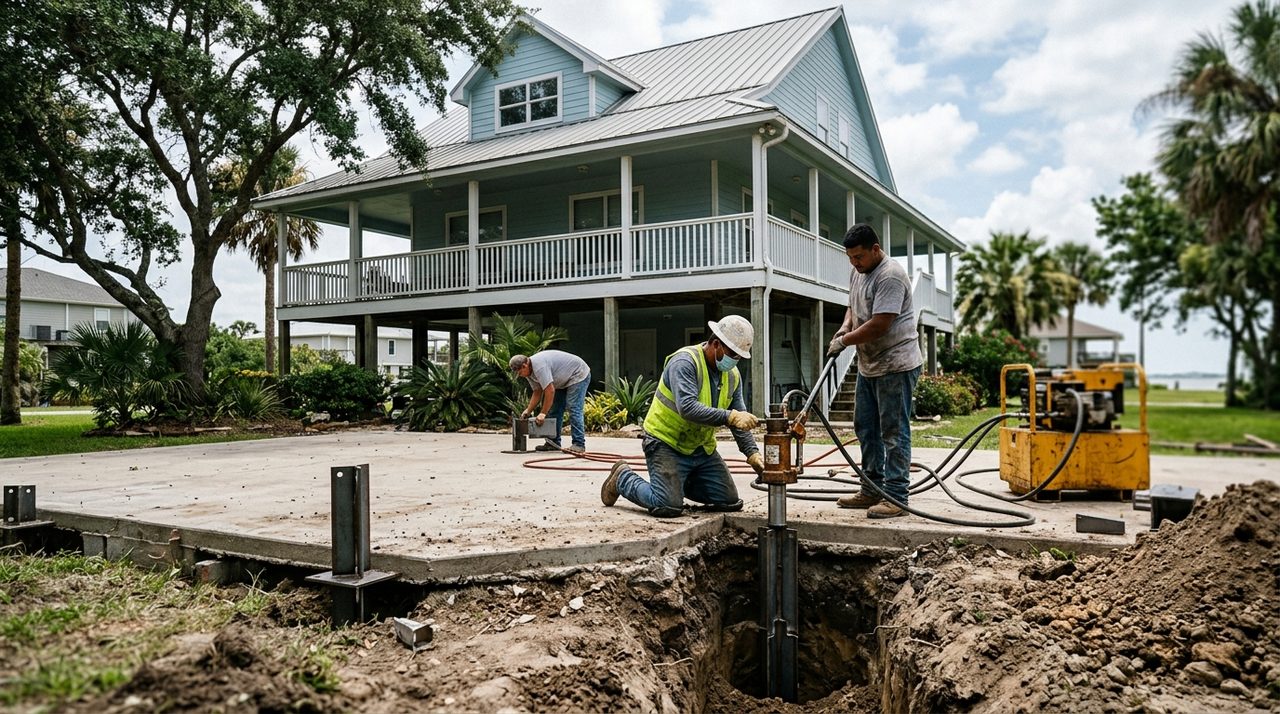
A qualified contractor will probe the perimeter for void depth before recommending any lift or underpinning. For moderate voids without significant settlement, controlled polyurethane foam injection ($2,000–$5,000 estimated) can fill and stabilize the cavity without the disruption of full pier installation. Going forward, a perimeter soaker-hose irrigation schedule during dry months — keeping the clay at consistent moisture — is the primary prevention tool for Webster lots with limited shade canopy.
Sources: Municipal permit office (see area profile), International Residential Code (as adopted by City of Houston)
Why it matters to you
Webster's oldest homes — particularly those in the original town grid from the 1950s through early 1980s — were built with cast-iron under-slab drain lines that took the brunt of Winter Storm Uri's February 2021 freeze event. Many homeowners patched interior walls but never addressed cracked under-slab pipe segments, leaving slow water intrusion directly under the slab. On Houston-area clay, a persistent under-slab leak does not just cause corrosion — it saturates and destabilizes the clay bearing layer, producing localized heave followed by accelerated settlement as soil structure breaks down. A foundation contractor seeing isolated interior settlement on a pre-1990 Webster home should flag this pattern immediately.
What a good pro does
Before signing any foundation repair contract, insist on a hydrostatic plumbing test performed by a Texas State Board of Plumbing Examiners–licensed plumber — this test costs an estimated $250–$400 and will identify active under-slab leaks that a visual inspection misses entirely. If a leak is confirmed, the plumbing scope must be completed first, because piering over an active leak will not hold. Any plumbing repair under the slab requires its own permit through the City of Webster permit office, separate from the foundation repair permit.
Sources: Texas State Board of Plumbing Examiners, Municipal permit office (see area profile)
Why it matters to you
Many Webster homes built between the late 1970s and mid-1990s received pressed concrete piling repairs during earlier ownership — a method that was the Houston-area standard at the time but is now recognized as unreliable on deep expansive clay because the pilings often do not reach stable bearing soil. A homeowner in one of Webster's established subdivisions who buys a home with a prior disclosure of foundation work may be inheriting a repair that is already re-failing, and a new contractor who simply adds more pressed pilings over the existing set compounds the problem. The difference between a $7,000 pressed-piling job and a $15,000–$22,000 steel push-pier job is not just price — it is depth to competent bearing.
What a good pro does
Ask every contractor bidding the job to specify the target depth for load-bearing soil and how they determined it — a responsible contractor references local soil boring data or prior pier-installation logs for the area. Steel push piers, installed at an estimated $1,200–$1,800 per pier, are driven until they reach refusal on competent soil rather than stopping at a preset depth, which makes them better suited to Webster's variable clay profile. Get at least three written proposals that include pier count, installation depth, and load-transfer method before deciding — and confirm each contractor will pull a City of Webster foundation repair permit before work begins.
Sources: Municipal permit office (see area profile), International Residential Code (as adopted by City of Houston), Texas Department of Licensing & Regulation
Why it matters to you
Webster has no city-wide HOA, but newer master-planned sections — most notably Edgewater, with construction dating to the 2000s–2010s — have mandatory HOAs with active architectural control committees. Foundation repair on these homes typically requires perimeter trenching for pier installation, which is visible exterior work that must be approved by the HOA before the contractor breaks ground. Homeowners who skip this step can face HOA fines and be required to restore landscaping or hardscaping to original specifications at their own expense — costs that can rival the repair itself on Edgewater lots with manicured front landscaping.
What a good pro does
Before scheduling any foundation contractor walkthrough in Edgewater or other newer Webster subdivisions, pull your deed restrictions and HOA management contact from the Harris County real property records or the TREC HOA Management Certificate database. Submit the contractor's scope-of-work drawing to the architectural review committee and get written approval in hand before the City of Webster permit is applied for — both approvals are needed, and the HOA process can add two to four weeks to project lead time. Document all repair work with photographs and keep the City of Webster permit card and final inspection sign-off permanently in your home file, as Texas sellers must disclose known foundation movement and repairs on the TREC seller's disclosure form at resale.
Sources: Local HOA / deed restrictions (see area profile), Municipal permit office (see area profile)
Hiring foundation repair in Webster? Webster is a small incorporated city in SE Harris County near Clear Lake and the NASA corridor, with housing stock ranging from 1950s-era homes in the original town grid to 2000s master-planned communities like Edgewater. Homeowners here deal with aging slab-on-grade foundations on coastal clay soils, subdivision-specific deed restrictions, and proximity to Clear Creek floodplain areas. Permitting runs through the City of Webster rather than Houston or Harris County, which contractors must account for in project planning.
Building era
Mixed: some mid-century (1950s–1960s) in the original town grid, with the majority built from the 1970s through the 1990s; newer infill, townhomes, and master-planned sections (e.g., Edgewater) date to the 2000s–2010s.
Typical style
Single-story and 1.5-story ranch/suburban traditional brick homes dominate older subdivisions; newer sections feature contemporary suburban traditional and Mediterranean-influenced designs; townhomes and garden-style condos near NASA Rd 1 and I-45 are typically contemporary stucco/brick construction.
Foundations
Predominantly slab-on-grade for post-1960 suburban construction; pier-and-beam may exist in some older or custom structures but is uncommon.
Common systems
1970s–1990s homes typically have original or once-replaced central HVAC systems, copper or CPVC plumbing (some older homes may have galvanized supply lines), and 100–200 amp electrical panels. Newer 2000s construction features modern HVAC with higher SEER ratings and PEX plumbing.
What that means for repairs
Kitchen and bath remodels in 1970s–1990s homes are common as these properties age past the 30–40 year mark. HVAC replacements, slab foundation repair on expansive clay soils, and re-roofing after storm damage are frequent projects. Newer communities like Edgewater require HOA architectural approval before exterior modifications.
Permit jurisdiction
City of Webster Permitting (Webster is an incorporated city with its own permit authority).
HOA & deed restrictions
No single city-wide HOA exists. HOAs and POAs operate on a subdivision-by-subdivision basis. Master-planned communities like Edgewater have mandatory HOAs with architectural controls and dues. Condo complexes have mandatory council-of-co-owners associations. Some older platted areas may have lapsed or inactive deed restrictions. Confirm HOA status per property via Harris County real property records or the TREC HOA Management Certificate database.
Historic districts
No City of Houston historic district designation confirmed. Webster is an independently incorporated city with no known local historic district overlay.
Contractor note
Contractors must pull permits through the City of Webster, not Houston or Harris County. Each subdivision may have its own HOA architectural review process that must be satisfied before exterior work begins, particularly in Edgewater and newer communities.
FEMA flood zone
FEMA Zone X (low flood risk) per official NFHL data. However, properties near Clear Creek along Webster's southern boundary may fall within higher-risk flood zones; homeowners in those areas should verify their specific parcel's FEMA designation. Clear Creek has historically been a source of localized flooding in the region.
Hurricane Harvey impact
SE Harris County, including the Clear Creek and Clear Lake corridor, experienced significant rainfall and localized flooding during Harvey, particularly near bayous and the Clear Creek floodplain. However, the worst catastrophic structural flooding in Harris County was concentrated in other areas (Addicks/Barker, Greens Bayou). No city-level official dataset specifically quantifying the number of flooded Webster homes was identified; impact appears to have been moderate and concentrated near low-lying drainage areas rather than catastrophic across the entire city.
Heat & humidity load
Houston's extreme summer heat and humidity drive heavy HVAC demand, especially in 1970s–1990s homes with aging or undersized systems. Slab-on-grade foundations on coastal clay soils are subject to seasonal expansion and contraction, making foundation monitoring and proper drainage maintenance critical during dry summer periods. Coastal proximity increases salt air corrosion risk on exterior metal components and roofing fasteners.
Working with contractors here
Contractors in Webster most commonly handle HVAC replacements, foundation repairs, and re-roofing on the large stock of 1970s–1990s suburban homes that have reached or exceeded their major system lifespans. Slab foundation issues driven by expansive clay soils are a recurring concern, particularly after extended dry spells followed by heavy rain. Kitchen and bath remodels are popular in these aging homes, often requiring updated plumbing and electrical to meet current code. In newer communities like Edgewater, contractors should expect HOA architectural review requirements and potentially stricter material and design specifications. Because Webster is independently incorporated, all permits must go through the City of Webster rather than Houston or Harris County, which can affect timelines and inspection scheduling.
Local Tip
Always ask for a written estimate before work begins. Texas contractors are required to provide one on jobs over $1,000.
Webster is a small incorporated city in SE Harris County near Clear Lake and the NASA corridor, with housing stock ranging from 1950s-era homes in the original town grid to 2000s master-planned communities like Edgewater. Homeowners here deal with aging slab-on-grade foundations on coastal clay soils, subdivision-specific deed restrictions, and proximity to Clear Creek floodplain areas. Permitting runs through the City of Webster rather than Houston or Harris County, which contractors must account for in project planning.
Source: U.S. Census Bureau, ACS 5-Year 2023
Most of Webster maps to FEMA Zone X (low mapped flood risk), but Houston's flash-flood reality means even low-risk blocks benefit from smart drainage and storm-hardened installs; risk climbs sharply on blocks nearest Clear Creek, where it varies parcel to parcel.
Source: FEMA National Flood Hazard Layer (NFHL). Flood zones vary by parcel — verify your individual FIRM panel.
Houston's flash-flood reality means even low-mapped-risk areas like Webster, TX can see sheet flow accumulate against a foundation during a slow-moving Gulf system, so verify that your perimeter drainage is clear and properly sloped before hurricane season opens. A TDLR-licensed foundation contractor can add or reposition surface drains to intercept runoff before it softens the clay bearing layer beneath your slab. Because Webster drains toward Clear Creek, block-level runoff can differ sharply from the mapped zone.
Even with low mapped flood risk, Webster, TX is not immune to the localized sheet flow that accompanies a Houston severe thunderstorm, and repeated minor inundation at the foundation perimeter sustains the clay moisture that drives slow heave cycles. A pre-storm season inspection confirming that soil grade, splash blocks, and downspout extensions all direct water away from the slab is the most cost-effective foundation repair step you can take. As a Harris County community, Webster may follow county rather than City of Houston storm rebuild rules.
Winter Storm Uri's multi-day freeze caused Houston clay soils to go through freeze-thaw cycling not common in the region, and even low-flood-risk neighborhoods in Webster, TX saw new door-sticking and brick-step cracking appear in the spring following the storm. A post-winter Zip-Level survey establishes whether that movement is seasonal and self-correcting or progressive and in need of pier work before summer drying amplifies the differential. As a Harris County community, Webster may follow county rather than City of Houston storm rebuild rules.
Sources: FEMA National Flood Hazard Layer (NFHL), Ready.gov -- Hurricanes, CenterPoint Energy -- Storm Center, City of Houston -- Emergency Preparedness, Ready.gov -- Winter Weather, Harris County Flood Control District
Houston-specific estimators to plan your project before you call a pro. All results are planning estimates — a licensed local pro confirms the details on site.
Grouped by mature root aggression & water demand.
Trunk center to the nearest exterior wall.
The root zone likely reaches your foundation's soil during Houston's dry summers, when clay shrinks most. Watch for sticking doors and diagonal cracks, keep soil moisture even with a soaker hose during drought, and have a foundation pro evaluate if you see any movement.
Find a Houston foundation pro →This is a planning estimate only — actual requirements depend on an on-site assessment by a licensed Houston pro. Guidance is based on general species root behavior in expansive clay, not a soil test.
Disconnect & drain every outdoor hose bib
Remove hoses, drain the spigots, and cover each with an insulated faucet sock. Un-drained hose bibs are the #1 burst point in a Houston freeze.
Insulate exposed pipes in the attic & garage
Wrap any pipe in an unconditioned space (attic runs, garage walls) with foam sleeves. Houston homes rarely insulate these because they only matter a few nights a year — which is exactly why they burst.
Open cabinet doors & keep a pencil-width drip
On hard-freeze nights, open kitchen/bath cabinets so warm air reaches the pipes and let faucets on exterior walls drip to relieve pressure.
Protect the attic/garage water heater & its lines
An attic or garage tank sits in unconditioned space. Insulate the cold-inlet and hot-outlet lines and confirm the emergency drain pan is clear so a leak doesn't reach the ceiling.
This is a planning estimate only — actual requirements depend on an on-site assessment by a licensed Houston pro. If a pipe has already burst, shut off your main water supply and call a licensed Houston plumber immediately — freeze bursts flood fast.
Sources: Municipal permit office (see area profile)
Sources: FEMA National Flood Hazard Layer (NFHL)Harris County Flood Control District
Sources: Municipal permit office (see area profile)
Sources: Local HOA / deed restrictions (see area profile)