Open Now
11707 S Sam Houston Pkwy W Suite K, Houston, TX 77031
Missouri City's 24-plus subdivision HOAs and a housing stock that ranges from 1960s slab-on-grade ranch homes to 2010s master-planned builds mean garage door work here is never one-size-fits-all: a door that passes architectural review in Quail Green may violate recorded CCRs two streets away in a different association. Fort Bend County's expansive black clay soil affects the oldest core neighborhoods hardest, racking door frames and binding tracks in ways that repeat every wet-dry cycle — and the City of Missouri City runs its own Building & Standards permitting process entirely separate from Houston or Fort Bend County. Read on to understand which issues actually apply to your specific section of Missouri City and what they cost to fix.
Ranked by verified Google rating × review volume × verification tier. How we rank →
Some highly-rated pros serve Missouri City from nearby and may not keep a Missouri City street address. Those are listed under "Also serving Missouri City" with their real city and distance, so you always know where each business is based.
11707 S Sam Houston Pkwy W Suite K, Houston, TX 77031
Highly-rated pros based nearby who cover Missouri City. Distance shown from the Missouri City area.
Serving Missouri City Based in Stafford · 3.4 mi away
Serving Missouri City Based in Stafford · 3.6 mi away
Serving Missouri City Based in Meyerland · 3.9 mi away
Serving Missouri City Based in Sharpstown · 3.9 mi away
Serving Missouri City Based in Sugar Land · 4 mi away
Serving Missouri City Based in Sugar Land · 4.1 mi away
Serving Missouri City Based in Sharpstown · 4.5 mi away
Serving Missouri City Based in Sugar Land · 4.6 mi away
Why it matters to you
Missouri City has at least 24 separate HOA and POA associations, each with its own recorded CCRs that may specify permitted panel styles, colors, and even whether carriage-style hardware is allowed. A homeowner in The Manors who orders a flush steel door without first submitting to the architectural review committee can face fines and a mandatory reinstall at their own expense — even if the door itself is perfectly functional and code-compliant.
What a good pro does
Before signing any install contract, pull your lot's restrictions from Fort Bend County Clerk records and identify the specific management company for your association. A knowledgeable Missouri City installer will supply sample spec sheets to your HOA's architectural committee and confirm written approval before ordering materials, not after. Budget an extra one-to-three weeks for ARC review cycles when planning the project timeline.
Sources: Local HOA / deed restrictions (see area profile), Municipal permit office (see area profile)
Why it matters to you
Missouri City's oldest sections — platted in the 1960s through 1980s — sit on the same Fort Bend County expansive black clay that consistently drives high demand for foundation repair across the city. Annual wet-dry cycles cause slab-on-grade foundations to heave and settle differentially, gradually distorting the rough opening around a garage door: tracks go out of plumb, rollers bind, and bottom weatherseals gap open. Homeowners in these older core blocks often notice the door getting harder to open each summer as soils dry and contract.
What a good pro does
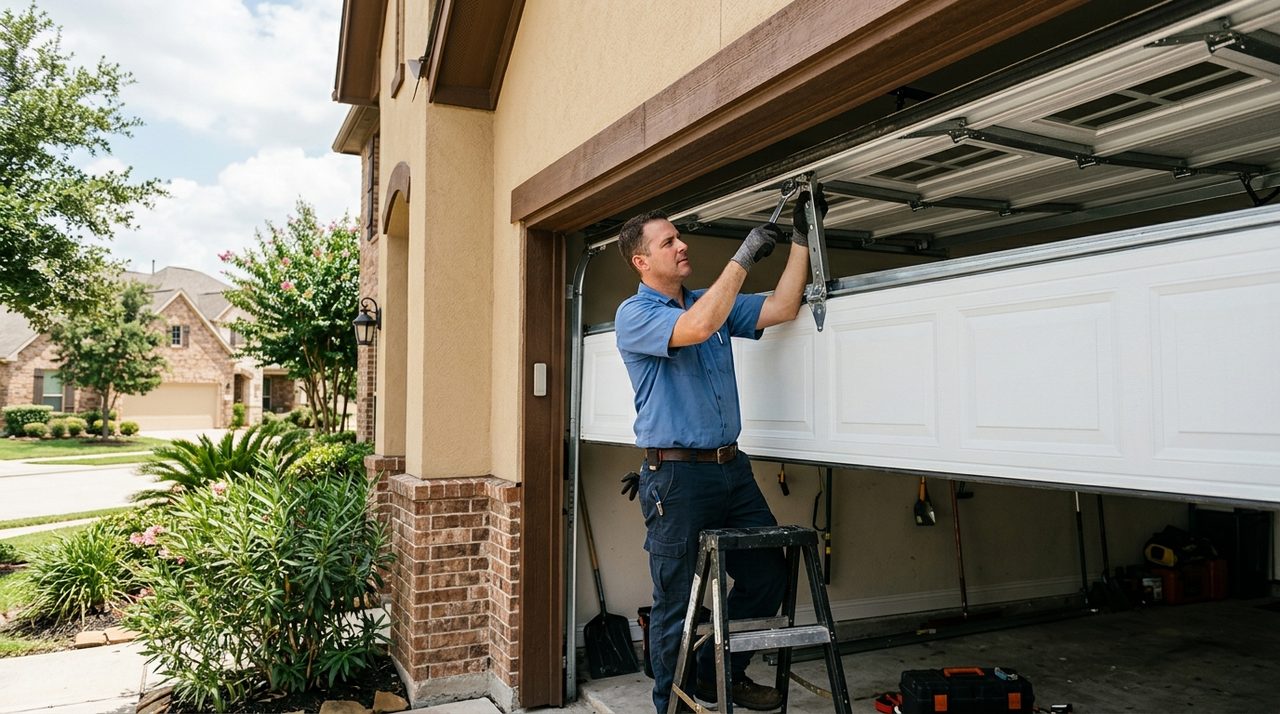
A qualified pro should check the door opening with a level and measure corner-to-corner diagonals before quoting any repair — if the frame is racked more than half an inch, adjusting tracks alone is a temporary fix. Full-opening reframe may be required, which triggers a permit with the City of Missouri City Building & Standards Department. Pair the reframe with a nylon-roller upgrade and reinforced bottom seal to extend service intervals.
Sources: Municipal permit office (see area profile), International Residential Code (as adopted by City of Houston)
Why it matters to you
Located roughly 20 miles southwest of Houston's inner Loop, Missouri City sits well within the Gulf Coast humidity band that keeps relative humidity at 65–70 percent year-round and regularly spikes above 90 percent in summer. Torsion springs, cables, and bottom brackets in non-climate-controlled garages corrode at two to three times the rate seen in drier Texas metros; a standard oil-tempered torsion spring set that might last 10,000 cycles in Dallas can fail in five to seven years here, especially in the attached garages common in Missouri City's production-builder homes where exhaust heat and humidity concentrate.
What a good pro does
Ask specifically for galvanized or powder-coated torsion springs rated for coastal humidity, and have the installer apply a silicone-safe lubricant to springs, hinges, and rollers at every service visit — not petroleum-based products that attract dust. Torsion spring replacement for a two-spring system runs approximately $200–$350 as an estimate; scheduling a proactive replacement around the seven-year mark rather than waiting for a break-under-load event avoids the $100–$175 emergency dispatch fee that after-hours calls command.
Sources: ENERGY STAR / U.S. Dept. of Energy
Why it matters to you
Missouri City's production-builder subdivisions from the 1990s and 2000s often feature two- or three-car garages with doors facing west or south to maximize lot yield on the street grid — exactly the orientation that catches peak afternoon sun during Houston's 150-plus hours above 95°F each year. An original single-layer steel door (effectively R-0) on an attached garage transfers enough radiant heat to meaningfully raise temperatures in adjacent living rooms and increase cooling loads; homes with finished or conditioned space above the garage feel this most sharply.
What a good pro does
Replacing a single-layer door with an insulated steel door rated R-13 to R-18 is one of the higher-return envelope upgrades available in Missouri City's suburban layout. Full replacement of a double-car insulated door runs an estimated $1,200–$2,400 installed. The City of Missouri City requires a building permit for full door replacements that alter the structural opening, so confirm your contractor pulls that permit through the city's Building & Standards Department — not Harris County or Houston — before work begins.
Sources: ENERGY STAR / U.S. Dept. of Energy, Municipal permit office (see area profile), International Residential Code (as adopted by City of Houston)
Hiring garage door repair in Missouri City? Missouri City spans decades of development, from 1960s-era core neighborhoods to 2010s master-planned communities, creating a wide range of home service needs. Contractors must navigate subdivision-specific deed restrictions and HOA rules that vary significantly across the city. The municipal permitting process is independent from Houston, and Fort Bend County drainage infrastructure differs from Harris County systems.
Building era
Mixed: 1960s–1980s in older core areas; 1990s–2010s in newer master-planned sections.
Typical style
One- and two-story brick veneer traditional suburban, with some stucco and siding accents in newer sections; production-builder plans predominate.
Foundations
Predominantly slab-on-grade, consistent with post-1960s Fort Bend County suburban construction standards.
Common systems
Older areas (1960s–1980s): original copper or galvanized plumbing, R-22 HVAC systems nearing or past end of life, older electrical panels (potentially Federal Pacific or Zinsco in 1970s homes). Newer areas (1990s–2010s): PEX or CPVC plumbing, R-410A HVAC, 200-amp electrical service.
What that means for repairs
Older core neighborhoods see significant HVAC replacements, re-plumbing from galvanized to PEX, and kitchen/bath remodels. Newer master-planned homes are beginning first-cycle roof replacements and cosmetic updates. Foundation repair is common in older slab-on-grade homes due to Fort Bend County expansive clay soils.
Permit jurisdiction
City of Missouri City Building & Standards Department for properties within city limits. Some ETJ areas may fall under Fort Bend County engineering.
HOA & deed restrictions
No city-wide mandatory HOA. At least 24 separate HOA/POA/community associations operate at the subdivision level. Many subdivisions (e.g., The Manors Owners Association, Quail Green HOA) have mandatory membership with recorded CCRs. Some older areas may have only recorded deed restrictions with no active HOA. Check Fort Bend County Clerk records for specific lot restrictions.
Historic districts
No historic district designation confirmed. Missouri City is an incorporated city in Fort Bend County, not subject to Houston's HAHC jurisdiction.
Contractor note
Missouri City has its own permitting process separate from Houston and Fort Bend County. Contractors must verify whether the property is inside city limits or in the ETJ, as permit requirements and inspection processes differ. Individual HOA architectural review committees may impose additional approval requirements beyond city permits.
FEMA flood zone
FEMA Zone X (low flood risk) per official NFHL data. However, Missouri City is large and individual subdivisions may have different flood zone designations, particularly near Oyster Creek and its tributaries. Property-specific FIRMettes should be checked for parcels near waterways.
Hurricane Harvey impact
No specific Harvey 2017 flood impact data was confirmed for Missouri City neighborhoods in the available research. Fort Bend County experienced significant flooding during Harvey, particularly along the Brazos River corridor, but subdivision-level impact in Missouri City varies. Homeowners should check Fort Bend County Drainage District records and individual property disclosure histories for Harvey-specific flood data.
Heat & humidity load
Fort Bend County's expansive clay soils undergo significant seasonal movement, making foundation monitoring critical during prolonged summer drought. Older HVAC systems in 1960s–1980s homes face extreme strain during Houston summers, and R-22 refrigerant phase-out makes replacement more cost-effective than repair. Newer homes with builder-grade HVAC may still underperform in extreme heat if ductwork was poorly sealed during construction.
Working with contractors here
Missouri City's mixed housing stock creates two distinct contractor markets: older core neighborhoods needing whole-system replacements (HVAC, plumbing re-pipes, electrical panel upgrades, and foundation repair) and newer master-planned communities entering their first major maintenance cycle with roof replacements, water heater swaps, and cosmetic remodels. Foundation work is a consistently high-demand service due to expansive clay soils across Fort Bend County, affecting both old and new construction. Contractors should be prepared for subdivision-specific HOA architectural review requirements that may dictate exterior material choices, fence styles, and even work hours. Job scoping should always include a check with the specific HOA management company, as restrictions vary widely between Missouri City's 24+ organized associations.
Local Tip
Always ask for a written estimate before work begins. Texas contractors are required to provide one on jobs over $1,000.
Missouri City spans decades of development, from 1960s-era core neighborhoods to 2010s master-planned communities, creating a wide range of home service needs. Contractors must navigate subdivision-specific deed restrictions and HOA rules that vary significantly across the city. The municipal permitting process is independent from Houston, and Fort Bend County drainage infrastructure differs from Harris County systems.
Source: U.S. Census Bureau, ACS 5-Year 2023
Most of Missouri City maps to FEMA Zone X (low mapped flood risk), but Houston's flash-flood reality means even low-risk blocks benefit from smart drainage and storm-hardened installs.
Source: FEMA National Flood Hazard Layer (NFHL). Flood zones vary by parcel — verify your individual FIRM panel.
After Beryl 2024 knocked out power across low-flood Houston neighborhoods for more than a week, the value of a battery-backup garage-door opener became undeniable for residents in Missouri City, TX. Schedule a pre-season inspection to confirm torsion springs, cables, and tracks are in working order so the door holds its structural position under sustained tropical winds without opener assistance. Confirm the current FEMA panel for your Missouri City parcel — the area maps to Zone X, but adjacent lots can differ.
Wind is the dominant severe-storm risk for garage doors in Missouri City, TX, and the May 2024 derecho proved that Houston's low-flood-risk neighborhoods are not sheltered from 100-mph straight-line gusts that bow panels and strip tracks from door frames. A TDLR-licensed technician can install a retrofit bracing kit on an existing door for a fraction of full-replacement cost, buying meaningful wind resistance without a new-door budget. Confirm the current FEMA panel for your Missouri City parcel — the area maps to Zone X, but adjacent lots can differ.
Winter Storm Uri 2021 left Houston neighborhoods without CenterPoint power for three to five days while temperatures held below freezing, making a battery-backup garage-door opener one of the most practical investments for Missouri City, TX homeowners heading into winter. Have a TDLR-licensed technician inspect torsion spring condition in the fall, since cold-brittle springs that snap during an ice storm can make the door impossible to move manually or with the opener. Confirm the current FEMA panel for your Missouri City parcel — the area maps to Zone X, but adjacent lots can differ.
Sources: FEMA National Flood Hazard Layer (NFHL), Ready.gov -- Hurricanes, CenterPoint Energy -- Storm Center, City of Houston -- Emergency Preparedness, Ready.gov -- Winter Weather, Harris County Flood Control District
Houston-specific estimators to plan your project before you call a pro. All results are planning estimates — a licensed local pro confirms the details on site.
Disconnect & drain every outdoor hose bib
Remove hoses, drain the spigots, and cover each with an insulated faucet sock. Un-drained hose bibs are the #1 burst point in a Houston freeze.
Insulate exposed pipes in the attic & garage
Wrap any pipe in an unconditioned space (attic runs, garage walls) with foam sleeves. Houston homes rarely insulate these because they only matter a few nights a year — which is exactly why they burst.
Open cabinet doors & keep a pencil-width drip
On hard-freeze nights, open kitchen/bath cabinets so warm air reaches the pipes and let faucets on exterior walls drip to relieve pressure.
Protect the attic/garage water heater & its lines
An attic or garage tank sits in unconditioned space. Insulate the cold-inlet and hot-outlet lines and confirm the emergency drain pan is clear so a leak doesn't reach the ceiling.
This is a planning estimate only — actual requirements depend on an on-site assessment by a licensed Houston pro. If a pipe has already burst, shut off your main water supply and call a licensed Houston plumber immediately — freeze bursts flood fast.
Sources: Municipal permit office (see area profile)
Sources: Local HOA / deed restrictions (see area profile)
Sources: Local HOA / deed restrictions (see area profile)Municipal permit office (see area profile)