Open Now
9402 Glenfield Ct, Houston, TX 77096
Meyerland's position in FEMA Zone AE along Brays Bayou means a clogged gutter is not a minor nuisance — it is a direct threat to foundations and finished interiors that many homeowners have already rebuilt once or twice since 2015. The neighborhood's mix of original 1960s single-story brick ranches and post-Harvey elevated two-story rebuilds creates two very different gutter situations on the same block, each with its own debris patterns, downspout configurations, and drainage consequences that generic metro advice does not address.
Ranked by verified Google rating × review volume × verification tier. How we rank →
Some highly-rated pros serve Meyerland from nearby and may not keep a Meyerland street address. Those are listed under "Also serving Meyerland" with their real city and distance, so you always know where each business is based.
9402 Glenfield Ct, Houston, TX 77096
Highly-rated pros based nearby who cover Meyerland. Distance shown from the Meyerland area.
Serving Meyerland Based in Medical Center · 2.2 mi away
Serving Meyerland Based in West University · 3.6 mi away
Serving Meyerland Based in Westbury · 3.8 mi away
Serving Meyerland Based in Tanglewood · 3.8 mi away
Serving Meyerland Based in Sharpstown · 4 mi away
Serving Meyerland Based in Upper Kirby · 4 mi away
Serving Meyerland Based in Briargrove · 4.5 mi away
Serving Meyerland Based in Medical Center · 5.3 mi away
Serving Meyerland Based in Westbury · 5.4 mi away
Why it matters to you
Meyerland's slab-on-grade homes — including the many original 1960s ranches that were not elevated after Harvey — sit on Houston Black clay that has been repeatedly saturated by Brays Bayou overbank flooding. When gutters overflow and spill water against the foundation perimeter, they add a chronic secondary saturation source on top of an already flood-stressed soil profile, accelerating differential heave and settlement in a neighborhood where foundation repair is already among the most common contractor calls.
What a good pro does
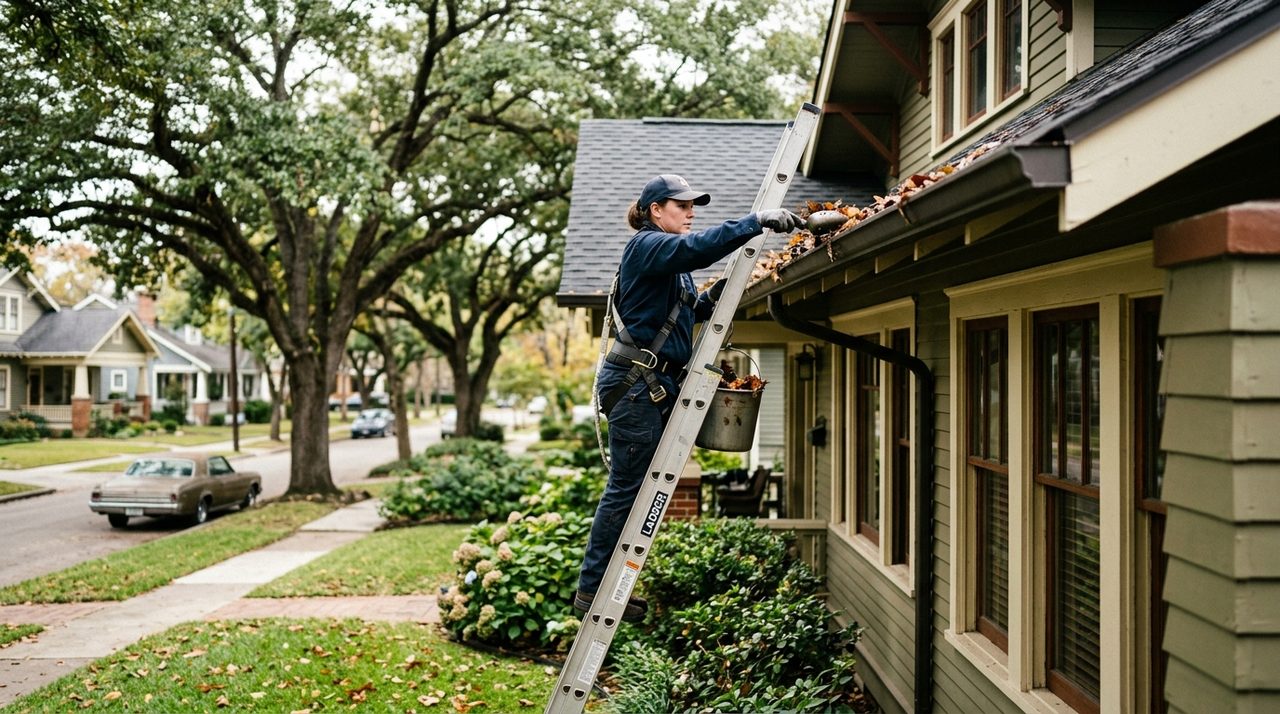
A thorough gutter cleaning here should include a downspout-discharge check: water must be routed well away from the foundation line, ideally into a functioning swale or splash block aimed toward the street rather than pooling along the brick veneer. On original ranch homes with 3-inch gutters, the technician should hand-clear compacted debris rather than relying solely on a blower, then flush each downspout run individually to confirm unobstructed flow to grade.
Sources: Harris County Flood Control District, FEMA National Flood Hazard Layer (NFHL)
Why it matters to you
Post-Harvey elevated homes in Meyerland — those raised 2 to 5 feet above their original grade to meet FEMA Zone AE base flood elevation requirements — have substantially longer downspout runs and additional offset elbows compared to the original ranch configurations. Those extra elbows at the pier-and-beam skirt line are precisely where shingle granules and wind-carried debris from surrounding mature trees compact into plugs that a standard ground-level flush cannot dislodge.
What a good pro does
When quoting an elevated Meyerland rebuild, a competent technician will walk the perimeter and count elbow bends before pricing — a two-story elevated home here can easily have 180–210 linear feet of gutter with six or more 45-degree offset elbows, pushing costs toward the $225–$275 estimated range for a standard clean-and-flush. No City of Houston permit is required for routine cleaning, but homeowners should confirm the crew carries general liability insurance given the added fall exposure on elevated structures.
Sources: City of Houston Permitting Center, FEMA National Flood Hazard Layer (NFHL)
Why it matters to you
The Meyerland Community Improvement Association enforces deed restrictions across all roughly 2,238 homes in the neighborhood, and visible debris spilling over fascia boards or dark algae streaking down brick veneer from a chronically overflowing gutter qualifies as a potential exterior maintenance violation. On the light-colored or white-trimmed post-Harvey rebuilds now common throughout Meyerland, organic staining from a single wet season of deferred cleaning is highly visible from the street and can prompt an MCIA notice.
What a good pro does
Scheduling gutter cleaning twice a year — once after spring pollen and catkin season and once after the fall leaf drop from the neighborhood's live oaks and ornamental trees — keeps fascia and soffit surfaces in compliance before MCIA inspections. Any gutter replacement or fascia repair triggered by the cleaning visit should be verified against MCIA deed restrictions on exterior materials before work begins; the association's office at 4999 W. Bellfort Ave. can confirm allowable finishes.
Sources: Local HOA / deed restrictions (see area profile)
Why it matters to you
Meyerland lots nearest Brays Bayou already contend with residual standing water in yards and swales after heavy rain events, and Harris County Mosquito Control District identifies clogged residential gutters as a primary Aedes aegypti breeding site across the metro. In a neighborhood where outdoor standing water is already elevated relative to the Houston average, even a modest debris dam holding two to three inches of rainwater in a gutter channel can produce a mosquito brood within seven to ten days during the May through October peak season.
What a good pro does
After any cleaning visit, the technician should verify that no low spots remain in the gutter run where water can pool between rain events — this is especially relevant on original 1960s ranch homes where bracket sag or slight pitch misalignment has developed over 60-plus years. A simple string-line or level check at the time of cleaning, followed by a hanger re-set if needed, eliminates the standing-water pocket without requiring a permit from the Houston Permitting Center for what amounts to minor hardware adjustment.
Sources: Harris County Flood Control District, City of Houston Permitting Center
Hiring gutter cleaning in Meyerland? Meyerland is a deed-restricted southwest Houston neighborhood of roughly 2,238 single-family homes, most originally built in the late 1950s–1960s, with a significant wave of post-Harvey rebuilds and elevations since 2017. The neighborhood sits in FEMA Zone AE near Brays Bayou, making flood mitigation, foundation elevation, and water damage restoration among the most critical home service categories. Contractors here must navigate mandatory HOA oversight through the Meyerland Community Improvement Association and City of Houston permitting requirements.
Building era
Late 1950s–1960s (median year built 1962), with substantial post-2017 new construction and rebuilds.
Typical style
Mid-century ranch-style single-story homes (brick veneer, low-sloped roofs) alongside newer two-story traditional/transitional rebuilds.
Foundations
Predominantly slab-on-grade; many post-Harvey rebuilds feature elevated slab foundations raised above base flood elevation.
Common systems
Original homes often have aging central HVAC systems, copper or galvanized plumbing, and older electrical panels (60–100 amp). Rebuilt homes typically have modern high-efficiency HVAC, PEX plumbing, and 200-amp electrical service.
What that means for repairs
Post-flood gut renovations and full rebuilds have been the dominant renovation activity since 2015. Many homeowners have elevated homes, replaced all drywall and insulation, upgraded plumbing to PEX, and installed modern HVAC. Unrenovated original ranch homes still require significant systems updates.
Permit jurisdiction
City of Houston — Houston Permitting Center.
HOA & deed restrictions
Mandatory HOA — Meyerland Community Improvement Association (MCIA), 4999 W. Bellfort Ave., Houston, TX 77035, (713) 729-2167. MCIA maintains a management certificate with the Texas Real Estate Commission and enforces deed restrictions across the neighborhood.
Historic districts
No City of Houston historic district designation confirmed.
Contractor note
Contractors must obtain City of Houston permits for structural, electrical, plumbing, and mechanical work. MCIA deed restrictions may also govern exterior modifications, fencing, and accessory structures — always verify with the HOA before beginning exterior work.
FEMA flood zone
FEMA Zone AE (high flood risk) — source: fema_nfhl. Meyerland is situated adjacent to Brays Bayou, and much of the neighborhood falls within the 100-year floodplain. Properties closest to the bayou and in lower-lying sections face the highest risk.
Hurricane Harvey impact
Meyerland experienced extensive, widespread home flooding during Hurricane Harvey (2017) and is one of Houston's most prominently impacted neighborhoods. The area also flooded significantly during the 2015 Memorial Day Flood and 2016 Tax Day Flood. Sections closest to Brays Bayou (including Meyerland Sections 1–8) were especially hard hit. Hundreds of homes were gutted and many were demolished and rebuilt or elevated. For street-level repetitive loss data, consult the Harris County Flood Education Mapping Tool and FEMA FIRMs.
Heat & humidity load
Original 1960s ranch homes with aging HVAC systems struggle with Houston's extreme summer heat and humidity. Older ductwork in unconditioned attics can develop condensation issues and mold. Post-flood rebuilt homes generally perform better but elevated foundations can expose ductwork and plumbing to extreme heat beneath the structure. Dehumidification and proper attic ventilation are essential across all vintages.
Working with contractors here
The most common contractor work in Meyerland falls into two categories: maintaining and upgrading original 1960s ranch homes, and completing or refining post-Harvey rebuilds and elevations. Plumbing contractors frequently replace galvanized or cast-iron drain lines in original homes, while electricians upgrade older panels to handle modern loads. Foundation repair is common on original slab-on-grade homes due to Houston's expansive clay soils and repeated flood saturation. Flood mitigation work — including home elevation, backflow preventer installation, and flood-resistant material retrofits — remains in high demand. Contractors should scope jobs with the understanding that many homes have had multiple flood events, and hidden moisture damage or improper previous repairs may be present behind walls and under flooring.
Local Tip
Always ask for a written estimate before work begins. Texas contractors are required to provide one on jobs over $1,000.
Meyerland is a deed-restricted southwest Houston neighborhood of roughly 2,238 single-family homes, most originally built in the late 1950s–1960s, with a significant wave of post-Harvey rebuilds and elevations since 2017. The neighborhood sits in FEMA Zone AE near Brays Bayou, making flood mitigation, foundation elevation, and water damage restoration among the most critical home service categories. Contractors here must navigate mandatory HOA oversight through the Meyerland Community Improvement Association and City of Houston permitting requirements.
Source: U.S. Census Bureau, ACS 5-Year 2023
Much of Meyerland maps to FEMA Zone AE (high flood risk), so flood-resilient detailing -- elevated equipment, water-tolerant materials, and drainage-first thinking -- is essential here, not optional; risk climbs sharply on blocks nearest Brays Bayou, where it varies parcel to parcel.
Source: FEMA National Flood Hazard Layer (NFHL). Flood zones vary by parcel — verify your individual FIRM panel.
Beryl 2024 dropped intense rain bands that overwhelmed gutters loaded with spring debris in low-lying neighborhoods — have yours professionally cleared and re-pitched if standing water sits in the trough for more than a few minutes. In areas like Meyerland where FEMA Zone AE inside the 100-year floodplain and proximity to Brays Bayou, proper gutter slope keeps overflow from pooling against exterior walls and worsening flood intrusion. Much of the housing stock predates modern wind codes (median build year 1972), so retrofits matter more here. Confirm the current FEMA panel for your Meyerland parcel — the area maps to Zone AE, but adjacent lots can differ.
Clear standing debris from gutters before the April-through-June severe storm window in Meyerland, because thunderstorm rainfall rates of two-plus inches per hour overwhelm even correctly sized gutters when they're half-full of leaves. A technician can also check that downspout outlets daylight freely at the curb or yard drain rather than backing up against your foundation during FEMA Zone AE inside the 100-year floodplain and proximity to Brays Bayou. In-city Meyerland work falls under City of Houston floodplain and permitting rules.
In Meyerland, where FEMA Zone AE inside the 100-year floodplain and proximity to Brays Bayou already stresses drainage infrastructure, a post-freeze gutter inspection should confirm that no sections shifted or sagged under Uri-style ice loading. A technician can re-pitch and refasten any run that now holds standing water, restoring drainage capacity before the spring severe storm season begins. With a median build year of 1972, the older building stock here is more exposed to hard-freeze damage than newer construction. Confirm the current FEMA panel for your Meyerland parcel — the area maps to Zone AE, but adjacent lots can differ.
Sources: FEMA National Flood Hazard Layer (NFHL), Ready.gov -- Hurricanes, CenterPoint Energy -- Storm Center, City of Houston -- Emergency Preparedness, Ready.gov -- Winter Weather, Harris County Flood Control District
Houston-specific estimators to plan your project before you call a pro. All results are planning estimates — a licensed local pro confirms the details on site.
Disconnect & drain every outdoor hose bib
Remove hoses, drain the spigots, and cover each with an insulated faucet sock. Un-drained hose bibs are the #1 burst point in a Houston freeze.
Insulate exposed pipes in the attic & garage
Wrap any pipe in an unconditioned space (attic runs, garage walls) with foam sleeves. Houston homes rarely insulate these because they only matter a few nights a year — which is exactly why they burst.
Open cabinet doors & keep a pencil-width drip
On hard-freeze nights, open kitchen/bath cabinets so warm air reaches the pipes and let faucets on exterior walls drip to relieve pressure.
Protect the attic/garage water heater & its lines
An attic or garage tank sits in unconditioned space. Insulate the cold-inlet and hot-outlet lines and confirm the emergency drain pan is clear so a leak doesn't reach the ceiling.
This is a planning estimate only — actual requirements depend on an on-site assessment by a licensed Houston pro. If a pipe has already burst, shut off your main water supply and call a licensed Houston plumber immediately — freeze bursts flood fast.
Sources: City of Houston Permitting Center
Sources: Harris County Flood Control District
Sources: Harris County Flood Control DistrictFEMA National Flood Hazard Layer (NFHL)
Sources: Local HOA / deed restrictions (see area profile)
Sources: Harris County Flood Control DistrictFEMA National Flood Hazard Layer (NFHL)