Closed
1135 Grand Central Parkway Suite 357, Conroe, TX 77304
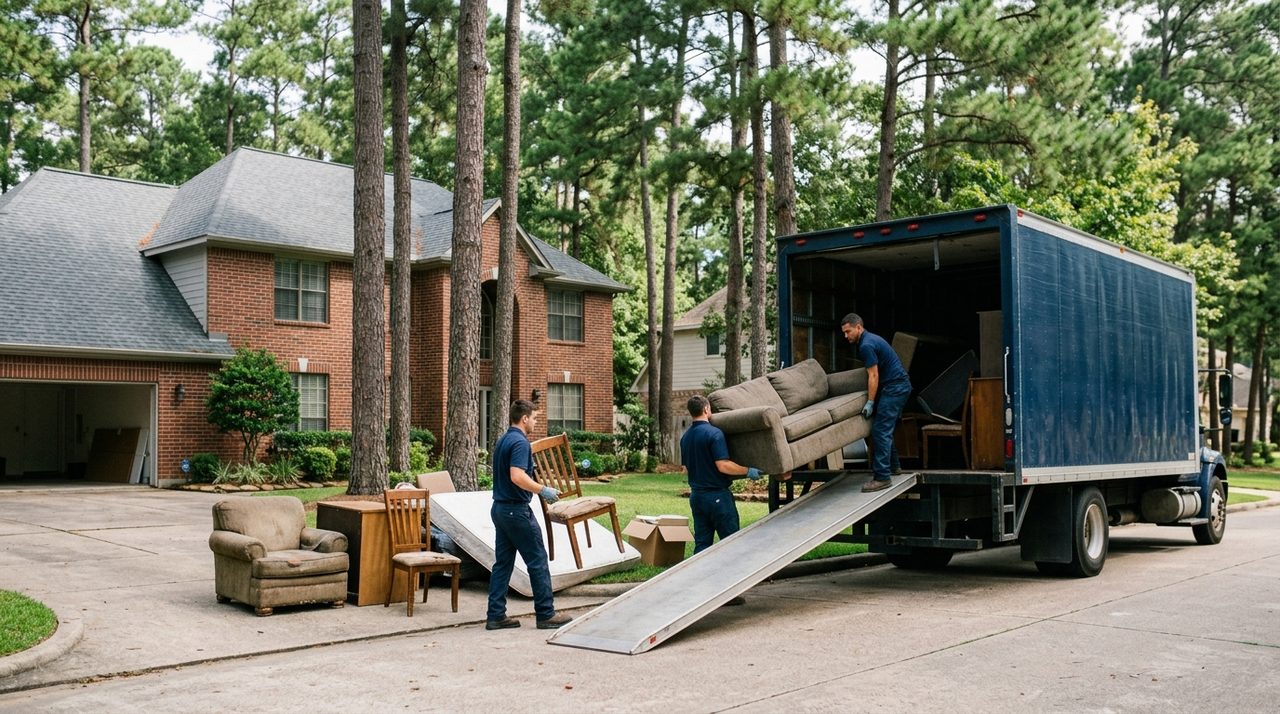
Conroe's housing stock spans six decades — from 1960s in-town brick ranches to sprawling 2020s master-planned subdivisions — which means junk removal jobs here range from estate clearouts packed with decades-old appliances to post-renovation builder-grade debris piles in brand-new tract homes. Montgomery County's clay-heavy soils crack patios and driveways on a predictable cycle, adding concrete rubble to the mix, while the patchwork of HOA subdivisions (some with strict staging rules, some with none at all) makes curbside logistics more complicated than a single municipal code would suggest. Understanding which rules apply to your specific subdivision — and which disposal facilities serve Montgomery County — is what separates a smooth haul from a fine or a return trip.
Ranked by verified Google rating × review volume × verification tier. How we rank →
Some highly-rated pros serve Conroe from nearby and may not keep a Conroe street address. Those are listed under "Also serving Conroe" with their real city and distance, so you always know where each business is based.
1135 Grand Central Parkway Suite 357, Conroe, TX 77304
812 W Dallas St Suite 110, Conroe, TX 77301
1311 E Davis St, Conroe, TX 77301
1308 E Davis St, Conroe, TX 77301
2418 N Frazier St #5, Conroe, TX 77303
Highly-rated pros based nearby who cover Conroe. Distance shown from the Conroe area.
Serving Conroe Based in Porter · 4.5 mi away
Serving Conroe Based in Porter · 4.6 mi away
Why it matters to you
Unlike a city with a single bulk-trash program, Conroe's subdivisions each operate under their own recorded covenants or lack them entirely. A master-planned community like those with active Architectural Control Committees may prohibit roll-off containers in driveways and limit curbside debris to 24–48 hours, while an older in-town neighborhood on the same zip code has no restrictions at all. Getting this wrong means the homeowner — not the hauler — absorbs any HOA fines.
What a good pro does
Before scheduling any large removal, pull your subdivision's recorded deed restrictions through the Montgomery County Clerk's office or your HOA management company. A knowledgeable junk-removal crew will ask about HOA status upfront, use closed-body trucks rather than open roll-offs when deed restrictions prohibit containers, and complete the haul in a single visit to avoid staged-debris violations. Confirm permit jurisdiction (City of Conroe vs. unincorporated Montgomery County) if the work involves any construction debris separation.
Sources: Local HOA / deed restrictions (see area profile), Municipal permit office (see area profile)
Why it matters to you
Montgomery County's clay-heavy Vertisol soils expand in wet seasons and shrink in dry ones, heaving and fracturing concrete driveways, patios, and pool decks on a years-long cycle. Homes built in the 1980s and 1990s — a large segment of Conroe's in-town stock — are now seeing their original flatwork fail, generating rubble that cannot go into a standard junk truck load. Most homeowners are caught off-guard when they learn concrete is priced separately, typically $60–$120 per ton above the base haul rate, because tipping fees at TCEQ-permitted facilities are calculated by weight.
What a good pro does
Get a written quote that itemizes concrete separately from household junk before any crew starts breaking up hardscape. A reputable hauler will weigh concrete debris at a TCEQ-permitted facility and provide a weight ticket — estimates of 'a few hundred pounds' routinely undercount broken slab. Budget roughly $200–$400 for a typical cracked patio removal on top of any furniture or household junk in the same load; final costs depend on slab thickness and square footage.
Sources: Texas Commission on Environmental Quality, Municipal permit office (see area profile)
Why it matters to you
Conroe's 1960s–1980s in-town neighborhoods still hold a significant share of homes with original or early-replacement HVAC systems, water heaters, and chest freezers — many of which failed during or after Winter Storm Uri in February 2021. Slab-on-grade construction means every dead compressor unit, air handler, or refrigerator must exit through the living space with no basement or crawl-space shortcut, making access tight and labor-intensive. Single-item pickups for large appliances typically run $75–$150 (estimated) in the Houston metro, but a multi-item Uri aftermath clearout can push into the $300–$500 range.
What a good pro does
Look for haulers who confirm refrigerant recovery documentation on HVAC units — federal EPA regulations require certified technicians to recover remaining refrigerant before disposal, and a hauler skipping this step creates liability for you as the homeowner. Ask specifically whether old R-22 window units and central compressors are handled separately from standard appliances, and verify that the hauler disposes at a TCEQ-permitted facility rather than a private lot or illegal dump site.
Sources: Texas Commission on Environmental Quality, EPA Lead Renovation, Repair and Painting (RRP) Rule
Why it matters to you
Conroe's older in-town blocks — particularly those built between the 1960s and early 1980s — have a long-established resident base, and estate clearouts in these homes routinely surface items that complicate a standard haul: CRT televisions, fluorescent tube lighting, old propane tanks, and furniture finished with pre-1978 lead-based paint covered under EPA lead-safe guidelines. A census median year built of 2004 for Conroe as a whole masks the older core, where homes are 50–60 years old and accumulations run deep — garages, attics, and detached tool sheds all need clearing.
What a good pro does
Before booking a full-house clearout in any pre-1980 Conroe home, ask the hauler to conduct a walkthrough to identify hazardous items that require separate handling: CRTs go to certified e-waste processors, propane tanks must be purged, and painted furniture from before 1978 should be flagged under EPA lead-safe rules. A thorough crew will sort these during loading rather than mixing them into the general haul, keeping your disposal compliant with TCEQ municipal solid waste transporter rules. Estimates for a full-truck clearout of a long-occupied home run $400–$650 for standard household junk, not counting any hazardous-item surcharges.
Sources: EPA Lead Renovation, Repair and Painting (RRP) Rule, Texas Commission on Environmental Quality
Hiring junk removal in Conroe? Conroe's housing stock ranges from 1960s-era in-town neighborhoods to modern master-planned communities, creating diverse home service needs across the area. Contractors must verify HOA and deed restriction status on a per-subdivision basis, as requirements vary widely. The mix of older and newer construction means service providers encounter everything from aging HVAC and galvanized plumbing to contemporary builder-grade systems.
Building era
Mixed: 1960s–1980s in older in-town areas; significant growth in 1990s–2010s suburban subdivisions; ongoing 2020s new construction.
Typical style
Texas Traditional brick ranch, contemporary two-story suburban homes, and some custom/farmhouse-influenced builds near rural and lake-adjacent areas.
Foundations
Predominantly slab-on-grade for post-1970 subdivision homes; pier-and-beam found in some older, custom, or flood-prone/lakefront properties.
Common systems
Older homes (1960s–1980s): original galvanized or copper plumbing, aging R-22 HVAC systems, and 100–150 amp electrical panels. Newer homes (2000s–2020s): PEX or CPVC plumbing, R-410A HVAC, and 200 amp electrical service. Central HVAC is standard across all eras.
What that means for repairs
Older in-town Conroe homes frequently need HVAC replacement, re-plumbing from galvanized to PEX, and electrical panel upgrades. Newer subdivision homes see cosmetic remodeling and builder-grade fixture upgrades within 10–15 years of construction.
Permit jurisdiction
City of Conroe Permits & Inspections Department for properties within city limits; Montgomery County Engineering for unincorporated areas.
HOA & deed restrictions
No single mandatory HOA covers all of Conroe. Individual subdivisions vary widely: many master-planned communities (e.g., Kellyn Oaks HOA) have mandatory HOAs with recorded covenants and assessments; other areas have no HOA or only voluntary associations. HOA status must be verified per subdivision.
Historic districts
No historic district designation confirmed for Conroe. Conroe is not within the City of Houston and would not have HAHC oversight.
Contractor note
Contractors must confirm whether a property is within Conroe city limits or unincorporated Montgomery County, as permit requirements and inspection processes differ. Many subdivisions require Architectural Control Committee approval for exterior work before a permit is even pulled.
FEMA flood zone
FEMA Zone X (low flood risk) per official NFHL data. However, Conroe includes areas near the San Jacinto River, Lake Conroe, and various creeks; properties closer to waterways may carry higher flood risk that should be verified on a parcel-by-parcel basis.
Hurricane Harvey impact
Not confirmed with specific Conroe-area damage data from research. Montgomery County experienced flooding during Harvey (2017), particularly in areas near the San Jacinto River and downstream of Lake Conroe dam releases. Specific impact to individual Conroe neighborhoods should be checked via Montgomery County Flood Control District records.
Heat & humidity load
Extended Houston-area summers with sustained 95°F+ temperatures and high humidity stress HVAC systems heavily. Older units in 1960s–1980s homes are particularly failure-prone during peak summer. Slab foundations in the expansive clay soils of Montgomery County are susceptible to movement during prolonged drought cycles, causing door/window alignment issues and potential plumbing stress.
Working with contractors here
Conroe's diverse housing stock means contractors frequently handle HVAC replacements and duct work in older homes, along with re-plumbing projects to replace deteriorating galvanized lines. In newer master-planned subdivisions, work tends toward warranty-era repairs, cosmetic upgrades, and fence/patio additions that require HOA architectural approval. Foundation repair is a recurring need across all eras due to Montgomery County's clay-heavy soils and seasonal moisture swings. Contractors should always confirm permit jurisdiction (City of Conroe vs. Montgomery County) and whether an ACC submission is required before scheduling exterior work. The geographic spread of the area means job scoping should account for potentially significant drive times between subdivisions.
Local Tip
Always ask for a written estimate before work begins. Texas contractors are required to provide one on jobs over $1,000.
Conroe's housing stock ranges from 1960s-era in-town neighborhoods to modern master-planned communities, creating diverse home service needs across the area. Contractors must verify HOA and deed restriction status on a per-subdivision basis, as requirements vary widely. The mix of older and newer construction means service providers encounter everything from aging HVAC and galvanized plumbing to contemporary builder-grade systems.
Source: U.S. Census Bureau, ACS 5-Year 2023
Most of Conroe maps to FEMA Zone X (low mapped flood risk), but Houston's flash-flood reality means even low-risk blocks benefit from smart drainage and storm-hardened installs; risk climbs sharply on blocks nearest the West Fork San Jacinto River and Lake Conroe, where it varies parcel to parcel.
Source: FEMA National Flood Hazard Layer (NFHL). Flood zones vary by parcel — verify your individual FIRM panel.
Sources: Municipal permit office (see area profile)
Sources: Local HOA / deed restrictions (see area profile)
Sources: Texas Commission on Environmental QualityEPA Lead Renovation, Repair and Painting (RRP) Rule