11801 W Montgomery Rd B, Houston, TX 77086
Best Junk Removal in NW Houston
NW Houston's patchwork of 1980s–1990s production subdivisions — each governed by its own mandatory HOA, built on shrink-swell Beaumont clay, and split between Houston city limits and unincorporated Harris County — creates a distinct set of junk-removal complications that go well beyond a standard curbside pickup call. Homeowners here are contending simultaneously with aging slab-on-grade homes overdue for appliance and HVAC overhauls, HOA staging rules that dictate exactly when and where debris can wait for a hauler, and cracked concrete hardscape that Houston's clay soil keeps generating. Understanding how permit jurisdiction, deed restrictions, and debris type interact before you schedule a haul will save you both fines and surprise charges.
Verified against Google Business data
Updated 2026
See the 10 Junk Removal Serving NW Houston 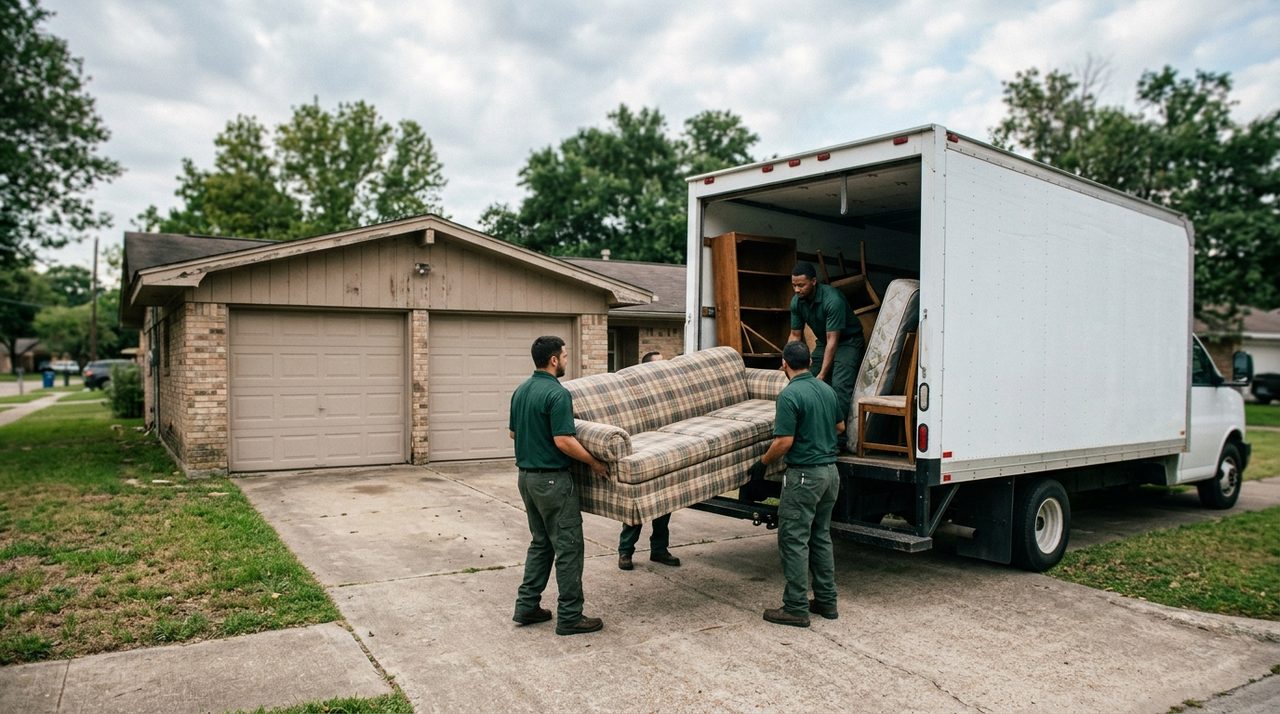
- Median home built
- 1985
- Median home value
- $215,085
- FEMA flood zone
- X500 (moderate)
- Typical cost (est.)
- $200–$650
- Most common local issue
- HOA staging restrictions on roll-offs and curbside dwell time in mandatory-HOA subdivisions
Ranked by verified Google rating × review volume × verification tier. How we rank →
Some highly-rated pros serve NW Houston from nearby and may not keep a NW Houston street address. Those are listed under "Also serving NW Houston" with their real city and distance, so you always know where each business is based.
Min rating:
10 resultsBased in NW Houston
Closed
11622 N Houston Rosslyn Rd, Houston, TX 77086
Closed
6402 Vickie Springs Ln, Houston, TX 77086
Also serving NW Houston
Highly-rated pros based nearby who cover NW Houston. Distance shown from the NW Houston area.
Serving NW Houston Based in Jersey Village · 1.6 mi away
Closed
Serving NW Houston Based in Jersey Village · 2.4 mi away
Closed
Serving NW Houston Based in Jersey Village · 2.5 mi away
Open Now
Serving NW Houston Based in Jersey Village · 2.9 mi away
Closed
Serving NW Houston Based in Jersey Village · 2.9 mi away
Closed
Serving NW Houston Based in Acres Homes · 3.2 mi away
Open Now
Serving NW Houston Based in Jersey Village · 3.6 mi away
Junk Removal in NW Houston: What You Should Know
HOA Staging Rules That Bite Harder Than the Hauler's Invoice
Why it matters to you
Nearly every platted subdivision in NW Houston — from Memorial Northwest to Meadows of Northwest Park — runs a mandatory HOA with an architectural review committee that controls what sits in your driveway and for how long. Many of these deed restrictions prohibit roll-off containers in driveways outright and cap curbside debris staging at 24–48 hours, meaning a junk load that sits while you wait for a callback can trigger a fine that lands on you, not the hauler.
What a good pro does
Before booking, pull your HOA's current deed restrictions from the TREC HOA Management Certificate Database and confirm whether a roll-off container or staged pile requires written approval. A knowledgeable NW Houston hauler will schedule same-day load and go rather than drop a container and leave, and will carry proof of TCEQ solid-waste transporter registration so you can show the HOA that disposal is going to a permitted facility — not being left on a neighboring lot.
Sources: Local HOA / deed restrictions (see area profile), Texas Commission on Environmental Quality
HVAC and Appliance Haul-Away in Homes Built for 1990s Equipment
Why it matters to you
NW Houston's median year-built of 1985 means a large share of homes are cycling through their second or even third HVAC system, and Winter Storm Uri (February 2021) accelerated that timeline across the entire metro by killing water heaters and air handlers in a single week. On slab-on-grade construction — the universal foundation type in these post-1960 Harris County tracts — there is no basement to stage a dead 80-pound air handler or 250-pound packaged unit: everything travels through the living space, and the old unit must leave the same day the new one arrives.
What a good pro does
Coordinate junk removal to arrive within the same window as your HVAC installer so the old unit does not sit in a hallway overnight. Confirm the hauler disposes of refrigerant-bearing compressors at a TCEQ-permitted facility, as improper refrigerant release violates EPA Section 608 requirements in addition to state solid-waste rules. Expect single-item appliance pickups to run $75–$150 as an estimate, with heavier packaged HVAC units often priced toward the top of that range due to weight.
Sources: Texas Commission on Environmental Quality, City of Houston Permitting Center
Cracked Concrete and Hardscape Debris Driven by Clay Soil Movement
Why it matters to you
NW Houston sits on the same expansive Beaumont Black clay that drives foundation repair calls across Harris County. Driveways, patios, and pool decks poured in the 1980s and 1990s are now 30–40 years old and have heaved, cracked, and separated through repeated wet-dry cycles. Homeowners replacing these slabs discover quickly that concrete rubble cannot ride in a standard junk truck — most facilities including the Westpark and McCarty Road transfer stations charge separately by the ton, and mixing concrete into a household load can cause the hauler to reject the entire truck or pass a surprise surcharge back to you.
What a good pro does
When scheduling, describe the debris explicitly as concrete or masonry rubble so the hauler can price by the ton from the start — budget $60–$120 per ton above base rates as an estimate. A reputable hauler will provide a separate concrete-only load if the volume justifies it. Verify the hauler is registered with TCEQ as a municipal solid-waste transporter, which ensures the concrete is going to a permitted C&D facility and not being illegally dumped — a Class B misdemeanor under Texas Health and Safety Code Section 365.012.
Sources: Texas Commission on Environmental Quality, Harris County Flood Control District
Navigating Split Permit Jurisdiction for Estate and Renovation Clearouts
Why it matters to you
NW Houston's subdivision grid straddles Houston city limits and unincorporated Harris County, and which side of that line your home sits on changes which agency oversees any associated permits and inspections — the Houston Permitting Center versus the Harris County Engineering Department. For major estate clearouts or post-renovation debris hauls in 1970s–1980s homes, this matters because pre-1978 construction can surface lead-painted materials and older fluorescent fixtures subject to EPA lead-safe and universal-waste rules, and the homeowner bears responsibility for ensuring proper disposal regardless of jurisdiction.
What a good pro does
Before a whole-house clearout in any NW Houston home built before 1980, confirm the property's municipal status by address — the Houston Permitting Center's online look-up tool or Harris County's parcel search will resolve it in minutes. Flag any pre-1978 painted furniture, CRT televisions, fluorescent bulbs, or old propane tanks to the hauler upfront; legitimate operators will separate these items for EPA-compliant universal-waste disposal rather than landfilling them with general household junk. Expect a full 10–12 cubic yard estate load to run $400–$650 as an estimate for standard items, with regulated materials priced separately.
Sources: EPA Lead Renovation, Repair and Painting (RRP) Rule, Municipal permit office (see area profile), City of Houston Permitting Center
Junk Removal in NW Houston: What You Should Know
Hiring junk removal in NW Houston? NW Houston encompasses dozens of separate subdivisions spanning construction eras from the 1960s through the 2010s, each with its own HOA and deed restrictions. Homeowners here typically manage aging slab-on-grade foundations on expansive clay soils, production-era HVAC systems, and roofing exposed to severe summer heat. Permit jurisdiction varies between the City of Houston and Harris County depending on whether the specific parcel falls inside or outside city limits.
- Housing era
- 1970s–2000s, with the largest concentration in the 1980s–1990s
- Foundation
- Concrete slab-on-grade (predominant for post-1960 tract housing in Harris County)
- Flood zone
- FEMA Zone X500 (moderate flood risk) — source
- Permits
- Mixed — parcels within Houston city limits use the Houston Permitting Center
Housing stock & systems
Building era
1970s–2000s, with the largest concentration in the 1980s–1990s.
Typical style
Traditional suburban brick or brick-and-siding one- and two-story homes, Texas traditional with gables and attached garages.
Foundations
Concrete slab-on-grade (predominant for post-1960 tract housing in Harris County).
Common systems
Central A/C with forced-air gas furnaces typical of 1980s–1990s production builds; copper or CPVC supply lines with cast iron or PVC drains; 200-amp electrical panels in newer sections, 100-amp in older 1970s-era homes.
What that means for repairs
Kitchen and bath remodels are common in 1970s–1980s homes reaching 40+ years. Foundation repair due to expansive clay soils is frequent. Roof replacements cycle every 15–20 years due to hail and heat exposure. HOA architectural review is typically required before exterior modifications.
Permits & restrictions
Permit jurisdiction
Mixed — parcels within Houston city limits use the Houston Permitting Center; unincorporated Harris County parcels (common in NW Houston) use Harris County Engineering Department. Verify annexation status per address.
HOA & deed restrictions
Most platted subdivisions have mandatory HOAs or POAs. Notable examples include Memorial Northwest Homeowners Association (mandatory for all property owners) and Meadows of Northwest Park HOA (mandatory). Older unplatted acreage tracts may lack formal HOAs. Confirm HOA status per property via deed records and the TREC HOA Management Certificate Database.
Historic districts
No City of Houston historic district designation confirmed.
Contractor note
Contractors must verify whether a specific address is inside Houston city limits or unincorporated Harris County, as permit requirements and inspection processes differ. Most subdivision HOAs require architectural committee approval before exterior work begins.
Flood & weather
FEMA flood zone
FEMA Zone X500 (moderate flood risk) — source: fema_nfhl. Portions of NW Houston near Cypress Creek, White Oak Bayou tributaries, and low-lying creek corridors may carry higher localized flood risk; confirm zone by specific address.
Hurricane Harvey impact
Harvey impact varied significantly across NW Houston. Areas near Cypress Creek and low-lying bayou tributaries experienced serious structural flooding, while higher-ground subdivisions saw little to no flooding. No single characterization applies area-wide. Some NW Houston subdivisions faced post-Harvey HOA disputes including foreclosure actions over unpaid dues and legal costs.
Heat & humidity load
Prolonged 95°F+ heat and high humidity stress aging HVAC systems in 1980s–1990s homes, accelerating compressor failures and ductwork degradation in unconditioned attic spaces. Slab movement peaks during summer drought cycles on expansive clay soils, causing doors to stick and drywall cracks to appear.
Working with contractors here
The most common service calls in NW Houston involve foundation leveling and pier installation on expansive clay soils, HVAC system replacement in 1980s–1990s production homes, and composition shingle roof replacements after hail events. Plumbing repiping is increasingly common as original polybutylene and CPVC lines in 1980s–1990s homes reach end of life. Contractors should plan for HOA architectural review timelines before scheduling exterior work—approval can take two to six weeks depending on the subdivision. Because permit jurisdiction is split between Houston and Harris County, job scoping must begin with confirming the property's municipal status to ensure correct permits and inspections.
Local Tip
Always ask for a written estimate before work begins. Texas contractors are required to provide one on jobs over $1,000.
About NW Houston
NW Houston encompasses dozens of separate subdivisions spanning construction eras from the 1960s through the 2010s, each with its own HOA and deed restrictions. Homeowners here typically manage aging slab-on-grade foundations on expansive clay soils, production-era HVAC systems, and roofing exposed to severe summer heat. Permit jurisdiction varies between the City of Houston and Harris County depending on whether the specific parcel falls inside or outside city limits.
- Median year built
- 1985
- Median home value
- $215,085
- Owner-occupied
- 53.6%
- Population
- 79,069
- Housing units
- 28,512
- Median income
- $64,291
Source: U.S. Census Bureau, ACS 5-Year 2023
Flood & storm risk
FEMA Zone X500Moderate flood riskNW Houston carries FEMA Zone X500 (moderate flood risk): outside the 100-year floodplain but inside the 500-year, so heavy-rain events still reach homes and flood-aware work pays off.
Source: FEMA National Flood Hazard Layer (NFHL). Flood zones vary by parcel — verify your individual FIRM panel.
Frequently Asked Questions
My NW Houston address is in an unincorporated Harris County pocket — do I need any permit or approval before scheduling a junk removal for a big renovation clearout?
For unincorporated Harris County addresses, permits for junk removal itself aren't required, but if your clearout involves demolition debris from a permitted remodel, the work generating that debris may require a Harris County Engineering Department permit rather than a Houston Permitting Center permit — and those are two separate offices with different inspection processes. Confirm your annexation status by address before assuming you're under City of Houston jurisdiction, because many NW Houston subdivisions straddle the line. The junk hauler doesn't pull permits, but knowing which jurisdiction applies protects you if an inspector asks about C&D waste disposal documentation.
Sources: Municipal permit office (see area profile)City of Houston Permitting Center
My 1985-built NW Houston home has old polybutylene supply lines — after a repipe, can the junk crew haul away the cut pipe and demo debris in the same load as household junk?
Most NW Houston junk haulers will take mixed light demo debris like pipe, drywall scraps, and cabinet pieces alongside household junk, but mixing heavy C&D materials into a standard load often triggers a weight surcharge or a separate disposal fee because TCEQ-permitted transfer stations (such as the Westpark and McCarty Road facilities) charge by the ton for construction waste above certain thresholds. Ask your hauler upfront whether they separate C&D from household junk in the truck, since some split the loads and bill differently for each. Budget an extra $60–$120 per ton (estimate) for any concrete, tile, or significant demo material mixed into the load.
Do junk removal crews in NW Houston have experience with HOA mandatory pre-approval — specifically, what should I ask before booking if my subdivision has an architectural review committee?
Before booking, ask the hauler directly whether they've worked in mandatory-HOA subdivisions in NW Houston such as Memorial Northwest or Meadows of Northwest Park, and whether they can stage the truck on the street rather than the driveway if your deed restrictions prohibit roll-offs on private property. Also confirm how long they need the debris to sit curbside, since many NW Houston HOAs cap curbside dwell time at 24–48 hours and fines accrue to the homeowner, not the hauler. Getting written HOA authorization before scheduling is your responsibility, but a hauler familiar with local deed restrictions will plan the job accordingly.
Sources: Local HOA / deed restrictions (see area profile)
NW Houston is FEMA Zone X500 — does that matter when scheduling a post-storm junk removal after a heavy-rain event damages my garage or floods my yard?
Zone X500 means your NW Houston property sits outside the 100-year floodplain but inside the 500-year boundary, so interior flooding from heavy-rain events is a real but less frequent risk than in AE-zone neighborhoods closer to Brays Bayou. If water does enter your garage or ground floor, the clock on mold colonization starts within 24–72 hours of drying conditions, so scheduling junk removal for waterlogged materials quickly still matters even at moderate flood risk. Post-storm demand for haulers spikes metro-wide after events like Beryl 2024, so call early and confirm the hauler can handle wet, heavy debris — waterlogged loads commonly trigger weight surcharges that push full-truck estimates toward $500–$900.
Is summer or fall a better time to schedule a whole-house estate clearout in NW Houston, and does timing affect pricing?
Post-storm seasons (late summer through early fall, hurricane season peaks August–October) create hauler backlogs across the Houston metro, so scheduling an estate clearout in spring or early summer typically means faster availability and less chance of surge pricing. NW Houston's 1970s–1990s housing stock means estate clearouts commonly surface CRT televisions, old fluorescent bulbs, and pre-1978 painted furniture — ask the hauler upfront how they handle those items, since improper disposal of electronics and lead-painted materials violates EPA guidelines and TCEQ solid waste rules. Pricing for a full-house clearout in these homes commonly runs $400–$900 in estimates depending on volume and hazardous-item count, so getting competing quotes in a slower season (January–March) can save meaningfully.
Sources: Texas Commission on Environmental QualityEPA Lead Renovation, Repair and Painting (RRP) Rule
Can the junk crew haul away an old propane tank or window-unit A/C from my 1980s NW Houston home, and are there any local rules I should know?
Most licensed Houston-area junk haulers will not accept propane tanks with any remaining gas — tanks must be fully purged and ideally certified empty before pickup, and you should confirm this with your hauler before the job day to avoid a wasted trip fee. Window A/C units contain refrigerants regulated under EPA Section 608, which prohibits venting and requires certified recovery before disposal; a hauler who simply tosses a working window unit in the truck without draining refrigerant is violating federal rules. Ask specifically whether the hauler has an EPA Section 608-certified technician or partners with one, particularly for homes in NW Houston's 1980s–1990s build range where window units and older refrigerants are still common.
Sources: Texas Commission on Environmental QualityEPA Lead Renovation, Repair and Painting (RRP) Rule