Serving Stafford Based in Missouri City · 1.9 mi away
Best Junk Removal in Stafford, TX
Stafford's 1970s–1990s brick-veneer slab-on-grade subdivisions are hitting the renovation and estate-clearout tipping point all at once — aging HVAC equipment, original galvanized drain lines being swapped out, and decades of accumulated garage and attic contents are generating junk loads that the City of Stafford's own bulk collection schedule wasn't built to absorb. Because Stafford is an independent incorporated city in Fort Bend County with its own permitting authority and no city-wide HOA, the rules on where you can stage a roll-off and how debris must be disposed of vary street by street based on your subdivision's deed restrictions — making upfront research essential before a single item hits the curb.
Verified against Google Business data
Updated 2026
See the 9 Junk Removal Serving Stafford 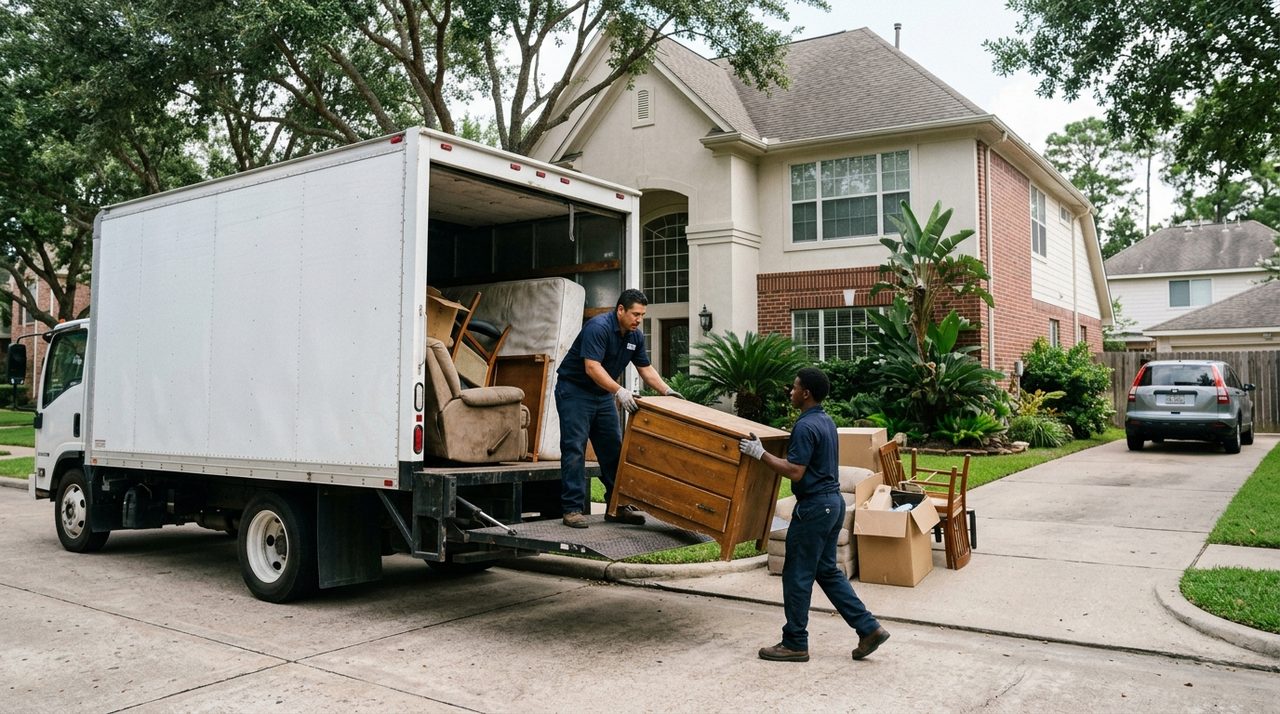
- Median home built
- 1992
- Median home value
- $247,900
- FEMA flood zone
- X (low)
- Typical cost (est.)
- $200–$650
- Most common local issue
- HVAC and appliance haul-away from aging 1970s–1990s homes reaching end of equipment life
Ranked by verified Google rating × review volume × verification tier. How we rank →
Some highly-rated pros serve Stafford from nearby and may not keep a Stafford street address. Those are listed under "Also serving Stafford" with their real city and distance, so you always know where each business is based.
Min rating:
9 resultsAlso serving Stafford
Highly-rated pros based nearby who cover Stafford. Distance shown from the Stafford area.
Serving Stafford Based in Missouri City · 2.4 mi away
Closed
Serving Stafford Based in Missouri City · 2.8 mi away
Serving Stafford Based in Sugar Land · 2.8 mi away
Open Now
Serving Stafford Based in Sugar Land · 3 mi away
Open Now
Serving Stafford Based in Sugar Land · 3.6 mi away
Serving Stafford Based in Sugar Land · 3.7 mi away
Closed
Serving Stafford Based in Sharpstown · 5.6 mi away
Closed
Serving Stafford Based in Sugar Land · 6.4 mi away
Junk Removal in Stafford: What You Should Know
HVAC and Appliance Removal from 1970s–1990s Slab Homes — No Basement Staging Room
Why it matters to you
Stafford's median home was built in 1992, meaning a significant portion of the housing stock still has original or first-replacement HVAC air handlers, compressor units, and water heaters now pushing 25–35 years of age. On slab-on-grade construction — the universal foundation type here — there is no basement or crawl space to stage bulky equipment; every refrigerant-laden compressor or water-logged air handler must come through the living area or a side gate, complicating extraction. Winter Storm Uri (February 2021) accelerated replacements across these same neighborhoods in a compressed window, and junk removers who don't account for refrigerant recovery and appliance weight surcharges can leave homeowners with unexpected add-on fees.
What a good pro does
A qualified hauler operating in Stafford should confirm ahead of arrival whether the compressor unit still contains refrigerant — if so, a certified HVAC technician must recover it before transport, as disposal of refrigerant-containing equipment is regulated under federal EPA Section 608 rules. The hauler then coordinates removal through the available exterior access route and disposes at a TCEQ-permitted solid waste transfer facility such as the Westpark or McCarty Road stations. Expect a single large appliance removal to run $75–$150 as an estimate, with heavier HVAC units potentially triggering weight surcharges.
Sources: Texas Commission on Environmental Quality, Municipal permit office (see area profile)
Subdivision HOA Staging Rules — No Blanket Answer Across Stafford
Why it matters to you
Unlike master-planned suburbs with a single governing association, Stafford has no city-wide HOA — individual subdivisions such as Grove West each operate their own community associations with distinct deed restrictions on roll-off container placement, curbside debris duration, and exterior modifications. A homeowner in one subdivision may freely stage a dumpster in the driveway for a weekend; a neighbor two streets over in a different association may face a fine for the same practice if the container sits more than 24–48 hours without written approval. The City of Stafford Permits Department governs construction permitting independently of Fort Bend County, but HOA architectural review requirements layer on top of any permit pulled.
What a good pro does
Before booking a roll-off or large-volume pickup, pull your deed records through the Fort Bend County Clerk to identify your specific subdivision's association and restrictions — do not assume Stafford has uniform rules. A junk removal company experienced in this area will ask for your subdivision name upfront and adjust staging logistics accordingly, opting for same-day full-truck loads rather than leaving a container when restrictions are tight. For whole-house clearouts requiring multiple trips, coordinate timing with your HOA's written approval process before the first load is scheduled.
Sources: Local HOA / deed restrictions (see area profile), Municipal permit office (see area profile)
Whole-House Estate Clearouts in Stafford's Aging Owner-Occupied Stock
Why it matters to you
Stafford's owner-occupancy rate sits at 43%, and the bulk of the housing stock dates to the 1970s through 1990s — a demographic profile that produces a steady volume of estate and downsizing clearouts as long-term residents transition. These clearouts in older ranch homes routinely surface items that require special handling: CRT televisions and tube monitors from pre-flat-screen eras, fluorescent light fixtures with ballasts, and furniture painted before 1978 that falls under EPA lead-safe handling guidelines. Garages and attics in these homes also accumulate propane cylinders, old pesticides, and paint cans that cannot go in a standard junk truck.
What a good pro does
A hauler working a Stafford estate clearout should walk the home before quoting and flag hazardous materials — legacy electronics, propane tanks, fluorescent bulbs, and pre-1978 painted items — that require separation from the general load. Disposal of these items must occur at TCEQ-permitted facilities equipped to handle them, not at general municipal transfer stations. Homeowners should ask specifically whether the company separates e-waste and hazmats or subcontracts that stream, since co-mingling regulated materials in a standard load is a violation under Texas Health and Safety Code and can expose the homeowner to liability for illegal dumping.
Sources: Texas Commission on Environmental Quality, EPA Lead Renovation, Repair and Painting (RRP) Rule
Cracked Patio and Driveway Concrete Disposal on Stafford's Expansive Clay
Why it matters to you
Stafford sits on Houston Black clay — a shrink-swell Vertisol that moves seasonally and attacks slabs, driveways, patio decks, and walkways on a years-long cycle. The 1970s–1990s housing stock means many original concrete flatwork installations are now 30–50 years old and actively buckling, and homeowners replacing them generate concrete rubble that most standard junk removal trucks will not accept without a significant premium. Most junk haulers price by volume, but concrete is priced by ton — a single cracked driveway section can weigh 1–2 tons — and disposal at facilities like the Westpark transfer station carries a separate per-ton tipping fee on top of base haul rates.
What a good pro does
When scoping a concrete or hardscape disposal job in Stafford, get an itemized quote that separates concrete tonnage from any mixed household junk, since co-mingling construction debris with standard junk can violate municipal solid waste separation rules and inflate costs unpredictably. Estimate concrete disposal at $60–$120 per ton above standard haul rates as a budgeting baseline. A hauler experienced on Stafford's clay soils will also confirm whether any reinforcing steel (rebar) is embedded in the rubble, since that requires additional sorting at the facility. All disposal must route to a TCEQ-permitted solid waste or C&D debris facility — not a standard neighborhood dumpster.
Sources: Texas Commission on Environmental Quality, Harris County Flood Control District
Junk Removal in Stafford: What You Should Know
Hiring junk removal in Stafford? Stafford is an incorporated city in Fort Bend County composed of many individual subdivisions, each with its own HOA rules, deed restrictions, and housing characteristics. The housing stock spans from 1970s ranch homes to 2010s production builds, predominantly slab-on-grade construction on expansive clay soils. Homeowners should verify their specific subdivision's HOA requirements and flood status before scoping any exterior or structural project.
- Housing era
- 1970s–1990s (bulk of existing stock), with newer infill and subdivisions from the 2000s–2010s
- Foundation
- Slab-on-grade (overwhelmingly standard for the era and region
- Flood zone
- FEMA Zone X (low flood risk) per official NFHL data
- Permits
- City of Stafford Permits Department (Stafford is an incorporated city with its own permitting…
Housing stock & systems
Building era
1970s–1990s (bulk of existing stock), with newer infill and subdivisions from the 2000s–2010s.
Typical style
One- and two-story brick veneer ranch homes, traditional and neo-eclectic production builder homes, with some townhomes and garden homes in newer phases.
Foundations
Slab-on-grade (overwhelmingly standard for the era and region; pier-and-beam limited to rare older or custom structures).
Common systems
Central AC with gas furnace; copper or CPVC supply plumbing in older homes transitioning to PEX in newer builds; 1970s–1980s homes may have original galvanized drain lines; electrical panels range from 100-amp in older homes to 200-amp in newer construction.
What that means for repairs
Kitchen and bathroom remodels are common in the 1970s–1990s stock as homeowners update finishes and fixtures. Foundation repair due to expansive clay soil movement is a recurring need. HVAC system replacements are frequent in pre-2000 homes reaching end of equipment life.
Permits & restrictions
Permit jurisdiction
City of Stafford Permits Department (Stafford is an incorporated city with its own permitting authority).
HOA & deed restrictions
No city-wide HOA exists. Many individual subdivisions have mandatory HOAs/POAs (e.g., Grove West Community Association, Inc.) that enforce deed restrictions and architectural standards. Some properties may have no HOA or minimal deed restrictions. Must be confirmed per property via deed records and Fort Bend County Clerk.
Historic districts
No historic district designation confirmed for any area within Stafford.
Contractor note
Contractors must pull permits through the City of Stafford, not Harris County or the City of Houston. Subdivision-level HOA architectural review committees may require pre-approval for exterior modifications, so contractors should confirm HOA requirements before beginning work.
Flood & weather
FEMA flood zone
FEMA Zone X (low flood risk) per official NFHL data. While the broader Fort Bend County area includes Brazos River floodplain zones, the Stafford city center area generally falls outside high-risk flood designations. Property-level verification via FEMA FIRM panels and Fort Bend County floodplain GIS is recommended.
Hurricane Harvey impact
Stafford was not identified as one of the hardest-hit cities during Hurricane Harvey (2017). While Fort Bend County experienced substantial flooding along the Brazos River, the worst-documented impacts were south and southwest of Stafford in Missouri City, Sugar Land, and Richmond/Rosenberg. Specific Stafford streets or subdivisions with repetitive flood losses could not be confirmed from available public records. Buyers and contractors should still check NFIP claims history and seller flood disclosures for individual properties.
Heat & humidity load
Extended Houston-area heat and humidity stress HVAC systems in the aging 1970s–1990s housing stock, making seasonal tune-ups and refrigerant checks essential. Slab foundations on expansive clay soils are vulnerable to differential movement during summer drought cycles, requiring homeowners to maintain consistent watering around foundations. Attic temperatures in single-story ranch homes can exceed 150°F, accelerating roof underlayment and radiant barrier degradation.
Working with contractors here
Foundation monitoring and repair is among the most common contractor engagements in Stafford due to the expansive clay soils and the age of the 1970s–1990s slab-on-grade housing stock. HVAC replacement is a high-demand service as original equipment in older homes reaches 20–30 years of age. Whole-home repiping is increasingly needed in pre-1990s homes with galvanized drain lines or deteriorating copper supply lines. Contractors should note that Stafford is an independent city with its own permitting process, inspection schedules, and code enforcement — not governed by the City of Houston or Fort Bend County for permitting purposes. Job scoping for exterior work must account for subdivision-level HOA architectural standards, which vary significantly across the city.
Local Tip
Always ask for a written estimate before work begins. Texas contractors are required to provide one on jobs over $1,000.
About Stafford
Stafford is an incorporated city in Fort Bend County composed of many individual subdivisions, each with its own HOA rules, deed restrictions, and housing characteristics. The housing stock spans from 1970s ranch homes to 2010s production builds, predominantly slab-on-grade construction on expansive clay soils. Homeowners should verify their specific subdivision's HOA requirements and flood status before scoping any exterior or structural project.
- Median year built
- 1992
- Median home value
- $247,900
- Owner-occupied
- 43%
- Population
- 17,279
- Housing units
- 6,988
- Median income
- $85,910
Source: U.S. Census Bureau, ACS 5-Year 2023
Flood & storm risk
FEMA Zone XLow flood riskMost of Stafford maps to FEMA Zone X (low mapped flood risk), but Houston's flash-flood reality means even low-risk blocks benefit from smart drainage and storm-hardened installs.
Source: FEMA National Flood Hazard Layer (NFHL). Flood zones vary by parcel — verify your individual FIRM panel.
Frequently Asked Questions
Does the City of Stafford require any permit or approval before a junk removal company hauls away a load from my property?
The City of Stafford does not require homeowners to pull a permit specifically for junk removal pickup, but Stafford is an independent incorporated city with its own code enforcement — not governed by the City of Houston or Fort Bend County — so any disputes about illegal staging or debris left on public right-of-way fall under Stafford's own municipal code. The hauler itself must be registered as a solid waste transporter with the TCEQ and must dispose of your load at a TCEQ-permitted facility, not at an unlicensed site. If your load includes C&D debris from a permitted renovation, confirm with the City of Stafford Permits Department whether any disposal documentation is required.
Sources: Texas Commission on Environmental QualityMunicipal permit office (see area profile)
My 1980s Stafford home has old CRT televisions and fluorescent shop lights in the garage — can a junk removal crew take those in a standard load?
Most Stafford junk removal crews will not mix CRT televisions or fluorescent tubes into a standard household load because both require separate handling under TCEQ solid waste rules — CRTs can be classified as hazardous waste depending on the disposal pathway, and fluorescent bulbs contain mercury. Expect to pay a separate item fee (estimates typically run $20–$50 per CRT) or arrange electronics drop-off through Fort Bend County's periodic hazardous waste collection events. When booking, specifically ask the hauler whether their permitted disposal facility accepts e-waste and fluorescent bulbs in the same manifest as household junk.
Stafford is mapped FEMA Zone X, so does that mean I won't face the same gut-out debris volumes neighbors in Meyerland deal with after heavy rain?
Zone X designation means Stafford's mapped flood risk is low relative to bayou-adjacent AE zones, but Fort Bend County's clay soil sheds water rather than absorbing it, and localized flash flooding from intense Gulf rain events (including the remnants of Beryl in 2024) can still produce interior water intrusion in older 1970s–1980s slab homes with low finished-floor elevations. If you do experience water intrusion, waterlogged drywall and flooring must be staged quickly to prevent mold — confirm curbside staging is permitted for your specific subdivision's HOA before a crew arrives, since rules vary across Stafford's individual subdivisions.
Sources: FEMA National Flood Hazard Layer (NFHL)Local HOA / deed restrictions (see area profile)
When is the worst time of year to schedule a large junk removal job in Stafford, and how far out should I book?
Late spring through early fall (May through September) is the busiest window for Stafford junk removers because that is when HVAC failures spike in the extreme Houston cooling season, post-storm debris loads hit after Gulf weather events, and homeowners do the bulk of their renovation and estate-clearout work. During peak summer, same-week booking is not reliable — estimate 7–14 days out for a full truckload job and confirm crew availability before renting a dumpster or committing to a contractor demo timeline. January through March is generally the easiest window for fast scheduling and, in some cases, more negotiable pricing.
My subdivision in Stafford has an HOA — can I get a roll-off dumpster dropped in my driveway for a whole-house clearout, or will I get fined?
There is no city-wide answer for Stafford because each subdivision's HOA or POA sets its own deed restrictions independently — an HOA like Grove West Community Association, Inc. may prohibit roll-off containers in driveways entirely or require written architectural review committee approval before placement. Check your specific subdivision's deed restrictions through the Fort Bend County Clerk's records before scheduling a roll-off delivery, and get any HOA approval in writing; fines for violations are the homeowner's responsibility, not the hauler's. If a driveway roll-off is prohibited, ask your junk removal company whether they can do a load-and-go service with a truck staged on the street during a defined window instead.
Sources: Local HOA / deed restrictions (see area profile)
A contractor replaced my HVAC and left the old air handler and compressor unit on the side of my Stafford house — does the junk crew need anything special to haul those away?
Before any junk removal crew can legally transport a refrigerant-containing HVAC compressor, the refrigerant must already have been recovered by an EPA Section 608-certified technician — this is federal law, and a crew that hauls a unit still holding refrigerant exposes you both to liability. Confirm with your HVAC installer that refrigerant recovery was completed and documented before the swap; most licensed HVAC contractors do this as part of the replacement job. Once recovered, the compressor and air handler are standard heavy items for a junk hauler — budget roughly $100–$200 as an estimate for the pair, and flag the combined weight upfront since these units add quickly to per-ton disposal fees.