Closed
302 Gentilly Dr, Katy, TX 77450
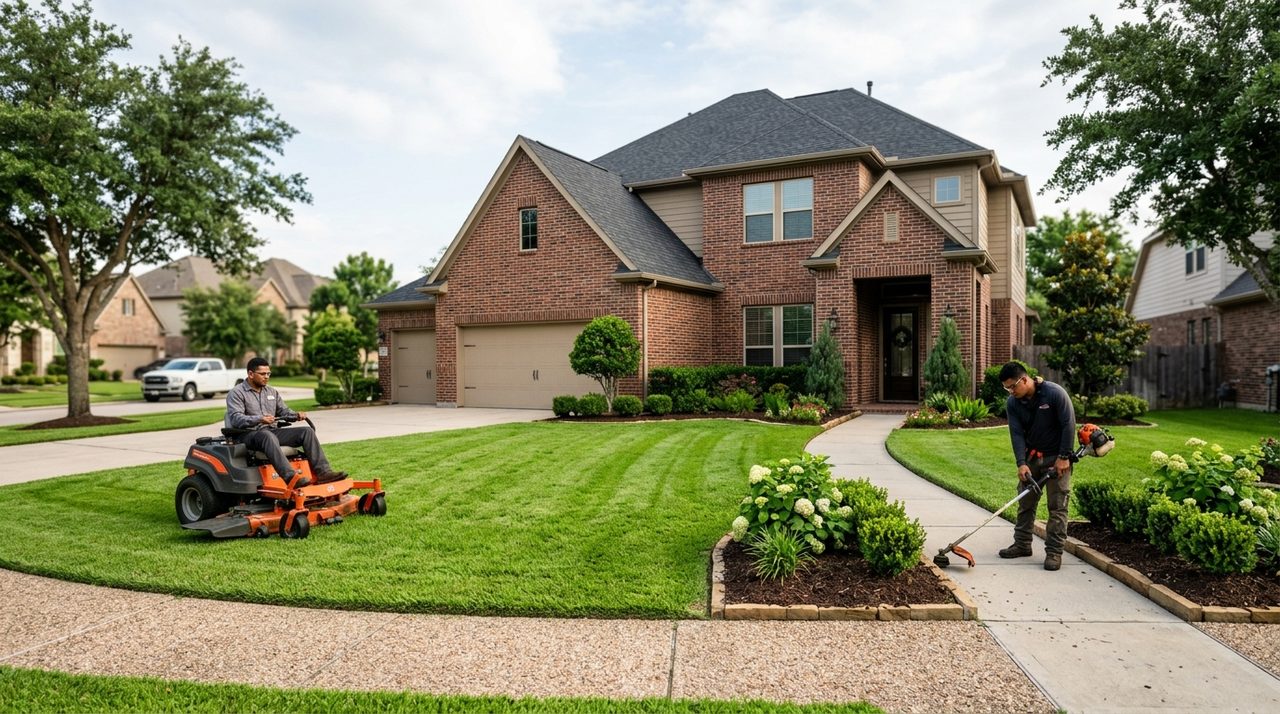
Cinco Ranch's 1990s–2000s production homes sit on Fort Bend County black clay soils where slab foundations move seasonally and landscaping choices made 25 years ago are now reaching a reckoning — overgrown canopy trees planted too close to slabs, irrigation systems that predate TCEQ backflow rules, and beds that pond after every Gulf rain event. On top of the soil and drainage realities, the community's dual HOA structure (Cinco Ranch HOA I and Cinco Ranch Residential Association II under the master Cinco Residential Property Association) means every landscape change — from new sod species to a dry creek bed — requires ACC pre-approval before a shovel breaks ground. This page gives Cinco Ranch homeowners the specific questions to ask and the sequence to follow before signing a landscaping contract.
Ranked by verified Google rating × review volume × verification tier. How we rank →
Some highly-rated pros serve Cinco Ranch from nearby and may not keep a Cinco Ranch street address. Those are listed under "Also serving Cinco Ranch" with their real city and distance, so you always know where each business is based.
302 Gentilly Dr, Katy, TX 77450
8426 Terrace Valley Cir, Richmond, TX 77407
19102 FM 1093, Richmond, TX 77407
21915 Kingsland Blvd, Katy, TX 77450
807 Kingsford Dr, Houston, TX 77094
515A S Fry Rd Suite 522, Katy, TX 77450
21930 Royal Montreal Dr, Katy, TX 77450
515 A S Fry Rd, Katy, TX 77450
Highly-rated pros based nearby who cover Cinco Ranch. Distance shown from the Cinco Ranch area.
Serving Cinco Ranch Based in Katy · 2 mi away
Serving Cinco Ranch Based in Katy · 2.4 mi away
Why it matters to you
Cinco Ranch's dual HOA system — HOA I east of Katy-Gaston Road, Residential Association II to the west — enforces legally binding deed restrictions that specify approved turf species, tree placement, mulch types, and hardscape parameters. The Cinco Residential Property Association master association has the authority to require removal of any non-compliant installation at the homeowner's expense, meaning a landscaper who skips the Architectural Control Committee review can leave you with a removal bill on top of the original project cost. ACC review cycles in Cinco Ranch typically run two to four weeks, which must be factored into any project timeline.
What a good pro does
A qualified Cinco Ranch landscaper should submit a detailed planting plan — including species list, tree siting, bed edging material, and any drainage structures — to the ACC before scheduling installation. Get written approval in hand before purchasing materials or breaking ground. Because Fort Bend County (not the City of Houston) is the permit jurisdiction here, permit applications for grading or retaining walls also flow through Fort Bend County Engineering and Development Services, not Houston's one-stop shop.
Sources: Local HOA / deed restrictions (see area profile), Municipal permit office (see area profile)
Why it matters to you
Fort Bend County's expansive black clay behaves differently in a 25-year-old established subdivision than in new construction: original grades have settled, original drainage swales have silted up or been inadvertently blocked by fence additions, and organic matter has stratified the soil so that water absorption is slower than when the homes were built. Even though most of Cinco Ranch maps to FEMA Zone X (low mapped flood risk), flash-flood conditions after Gulf rain events routinely leave standing water in beds and against foundations — exactly the moisture cycling that causes differential slab settlement over time.
What a good pro does
A landscaper experienced with Fort Bend clay should walk the lot during or immediately after a rain event, not just in dry conditions, to diagnose where water is pooling and why. French drains or dry creek beds connecting to the neighborhood's drainage infrastructure are the most common corrective approach, with typical costs estimated at $2,500–$7,500 for a residential lot depending on linear footage and outfall access. Any grading work that materially alters site drainage may require a Fort Bend County permit.
Sources: FEMA National Flood Hazard Layer (NFHL), Harris County Flood Control District, Municipal permit office (see area profile)
Why it matters to you
Live oaks, Chinese tallows, and crepe myrtles planted in Cinco Ranch during the 1990s community build-out are now mature, and many sit within 10–15 feet of slab foundations — the range where large root systems can dry the surrounding clay unevenly, accelerating differential settlement. Fort Bend County clay amplifies this risk because the soil shrinks dramatically during summer drought and swells after rain, and established tree roots direct moisture away from the foundation perimeter in patterns that change with each season. Homes built in 1997 (the Census median year built for this area) that have never had a root assessment are likely overdue for one.
What a good pro does
A landscaper advising on tree removals or new plantings near Cinco Ranch slabs should observe a minimum 10-foot setback for medium canopy trees and 15 feet or more for large species, and recommend linear root barriers where mature trees must stay in place. New plantings should favor shallower-rooted species appropriate for USDA Zone 9a/9b. Any tree removal near the foundation should be followed by root zone monitoring, since rapid clay re-hydration after root removal can also cause heave.
Sources: Local HOA / deed restrictions (see area profile), International Residential Code (as adopted by City of Houston)
Why it matters to you
Many Cinco Ranch irrigation systems were installed in the 1990s and early 2000s under older standards, and some may lack backflow prevention assemblies that meet current TCEQ Chapter 344 requirements or have assemblies that have never been tested by a licensed backflow tester. Cinco Ranch is served by MUD water systems, which have their own inspection and compliance expectations separate from municipal utilities, and Stage 2 water restrictions enforced by the relevant MUD can make an uncalibrated or leaking irrigation system both a compliance issue and a significant water bill problem.
What a good pro does
Texas law requires that irrigation system design and installation — including any modification to zone layout or backflow prevention — be performed by or directly supervised by a TCEQ-licensed irrigator; a general landscaper without that license cannot legally do the work independently. Fort Bend County requires a permit for new irrigation system installation. Homeowners updating a 20-plus-year-old system should also request a smart controller retrofit with a rain sensor to stay within MUD water restriction schedules, reducing both fine risk and turf stress during summer heat.
Sources: Texas Commission on Environmental Quality, Municipal permit office (see area profile)
Hiring landscapers in Cinco Ranch? Cinco Ranch is one of Houston's largest master-planned communities, featuring production-built suburban homes from the 1990s and 2000s now reaching the age where major system replacements become routine. Homeowners must navigate mandatory HOA architectural review alongside Fort Bend County permitting for exterior modifications, roofing, and additions. The predominantly slab-on-grade construction on Fort Bend County clay soils means foundation monitoring and drainage management are ongoing concerns.
Building era
Primarily 1990s–2000s, with continued build-out into the early 2010s.
Typical style
Conventional suburban traditional — brick and brick/stone two-story and single-story homes, with some Mediterranean/stucco accents.
Foundations
Likely predominantly slab-on-grade (consistent with 1990s–2000s Houston-area production building; not explicitly documented in sources reviewed).
Common systems
Central forced-air HVAC (typically 15–25 years old, many nearing or past replacement age), copper or CPVC supply plumbing, PVC drain lines, 200-amp electrical panels. Original HVAC units in 1990s-era sections are likely already replaced or due for replacement.
What that means for repairs
Kitchen and bathroom remodels are common as homes reach 20–30 years. HVAC replacements and roof replacements (composition shingle, 20-year cycle) are the most frequent major projects. All exterior modifications require HOA Architectural Control Committee approval before work begins.
Permit jurisdiction
Fort Bend County engineering and development services (unincorporated area — not City of Houston or any incorporated municipality). MUD districts may also apply for certain infrastructure items.
HOA & deed restrictions
Mandatory dual HOA system: Cinco Ranch HOA I (east of Katy-Gaston Road) and Cinco Ranch Residential Association II, Inc. (west of Katy-Gaston Road), under the Cinco Residential Property Association master association. Deed restrictions and architectural guidelines are legally enforceable. ACC approval required for most exterior changes.
Historic districts
No City of Houston historic district designation confirmed. Cinco Ranch is in unincorporated Fort Bend County and is not subject to HAHC oversight.
Contractor note
Contractors must obtain Fort Bend County permits for structural, electrical, plumbing, and mechanical work, and homeowners must separately secure HOA ACC approval before exterior work begins. Failing to obtain ACC pre-approval can result in required removal of completed work at the homeowner's expense.
FEMA flood zone
FEMA Zone X (low flood risk) — source: fema_nfhl. Cinco Ranch is largely outside FEMA special flood hazard areas. Some sections near Buffalo Bayou tributaries or detention basins may carry higher risk at the lot level; buyers should verify individual parcels with Fort Bend County floodplain data.
Hurricane Harvey impact
Cinco Ranch is characterized as mostly outside special flood hazard areas and is generally marketed as low flood risk. Broader Harvey-era media coverage referenced Katy-area and Barker Reservoir impacts, but sourced research did not identify specific Cinco Ranch streets or subsections with confirmed significant or recurring Harvey flooding. Lot-level flood history should be verified through Fort Bend County records and individual seller disclosures.
Heat & humidity load
Extreme summer heat drives heavy HVAC demand; aging 1990s-era systems in older sections are particularly vulnerable to compressor failure during sustained 95°F+ stretches. Slab foundations on expansive clay soils can shift during drought cycles, requiring foundation inspections and watering programs. Composition shingle roofs degrade faster under intense UV exposure, and 20-year replacements often come due at 15–18 years.
Working with contractors here
The most common contractor work in Cinco Ranch centers on aging-system replacements: HVAC changeouts, roof replacements, and water heater swaps for homes now 20–30 years old. Foundation repair and drainage improvement are steady demand drivers given the clay soil conditions and slab-on-grade construction. Kitchen and bathroom remodels are the leading interior renovation category as homeowners update original 1990s finishes. Contractors should factor HOA ACC review timelines into project schedules — exterior work proposals can take 2–4 weeks for approval, and non-compliant work may need to be undone. Permitting through Fort Bend County rather than the City of Houston means different inspection scheduling processes and fee structures than inner-loop Houston work.
Local Tip
Always ask for a written estimate before work begins. Texas contractors are required to provide one on jobs over $1,000.
Cinco Ranch is one of Houston's largest master-planned communities, featuring production-built suburban homes from the 1990s and 2000s now reaching the age where major system replacements become routine. Homeowners must navigate mandatory HOA architectural review alongside Fort Bend County permitting for exterior modifications, roofing, and additions. The predominantly slab-on-grade construction on Fort Bend County clay soils means foundation monitoring and drainage management are ongoing concerns.
Source: U.S. Census Bureau, ACS 5-Year 2023
Most of Cinco Ranch maps to FEMA Zone X (low mapped flood risk), but Houston's flash-flood reality means even low-risk blocks benefit from smart drainage and storm-hardened installs.
Source: FEMA National Flood Hazard Layer (NFHL). Flood zones vary by parcel — verify your individual FIRM panel.
Sources: Municipal permit office (see area profile)Local HOA / deed restrictions (see area profile)
Sources: Local HOA / deed restrictions (see area profile)Municipal permit office (see area profile)
Sources: FEMA National Flood Hazard Layer (NFHL)Harris County Flood Control District
Sources: Local HOA / deed restrictions (see area profile)Texas Commission on Environmental Quality