215 Wynne St, Houston, TX 77009
Best Pest Control in The Heights
The Heights throws every pest-control variable at once: century-old pier-and-beam bungalows with open crawlspaces and cast-iron drains sit feet away from sealed slab-on-grade townhomes, creating two entirely different pest-entry profiles on the same block. Houston's position in USDA termite pressure Zone 5 (Formosan heartland) hits both foundation types, while the older homes' galvanized and cast-iron plumbing infrastructure makes American cockroach intrusion a near-constant post-rain reality in the inner loop. Understanding which of those housing generations you own — and what the Harris County Clerk's deed restrictions and any townhome HOA allow on the exterior — determines how your pest-control program is built.
Verified against Google Business data
Updated 2026
See the 10 Pest Control Serving The Heights 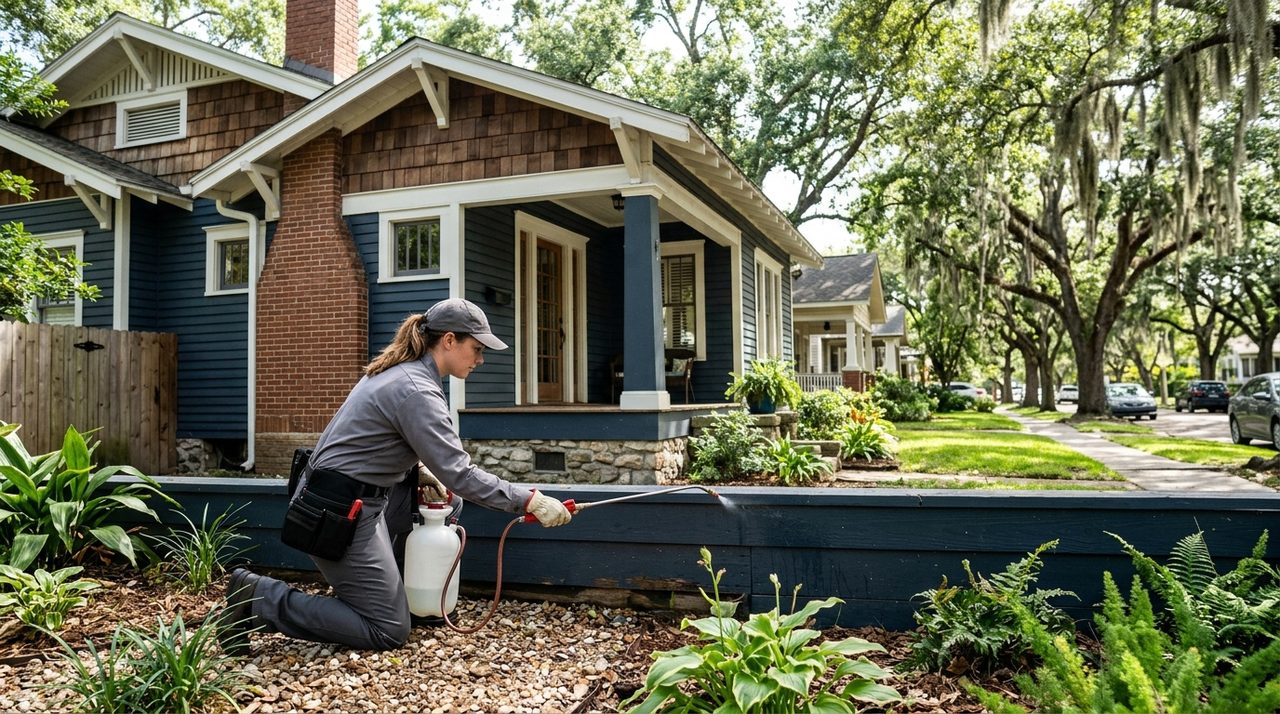
- Median home built
- 1978
- Median home value
- $513,961
- FEMA flood zone
- X (low)
- Typical quarterly service plan (est.)
- $40–$70/visit
- Most common local issue
- American cockroach sewer intrusion in pre-1980 pier-and-beam bungalows with cast-iron drain lines
Ranked by verified Google rating × review volume × verification tier. How we rank →
Some highly-rated pros serve The Heights from nearby and may not keep a The Heights street address. Those are listed under "Also serving The Heights" with their real city and distance, so you always know where each business is based.
Min rating:
10 resultsBased in The Heights
Also serving The Heights
Highly-rated pros based nearby who cover The Heights. Distance shown from the The Heights area.
Closed
Serving The Heights Based in Lazybrook / Timbergrove · 1 mi away
Closed
Serving The Heights Based in Lazybrook / Timbergrove · 1.1 mi away
Serving The Heights Based in Lazybrook / Timbergrove · 1.3 mi away
Closed
Serving The Heights Based in Lazybrook / Timbergrove · 2 mi away
Closed
Serving The Heights Based in Lazybrook / Timbergrove · 2.2 mi away
Closed
Serving The Heights Based in Lazybrook / Timbergrove · 2.2 mi away
Closed
Serving The Heights Based in Midtown · 3.1 mi away
Closed
Serving The Heights Based in Brookhollow · 4.1 mi away
Serving The Heights Based in Lazybrook / Timbergrove · 4.1 mi away
Pest Control in The Heights: What You Should Know
Pier-and-Beam Crawlspaces Are Termite Superhighways in Original Bungalows
Why it matters to you
The 1890s–1930s Craftsman cottages that define the Heights' historic streetscapes sit on pier-and-beam foundations with open or partially vented crawlspaces — conditions that give Formosan and Reticulitermes subterranean termites direct, unimpeded access to structural wood in ways that slab-on-grade construction at least partially limits. Houston's rank in USDA termite pressure Zone 5 means swarm season (February–June) arrives every year without fail, and the dense mature-tree canopy throughout the Heights — combined with the mulched landscaping common to renovated bungalows — keeps soil moisture high against foundation piers. Because portions of the Heights fall within City of Houston Historic Districts (Heights East, Heights West, Heights South) under HAHC review, exterior bait-station placement or any soil treatment near a designated structure should be confirmed not to conflict with recorded deed restrictions at the Harris County Clerk before work begins.
What a good pro does
A licensed Texas Structural Pest Control operator — holding a TDLR termite-category endorsement — should perform a full crawlspace inspection including pier condition, vapor barrier integrity, and wood-to-soil contact before recommending liquid barrier (Termidor-type) versus bait station (Sentricon-type) approaches. For historic bungalows, in-soil liquid barriers around the perimeter typically run an estimated $800–$1,800 based on linear footage, while bait station networks run $1,200–$2,000 installed plus $300–$500/year monitoring; a competent pro will explain which system fits your specific pier-and-beam layout rather than defaulting to one method. Pre-treatment documentation and post-treatment monitoring reports are worth keeping on file, as they become relevant if you ever sell under a lender-required WDI inspection.
Sources: Texas Department of Licensing & Regulation, Local HOA / deed restrictions (see area profile)
American Cockroaches Invade Through Cast-Iron Drains After Every Heavy Rain
Why it matters to you
Houston's flat topography and combined storm/sanitary infrastructure send Periplaneta americana — the 'waterbug' that most Heights homeowners know on sight — surging out of sewers and into homes every time a significant rain event overwhelms drainage. The original Heights bungalows (and many mid-century infill homes from the 1940s–1960s) still carry cast-iron drain lines that have decades of buildup and micro-fractures, giving cockroaches countless harborage points below the pier-and-beam floor and direct routes up through floor drains and open slab penetrations where plumbing was updated piecemeal during gut renovations. Even the newer slab-on-grade townhomes built in the 2000s are not immune: post-Harvey (2017) and post-Uri (2021) pipe repairs that were improperly resealed around slab penetrations created new entry points that owners often don't discover until roach pressure appears inside a 'modern' unit.
What a good pro does
Effective control means treating the source — not just the interior. A TDLR-licensed applicator should inspect and treat exterior weep holes, floor drain connections, and any visible slab penetrations with residual gel bait and exclusion foam, while also assessing whether aging cast-iron lines under the crawlspace need a plumber's camera inspection before pest work can fully succeed. Routine perimeter spray alone will not break the cycle when cockroaches are re-entering from active sewer infrastructure; interior drain treatments with appropriate EPA-registered products and physical exclusion at entry points are the standard of care for inner-loop Heights homes.
Sources: Texas Department of Licensing & Regulation, Texas Commission on Environmental Quality
Rodent Entry Paths Reopen Constantly in Heights Homes With Clay-Soil Settling
Why it matters to you
Houston's expansive Beaumont/Houston Black clay soil creates seasonal slab movement that is a particular problem for the mixed housing stock of the Heights — newer slab-on-grade townhomes experience gap cycling around garage door sweeps, utility chases, and brick veneer weep holes with every wet-dry soil cycle, while post-Uri pipe repairs in both bungalows and newer builds frequently left utility wall penetrations poorly sealed. The Heights is also surrounded by active tear-down-and-rebuild construction zones, and each demolition site displaces established Rattus norvegicus and Mus musculus populations directly into neighboring homes. The dense residential density of the neighborhood — with townhome developments sharing walls along narrow lots — means a single active rodent harborage can pressure a whole row of attached units simultaneously.
What a good pro does
A thorough rodent exclusion inspection for a Heights property must account for both foundation type and renovation history: a pier-and-beam bungalow needs crawlspace screening and joist bay sealing, while a slab townhome needs careful attention to shared-wall utility chases, rooftop deck penetrations, and garage thresholds. Professional exclusion plus interior rodent treatment in Houston typically runs an estimated $400–$900; TDLR-licensed technicians should provide a written exclusion map documenting every sealed entry point so subsequent soil movement or construction activity can be re-inspected efficiently. Ongoing perimeter monitoring is especially worth maintaining while adjacent lots are under active construction.
Sources: Texas Department of Licensing & Regulation, Local HOA / deed restrictions (see area profile)
Townhome HOA Rules and Deed Restrictions Shape What Exterior Treatments Are Allowed
Why it matters to you
The Heights has no single neighborhood-wide mandatory HOA, but the dozens of small mandatory POAs and HOAs governing its townhome enclaves — Heights Abbey HOA, Studemont Heights POA, and many others — each carry their own recorded deed restrictions on exterior modifications, which can affect where bait stations are placed, when broadcast lawn treatments occur, and whether visible rodent bait boxes meet architectural standards. Beyond formal HOAs, the original Heights plat deed restrictions recorded with the Harris County Clerk govern most bungalow lots and can restrict certain exterior applications. Townhome owners in particular must also consider that shared walls and shared-turf common areas mean pest treatment on one unit may be ineffective without coordination across the HOA — a dynamic that individual service contracts often do not address.
What a good pro does
Before signing any perimeter or lawn pest-control contract for a Heights townhome, pull the recorded covenants from the Harris County Clerk's office (or request them from your HOA board) to confirm whether exterior bait station placement or broadcast turf treatment requires advance approval from the architectural control committee. A pest-control operator experienced in the Heights inner-loop market will ask about HOA status upfront and can often work within a community-wide program framework — treating all units on a coordinated schedule — which is significantly more effective for rodent and cockroach pressure in attached-townhome rows than isolated single-unit service. No City of Houston permit is required for routine pest control service under Texas Structural Pest Control Act rules, but fumigation (if ever applicable) requires fire marshal notification regardless of HOA status.
Sources: Local HOA / deed restrictions (see area profile), Texas Department of Licensing & Regulation
Pest Control in The Heights: What You Should Know
Hiring pest control in The Heights? The Heights spans housing from the 1890s through brand-new construction, meaning contractors encounter pier-and-beam Craftsman cottages and modern slab-on-grade townhomes on the same block. Deed restrictions are common across most plats, and dozens of small mandatory HOAs govern newer townhome enclaves, so exterior work often requires checking recorded covenants at the Harris County Clerk's office. The mix of century-old galvanized plumbing and modern PEX systems makes thorough pre-job inspections essential.
- Housing era
- Mixed
- Foundation
- Mixed — older homes (pre-1950s) are predominantly pier-and-beam
- Flood zone
- FEMA Zone X (low flood risk) per the official NFHL API
- Permits
- Houston Permitting Center (City of Houston)
Housing stock & systems
Building era
Mixed: original 1890s–1930s bungalows, scattered mid-century infill (1940s–1960s), and a dominant wave of townhome and new single-family construction from the late 1990s through the 2010s.
Typical style
Historic Craftsman bungalows, Victorian/Queen Anne–inspired homes, contemporary 2-to-4-story townhomes with rooftop decks, and transitional new-build single-family homes with traditional exteriors and modern interiors.
Foundations
Mixed — older homes (pre-1950s) are predominantly pier-and-beam; newer townhomes and post-1990s construction are typically slab-on-grade.
Common systems
Older homes: original or retrofitted central HVAC, galvanized or cast-iron drain lines, knob-and-tube or cloth-wrapped wiring that may have been partially updated. Newer construction: modern central HVAC with high-efficiency units, PEX or copper plumbing, 200-amp electrical panels. Many renovated older homes have hybrid systems mixing old and new.
What that means for repairs
Tear-down-and-rebuild of older cottages for new single-family or townhome construction is extremely common. Remaining historic homes frequently undergo full gut renovations including foundation leveling, complete re-plumbing from galvanized to PEX, electrical panel upgrades, and HVAC modernization while preserving Craftsman exterior character.
Permits & restrictions
Permit jurisdiction
Houston Permitting Center (City of Houston).
HOA & deed restrictions
No single neighborhood-wide mandatory HOA. The Houston Heights Association (HHA) is a voluntary civic organization focused on deed restriction enforcement and community events. Numerous small mandatory HOAs/POAs exist for specific townhome and gated developments (e.g., Heights Abbey HOA, Studemont Heights POA). Deed restrictions are common across most original Heights plats and recorded with the Harris County Clerk.
Historic districts
Portions of the Heights fall within City of Houston Historic Districts (Heights East, Heights West, Heights South) subject to Houston Archaeological & Historical Commission (HAHC) review for exterior modifications and demolition. Exact boundaries should be confirmed with the HAHC before any exterior work.
Contractor note
Properties in HAHC-designated historic districts require a Certificate of Appropriateness for exterior changes, including roofing material, siding, windows, and fencing. Contractors should verify historic district status before quoting exterior work, as non-compliant modifications can result in stop-work orders and forced remediation.
Flood & weather
FEMA flood zone
FEMA Zone X (low flood risk) per the official NFHL API. However, proximity to White Oak Bayou along the southern and eastern edges of the Heights means localized street flooding and bayou overflow can affect properties near the waterway, particularly south of 11th Street.
Hurricane Harvey impact
Not confirmed with specific damage statistics from research. The Heights generally fared better than many Houston neighborhoods during Hurricane Harvey (2017) due to its slightly elevated terrain — the neighborhood was historically marketed as being higher than downtown Houston. However, areas near White Oak Bayou experienced flooding, and some low-lying streets saw significant water intrusion. Specific property impact should be verified through Harris County Flood Control District records.
Heat & humidity load
Pier-and-beam homes with older insulation and single-pane windows place extreme demands on HVAC systems during Houston summers. Crawl space moisture under pier-and-beam foundations promotes mold, wood rot, and pest issues. Newer townhomes with flat or low-slope roofs and rooftop decks require diligent roof drainage maintenance to prevent ponding and leaks during summer storms.
Working with contractors here
The Heights is one of Houston's most active markets for both renovation and new construction. Contractors most commonly handle foundation leveling and repair on pier-and-beam homes, whole-house re-plumbing to replace aging galvanized lines, and electrical upgrades from outdated panels and wiring to modern 200-amp service. Exterior work on historic district properties requires HAHC approval, adding lead time and material specification constraints that must be factored into bids. Townhome work frequently involves rooftop deck waterproofing, stucco repair, and shared-wall considerations that require coordination with adjacent owners or HOA boards. Given the extreme variation in housing age on a single block, contractors should never assume systems or foundation types based on neighboring properties — each home demands its own inspection.
Local Tip
Always ask for a written estimate before work begins. Texas contractors are required to provide one on jobs over $1,000.
About The Heights
The Heights spans housing from the 1890s through brand-new construction, meaning contractors encounter pier-and-beam Craftsman cottages and modern slab-on-grade townhomes on the same block. Deed restrictions are common across most plats, and dozens of small mandatory HOAs govern newer townhome enclaves, so exterior work often requires checking recorded covenants at the Harris County Clerk's office. The mix of century-old galvanized plumbing and modern PEX systems makes thorough pre-job inspections essential.
- Median year built
- 1978
- Median home value
- $513,961
- Owner-occupied
- 58.9%
- Population
- 76,262
- Housing units
- 38,599
- Median income
- $114,376
Source: U.S. Census Bureau, ACS 5-Year 2023
Flood & storm risk
FEMA Zone XLow flood riskMost of The Heights maps to FEMA Zone X (low mapped flood risk), but Houston's flash-flood reality means even low-risk blocks benefit from smart drainage and storm-hardened installs; risk climbs sharply on blocks nearest White Oak Bayou, where it varies parcel to parcel.
Source: FEMA National Flood Hazard Layer (NFHL). Flood zones vary by parcel — verify your individual FIRM panel.
Free The Heights Tools & Calculators
Houston-specific estimators to plan your project before you call a pro. All results are planning estimates — a licensed local pro confirms the details on site.
Houston Subtropical Pest Treatment Planner
Open full tool & FAQ →Your Houston treatment schedule
| Pest | Cadence | Active window |
|---|---|---|
Mosquito control A standard 4-week barrier treatment holds a typical suburban lot through Houston's core mosquito season. | Every 28 days | April – October |
Termite (subterranean) A once-a-year spring inspection is the baseline for a drier, sunnier Houston lot — catch mud tubes and swarmer wings before damage compounds. | Annual inspection | Spring |
General pest guard (roaches, ants, spiders) Houston's year-round warmth means general pests never fully die off — a quarterly perimeter treatment is the standard maintenance rhythm. | Quarterly | Mar · Jun · Sep · Dec |
This is a planning estimate only — actual requirements depend on an on-site assessment by a licensed Houston pro. Texas requires an SPCB-licensed applicator for chemical treatment — ask for the technician's license number.
Frequently Asked Questions
Do I need a permit from the City of Houston to have my Heights bungalow tented and fumigated for drywood termites?
Routine liquid or bait termite treatments do not require a Houston Permitting Center permit, but structural fumigation (tent fumigation) requires the licensed applicator to notify the local fire marshal and coordinate with the City of Houston before work begins. The pest control company itself must hold a TDLR Structural Pest Control license with the appropriate fumigation category endorsement — that license is state-issued, not city-issued. Ask any company quoting tent fumigation in The Heights to show you their TDLR license number and confirm they have handled the fire-marshal notification; that step is on them, not you.
My Heights home was built around 1920 and still has the original pier-and-beam foundation. How does that change what a termite inspection should cover compared to the new townhome next door?
On a pier-and-beam home of that era, the inspector must physically enter the crawlspace and probe every accessible wood member — sills, girders, floor joists, and piers — because Formosan and native subterranean termites can have active galleries entirely hidden from the interior. The new slab-on-grade townhome next door has no crawlspace, so inspection focuses on expansion joints, plumbing penetrations, and weep holes instead. If your bungalow has had any foundation leveling work, ask the inspector to pay particular attention to areas where new concrete piers were poured, since disturbed soil adjacent to fresh concrete is a known termite recruitment site in Houston's clay soils.
White Oak Bayou runs close to the western edge of The Heights. Should I be doing anything extra for mosquito control even though my block is mapped FEMA Zone X?
FEMA Zone X means your parcel carries low mapped flood risk, but bayou-adjacent blocks in The Heights can still hold standing water in low spots for 72 hours or more after heavy rain on Houston's dense clay soil — enough time for Aedes aegypti to complete a breeding cycle. Harris County Mosquito Control District aerial spraying covers public rights-of-way along bayou corridors but does not treat private yards, so a licensed pest control operator can fill that gap with yard larviciding and monthly barrier spray programs during the April–October peak season (estimated $75–$150 per application). If your yard drains slowly after rain, ask the technician to do a source-reduction walk — eliminating standing water beats any spray program.
Sources: FEMA National Flood Hazard Layer (NFHL)Harris County Flood Control District
I'm renovating a 1910 bungalow in the Heights East historic district. Will the pest control company need HAHC approval before treating or sealing the exterior?
Routine chemical perimeter treatments, bait station placement, and interior pest work do not trigger Houston Archaeological and Historical Commission review. HAHC oversight applies to physical exterior modifications — replacing siding, altering windows, installing new fencing — so if a technician recommends exclusion work that involves patching or replacing wood fascia, soffit material, or decorative trim elements on a contributing structure, that specific scope may require a Certificate of Appropriateness before the work is done. Confirm whether your property falls within the Heights East, Heights West, or Heights South district boundary with the HAHC before scheduling any exclusion carpentry, since non-compliant repairs on a historic contributing structure can result in a stop-work order.
My Heights townhome is in a small mandatory HOA. Can the pest control company just start treating the shared fence line and exterior foundation, or do I need HOA sign-off first?
Deed restrictions recorded with the Harris County Clerk — not a neighborhood-wide HOA — govern most original Heights plats, but if your townhome development has a mandatory HOA or POA (common in the wave of late-1990s through 2010s townhome construction in The Heights), its governing documents may restrict visible bait stations, broadcast spray timing near shared amenities, or require that any exterior treatment on common-area boundaries be part of a community-wide program. Pull your HOA's CC&Rs or check with the board before the tech treats anything on or adjacent to shared structures. A company experienced in the Heights townhome market will ask about HOA status at booking and work within those windows.
Sources: Local HOA / deed restrictions (see area profile)
After the May 2024 derecho stripped soffit panels off a lot of older bungalows in the Heights, I'm seeing what look like roof rats in my attic. What should the pest control scope include and what's a realistic cost estimate?
A complete scope for a post-storm rodent intrusion in a Heights bungalow should include a full exterior inspection to identify every new gap opened by wind damage — fascia ends, soffit voids, ridge cap separations, and utility penetrations — followed by mechanical exclusion (hardware cloth, copper mesh, or metal flashing at all entry points) and snap-trap deployment in the attic for active animals. Expect estimated costs of $400–$900 for exclusion plus rodenticide-free interior trapping on a typical Heights bungalow, though storm-damaged homes with significant soffit loss may run higher depending on repair scope. If the technician finds bats have also colonized the attic, Texas Parks and Wildlife Department rules prohibit eviction during the May–August maternity season, so timing matters — ask specifically about bat sign during the inspection.