Closed
1316 Eberhard St, Houston, TX 77019
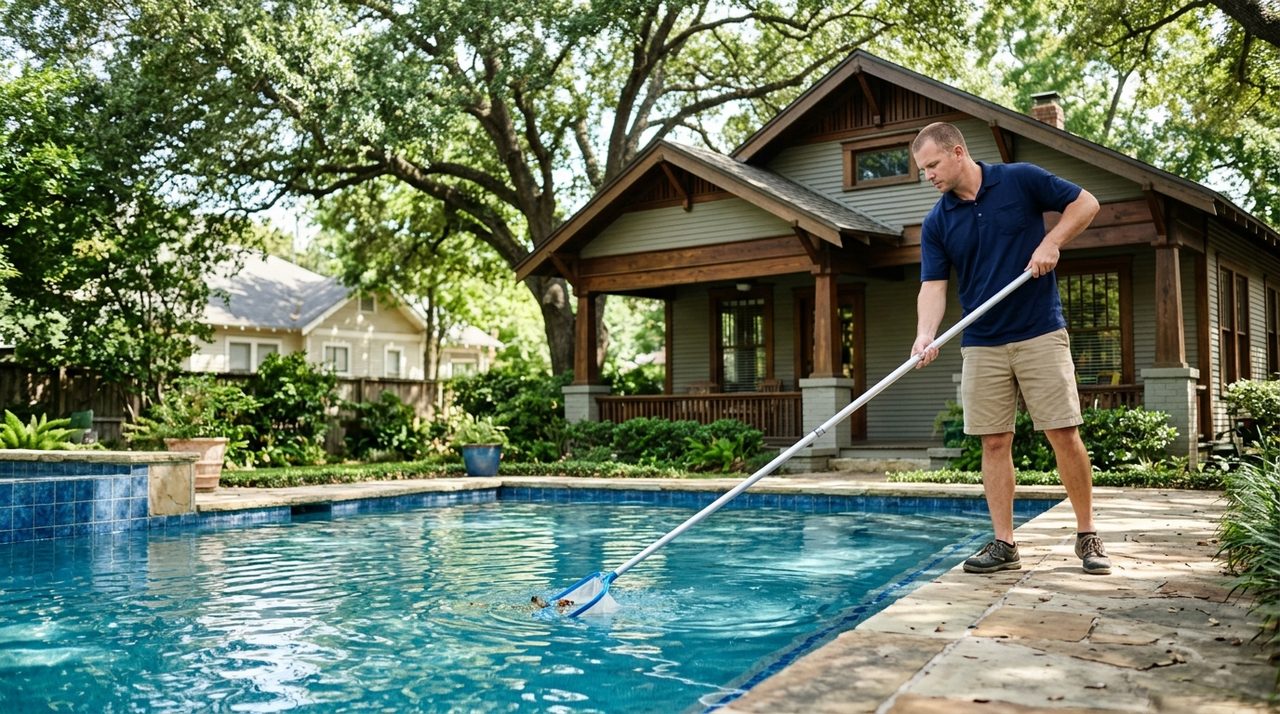
River Oaks pools sit on some of Houston's most intensively landscaped estate lots — mature live oaks, magnolias, and heritage specimen trees that make these properties extraordinary also relentlessly load pool water with tannins, pollen, and leaf debris year-round. Add the mandatory oversight of River Oaks Property Owners, Inc. (ROPO), whose deed restrictions require visible water clarity and govern equipment screening, and pool maintenance here carries a compliance dimension that most Houston neighborhoods never face. Understanding how Houston's extreme UV, the neighborhood's storied tree canopy, and ROPO's standards interact is what separates a service provider who can work in River Oaks from one who cannot.
Ranked by verified Google rating × review volume × verification tier. How we rank →
Some highly-rated pros serve River Oaks from nearby and may not keep a River Oaks street address. Those are listed under "Also serving River Oaks" with their real city and distance, so you always know where each business is based.
1316 Eberhard St, Houston, TX 77019
2929 Allen Pkwy STE. 200, Houston, TX 77019
Highly-rated pros based nearby who cover River Oaks. Distance shown from the River Oaks area.
Serving River Oaks Based in Galleria · 2 mi away
Serving River Oaks Based in Lazybrook / Timbergrove · 2.1 mi away
Serving River Oaks Based in Tanglewood · 2.7 mi away
Serving River Oaks Based in Bellaire · 3 mi away
Serving River Oaks Based in Braeswood · 3.1 mi away
Serving River Oaks Based in Bellaire · 4 mi away
Serving River Oaks Based in Independence Heights · 4.3 mi away
Serving River Oaks Based in The Heights · 4.5 mi away
Why it matters to you
River Oaks lots were master-planned beginning in the 1920s and now carry some of the densest mature tree canopy of any inner-loop Houston neighborhood — live oaks, southern magnolias, and crape myrtles that drop continuous organic material directly into pool water. That debris decays into phosphates, which feed algae blooms in water temperatures that stay above 70°F for eight to nine months of the year in Houston's subtropical climate. A single long weekend without skimming in summer can tip a chemically balanced pool into a green-water situation that requires a full shock-and-clarifier remediation costing an estimated $250–$600.
What a good pro does
A capable service tech for River Oaks pools tests phosphate levels at every visit — not just chlorine and pH — and uses a phosphate remover as a preventive tool rather than a crisis response. Brushing all surfaces, emptying skimmer baskets mid-week between visits, and trimming overhanging branches (coordinated with an arborist who understands the City of Houston's tree ordinance) are all part of managing a canopy-heavy estate pool. Texas does not require a state license for routine chemical maintenance, but technicians applying certain algaecides classified as pesticides may need a Texas Department of Agriculture pesticide applicator credential.
Sources: Texas Department of Licensing & Regulation, Texas Commission on Environmental Quality
Why it matters to you
In the core platted sections of River Oaks — those governed by River Oaks Property Owners, Inc. — deed restrictions are actively monitored and enforced by ROPO, a mandatory property owners association with a long institutional history. Pool water must remain visibly clear to the drain, and any equipment, fencing, or deck material added or replaced in a manner visible from the street can trigger an ROPO review requirement. Unlike HOA-governed suburban master-planned communities where rules are often aspirational, ROPO has the organizational capacity and decades of precedent to pursue violations. A service lapse that turns a pool green is not just an aesthetic problem — it is a deed-restriction compliance problem.
What a good pro does
Choose a pool service company that is familiar with ROPO's standards and can provide written service logs on request, since documentation of regular professional maintenance is the clearest defense against a compliance inquiry. When equipment replacements (pump motors, salt cells, heaters) are needed, verify whether City of Houston electrical or mechanical permits are required through the Houston Permitting Center before work begins — the City of Houston, not a suburban office, is the permit authority here. Note that adjacent pockets such as Huldy Street Terrace near the River Oaks Shopping Area operate without HOA governance, so requirements vary even block to block in this super-neighborhood.
Sources: Local HOA / deed restrictions (see area profile), City of Houston Permitting Center
Why it matters to you
Despite the canopy that shades much of River Oaks' garden-side landscape, many pools on these large estate lots have open swimming areas deliberately designed for sun exposure. Houston sits at roughly 29.8°N latitude, and UV index readings regularly hit 10–11 from May through September — among the highest sustained levels in the continental U.S. Unstabilized free chlorine degrades within two to three hours of full-sun exposure at those UV levels, meaning a Monday morning service visit can leave a pool chemically unprotected by Tuesday afternoon, regardless of how precise the dosing was.
What a good pro does
Proper cyanuric acid (stabilizer) management — targeting 30–50 ppm for traditionally chlorinated pools — is the primary tool for extending chlorine residual between service visits in a Houston summer. A qualified technician adjusts stabilizer levels seasonally and cross-checks them against free chlorine readings rather than treating them as a set-and-forget parameter. For River Oaks pools with saltwater chlorine generators, which are common in the high-end pool builds that accompany this neighborhood's frequent teardown-rebuild activity, maintaining correct stabilizer levels is equally critical because salt cells cannot compensate for photodegradation alone.
Why it matters to you
River Oaks maps predominantly to FEMA Zone X, meaning direct inundation from bayou flooding is not the primary storm risk — but Hurricane Beryl in July 2024 and the May 2024 derecho delivered catastrophic wind events that stripped decades-old trees across this neighborhood, dumping massive volumes of debris, bark sediment, and organic material directly into pools. That kind of sudden organic load crashes free chlorine, spikes phosphates and turbidity, and can turn a well-maintained pool into a health hazard within 48 hours. Blocks nearest Buffalo Bayou face additional risk: FEMA flood zone designations vary parcel to parcel in that corridor, and storm surge from bayou overtopping can add actual floodwater chemistry problems on top of debris contamination.
What a good pro does
Immediately after a major storm, a pool tech should conduct an emergency visit to skim bulk debris, shock the pool to restore sanitizer, and run the filter continuously on an extended backwash cycle until turbidity clears. Multiple water tests over the following week — not a single post-storm visit — are needed to confirm chlorine, pH, alkalinity, and phosphate levels have all stabilized. Equipment inspection is equally important: Beryl's sustained winds downed large limbs across River Oaks that damaged pump lids, broke conduit, and knocked automation controllers offline on numerous properties.
Sources: FEMA National Flood Hazard Layer (NFHL), Harris County Flood Control District
Hiring pool cleaning in River Oaks? River Oaks is Houston's premier residential neighborhood, featuring 1920s–1930s estate homes alongside modern luxury rebuilds on large lots. Homeowners face a unique combination of mandatory HOA oversight from River Oaks Property Owners, Inc. (ROPO), strict deed restrictions, and the maintenance demands of aging pier-and-beam foundations, mature tree root systems, and historic-era plumbing and electrical. Contractors working here must navigate both high client expectations and the regulatory requirements of the City of Houston permitting process.
Building era
1920s–1930s (original build-out), with significant post-1980 and 2000s-present luxury infill and teardown rebuilds.
Typical style
English Tudor, Spanish Colonial Revival, Georgian, Colonial, and contemporary custom luxury homes.
Foundations
Mixed — older homes predominantly pier-and-beam; newer construction and rebuilds typically slab-on-grade with post-tension or drilled piers.
Common systems
Original homes may retain cast-iron drain lines, galvanized supply piping, and older panel boxes requiring upgrades. Newer builds feature modern PEX/copper plumbing, 200+ amp electrical panels, and high-efficiency zoned HVAC systems. Mature-era homes often have outdated ductwork and window-unit retrofits.
What that means for repairs
Teardown-and-rebuild activity is extremely common on original lots, as land values far exceed structure values for many older homes. Whole-house gut renovations of surviving 1920s–1940s estates are also frequent, typically involving foundation leveling, full re-plumbing, electrical panel upgrades, and HVAC modernization while preserving architectural character.
Permit jurisdiction
Houston Permitting Center (City of Houston).
HOA & deed restrictions
Core River Oaks platted sections (e.g., River Oaks Sec 01) are governed by River Oaks Property Owners, Inc. (ROPO) — a mandatory HOA/POA with recorded deed restrictions. Adjacent pockets such as Huldy Street Terrace / Shepherd Crest near the River Oaks Shopping Area have no HOA. Condominiums like River Oaks Gardens are governed by their own condo associations (e.g., River Oaks Gardens Council of Co-Owners). Related civic organizations in the broader super neighborhood include Avalon Property Owners Association and West Lane Place Civic Association.
Historic districts
No City of Houston historic district designation confirmed. River Oaks is deed-restricted through its original master-planned community covenants, but this is a private restriction, not a Houston Archaeological and Historical Commission (HAHC) overlay.
Contractor note
ROPO and section POAs actively monitor and may require pre-approval for exterior modifications, fencing, and new construction visible from the street. Contractors should verify both City of Houston permit requirements and HOA/deed restriction compliance before beginning any exterior or structural work.
FEMA flood zone
FEMA Zone X (low flood risk) per official NFHL data. However, the neighborhood's western edge borders Buffalo Bayou, and localized street flooding can occur during extreme rainfall events despite the low-risk designation.
Hurricane Harvey impact
Not confirmed with specific damage data from research — River Oaks experienced some flooding during Hurricane Harvey (2017), particularly in areas closest to Buffalo Bayou. The neighborhood's elevation and drainage infrastructure offered relative protection to many homes, but properties along the bayou corridor and lower-lying lots did sustain water damage. Check Harris County Flood Control District records for property-specific Harvey inundation data.
Heat & humidity load
Houston's extreme summer heat and humidity place heavy demands on HVAC systems in River Oaks' large-footprint homes, especially older estates with poor insulation and aging ductwork. Mature tree canopy provides shade but contributes to foundation movement through root-driven soil moisture changes. Pier-and-beam crawl spaces in original homes require ventilation monitoring to prevent moisture-related wood damage.
Working with contractors here
The most common contractor work in River Oaks includes foundation repair and leveling on 1920s–1940s pier-and-beam structures, whole-house re-plumbing to replace cast-iron and galvanized lines, electrical panel upgrades from 100-amp to 200+ amp service, and full HVAC system replacements with zoned systems for 5,000–16,000+ square foot homes. Teardown-and-rebuild projects are a significant portion of new construction activity, requiring demolition, site engineering, and ground-up custom builds. Contractors should expect extended project timelines due to ROPO architectural review, City of Houston permitting for demolitions and new construction, and the high-end finish expectations of River Oaks homeowners. Job scoping must account for mature tree preservation ordinances, potential asbestos and lead paint in pre-1980 structures, and limited staging space on densely landscaped lots.
Local Tip
Always ask for a written estimate before work begins. Texas contractors are required to provide one on jobs over $1,000.
River Oaks is Houston's premier residential neighborhood, featuring 1920s–1930s estate homes alongside modern luxury rebuilds on large lots. Homeowners face a unique combination of mandatory HOA oversight from River Oaks Property Owners, Inc. (ROPO), strict deed restrictions, and the maintenance demands of aging pier-and-beam foundations, mature tree root systems, and historic-era plumbing and electrical. Contractors working here must navigate both high client expectations and the regulatory requirements of the City of Houston permitting process.
Source: U.S. Census Bureau, ACS 5-Year 2023
Most of River Oaks maps to FEMA Zone X (low mapped flood risk), but Houston's flash-flood reality means even low-risk blocks benefit from smart drainage and storm-hardened installs; risk climbs sharply on blocks nearest Buffalo Bayou, where it varies parcel to parcel.
Source: FEMA National Flood Hazard Layer (NFHL). Flood zones vary by parcel — verify your individual FIRM panel.
Sources: City of Houston Permitting Center
Sources: Local HOA / deed restrictions (see area profile)
Sources: FEMA National Flood Hazard Layer (NFHL)Harris County Flood Control District
Sources: Local HOA / deed restrictions (see area profile)
Sources: Local HOA / deed restrictions (see area profile)Texas Department of Licensing & Regulation