Closed
3004 Kleimann Ave, Galveston, TX 77551
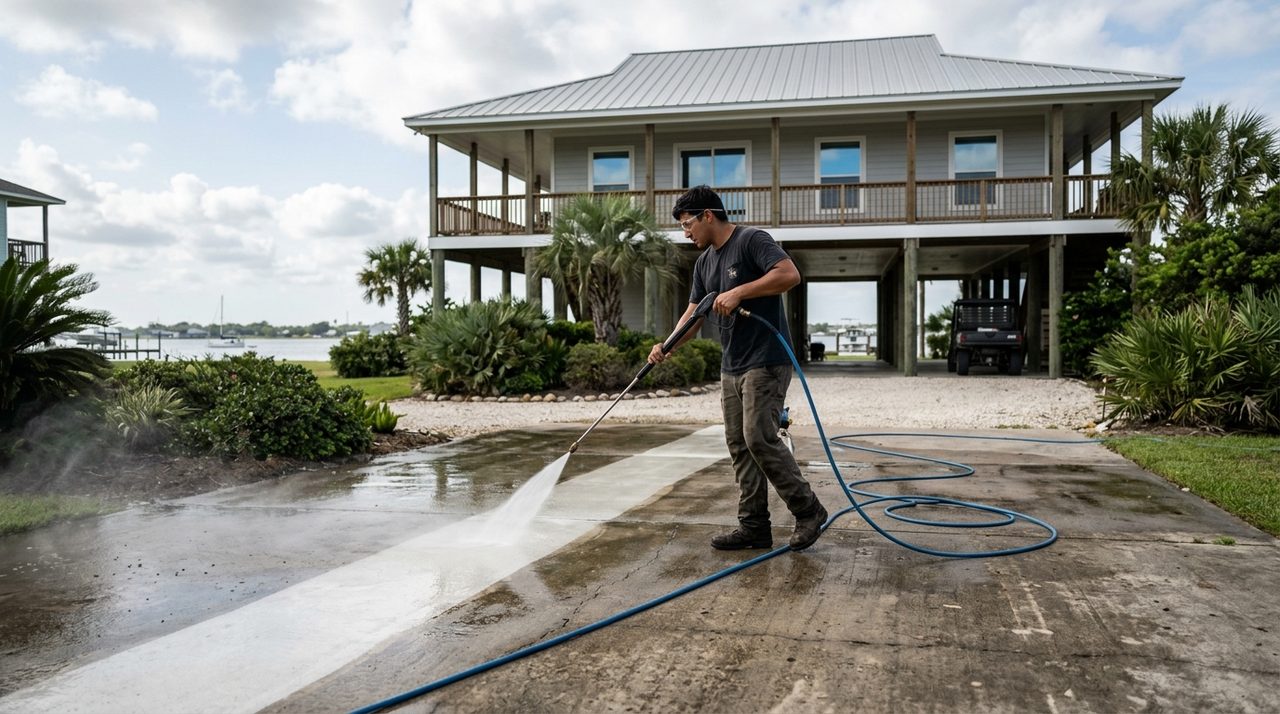
Galveston's salt-air environment, FEMA Zone AE flood exposure, and housing stock ranging from 19th-century Victorians to modern raised beach houses create pressure-washing demands unlike anywhere else in the Houston metro — storm-surge mud lines, salt-deposited mineral staining, and humidity-fed black algae all compete for attention on the same exterior surfaces. Because permit jurisdiction here falls under the City of Galveston Development Services Department (never Houston's Permitting Center), and because many properties sit in locally designated historic districts with preservation review requirements, even routine exterior cleaning decisions carry more weight than they would inland. Understanding which surfaces need soft-wash chemistry, which need containment for runoff, and which face HOA or historic-district scrutiny will save you time and money before you hire anyone.
Ranked by verified Google rating × review volume × verification tier. How we rank →
Some highly-rated pros serve Galveston from nearby and may not keep a Galveston street address. Those are listed under "Also serving Galveston" with their real city and distance, so you always know where each business is based.
3004 Kleimann Ave, Galveston, TX 77551
1816 Market St, Galveston, TX 77550
3528 Broadway Avenue J Ste 130, Galveston, TX 77550
Highly-rated pros based nearby who cover Galveston. Distance shown from the Galveston area.
Serving Galveston Based in La Marque · 5.5 mi away
Why it matters to you
Galveston sits almost entirely within FEMA Zone AE, meaning major events — including Hurricane Harvey (2017) and Hurricane Beryl (2024) — leave distinct bathtub-ring flood marks on brick, stucco, and wood siding at the exact height floodwater reached. On the island's older Victorian and Gulf Coast vernacular homes, these tannic and mineral-laden lines penetrate porous masonry and historic wood clapboard in ways that standard garden-hose rinsing cannot touch.
What a good pro does
A qualified operator will identify the flood-line height, apply a targeted alkaline pre-soak to break down organic debris and mud minerals, and use controlled low-to-medium pressure appropriate to the surface — historic wood clapboard typically requires no more than 500–800 PSI to avoid grain damage. Because wash water from these jobs contains sediment and potential chemical cleaners that cannot legally discharge into Galveston's storm drains under TCEQ rules, responsible operators contain and properly dispose of runoff rather than letting it sheet toward the street.
Sources: FEMA National Flood Hazard Layer (NFHL), Texas Commission on Environmental Quality
Why it matters to you
Unlike inland Houston neighborhoods where the main exterior staining driver is clay-soil efflorescence, Galveston homeowners on pier-and-beam and piling foundations face a different mineralogy: airborne sea salt and marine humidity deposit a thin, corrosive brine film on every exposed surface — concrete pilings, wood siding, Hardie board, metal railings, and even roofing. Left untreated, that salt layer traps moisture against the substrate and accelerates the corrosion already well-documented in Galveston's coastal HVAC and fastener systems. The island's median home was built around 1973, meaning much of this exterior material has decades of layered salt accumulation.
What a good pro does
Effective treatment for salt-loaded surfaces requires a fresh-water rinse-first approach to dilute brine before applying any cleaning chemistry, followed by a low-pressure soft-wash with a pH-appropriate detergent, then a thorough post-rinse. Operators experienced in Galveston's coastal environment know to specify marine-grade or stainless fastener-safe chemistry so cleaning solutions don't accelerate metal corrosion on railings or anchor hardware. No City of Galveston permit is required for routine residential washing, but operators working near historic district structures should confirm with the City of Galveston Development Services Department whether any surface treatment triggers preservation review.
Sources: Texas Commission on Environmental Quality, City of Houston Permitting Center
Why it matters to you
Galveston's average annual humidity and proximity to the Gulf mean that the black-streak algae Gloeocapsa magma colonizes asphalt shingle roofs faster than almost anywhere else in the region — often visibly within two years of a prior cleaning. On homes built in the 1960s through 1990s (a large share of the island's owner-occupied stock, given a median year built of 1973), original 3-tab shingles are already granule-depleted, making high-pressure washing a warranty-voiding and physically damaging option. Some Galveston condo and subdivision HOAs also issue written violation notices for visibly stained roofs, adding a compliance timeline to an already urgent maintenance need.
What a good pro does
The correct approach is a chemical soft-wash: a low-pressure (under 500 PSI) application of a sodium hypochlorite-based algaecide solution that kills Gloeocapsa magma at the root without blasting granules off the shingle surface. A post-treatment zinc or copper-based biocide applied to the ridge can extend clean intervals to three or four years. Operators in Galveston should verify that any algaecide product applied at biocidal concentrations does not trigger Texas Department of Agriculture pesticide applicator licensing requirements under Texas law.
Sources: Local HOA / deed restrictions (see area profile), Texas Commission on Environmental Quality
Why it matters to you
Galveston's historic core contains some of Texas's most intact 19th-century residential architecture — Victorian cottages, raised Italianate homes, and Gulf Coast vernacular structures with original wood siding, decorative millwork, and soft historic brick. The City of Galveston maintains its own local historic districts and preservation program entirely separate from Houston's Historic Preservation Office (HAHC), and properties within those districts may require review before exterior work alters finishes. Aggressive pressure washing on soft historic brick or original wood can permanently damage irreplaceable material and potentially trigger a preservation violation under Galveston's own ordinances.
What a good pro does
Preservation-aware pressure washing on Galveston's historic properties means defaulting to soft-wash chemistry and pressures under 500 PSI on wood surfaces, and often as low as 200–300 PSI on soft historic masonry. Before any cleaning job on a structure within a City of Galveston historic district, homeowners should confirm with the City of Galveston Development Services Department whether the proposed cleaning method or chemical constitutes a regulated exterior alteration. A knowledgeable operator will also avoid any cleaner that could bleach original painted finishes or etch lime-based mortar joints common in pre-1920 Galveston construction.
Sources: City of Houston Permitting Center, Texas Commission on Environmental Quality
Hiring pressure washing in Galveston? Galveston's housing stock spans from historic 19th-century Victorian homes to modern beach developments, creating an exceptionally diverse home service landscape. Homeowners must contend with persistent salt air corrosion, high flood risk across much of the island, and hurricane exposure that drives demand for wind-resistant roofing, elevated foundations, and robust moisture management. Permit jurisdiction falls under the City of Galveston Development Services Department or Galveston County, never the City of Houston Permitting Center.
Building era
Highly mixed — 1800s historic core through 21st-century beach and master-planned construction.
Typical style
Mix of Victorian, Gulf Coast vernacular, raised beach houses, mid-century ranch, and modern coastal developments; no single dominant style across the area.
Foundations
Mixed — many historic and coastal homes on pier-and-beam or raised pilings; newer mainland construction often slab-on-grade. Not confirmed at subdivision level — check property records.
Common systems
Older homes may have outdated electrical and galvanized plumbing requiring upgrades; coastal properties require corrosion-resistant HVAC equipment rated for salt air environments; newer builds typically feature modern central HVAC and PEX or copper plumbing.
What that means for repairs
Historic restoration is common in Galveston's core; coastal properties frequently undergo elevation projects, hurricane hardening, and replacement of salt-air-corroded exterior systems. Flood damage repair drives significant renovation activity across all housing types.
Permit jurisdiction
City of Galveston Development Services Department (within city limits); individual incorporated cities handle their own permitting elsewhere in Galveston County; unincorporated areas fall under Galveston County jurisdiction. Not the City of Houston Permitting Center.
HOA & deed restrictions
No county-wide mandatory HOA. HOAs exist at the subdivision, condo, and master-planned community level. Many single-family homes in Galveston have no HOA. Check deed restrictions recorded with the Galveston County Clerk for specific properties.
Historic districts
No City of Houston historic district designation — Galveston is outside Houston's jurisdiction. The City of Galveston maintains its own historic preservation program and local historic districts, governed by Galveston's ordinances separate from Houston's HAHC.
Contractor note
Contractors must verify whether work falls within City of Galveston, another incorporated Galveston County city, or unincorporated county jurisdiction, as permitting requirements and floodplain regulations differ significantly. Properties in local historic districts within the City of Galveston may require additional preservation review separate from any Houston process.
FEMA flood zone
FEMA Zone AE (high flood risk) — source: fema_nfhl. Galveston's island geography and coastal exposure create significant flood risk from both storm surge and rainfall. Proximity to the Gulf of Mexico and Galveston Bay compounds risk across most of the area.
Hurricane Harvey impact
Hurricane Harvey's flood impacts in Galveston County were highly localized and varied by precise location — bayfront vs. mainland interior, creek proximity, and elevation. Specific street-level flooding data for this area could not be confirmed without a more precise subdivision or address — check FEMA Harvey flood inundation maps and Galveston County floodplain administrator reports for property-specific history.
Heat & humidity load
Extreme humidity and salt air accelerate corrosion of HVAC condensers, metal roofing components, and exterior fasteners. Summer heat combined with coastal moisture drives high demand for dehumidification, mold remediation, and HVAC maintenance. Prolonged UV exposure degrades exterior paint and sealants faster than inland areas.
Working with contractors here
Contractors in Galveston most commonly work on flood damage repair, foundation elevation projects, hurricane-hardening (impact windows, fortified roofing), and replacement of salt-air-corroded exterior systems including HVAC condensers, metal railings, and fasteners. The wide range of housing eras means contractors must be prepared for both historic restoration requiring period-appropriate materials and modern coastal construction techniques. Job scoping should always include assessment of flood history, current elevation relative to base flood elevation, and whether the property falls within a City of Galveston historic district requiring preservation review. Corrosion-resistant materials and marine-grade hardware should be specified as standard for any exterior work.
Local Tip
Always ask for a written estimate before work begins. Texas contractors are required to provide one on jobs over $1,000.
Galveston's housing stock spans from historic 19th-century Victorian homes to modern beach developments, creating an exceptionally diverse home service landscape. Homeowners must contend with persistent salt air corrosion, high flood risk across much of the island, and hurricane exposure that drives demand for wind-resistant roofing, elevated foundations, and robust moisture management. Permit jurisdiction falls under the City of Galveston Development Services Department or Galveston County, never the City of Houston Permitting Center.
Source: U.S. Census Bureau, ACS 5-Year 2023
On Galveston Island, storm surge and Gulf wind are the defining hazards: much of Galveston sits in FEMA Zone AE coastal high-hazard territory, so wind-rated, elevation- and surge-aware work is the baseline, not an upgrade.
Source: FEMA National Flood Hazard Layer (NFHL). Flood zones vary by parcel — verify your individual FIRM panel.
Sources: City of Houston Permitting Center