Closed
5150 Franz Rd Suite 600, Katy, TX 77493
Katy's sprawling master-planned subdivisions — most built between the mid-1990s and 2010s on Houston Black clay slab foundations — create a perfect storm for exterior surface degradation: mandatory HOA architectural standards demand clean driveways and fences, while the area's FEMA Zone X500 designation and post-Harvey flood memory mean mud-line staining and organic buildup are facts of life here. This page cuts through generic advice to address what Katy homeowners with aging production-built homes and active ACC committees actually need to know before hiring a pressure washer.
Ranked by verified Google rating × review volume × verification tier. How we rank →
5150 Franz Rd Suite 600, Katy, TX 77493
24285 Katy Fwy Suite 300, Katy, TX 77494
23302 W Fernhurst Dr #400, Katy, TX 77494
10464 Gaston Rd, Katy, TX 77494
28349 Rose Ln, Katy, TX 77494
22715 Petrizzi Ln, Katy, TX 77449
11511 Gaston Rd, Katy, TX 77494
24044 Cinco Village Center Blvd Suite 100, Katy, TX 77494
4515 Wellington Grove Ln, Katy, TX 77494
5206 E 3rd St suite B, Katy, TX 77493
Why it matters to you
Virtually every Katy subdivision — from Mission West to Grand Lakes to Cinco Ranch — has a mandatory HOA with an active Architectural Control Committee that issues written notices for algae-streaked driveways, green-tinged brick exteriors, and grayed or mildewed wood fences. Cure windows can be as short as 30 days, and under Texas Property Code Chapter 204, failure to comply can escalate to fines or liens. Because Houston's average annual humidity exceeds 75%, Gloeocapsa magma black algae and green mold reappear on Katy's 1990s-era concrete and brick within 6–12 months of cleaning without a post-treatment biocide — meaning one cleaning may not satisfy the HOA for long.
What a good pro does
A qualified operator in Katy should document the HOA notice, photograph the affected surfaces before and after, and apply a post-wash algaecide or sodium hypochlorite treatment at low pressure (soft-wash, under 500 PSI on siding) to extend clean time well beyond the cure window. Texas does not require a state license for pressure washing itself, but if the biocide product is classified as a pesticide, the applicator needs a Texas Department of Agriculture (TDA) pesticide applicator credential — ask before they spray. Full-property packages (house, driveway, fence) typically run $500–$900 estimated, which is far less than an HOA fine escalation.
Sources: Local HOA / deed restrictions (see area profile)
Why it matters to you
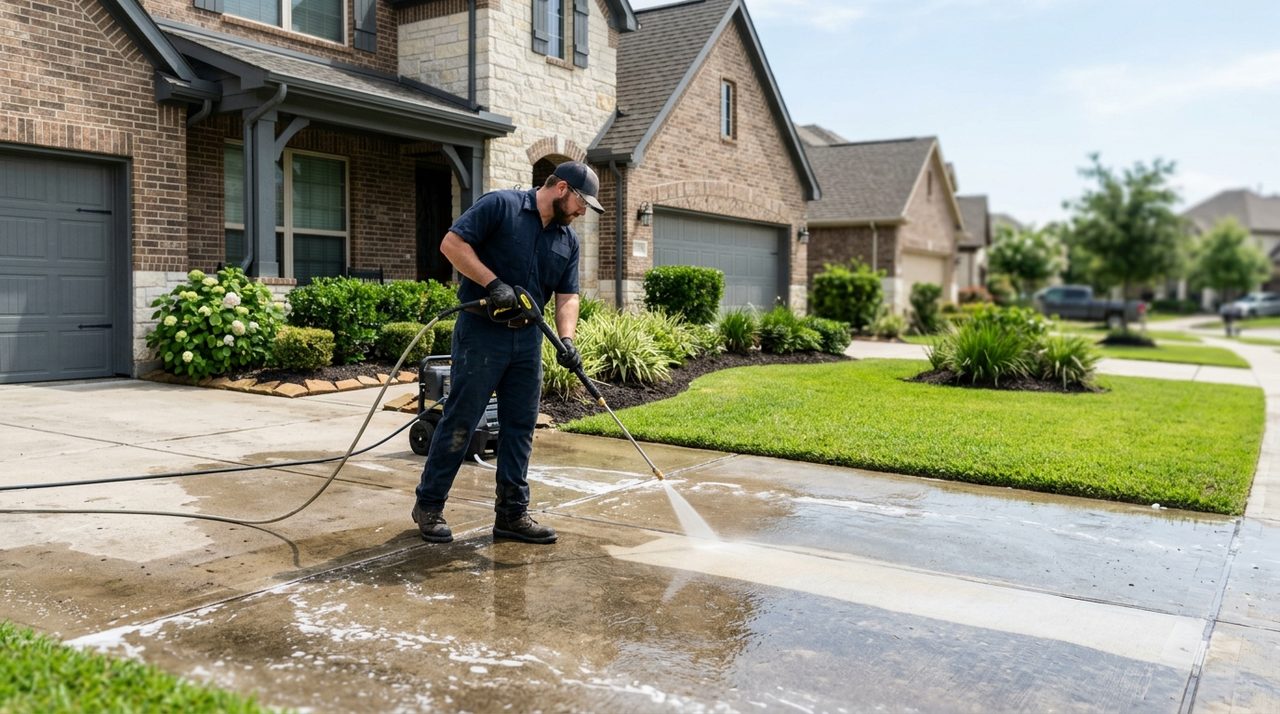
Katy sits on Houston Black expansive clay, and most homes here are slab-on-grade construction consistent with area building patterns through the 1990s–2010s. As this clay wicks moisture upward through concrete, it deposits white mineral efflorescence and red-clay mud staining along driveway edges, patio perimeters, and foundation-level brick — staining that a cold-water pressure rinse alone cannot remove. Add vehicle oil that bakes into porous, UV-hammered concrete over a Houston summer, and a standard residential driveway (up to ~1,000 sq ft) often needs chemical pre-treatment well beyond what a spray-and-rinse operator offers.
What a good pro does
A proper job on a Katy driveway starts with a pH-appropriate degreaser or efflorescence-dissolving acid wash applied as a pre-treatment before the pressure lance ever touches the surface. Hot-water equipment (around 180°F) significantly outperforms cold-water rigs on baked-in oil staining — budget for a 20–40% premium over the baseline $150–$350 driveway estimate when staining is heavy. The operator must also contain runoff from any degreaser application: TCEQ regulations prohibit detergent-laden wash water from entering storm drains that flow directly to Katy-area bayous and ultimately Galveston Bay.
Why it matters to you
Post-1990s Katy subdivisions are defined by pine privacy fencing, and Houston's combination of 100°F-plus summers, heavy rain, and active termite pressure means untreated pine grays, cracks, and grows surface mold within 12–18 months. The HOA appearance cycle and a re-stain or re-seal every two years make proper pressure washing a critical upstream step — but weathered pine is fragile, and over-pressuring above 1,200 PSI splinters the grain, creating channels that actually accelerate moisture absorption and further decay.
What a good pro does
Fence washing in Katy's subdivisions should use a fan-tip nozzle at 800–1,200 PSI maximum, working with the grain, followed by a brightener wash to open the wood fibers before any stain is applied. At an estimated $0.35–$0.65 per linear foot, a 200-linear-foot backyard fence runs roughly $70–$130 for the wash portion alone — inexpensive relative to a full fence replacement. If an ACC notice cites fence appearance, get the wash and stain scoped together and verify the stain color is pre-approved by your specific subdivision's ACC before any product is purchased.
Sources: Local HOA / deed restrictions (see area profile)
Why it matters to you
Katy sits in FEMA Zone X500 — outside the 100-year floodplain but inside the 500-year boundary — and the 2017 Harvey event demonstrated that X500 zones are not immune to flood intrusion. Homes that took on water, even a few inches in the yard, often show a distinct bathtub-ring mud line on brick courses, stucco banding, and concrete stem walls that persists for years without targeted cleaning. The May 2024 derecho and Hurricane Beryl in July 2024 also deposited tannic leaf stain and wind-driven dirt deep into Katy's porous 1990s-era brick and mortar joints.
What a good pro does
Flood-line and storm-stain removal on brick requires a lower-pressure wash (under 1,500 PSI on brick joints) combined with an alkaline cleaner or dilute muriatic acid for mineral deposits — not a standard residential rinse. Ask any operator bidding this work whether they have hot-water equipment, because cold water is largely ineffective on set-in tannic staining. Post-storm jobs with chemical pre-treatment carry an estimated 20–40% premium over base house-wash pricing ($250–$550 for a typical 2,000–2,500 sq ft Katy home), and TCEQ rules require that runoff from chemical washes be contained rather than directed into the street's storm drain inlets.
Sources: FEMA National Flood Hazard Layer (NFHL), Texas Commission on Environmental Quality
Hiring pressure washing in Katy? Katy and West Houston encompass dozens of master-planned subdivisions, each with its own HOA or property owners' association enforcing architectural standards. The predominantly suburban housing stock demands regular maintenance of slab foundations, modern HVAC systems, and exterior compliance with deed restrictions. Contractors working here must navigate subdivision-specific approval processes and remain aware of moderate flood risk across much of the area.
Building era
Primarily 1990s through 2010s, with continued new construction in outer sections.
Typical style
Production-built traditional and transitional suburban homes typical of Houston-area master-planned communities.
Foundations
Predominantly slab-on-grade (not explicitly confirmed in research but consistent with area construction patterns).
Common systems
Central AC systems (typically 15-20 SEER rated in newer builds), copper or PEX plumbing, 200-amp electrical panels in post-2000 homes. Older 1990s sections may have original R-410A or R-22 refrigerant systems nearing end of life.
What that means for repairs
Kitchen and bathroom remodels are common in 1990s-era sections aging into their second ownership cycle. Exterior modifications—roofing, fencing, paint, pergolas, and pools—require prior ACC/HOA approval in virtually all subdivisions.
Permit jurisdiction
Mixed jurisdiction. Portions within the City of Katy require permits through the City of Katy; unincorporated Harris County areas use Harris County Engineering; portions annexed by the City of Houston use the Houston Permitting Center. Verify ETJ status by specific address.
HOA & deed restrictions
Mandatory HOAs/POAs are very common across Katy and West Houston subdivisions. Each subdivision maintains its own HOA with an Architectural Control Committee (ACC). Examples include Mission West (mandatory HOA) and West Memorial Civic Association (deed-restricted community managed by Goodwin & Company). No single area-wide HOA exists; specific HOA names must be verified by subdivision via county clerk records or TREC HOA Management Certificate database.
Historic districts
No City of Houston historic district designation confirmed. Katy subdivisions are suburban master-planned communities, not historic areas.
Contractor note
Contractors must verify which jurisdiction applies to each job site, as Katy straddles city and county lines. Nearly all subdivisions require HOA/ACC pre-approval for exterior work, and failure to obtain approval exposes homeowners and contractors to legal enforcement under Texas Property Code Chapter 204.
FEMA flood zone
FEMA Zone X500 (moderate flood risk) - source: fema_nfhl. Portions of Katy and West Houston are proximate to Buffalo Bayou tributaries and Barker Reservoir, which can influence localized flood conditions beyond what the zone designation suggests.
Hurricane Harvey impact
Research did not provide subdivision-specific Harvey impact data for Katy/West Houston. However, the Katy area is widely known to have experienced significant flooding during Hurricane Harvey (2017), particularly in neighborhoods near Barker Reservoir due to controlled releases. Homeowners should check individual property flood history through Harris County Flood Control District records and FEMA claims data.
Heat & humidity load
Extreme Houston-area summer heat (sustained 95°F+ with high humidity) places heavy demand on HVAC systems in these largely single-story and two-story homes. Attic insulation degradation, refrigerant loss, and condensate drain issues are common summer service calls. Slab foundations may experience seasonal movement due to expansive clay soils cycling between drought and saturation.
Working with contractors here
Contractors in Katy and West Houston most frequently handle HVAC maintenance and replacement, roof repairs, and fence/exterior renovation projects driven by aging 1990s-2000s housing stock. HOA-mandated architectural standards mean exterior jobs—from paint to roofing material selection—often require ACC pre-approval before work begins, so contractors should build approval timelines into project scoping. Post-Harvey, there remains steady demand for foundation inspection, moisture remediation, and drainage improvement work. The sprawling geography of the area means job sites can be 15-20 miles apart even within 'Katy,' so efficient scheduling is essential. Contractors should verify permit jurisdiction (City of Katy, City of Houston, or Harris County) for each address before pulling permits.
Local Tip
Always ask for a written estimate before work begins. Texas contractors are required to provide one on jobs over $1,000.
Katy and West Houston encompass dozens of master-planned subdivisions, each with its own HOA or property owners' association enforcing architectural standards. The predominantly suburban housing stock demands regular maintenance of slab foundations, modern HVAC systems, and exterior compliance with deed restrictions. Contractors working here must navigate subdivision-specific approval processes and remain aware of moderate flood risk across much of the area.
Source: U.S. Census Bureau, ACS 5-Year 2023
Katy carries FEMA Zone X500 (moderate flood risk): outside the 100-year floodplain but inside the 500-year, so heavy-rain events still reach homes and flood-aware work pays off.
Source: FEMA National Flood Hazard Layer (NFHL). Flood zones vary by parcel — verify your individual FIRM panel.
Sources: City of Houston Permitting CenterTexas Commission on Environmental Quality
Sources: Local HOA / deed restrictions (see area profile)