Closed
207 Loon River Dr, Huffman, TX 77336
Kingwood's master-planned villages stretch from 1970s Greentree to 2010s-era subdivisions along the San Jacinto River corridor, meaning exterior surfaces range from decades-old concrete driveways riddled with oxidation to newer construction already greening from the bayou-adjacent humidity that defines northeast Houston. The community's mandatory deed-restriction structure — enforced by both the Lake Houston Community Association and individual village HOAs — puts pressure-washing compliance squarely on the homeowner's radar, not just aesthetics. This page cuts through what Kingwood's specific housing mix, tree canopy, and HOA enforcement calendar actually mean for getting exterior surfaces cleaned correctly.
Ranked by verified Google rating × review volume × verification tier. How we rank →
Some highly-rated pros serve Kingwood from nearby and may not keep a Kingwood street address. Those are listed under "Also serving Kingwood" with their real city and distance, so you always know where each business is based.
207 Loon River Dr, Huffman, TX 77336
4321 Kingwood Dr Suite 101, Kingwood, TX 77339
5334A FM 1960, Humble, TX 77346
4211 Meadow Springs Dr, Kingwood, TX 77339
19842 January Dr, Humble, TX 77346
Highly-rated pros based nearby who cover Kingwood. Distance shown from the Kingwood area.
Serving Kingwood Based in NE Houston · 3.8 mi away
Serving Kingwood Based in Humble · 5.2 mi away
Serving Kingwood Based in Humble · 5.5 mi away
Serving Kingwood Based in Humble · 6.2 mi away
Why it matters to you
Kingwood homeowners face a two-tier compliance structure unusual even by Houston suburban standards: the Lake Houston Community Association sets community-wide exterior appearance standards, while individual village HOAs — with fees running an additional $100–$600 annually per village — maintain their own architectural review processes. Cure windows for algae-stained driveways, discolored fencing, or green-streaked roofs can be as short as 30 days, and some village CC&Rs specifically prohibit high-pressure washing on roofing materials, meaning the wrong cleaning method can itself become a violation.
What a good pro does
Before scheduling any work, request the specific village-level CC&Rs and confirm whether a pre-approval or notice is required — some Kingwood village ARCs want written notification even for routine soft-washing. A qualified operator will document surface condition before and after, use low-pressure soft-wash (under 500 PSI) on asphalt shingles per manufacturer guidance, and provide a written scope you can submit to the HOA if challenged. No City of Houston permit is required for routine residential pressure washing, but the HOA approval step is non-negotiable here.
Sources: Local HOA / deed restrictions (see area profile), City of Houston Permitting Center
Why it matters to you
Kingwood's founding design principle was preserving mature pine and hardwood forest throughout its villages, which is exactly the condition that accelerates Gloeocapsa magma black-algae colonization on roofs, driveways, and wood fencing. Homes in canopy-heavy sections like Greentree and Forest Cove — built as early as the 1970s — sit under continuous shade that keeps surfaces damp long after rainfall, cutting the typical 6–12 month reappearance window for black streaks down further. Post-storm organic debris from Hurricane Beryl (2024) and the May 2024 derecho accelerated this cycle for many northwest-facing roof planes.
What a good pro does
An effective treatment for Kingwood homes applies a post-wash biocide — typically a sodium hypochlorite or quaternary ammonium solution — as a residual treatment after soft-washing, which extends clean appearance from a few months to 12–18 months. Operators should note that algaecide products applied at label-specified concentrations may require a Texas Department of Agriculture (TDA) pesticide applicator license; ask your operator to confirm their TDA status before they apply any chemical treatment to your roof or siding.
Sources: Local HOA / deed restrictions (see area profile)
Why it matters to you
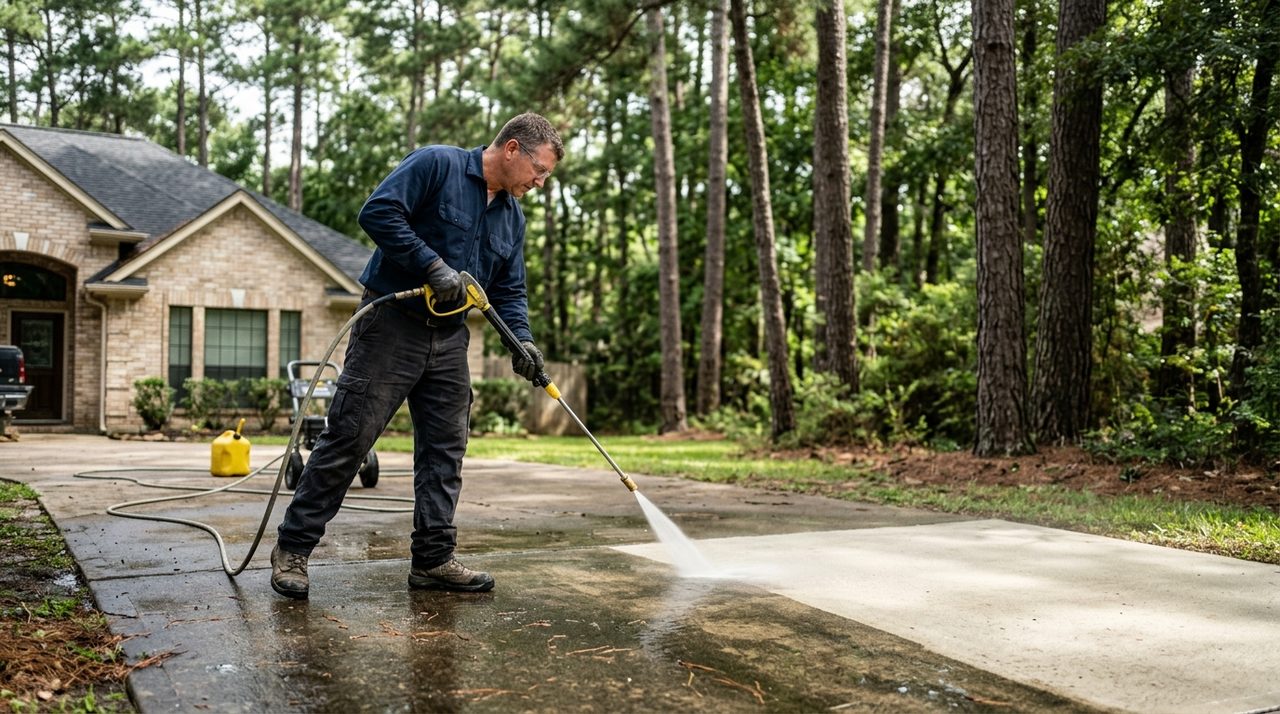
The median year built across Kingwood's Census tract is 1997, but older villages like Woodland Hills and Kings Forest contain original concrete driveways poured in the late 1970s and 1980s — now 40-plus years of vehicle oil, UV oxidation, and Houston clay wicking mineral salts upward through the slab. Winter Storm Uri's 2021 freeze-thaw cycle opened surface spalling on already-porous older slabs, giving oil and tannic staining from leaf debris a deeper foothold. Standard cold-water rinsing at consumer-grade pressure simply does not break the bond of baked-in oil on this type of surface.
What a good pro does
For Kingwood driveways in pre-2000 sections, a professional operator should apply a hot-water unit (water heated to 180–200°F) combined with a alkaline degreaser pre-soak, dwelling at least 5–10 minutes before pressure application. Expect a 20–40% cost premium over a standard driveway wash — bringing a typical driveway job from the $150–$350 base range up toward $200–$490 — for chemical pre-treatment and hot-water equipment on heavily stained surfaces. This is an estimate; pricing varies with surface condition and linear footage.
Why it matters to you
Kingwood's storm-drain network ultimately drains toward Lake Houston and the West Fork San Jacinto River, both sensitive water bodies. TCEQ regulations under the Texas Pollutant Discharge Elimination System (TPDES) prohibit pressure-wash wastewater containing degreasers, detergents, or chemical cleaners from entering storm drains — and in Kingwood, curb drains connect quickly to that watershed. Properties along the Kingwood Greenbelt trail system or backing to drainage channels are particularly close to the discharge point. Because Kingwood is within City of Houston limits, Houston's own stormwater ordinance also applies, and code enforcement can act on violations in incorporated areas.
What a good pro does
A compliant operator working on Kingwood driveways or commercial-style jobs using degreasers should use berms, wet-vac reclaim equipment, or absorbent containment to prevent runoff from reaching curb drains — and dispose of recovered wash water in a sanitary sewer via an approved connection, not on-site discharge. For routine soft-wash jobs using diluted bleach solutions on siding or roofs, the operator should ensure rinsate does not pool near storm-drain inlets. Ask operators directly how they handle wash-water containment before work begins; it is a meaningful environmental and legal compliance question in this specific location.
Sources: Texas Commission on Environmental Quality, City of Houston Permitting Center
Hiring pressure washing in Kingwood? Kingwood is a large master-planned community in northeast Houston with a mandatory community association structure and deed restrictions governing exterior modifications. The neighborhood encompasses multiple villages with varying build periods, meaning housing stock age and systems vary significantly by subdivision. Homeowners should verify both community-wide and village-level deed restrictions before undertaking exterior or structural work.
Building era
Mixed — development spans from the 1970s through the 2010s across various villages. Specific decade varies by subdivision.
Typical style
Not confirmed from available sources — likely a mix of traditional suburban styles typical of Houston master-planned communities across multiple decades.
Foundations
Not confirmed — slab-on-grade is typical for Houston-area suburban construction of this era, but specific confirmation not available for all Kingwood villages.
Common systems
Given the multi-decade build-out, systems range widely: older sections may have original HVAC, galvanized or copper plumbing, and older electrical panels, while newer sections feature modern systems. Homes from the 1970s–1980s may have aging ductwork and R-22 refrigerant HVAC units requiring replacement.
What that means for repairs
Renovation activity likely varies by village age — older Kingwood sections (Greentree, Woodland Hills) may see full HVAC replacements, kitchen/bath remodels, and roof replacements, while newer sections focus on cosmetic updates. All exterior modifications must comply with deed restrictions enforced by the community association.
Permit jurisdiction
Houston Permitting Center — Kingwood is within City of Houston limits. No separate Kingwood municipal permit office exists.
HOA & deed restrictions
Mandatory master association structure — the Lake Houston Community Association manages community-wide facilities and business. Mandatory Kingwood Association fees are approximately $200–$400 annually. Many villages/subdivisions have additional HOAs with fees of $100–$600 annually. Some areas include gated-community surcharges. Deed restrictions are enforced by community associations in lieu of municipal zoning.
Historic districts
No City of Houston historic district designation confirmed.
Contractor note
Contractors must obtain City of Houston permits for regulated work and ensure all exterior modifications comply with both the master community association deed restrictions and any applicable village-level HOA architectural review requirements before beginning work.
FEMA flood zone
FEMA Zone X (low flood risk) — source: fema_nfhl. Note: Kingwood is situated near the San Jacinto River and Lake Houston; flood risk can vary significantly by specific tract and proximity to waterways. Homeowners in areas closer to the river or drainage channels should verify their individual FIRM panel.
Hurricane Harvey impact
Parts of Kingwood were impacted by Hurricane Harvey in 2017, but specific streets and recurring flood areas could not be confirmed from available sources. Homeowners should check Harris County Flood Control District records and FEMA flood insurance claims data for tract-specific Harvey impact information.
Heat & humidity load
Houston's extreme summer heat and humidity stress HVAC systems heavily across Kingwood's varied housing stock. Older homes may have undersized or aging units struggling to maintain efficiency. High humidity also creates conditions for mold growth in attics and crawl spaces, and heavy summer storms can expose roofing and drainage vulnerabilities.
Working with contractors here
Kingwood's multi-decade build-out means contractors encounter a wide range of systems and conditions depending on the specific village. Older sections built in the 1970s–1980s commonly need HVAC replacements, re-roofing, plumbing upgrades, and electrical panel modernization. Newer sections may focus on cosmetic remodeling and energy efficiency improvements. All exterior work must be pre-approved through the relevant community association or village HOA architectural review process, which can add lead time to project scheduling. Contractors should also be aware that flood remediation and moisture mitigation remain relevant trades in sections closer to waterways, even in areas mapped as Zone X.
Local Tip
Always ask for a written estimate before work begins. Texas contractors are required to provide one on jobs over $1,000.
Kingwood is a large master-planned community in northeast Houston with a mandatory community association structure and deed restrictions governing exterior modifications. The neighborhood encompasses multiple villages with varying build periods, meaning housing stock age and systems vary significantly by subdivision. Homeowners should verify both community-wide and village-level deed restrictions before undertaking exterior or structural work.
Source: U.S. Census Bureau, ACS 5-Year 2023
Most of Kingwood maps to FEMA Zone X (low mapped flood risk), but Houston's flash-flood reality means even low-risk blocks benefit from smart drainage and storm-hardened installs; risk climbs sharply on blocks nearest the San Jacinto River and Lake Houston, where it varies parcel to parcel.
Source: FEMA National Flood Hazard Layer (NFHL). Flood zones vary by parcel — verify your individual FIRM panel.
Sources: City of Houston Permitting CenterLocal HOA / deed restrictions (see area profile)
Sources: Local HOA / deed restrictions (see area profile)
Sources: Local HOA / deed restrictions (see area profile)