Open Now
3307 Candlepine Dr, Spring, TX 77388
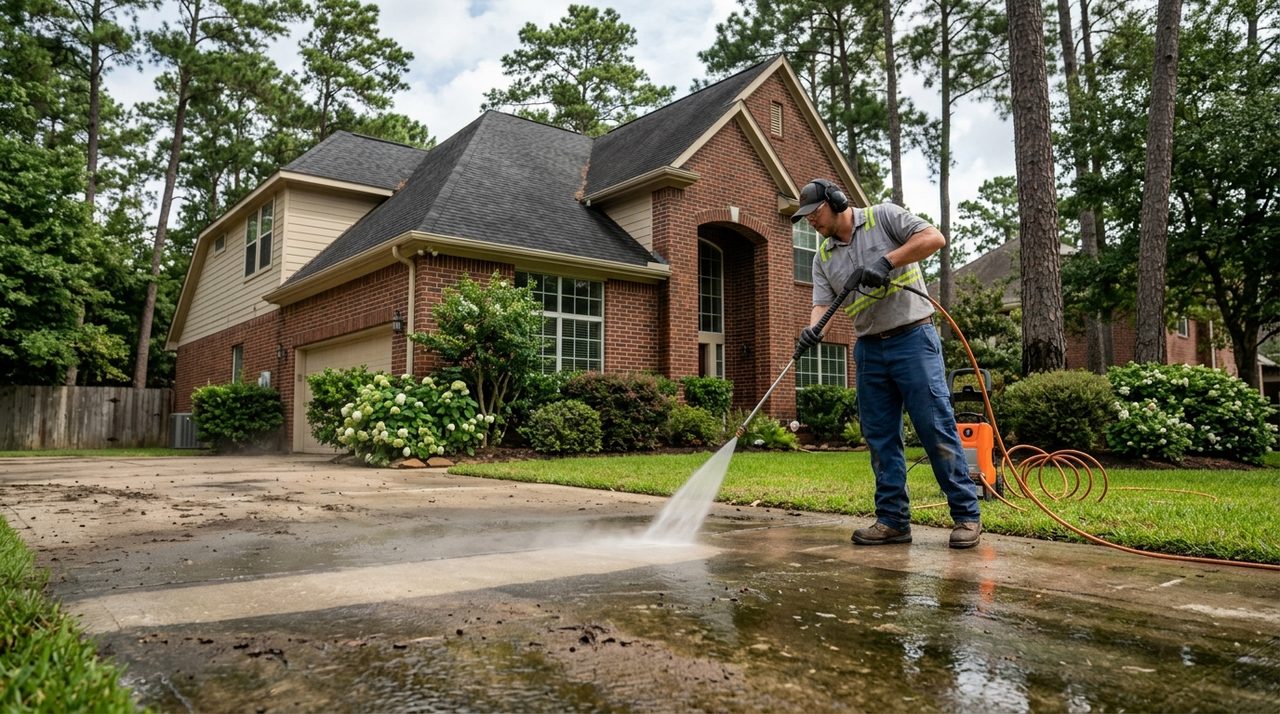
Spring's sprawling patchwork of 1970s–2000s brick-veneer subdivisions — built slab-on-grade over Harris County's expansive black clay — creates a specific and recurring set of exterior cleaning problems that most homeowners underestimate until an HOA violation notice arrives. Between Gloeocapsa magma colonizing north-facing brick and decade-old concrete driveways stained by clay-wicked minerals and baked-in motor oil, routine rinsing with a garden hose never keeps up. This page explains what actually drives exterior staining in Spring, what it costs to fix, and what to expect from a qualified wash operator working in unincorporated Harris County.
Ranked by verified Google rating × review volume × verification tier. How we rank →
Some highly-rated pros serve Spring from nearby and may not keep a Spring street address. Those are listed under "Also serving Spring" with their real city and distance, so you always know where each business is based.
3307 Candlepine Dr, Spring, TX 77388
24703 Broad Branch Ct, Spring, TX 77373
117 Goedecke Rd, Spring, TX 77373
21522 Falvel Rd, Spring, TX 77388
I-45 Cypresswood Dr, Spring, TX 77373
22742 Cypresswood Dr #1136, Spring, TX 77373
Highly-rated pros based nearby who cover Spring. Distance shown from the Spring area.
Serving Spring Based in The Woodlands · 1.7 mi away
Serving Spring Based in The Woodlands · 1.9 mi away
Serving Spring Based in The Woodlands · 2.4 mi away
Serving Spring Based in The Woodlands · 3 mi away
Why it matters to you
Spring's median home was built in 1991 on a slab poured directly over Harris County's Beaumont black clay — the same shrink-swell soil responsible for the area's chronic foundation movement. As the clay wets and dries through seasonal cycles, it wicks soluble mineral salts upward through the slab and into mortar joints, depositing white efflorescence blooms on driveways, patios, and foundation-level brick that standard cold-water rinsing cannot dissolve. Red-clay mud driven under garage doors and across stamped concrete during heavy rains bakes on under spring and summer UV.
What a good pro does
A knowledgeable operator will apply a dilute muriatic acid or phosphoric acid pre-treatment to dissolve carbonate efflorescence before any pressure is applied — cold water alone re-deposits the mineral rather than removing it. On aged concrete driveways (many in Spring are now 25–45 years old), hot-water surface cleaning at controlled pressure loosens oxidized clay staining without spalling already-weathered aggregate. Expect a 20–30% cost premium over a basic rinse job for chemical pre-treatment on heavily stained surfaces; estimates for a standard Spring driveway and walkway run $150–$350.
Why it matters to you
Dozens of Spring's established subdivisions — particularly those platted in the 1970s and 1980s along Spring Creek and Cypress Creek tributaries — now have mature oak and pine canopy that keeps north- and east-facing brick faces perpetually shaded and damp. Houston's average annual humidity above 75% means Gloeocapsa magma (the organism responsible for black streaking) can recolonize a freshly washed brick surface within 6–12 months. Wood privacy fences in the same subdivisions gray and develop green mold within a single wet season without follow-up treatment.
What a good pro does
On brick siding, a trained operator uses a low-pressure soft-wash application of a sodium hypochlorite solution — not a high-pressure stream that can erode mortar joints on 1970s–1980s masonry — followed by a biocide post-rinse that extends clean appearance to 18–24 months rather than 6. Wood fence washing in Spring should be done at no more than 1,200 PSI to avoid splintering weathered pine prior to staining or sealing; fence washing typically runs $0.35–$0.65 per linear foot. Texas does not require a state license for pressure washing itself, but operators applying algaecide products at commercial concentrations may need a Texas Department of Agriculture pesticide applicator credential.
Sources: Local HOA / deed restrictions (see area profile), Texas Commission on Environmental Quality
Why it matters to you
Spring has no single governing HOA — instead, most post-1970 subdivisions are governed by their own mandatory property owners' associations (POAs) with deed-tied membership, confirmed through Harris County Clerk deed records. Many of these POAs maintain active architectural review committees that issue written violation notices for algae-stained driveways, discolored vinyl or wood fencing, and green-streaked roof shingles, often with cure windows as short as 30 days. Because Spring is largely unincorporated Harris County rather than City of Houston proper, there is no city zoning overlay, but the private deed restrictions carry the same legal force.
What a good pro does
Before scheduling work, confirm your subdivision's specific POA rules — some CC&Rs restrict the hours contractors may operate equipment, require HOA-approved contractors, or prohibit high-pressure washing on certain roofing materials. For roof cleaning, Spring's dominant architectural asphalt shingles (common on homes built 1985–2005) require soft-wash at under 500 PSI; high-pressure application voids most shingle manufacturer warranties and accelerates granule loss on aging roofs. A full-property soft-wash package — house exterior, driveway, and fence — typically quotes $500–$900 in the Houston metro and is often the most cost-effective way to clear a POA notice in a single visit.
Sources: Local HOA / deed restrictions (see area profile), International Residential Code (as adopted by City of Houston)
Why it matters to you
Many Spring driveways serving two-car attached garages — the standard layout across 1980s–2000s subdivisions here — show significant oil and tire-rubber staining, particularly where older vehicles or boats are stored on the apron. Removing this type of oxidized petroleum staining requires hot-water equipment and chemical degreasers beyond what a cold-water rinse delivers. However, TCEQ regulations and Harris County stormwater rules prohibit wash water containing degreasers or chemical cleaners from flowing into street gutters and storm drains, which in this part of Harris County drain toward Spring Creek and Cypress Creek corridors.
What a good pro does
A compliant operator will use containment berms or absorbent booms to capture degreaser-laden runoff on driveway jobs, then transport and dispose of it properly rather than letting it sheet-flow to the street inlet. TCEQ has issued notices of violation to Houston-area pressure-wash operators for improper discharge, so ask any bidder specifically how they handle runoff on degreaser jobs — a vague answer is a red flag. Hot-water driveway cleaning with proper containment typically carries a 20–40% premium over a standard cold-water wash; on a heavily stained Spring driveway, budget toward the upper end of the $150–$350 estimate range.
Sources: Texas Commission on Environmental Quality, FEMA National Flood Hazard Layer (NFHL)
Hiring pressure washing in Spring? Spring is a large, mostly unincorporated area of Harris County comprising dozens of distinct subdivisions, each with its own HOA rules and deed restrictions. Homeowners here primarily deal with maintaining 1970s–2000s era slab-on-grade suburban homes, with common needs including HVAC replacement, foundation monitoring on expansive clay soils, and roof repairs. Proximity to Spring Creek and Cypress Creek tributaries means flood risk varies dramatically by subdivision, making property-specific flood zone verification essential before any major renovation.
Building era
1970s–2000s, with continued new construction near Grand Parkway (SH-99) in the 2010s–2020s.
Typical style
One- and two-story brick veneer detached single-family homes in traditional, ranch, and contemporary suburban styles with attached two-car garages.
Foundations
Slab-on-grade (dominant); pier-and-beam is rare and limited to occasional older properties.
Common systems
Central HVAC systems (many original units in 1970s–1980s homes are past useful life), copper or CPVC plumbing with some polybutylene in 1980s–early 1990s builds, and 100–200 amp electrical panels typical of era.
What that means for repairs
Kitchen and bathroom remodels are common in 1970s–1990s homes. HVAC system replacements are frequent due to system age. Foundation repair is a recurring need due to expansive clay soils and seasonal moisture fluctuation. Roof replacements are common on 20+ year homes after hail events.
Permit jurisdiction
Harris County Engineering Department for unincorporated areas (most of Spring); some portions within City of Houston ETJ may require Houston Permitting Center coordination.
HOA & deed restrictions
No single area-wide HOA exists. Most post-1970 subdivisions have mandatory property owners' associations (POAs) with deed-tied membership. Some older pockets have voluntary civic clubs or no active HOA. Specific HOA identity must be confirmed via Harris County Clerk deed records or TREC HOA Management Certificate Database.
Historic districts
No City of Houston historic district designation confirmed. Spring is largely unincorporated Harris County with no known HAHC-designated historic districts.
Contractor note
Contractors must verify whether a property falls within an incorporated city or unincorporated Harris County, as permit requirements and inspections differ. HOA architectural review and approval is required in most subdivisions before exterior modifications.
FEMA flood zone
FEMA Zone X (low flood risk) per official NFHL data. However, Spring encompasses areas near Spring Creek and Cypress Creek tributaries where flood risk can vary significantly by subdivision and specific lot. Property-level FIRM verification is strongly recommended.
Hurricane Harvey impact
Hurricane Harvey caused widespread flooding across north Harris County in 2017, with neighborhoods along Spring Creek and Cypress Creek corridors experiencing varying degrees of inundation. A single authoritative list of affected Spring subdivisions is not publicly compiled — property-specific impact should be verified through Harris County Flood Control District mapping tools and seller disclosures.
Heat & humidity load
Sustained 95°F+ temperatures and high humidity stress HVAC systems heavily, especially aging units in 1970s–1980s homes. Expansive clay soils contract during summer drought, increasing foundation movement risk. Attic temperatures can exceed 150°F, accelerating roofing material degradation and making attic insulation upgrades a common summer-driven project.
Working with contractors here
Contractors in Spring most commonly handle HVAC replacements, foundation repair, roof replacements, and kitchen/bath remodels driven by the aging 1970s–2000s housing stock. Foundation work is particularly prevalent due to the area's expansive clay soils and seasonal moisture cycles. Job scoping must account for subdivision-specific HOA architectural guidelines, which frequently regulate exterior colors, materials, fencing, and even contractor work hours. Because Spring is largely unincorporated Harris County, permits are handled through county engineering rather than the City of Houston, and contractors should verify jurisdiction boundaries on a per-property basis. Properties near creek corridors may require additional floodplain development permits even if the lot itself is mapped Zone X.
Local Tip
Always ask for a written estimate before work begins. Texas contractors are required to provide one on jobs over $1,000.
Spring is a large, mostly unincorporated area of Harris County comprising dozens of distinct subdivisions, each with its own HOA rules and deed restrictions. Homeowners here primarily deal with maintaining 1970s–2000s era slab-on-grade suburban homes, with common needs including HVAC replacement, foundation monitoring on expansive clay soils, and roof repairs. Proximity to Spring Creek and Cypress Creek tributaries means flood risk varies dramatically by subdivision, making property-specific flood zone verification essential before any major renovation.
Source: U.S. Census Bureau, ACS 5-Year 2023
Most of Spring maps to FEMA Zone X (low mapped flood risk), but Houston's flash-flood reality means even low-risk blocks benefit from smart drainage and storm-hardened installs.
Source: FEMA National Flood Hazard Layer (NFHL). Flood zones vary by parcel — verify your individual FIRM panel.
Sources: City of Houston Permitting Center
Sources: Local HOA / deed restrictions (see area profile)