Open Now
6140 Hwy 6 Ste. 232, Missouri City, TX 77459
Stafford's housing stock — dominated by 1970s–1990s brick-veneer ranch homes and production builds sitting on Fort Bend County's expansive black clay — creates a specific set of exterior maintenance headaches that generic pressure washing cannot solve. The city's patchwork of subdivision HOAs (some active, some dormant) means a driveway or fence cleaning job can carry compliance stakes that differ block by block, and the slab-on-grade construction virtually guarantees mineral wicking and clay staining at ground level. Understanding which surfaces need soft-wash chemistry versus pressure, and which HOA might be watching, is the practical value of this page.
Ranked by verified Google rating × review volume × verification tier. How we rank →
Some highly-rated pros serve Stafford from nearby and may not keep a Stafford street address. Those are listed under "Also serving Stafford" with their real city and distance, so you always know where each business is based.
6140 Hwy 6 Ste. 232, Missouri City, TX 77459
11414 Brook Meadows Ln, Stafford, TX 77477
4211 Shady Village Ct, Missouri City, TX 77459
644 Stafford Run Rd D, Stafford, TX 77477
Highly-rated pros based nearby who cover Stafford. Distance shown from the Stafford area.
Serving Stafford Based in Missouri City · 1.5 mi away
Serving Stafford Based in Sugar Land · 2.6 mi away
Serving Stafford Based in Missouri City · 2.8 mi away
Serving Stafford Based in Sugar Land · 2.9 mi away
Serving Stafford Based in Westbury · 3.2 mi away
Serving Stafford Based in Sharpstown · 3.3 mi away
Why it matters to you
Stafford's slab-on-grade homes, most built between 1975 and 1995, sit directly on Fort Bend County's Beaumont clay. As the soil cycles through Houston's wet and dry seasons, mineral salts and red-clay sediment wick upward through concrete driveways, mortar joints, and the base courses of brick veneer — leaving white efflorescence deposits and rust-colored mud staining that a garden hose or basic rinse cannot touch. On a 1980s ranch home, this staining is often mistaken for mold but requires a completely different chemical approach.
What a good pro does
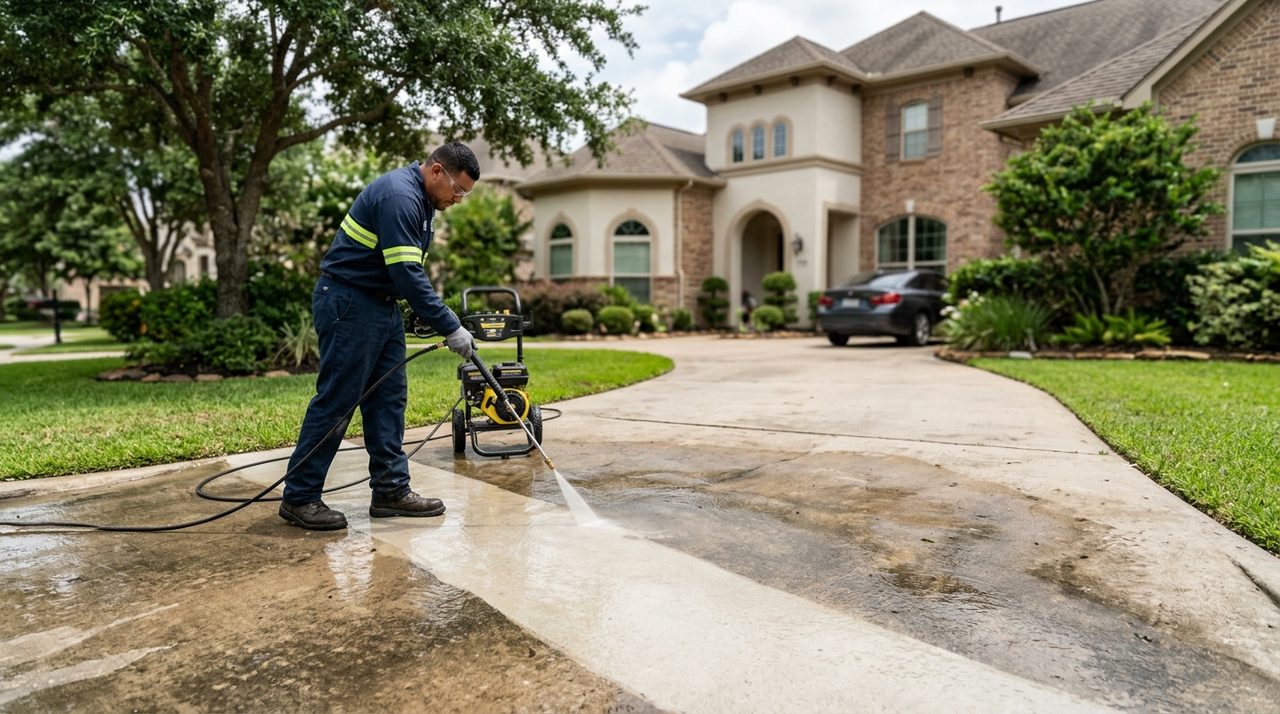
A qualified operator should apply a diluted phosphoric or muriatic acid pre-treatment specifically formulated for efflorescence, dwell it adequately, then follow with controlled-pressure washing (typically 1,500–2,500 PSI on concrete flatwork, lower on aged mortar joints) rather than a blanket high-pressure blast that can erode mortar. No City of Stafford permit is required for residential pressure washing, but the operator should confirm the cleaning chemistry does not discharge into a storm drain inlet — wastewater with chemical cleaners must be contained per TCEQ stormwater rules.
Why it matters to you
Stafford has no city-wide HOA, but individual subdivisions — including communities like Grove West — maintain their own architectural review standards and deed restrictions. A homeowner in one Stafford subdivision may receive a written cure notice for an algae-stained driveway or a greening wood fence within a 30-day window, while a neighbor one street over in a deed-restriction-light subdivision faces no such requirement. With a census median home value of roughly $248,000 and 43% owner-occupancy, many Stafford properties are also rental units where landlords may not realize an HOA notice has been issued.
What a good pro does
Before scheduling any exterior wash, pull your subdivision's deed restrictions through Fort Bend County Clerk records to confirm whether an architectural review committee is active and whether any CC&Rs specify approved cleaning methods or surface treatments. Some CC&Rs in the region explicitly restrict high-pressure washing on certain roofing or siding materials. A knowledgeable operator will ask for this documentation upfront rather than after the fact.
Sources: Local HOA / deed restrictions (see area profile)
Why it matters to you
Even though most of Stafford maps to FEMA Zone X (low flood risk), the city sits within Southwest Houston's broader high-humidity belt, and its drainage channels and detention areas create localized pockets of elevated ambient moisture. Homes within a few blocks of these corridors — especially those shaded by mature trees planted with 1970s–1980s landscaping plans — accumulate Gloeocapsa magma black algae and green mold on north-facing brick, wood privacy fences, and shaded driveway sections at an accelerated rate, often returning within 6–12 months of a basic cleaning.
What a good pro does
The correct response is a soft-wash application — typically a sodium hypochlorite-based biocide at appropriate dilution — applied at low pressure (under 500 PSI) to kill the biological root system rather than just surface-blast the visible staining. A post-treatment algaecide applied after cleaning extends the clean significantly. Texas does not require a state pressure-washing license, but operators applying biocide products classified as pesticides under Texas Department of Agriculture definitions should hold a TDA pesticide applicator credential.
Sources: FEMA National Flood Hazard Layer (NFHL), Texas Commission on Environmental Quality
Why it matters to you
Stafford's older ranch homes — many poured on expansive clay slabs in the late 1970s through early 1990s — have original concrete driveways that have undergone decades of seasonal heave and settlement. That movement creates surface micro-cracking that allows motor oil, tire rubber oxidation, and UV-baked grease to penetrate well below the surface layer. Winter Storm Uri's (2021) freeze-thaw cycle accelerated spalling on already-stressed flatwork across Fort Bend County, leaving the concrete even more porous and stain-receptive.
What a good pro does
Cold-water pressure washing alone will not lift embedded oil from aged, spalled concrete. A competent operator uses hot-water equipment (180°F+) in combination with a commercial degreaser pre-soak, then extracts the emulsified waste rather than flushing it into the nearest storm drain — a direct TCEQ compliance requirement when degreasers are involved. Expect a 20–40% cost premium over a standard driveway wash for this level of treatment; budget estimates for a Stafford driveway job with chemical pre-treatment typically run $200–$450.
Hiring pressure washing in Stafford? Stafford is an incorporated city in Fort Bend County composed of many individual subdivisions, each with its own HOA rules, deed restrictions, and housing characteristics. The housing stock spans from 1970s ranch homes to 2010s production builds, predominantly slab-on-grade construction on expansive clay soils. Homeowners should verify their specific subdivision's HOA requirements and flood status before scoping any exterior or structural project.
Building era
1970s–1990s (bulk of existing stock), with newer infill and subdivisions from the 2000s–2010s.
Typical style
One- and two-story brick veneer ranch homes, traditional and neo-eclectic production builder homes, with some townhomes and garden homes in newer phases.
Foundations
Slab-on-grade (overwhelmingly standard for the era and region; pier-and-beam limited to rare older or custom structures).
Common systems
Central AC with gas furnace; copper or CPVC supply plumbing in older homes transitioning to PEX in newer builds; 1970s–1980s homes may have original galvanized drain lines; electrical panels range from 100-amp in older homes to 200-amp in newer construction.
What that means for repairs
Kitchen and bathroom remodels are common in the 1970s–1990s stock as homeowners update finishes and fixtures. Foundation repair due to expansive clay soil movement is a recurring need. HVAC system replacements are frequent in pre-2000 homes reaching end of equipment life.
Permit jurisdiction
City of Stafford Permits Department (Stafford is an incorporated city with its own permitting authority).
HOA & deed restrictions
No city-wide HOA exists. Many individual subdivisions have mandatory HOAs/POAs (e.g., Grove West Community Association, Inc.) that enforce deed restrictions and architectural standards. Some properties may have no HOA or minimal deed restrictions. Must be confirmed per property via deed records and Fort Bend County Clerk.
Historic districts
No historic district designation confirmed for any area within Stafford.
Contractor note
Contractors must pull permits through the City of Stafford, not Harris County or the City of Houston. Subdivision-level HOA architectural review committees may require pre-approval for exterior modifications, so contractors should confirm HOA requirements before beginning work.
FEMA flood zone
FEMA Zone X (low flood risk) per official NFHL data. While the broader Fort Bend County area includes Brazos River floodplain zones, the Stafford city center area generally falls outside high-risk flood designations. Property-level verification via FEMA FIRM panels and Fort Bend County floodplain GIS is recommended.
Hurricane Harvey impact
Stafford was not identified as one of the hardest-hit cities during Hurricane Harvey (2017). While Fort Bend County experienced substantial flooding along the Brazos River, the worst-documented impacts were south and southwest of Stafford in Missouri City, Sugar Land, and Richmond/Rosenberg. Specific Stafford streets or subdivisions with repetitive flood losses could not be confirmed from available public records. Buyers and contractors should still check NFIP claims history and seller flood disclosures for individual properties.
Heat & humidity load
Extended Houston-area heat and humidity stress HVAC systems in the aging 1970s–1990s housing stock, making seasonal tune-ups and refrigerant checks essential. Slab foundations on expansive clay soils are vulnerable to differential movement during summer drought cycles, requiring homeowners to maintain consistent watering around foundations. Attic temperatures in single-story ranch homes can exceed 150°F, accelerating roof underlayment and radiant barrier degradation.
Working with contractors here
Foundation monitoring and repair is among the most common contractor engagements in Stafford due to the expansive clay soils and the age of the 1970s–1990s slab-on-grade housing stock. HVAC replacement is a high-demand service as original equipment in older homes reaches 20–30 years of age. Whole-home repiping is increasingly needed in pre-1990s homes with galvanized drain lines or deteriorating copper supply lines. Contractors should note that Stafford is an independent city with its own permitting process, inspection schedules, and code enforcement — not governed by the City of Houston or Fort Bend County for permitting purposes. Job scoping for exterior work must account for subdivision-level HOA architectural standards, which vary significantly across the city.
Local Tip
Always ask for a written estimate before work begins. Texas contractors are required to provide one on jobs over $1,000.
Stafford is an incorporated city in Fort Bend County composed of many individual subdivisions, each with its own HOA rules, deed restrictions, and housing characteristics. The housing stock spans from 1970s ranch homes to 2010s production builds, predominantly slab-on-grade construction on expansive clay soils. Homeowners should verify their specific subdivision's HOA requirements and flood status before scoping any exterior or structural project.
Source: U.S. Census Bureau, ACS 5-Year 2023
Most of Stafford maps to FEMA Zone X (low mapped flood risk), but Houston's flash-flood reality means even low-risk blocks benefit from smart drainage and storm-hardened installs.
Source: FEMA National Flood Hazard Layer (NFHL). Flood zones vary by parcel — verify your individual FIRM panel.
Sources: City of Houston Permitting Center
Sources: Local HOA / deed restrictions (see area profile)