5110 Chasewood Dr, Bacliff, TX 77518
Best Roofers in Kemah, TX
Kemah's bayfront position on Galveston Bay places every roof here in TWIA's catastrophe zone, where salt-laden Gulf air corrodes exposed metal components and direct hurricane fetch from the open bay amplifies wind uplift far beyond what inland Harris County homes experience. The City of Kemah runs its own independent building department — not Houston, not Galveston County — and any re-roof or structural repair on this AE-zone coastline must clear local permits and, in many cases, FEMA substantial-improvement rules before work begins. Understanding those layered requirements before you hire is the difference between a repair that passes inspection and one that triggers a full floodplain compliance overhaul.
Verified against Google Business data
Updated 2026
See the 10 Roofers Serving Kemah 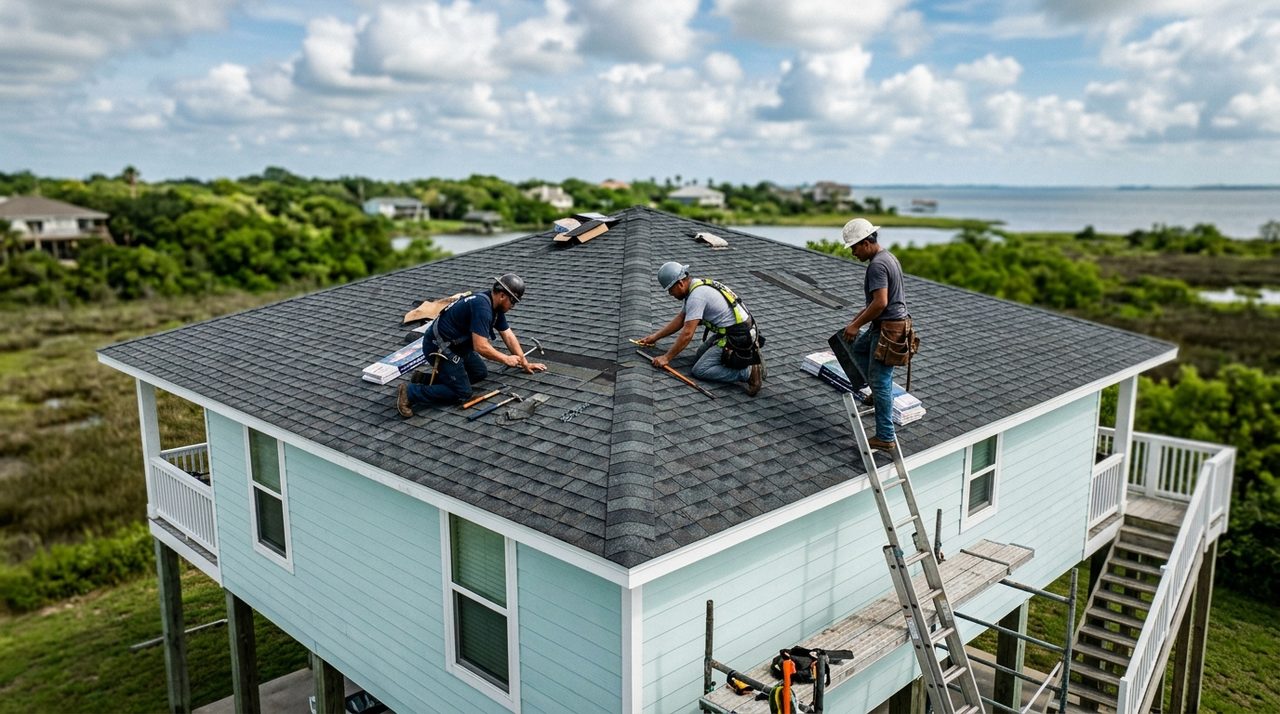
- Median home built
- 1995
- Median home value
- $268,900
- FEMA flood zone
- AE (high)
- Typical re-roof cost (est.)
- $10,500–$18,500
- Most common local issue
- Salt-air corrosion of metal flashing & fasteners on bayfront homes
Ranked by verified Google rating × review volume × verification tier. How we rank →
Some highly-rated pros serve Kemah from nearby and may not keep a Kemah street address. Those are listed under "Also serving Kemah" with their real city and distance, so you always know where each business is based.
Min rating:
10 resultsBased in Kemah
1207 Esther St B, Kemah, TX 77565
223 E Shore Dr, Kemah, TX 77565
Also serving Kemah
Highly-rated pros based nearby who cover Kemah. Distance shown from the Kemah area.
Open Now
Serving Kemah Based in League City · 2.5 mi away
Serving Kemah Based in Seabrook · 2.9 mi away
Open Now
Serving Kemah Based in League City · 3.1 mi away
Open Now
Serving Kemah Based in League City · 3.1 mi away
Closed
Serving Kemah Based in League City · 3.5 mi away
Closed
Serving Kemah Based in League City · 3.8 mi away
Closed
Serving Kemah Based in League City · 3.8 mi away
Roofers in Kemah: What You Should Know
Hurricane & Derecho Wind Uplift on Open-Bay Coastal Roofs
Why it matters to you
Kemah sits on Galveston Bay with little tree canopy or inland buffer to break Gulf storm fetch, meaning wind loads here routinely exceed what is felt even a few miles inland. The May 2024 derecho and Harvey 2017 both stripped ridge caps and lifted shingle tabs from the 1990s–2000s-era waterfront homes and pier-supported beach-house-style structures that make up much of the City. Homes built before 2006 IRC wind-resistance upgrades — a significant portion of Kemah's median-1995-vintage housing stock — are especially vulnerable to field-section delamination during sustained coastal winds.
What a good pro does
A qualified roofer working on Kemah's bayfront should specify TWIA-eligible, high-wind-rated shingles (minimum 130 mph tested) and install them with a six-nail pattern per manufacturer coastal requirements rather than the four-nail standard. All permits must be pulled through the City of Kemah's own building department — not the City of Houston — and the contractor should provide documentation of installed product wind ratings to support any TWIA claim. Requesting a post-installation inspection sign-off from the City of Kemah before final payment protects you if a subsequent storm triggers a coverage dispute.
Sources: Texas Windstorm Insurance Association (TWIA), International Residential Code (as adopted by City of Houston), Municipal permit office (see area profile)
Salt-Air Corrosion Destroying Flashing, Fasteners & Metal Components
Why it matters to you
Galveston Bay's salt-laden air attacks exposed steel nails, galvanized drip edge, and standard aluminum flashing within two to five years on bayfront properties — far faster than the 15–20 year lifecycle those materials are rated for in inland environments. On Kemah's pier-and-beam and elevated pile-foundation homes, this corrosion is compounded by the roof's exposure on all four sides with no neighboring structures providing shelter. Homeowners who accepted a low-bid re-roof after Harvey using standard hardware are often now seeing rust staining, lifted flashing, and fastener blowback that voids their underlayment seal.
What a good pro does
Insist on stainless-steel or hot-dipped galvanized ring-shank nails, copper or stainless flashing at all penetrations and valleys, and a corrosion-resistant drip edge rated for coastal exposure. A roofer experienced in Galveston County coastal work will specify these materials by default; ask to see the product data sheets before contract signing. These upgrades add roughly $800–$1,800 to a typical Kemah re-roof estimate but extend the interval before next replacement by years in the salt-air environment.
Sources: Texas Windstorm Insurance Association (TWIA), International Residential Code (as adopted by City of Houston)
FEMA AE Zone Rules & the 50% Substantial-Improvement Trigger
Why it matters to you
Nearly all of Kemah maps to FEMA Zone AE, meaning any renovation — including a full roof replacement combined with other concurrent work — that exceeds 50% of the structure's pre-improvement market value requires bringing the entire building into current floodplain compliance. For a bay cottage with a Census-area median value near $268,900, that threshold can be crossed faster than homeowners expect when storm damage is widespread. A roof replacement on an elevated pier home that simultaneously involves deck repairs, siding, and HVAC work can collectively trigger this rule, dramatically expanding scope and cost.
What a good pro does
Before signing a roofing contract, confirm the scope in writing with the City of Kemah building department and ask whether your combined repairs approach the substantial-improvement threshold. A roofer familiar with coastal AE-zone work will proactively flag this risk and coordinate with the city rather than treating roofing as an isolated line item. Obtaining an updated elevation certificate before work begins establishes your current compliance baseline and protects you if an inspector reviews the project mid-construction.
Sources: FEMA National Flood Hazard Layer (NFHL), Municipal permit office (see area profile)
Flat & Low-Slope Membrane Failure on Post-Harvey Elevated Additions
Why it matters to you
Kemah's post-1990s waterfront redevelopment produced a wave of elevated townhomes, marina-oriented condos, and remodeled bay cottages, many of which incorporate flat or low-slope (under 2:12 pitch) roof sections over ground-level parking areas or enclosed storage beneath the elevated living floor. These modified bitumen or TPO membranes take a direct hit from Kemah's combination of intense UV exposure, Harvey-scale rainfall that overwhelms internal drains, and salt-air degradation of seam adhesives — accelerating membrane delamination well before the 15-year expected life. Ponding water on a flat section above a finished living space can migrate laterally under the membrane and emerge as an interior leak far from the actual breach.
What a good pro does
A roofer replacing a flat or low-slope section in Kemah should specify a two-ply modified bitumen system or a 60-mil TPO membrane with heat-welded seams rather than adhered, and slope the new deck framing (even minimally, to 1/4 inch per foot) toward larger-diameter scuppers rated for high-intensity rainfall. City of Kemah permits are required for structural changes to the roof deck, and the contractor must account for FEMA flood-resistant material requirements below the base flood elevation on any portion of the structure that qualifies. Budget estimates for flat/low-slope replacement in this market run approximately $5.00–$7.50 per square foot installed — higher at the coastal premium — and should be treated as a distinct line item from any sloped-surface work.
Sources: FEMA National Flood Hazard Layer (NFHL), International Residential Code (as adopted by City of Houston), Municipal permit office (see area profile)
Roofers in Kemah: What You Should Know
Hiring roofers in Kemah? Kemah is a small incorporated city on Galveston Bay with a mix of original bay cottages, 1990s–2000s waterfront redevelopment, and newer elevated townhome/marina communities. Homeowners here face persistent challenges from storm surge exposure, salt-air corrosion, and FEMA floodplain compliance requirements. Contractors working in Kemah must be familiar with elevated foundation systems, coastal building codes, and the City of Kemah's own permitting process.
- Housing era
- Mixed
- Foundation
- Mixed — pier-and-beam/elevated pile foundations dominate along the bayfront and canal-adjacent properties
- Flood zone
- FEMA Zone AE (high flood risk) — source
- Permits
- City of Kemah (independent incorporated city with its own municipal government and building department)
Housing stock & systems
Building era
Mixed: pre-1960s original cottages, 1970s–1980s infill, significant 1990s–2000s waterfront redevelopment, and post-2008 elevated infill.
Typical style
Coastal raised beach-house style (pier-supported with elevated living areas), traditional suburban SFRs (brick veneer or siding), and townhome/condo marina-oriented developments with stucco or fiber-cement siding.
Foundations
Mixed — pier-and-beam/elevated pile foundations dominate along the bayfront and canal-adjacent properties; slab-on-grade more common in interior and newer suburban pockets.
Common systems
Older cottages may have original copper or galvanized plumbing and outdated electrical panels; 1990s–2000s homes typically feature central HVAC, PVC/CPVC plumbing, and 200-amp electrical service. Salt-air exposure accelerates corrosion on HVAC condensers, metal roofing components, and exterior electrical fixtures across all eras.
What that means for repairs
Most common renovation activity includes elevating older homes to meet current FEMA BFE requirements, replacing storm-damaged structures with new elevated construction, upgrading HVAC and exterior materials to salt-air-resistant alternatives, and converting or remodeling ground-level areas beneath raised homes for parking or storage.
Permits & restrictions
Permit jurisdiction
City of Kemah (independent incorporated city with its own municipal government and building department).
HOA & deed restrictions
No city-wide mandatory HOA or master association. HOAs are present in specific newer townhome, condo, and marina developments on a project-by-project basis. Older platted areas (e.g., original Kemah Townsite) generally have no organized HOA. Voluntary civic clubs may exist in some pockets but are not confirmed. Deed restrictions vary by subdivision — check Galveston County Clerk records for specific parcels.
Historic districts
No City of Houston historic district designation confirmed. Kemah is an independent incorporated city; no HAHC jurisdiction applies. No locally designated historic districts confirmed in current city records.
Contractor note
Contractors must pull permits through the City of Kemah, not Houston or Galveston County. Coastal AE zone requirements often mandate elevation certificates, flood-resistant materials below BFE, and compliance with FEMA substantial improvement/damage rules for renovations exceeding 50% of the structure's market value.
Flood & weather
FEMA flood zone
FEMA Zone AE (high flood risk) — source: fema_nfhl. Kemah sits directly on Galveston Bay and is exposed to both storm surge and tidal flooding. Much of the city falls within AE and potentially VE (velocity) zones along the immediate shoreline. Proximity to Clear Creek and Galveston Bay amplifies flood risk during tropical weather events.
Hurricane Harvey impact
Kemah experienced flooding during Hurricane Harvey (2017) from a combination of extreme rainfall and storm surge/tidal influence from Galveston Bay. Specific damage data for Kemah was not itemized separately from broader Galveston County FEMA reports, but the bayfront location and low elevation made the area vulnerable to both surge-driven and rain-driven flooding. Many older, non-elevated homes in the area sustained water damage. Post-Harvey, elevated construction and stricter floodplain compliance have become more prevalent.
Heat & humidity load
Extreme humidity and sustained heat along Galveston Bay push HVAC systems hard from May through October. Salt-laden coastal air accelerates corrosion on condenser coils, ductwork fasteners, and exterior metal components. Pier-and-beam homes benefit from under-house ventilation but require regular inspection for moisture damage, mold, and pest intrusion during the humid season.
Working with contractors here
Contractors in Kemah most frequently handle foundation elevation projects, HVAC replacement with salt-air-resistant units, and exterior envelope repairs caused by coastal weather exposure. Roof replacements are common after storm events, with wind-rated materials and proper tie-downs critical given the bayfront exposure. Plumbing work in older cottages often involves full re-pipes from galvanized to modern materials. Job scoping must account for FEMA elevation requirements — any substantial improvement to a structure in the AE zone requires bringing the entire building into current floodplain compliance, which can dramatically expand project scope and cost. Access can be tight on narrow waterfront lots, and contractors should verify whether the specific property falls under a project-level HOA with architectural review requirements before beginning exterior work.
Local Tip
Always ask for a written estimate before work begins. Texas contractors are required to provide one on jobs over $1,000.
About Kemah
Kemah is a small incorporated city on Galveston Bay with a mix of original bay cottages, 1990s–2000s waterfront redevelopment, and newer elevated townhome/marina communities. Homeowners here face persistent challenges from storm surge exposure, salt-air corrosion, and FEMA floodplain compliance requirements. Contractors working in Kemah must be familiar with elevated foundation systems, coastal building codes, and the City of Kemah's own permitting process.
- Median year built
- 1995
- Median home value
- $268,900
- Owner-occupied
- 65%
- Population
- 1,952
- Housing units
- 872
- Median income
- $95,152
Source: U.S. Census Bureau, ACS 5-Year 2023
Flood & storm risk
FEMA Zone AEHigh flood riskMuch of Kemah maps to FEMA Zone AE (high flood risk), so flood-resilient detailing -- elevated equipment, water-tolerant materials, and drainage-first thinking -- is essential here, not optional; risk climbs sharply on blocks nearest Galveston Bay, where it varies parcel to parcel.
Source: FEMA National Flood Hazard Layer (NFHL). Flood zones vary by parcel — verify your individual FIRM panel.
Houston Storm Readiness in Kemah
Hurricane & flooding
In Kemah, TX, surge and Category-level winds require roofing materials rated to Miami-Dade or TAS standards, so verify with your roofer that any existing or replacement shingles carry a NOA approval number before hurricane season. A non-rated product installed on a coastal roof may void your wind coverage under Texas Department of Insurance guidelines. Confirm the current FEMA panel for your Kemah parcel — the area maps to Zone AE, but adjacent lots can differ.
Severe storms & hail
Coastal Kemah, TX roofs face the highest sustained wind loads during any severe storm, so ask a roofer to verify that all hip and ridge shingles are installed with six nails rather than the standard four and that all field shingles in the first three rows from the eave are hand-sealed with roofing cement. The May 2024 derecho proved that even non-hurricane wind events can exceed design loads on roofs that were correctly installed but never upgraded for coastal exposure. As a Galveston County community, Kemah may follow county rather than City of Houston storm rebuild rules.
Ice storms & freezes
In Kemah, TX, ice on a coastal roof does not just load the structure—it also traps salt residue against the shingle surface during the melt cycle, accelerating granule loss and mat degradation. Ask a TDLR-licensed roofer to inspect granule coverage after any freeze event and document shingle condition for your homeowner insurance record while storm-season hail claims are still fresh. Because Kemah drains toward Galveston Bay, block-level runoff can differ sharply from the mapped zone.
Sources: FEMA National Flood Hazard Layer (NFHL), Ready.gov -- Hurricanes, CenterPoint Energy -- Storm Center, City of Houston -- Emergency Preparedness, Ready.gov -- Winter Weather, Harris County Flood Control District
Free Kemah Tools & Calculators
Houston-specific estimators to plan your project before you call a pro. All results are planning estimates — a licensed local pro confirms the details on site.
Hurricane Roof Wind-Load & TDI/WPI-8 Estimator
Open full tool & FAQ →115–120 mph
Estimated design wind speed for your zone
Outside the TDI catastrophe area, so a WPI-8 is generally not mandated — but Houston still sees hurricane-force gusts (Beryl, 2024). Insist on properly rated shingles installed to the manufacturer's high-wind nailing pattern (6 nails) and starter strips, or a wind claim can be denied for improper installation.
Find a Houston roofer →This is a planning estimate only — actual requirements depend on an on-site assessment by a licensed Houston pro. Wind-speed zones are approximate; your exact TDI/WPI-8 obligation depends on your address's designation. Verify with the Texas Department of Insurance before contracting.
Houston Freeze Prep & Pipe Insulation Checklist
Open full tool & FAQ →Your freeze checklist — 4 tasks
- 1
Disconnect & drain every outdoor hose bib
Remove hoses, drain the spigots, and cover each with an insulated faucet sock. Un-drained hose bibs are the #1 burst point in a Houston freeze.
- 2
Insulate exposed pipes in the attic & garage
Wrap any pipe in an unconditioned space (attic runs, garage walls) with foam sleeves. Houston homes rarely insulate these because they only matter a few nights a year — which is exactly why they burst.
- 3
Open cabinet doors & keep a pencil-width drip
On hard-freeze nights, open kitchen/bath cabinets so warm air reaches the pipes and let faucets on exterior walls drip to relieve pressure.
- 4
Protect the attic/garage water heater & its lines
An attic or garage tank sits in unconditioned space. Insulate the cold-inlet and hot-outlet lines and confirm the emergency drain pan is clear so a leak doesn't reach the ceiling.
This is a planning estimate only — actual requirements depend on an on-site assessment by a licensed Houston pro. If a pipe has already burst, shut off your main water supply and call a licensed Houston plumber immediately — freeze bursts flood fast.
Frequently Asked Questions
Do I need a permit from the City of Kemah for a full shingle re-roof, and how long does approval usually take?
Yes — the City of Kemah's building department handles all roofing permits independently; you cannot file with Houston or Galveston County. For a standard re-roof, most homeowners report turnaround of a few business days to about a week under normal conditions, though post-storm backlogs (as seen after the May 2024 derecho) can stretch that to several weeks. Your contractor must be registered with the City of Kemah to pull the permit — confirm that before signing a contract.
Sources: Municipal permit office (see area profile)
My Kemah home was built in the early 1990s during the waterfront redevelopment boom — are there roofing issues specific to that era I should watch for?
Homes from that 1990s–2000s redevelopment wave are now 25–35 years old, putting their original architectural shingles squarely at or past effective service life given Houston's heat cycling and coastal UV load — expect actual performance of 15–18 years rather than the rated 25–30. Galvanized flashing and fasteners installed in that era are also likely corroded through from decades of salt-air exposure on Galveston Bay, which can allow water intrusion even when the shingle field looks intact. A full tear-off inspection of decking and flashing — not just a surface assessment — is worth requesting for any home of this vintage.
I've heard that repairs on a flood-zone home in Kemah can trigger the 50% rule — does replacing just the roof count toward that threshold?
It can, depending on the cost of the roofing work relative to your structure's pre-improvement market value as determined by the City of Kemah. If the re-roof contract — combined with other improvements made in a rolling period — pushes past 50% of that assessed market value, FEMA's substantial-improvement rule requires bringing the entire structure into current Base Flood Elevation compliance, which can mean elevating the whole building. For a modest Kemah cottage with a lower assessed value, even a mid-range re-roof estimate of $12,000–$16,000 (est.) could contribute meaningfully to that threshold, so ask the City's building department for a written substantial-improvement determination before work begins.
Sources: FEMA National Flood Hazard Layer (NFHL)Municipal permit office (see area profile)
Which roofing materials actually hold up best to Kemah's salt air and bayfront wind exposure, and does TWIA care what I install?
For bayfront Kemah properties, Class 4 impact-resistant architectural shingles with stainless-steel or hot-dipped galvanized ring-shank nails are the practical minimum — standard electro-galvanized fasteners corrode within a few years this close to the bay. Standing-seam metal with a Kynar/PVDF coating is the premium option for longevity against salt air, though it runs roughly $18,000–$35,000 (est.) for a typical footprint. TWIA requires that installed roofing systems meet specific wind-resistance standards for properties in its coverage area, so confirm your chosen product's tested rating with your contractor and keep documentation for your TWIA policy.
Sources: Texas Windstorm Insurance Association (TWIA)International Residential Code (as adopted by City of Houston)
When is the worst time to schedule a roof replacement in Kemah, and how far out should I book a contractor?
The Atlantic hurricane season runs June through November, and reputable local roofers fill up quickly once a named storm threatens the bay — trying to schedule during or immediately after a storm event typically means 15–25% higher prices and a wait measured in months rather than weeks. The practical sweet spot is late winter through early spring (February–April), after the holiday slowdown and before the peak storm season, when contractor availability is better and pricing is closer to baseline. If you're scheduling post-storm emergency work, get a temporary waterproofing cover installed quickly and lock in a written contract with a local firm before demand pricing fully sets in.
My elevated Kemah townhome has a project-level HOA — does it control what roofing materials or colors I can use, or does city permitting override that?
City of Kemah permitting and your HOA's Architectural Review Committee (ARC) are separate processes that run in parallel — clearing one does not substitute for the other. Newer townhome and marina-oriented developments in Kemah frequently have project-level HOAs with their own material and color approval requirements, and ARC review timelines can run 10–30 days, which matters a great deal if storm damage is causing active leaks. Before selecting a shingle product or color, pull your deed restrictions from Galveston County Clerk records and submit to the ARC simultaneously with your city permit application to avoid delays.
Sources: Local HOA / deed restrictions (see area profile)Municipal permit office (see area profile)