Open Now
Serving Montrose Based in Upper Kirby · 0.8 mi away
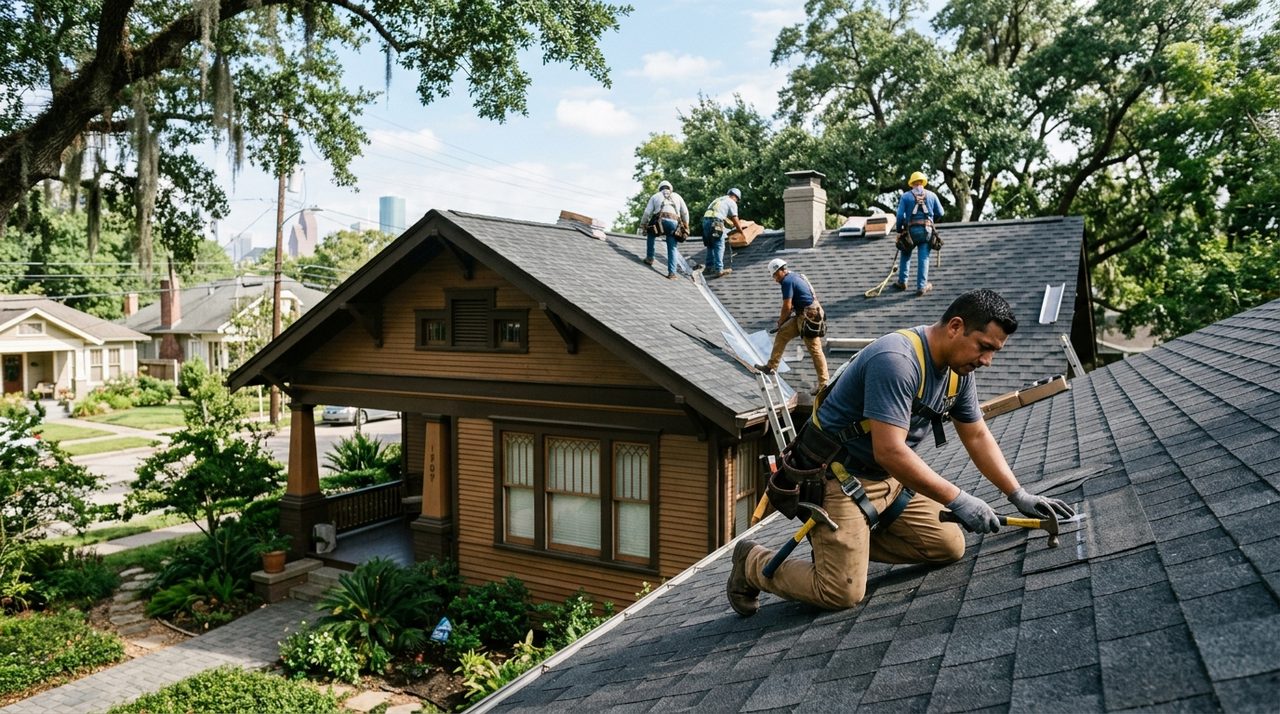
Montrose's century-spanning housing stock — from 1920s Craftsman bungalows with original wood-board decking to 2010s slab-on-grade townhomes packed onto subdivided lots — creates roofing challenges that vary dramatically from one property to the next, even on the same block. The City of Houston Permitting Center governs all roofing work here, but HAHC historic district review can add weeks of lead time on exterior changes for bungalows in locally designated zones, and block-level deed restrictions may restrict material choices independently of any HOA. Understanding which rules apply to your specific parcel before signing a roofing contract is the most important step a Montrose homeowner can take.
Ranked by verified Google rating × review volume × verification tier. How we rank →
Some highly-rated pros serve Montrose from nearby and may not keep a Montrose street address. Those are listed under "Also serving Montrose" with their real city and distance, so you always know where each business is based.
Highly-rated pros based nearby who cover Montrose. Distance shown from the Montrose area.
Serving Montrose Based in Upper Kirby · 0.8 mi away
Serving Montrose Based in Midtown · 1.1 mi away
Serving Montrose Based in River Oaks · 1.2 mi away
Serving Montrose Based in Midtown · 1.6 mi away
Serving Montrose Based in Midtown · 1.7 mi away
Serving Montrose Based in Midtown · 1.7 mi away
Serving Montrose Based in Lazybrook / Timbergrove · 1.8 mi away
Serving Montrose Based in West University · 1.9 mi away
Serving Montrose Based in Upper Kirby · 2 mi away
Serving Montrose Based in West University · 2.3 mi away
Why it matters to you
Montrose's 1920s–1940s bungalows and their subsequent additions — enclosed rear patios, garage apartments, and mid-century ranch annexes — routinely feature flat or low-slope (under 2:12 pitch) roof sections covered in aged modified bitumen or built-up membranes. Houston's extreme rainfall intensity, including events like Harvey's 60-inch deluge, overwhelms interior drains and scuppers on these sections, causing prolonged ponding that silently delamines membranes and rots wood-board or early-OSB decking underneath — damage that often isn't visible until a ceiling stain appears.
What a good pro does
A qualified roofer should probe the existing deck for soft spots before quoting any flat-section replacement, and should replace functional drains and scuppers concurrently with the membrane. Installed modified bitumen or TPO runs approximately $4.50–$7.50 per square foot (est.) in the current Houston market. Because this is a structural repair category on an older home, the City of Houston Permitting Center requires a building permit — your contractor must pull it, not ask you to waive it.
Sources: City of Houston Permitting Center, FEMA National Flood Hazard Layer (NFHL)
Why it matters to you
Parts of Montrose fall within City of Houston locally designated historic districts, where the Houston Archaeological and Historical Commission must approve exterior changes — including roofing material type and sometimes color — before work begins. Separately, individual plat deed restrictions recorded at the Harris County Clerk's office may prohibit metal roofing, specify shingle profiles, or cap roof height on infill townhomes, and these restrictions apply even where no mandatory HOA exists. A homeowner who replaces a failing wood-shake roof with architectural asphalt shingles without checking either layer of review can face forced removal at their own cost.
What a good pro does
Before signing any contract, verify your parcel's historic district status through the City of Houston Historic Preservation Office online map, and pull the recorded deed restrictions from the Harris County Clerk's property records. A roofer familiar with Montrose should factor a 10–30 day HAHC review window into the project schedule for designated properties and should document the approved material specification in writing before ordering materials.
Sources: City of Houston Permitting Center, Local HOA / deed restrictions (see area profile), Municipal permit office (see area profile)
Why it matters to you
Montrose's pre-1980 bungalows and cottages — many still with original pier-and-beam framing and narrow attic cavities — were built with gable or box vents only, well short of the IRC R806 balanced ridge-to-soffit ratios required today. Houston's average annual relative humidity exceeding 75% means moisture condenses on roof decking year-round in these under-ventilated spaces. The result is OSB or original board sheathing that delaminates quietly; a roofer installing new shingles over a compromised deck is setting the homeowner up for another replacement within five to eight years.
What a good pro does
Any full re-roof quote on a pre-1980 Montrose bungalow should include a ventilation audit — measured net free area versus attic square footage — and a deck probing protocol before pricing. Adding a continuous ridge vent and increasing soffit intake is standard remediation, and the City of Houston building permit required for a full re-roof covers these ventilation corrections under the same inspection. Budget $9,000–$16,000 (est.) for a standard re-roof and factor in deck replacement costs if delamination is found.
Sources: International Residential Code (as adopted by City of Houston), City of Houston Permitting Center
Why it matters to you
The May 2024 derecho pushed straight-line winds exceeding 100 mph across Harris County, and Montrose's mix of older architectural and 3-tab shingles installed before the 2006 IRC wind-resistance upgrades was particularly vulnerable. Unlike the dense tree canopy in neighborhoods such as Memorial, many Montrose blocks — especially those cleared for townhome infill — offer minimal wind-break, leaving ridge caps, hip shingles, and starter courses exposed to full uplift forces. Granule loss and lifted tabs from that event may not be visible from the street but are actively shortening shingle life under Houston's 2,700-plus annual cooling degree days of UV exposure.
What a good pro does
A post-storm inspection on a Montrose home should include binocular or drone imaging of ridge and field sections, not just a ground walk. If shingles predate 2006, ask for a nail-pattern verification — proper 4-nail or 6-nail patterns per IRC wind requirements substantially reduce uplift risk on re-roofs. Upgrading to Class 4 impact-resistant shingles adds an estimated $1,500–$3,500 (est.) to a full re-roof but may qualify for an insurance premium discount; confirm eligibility with your carrier and verify any TWIA wind pool requirements if applicable to your policy.
Sources: International Residential Code (as adopted by City of Houston), Texas Windstorm Insurance Association (TWIA), ENERGY STAR / U.S. Dept. of Energy
Hiring roofers in Montrose? Montrose is one of Houston's most architecturally diverse inner-loop neighborhoods, with housing stock ranging from early-20th-century bungalows to modern townhomes and mid-rise condos. Homeowners and contractors must navigate a complex overlay of deed restrictions, possible historic district review, and varied foundation types that change block by block. The absence of a single mandatory HOA means individual plat covenants and city codes are the primary regulatory framework.
Building era
Mixed — ranging from 1920s–1940s original bungalows and cottages to 1970s–1980s apartment conversions and 2000s–present new-construction townhomes.
Typical style
Highly heterogeneous: Craftsman bungalows, mid-century ranch, Victorian-era homes, contemporary townhomes, and multi-family conversions coexist within the same blocks.
Foundations
Mixed — older homes are frequently pier-and-beam; newer townhomes and infill construction are typically slab-on-grade.
Common systems
Older pier-and-beam homes often have galvanized or cast-iron plumbing, outdated electrical panels, and window-unit or older central HVAC systems. Newer townhomes feature modern HVAC, PEX plumbing, and updated electrical. The wide era range means system conditions vary dramatically by property.
What that means for repairs
Renovation activity is extremely common due to the prevalence of aging bungalows on high-value lots. Whole-home gut renovations, kitchen and bath modernizations, and foundation leveling on pier-and-beam structures are frequent. New-construction townhome infill on subdivided lots is also a major activity driver.
Permit jurisdiction
City of Houston Permitting Center (Montrose is within Houston city limits).
HOA & deed restrictions
No single mandatory HOA governs all of Montrose. Specific sub-areas and condo regimes (e.g., Montrose Place Townhomes Owners Association, Montrose Place Homeowners Association) have mandatory membership. Deed restrictions are common and vary by plat — buyers and contractors should review recorded covenants at the Harris County Clerk's office.
Historic districts
Parts of Montrose fall within City of Houston locally designated historic districts, requiring HAHC design review and approval for exterior changes, demolitions, and new construction. Specific district names not confirmed in available research — check the City of Houston Historic Preservation Office for parcel-level status.
Contractor note
Contractors must verify whether a property sits within a locally designated historic district before beginning exterior work or demolition, as HAHC approval may be required. Additionally, individual deed restrictions may impose setback, height, or use limitations that differ from adjacent properties on the same street.
FEMA flood zone
FEMA Zone X (low flood risk) per official NFHL data. However, Montrose's proximity to Buffalo Bayou and various drainage channels means flood risk can vary sharply by block and lot elevation. Property-level flood zone verification is strongly recommended.
Hurricane Harvey impact
Neighborhood-wide Harvey flood impact could not be confirmed from available research. Montrose is an inner-loop area where flooding during Harvey varied significantly by block and proximity to bayous and drainage infrastructure. Homeowners should check individual property flood history through Harris County Flood Control District records and FEMA claim databases.
Heat & humidity load
Older pier-and-beam homes in Montrose are prone to moisture intrusion, subfloor mildew, and HVAC strain during Houston's extreme summer humidity. Aging galvanized plumbing in pre-war homes is susceptible to condensation-related corrosion. Modern townhomes with tight building envelopes benefit from efficient HVAC but may require dehumidification support.
Working with contractors here
Montrose's extreme housing diversity means contractors encounter everything from 1920s pier-and-beam bungalow foundation repair to cutting-edge townhome warranty work. Plumbing repiping is common in pre-war homes still running galvanized or cast-iron lines. Electrical panel upgrades are frequently needed in older homes not designed for modern load demands. Historic district properties require HAHC coordination, which can add weeks to project timelines for exterior work. Contractors should always pull deed restrictions before scoping additions or accessory structures, as setback and height limits vary from lot to lot even on the same block.
Local Tip
Always ask for a written estimate before work begins. Texas contractors are required to provide one on jobs over $1,000.
Montrose is one of Houston's most architecturally diverse inner-loop neighborhoods, with housing stock ranging from early-20th-century bungalows to modern townhomes and mid-rise condos. Homeowners and contractors must navigate a complex overlay of deed restrictions, possible historic district review, and varied foundation types that change block by block. The absence of a single mandatory HOA means individual plat covenants and city codes are the primary regulatory framework.
Source: U.S. Census Bureau, ACS 5-Year 2023
Most of Montrose maps to FEMA Zone X (low mapped flood risk), but Houston's flash-flood reality means even low-risk blocks benefit from smart drainage and storm-hardened installs.
Source: FEMA National Flood Hazard Layer (NFHL). Flood zones vary by parcel — verify your individual FIRM panel.
Wind uplift at the roof-to-wall connection is the structural failure mode that matters most in Montrose since flooding is not the primary risk here. Ask your roofer to inspect the starter-course fastening pattern and, if your home was built before the 2009 IRC updates, discuss installing supplemental ring-shank nails along all perimeter rows before the next major storm. In-city Montrose work falls under City of Houston floodplain and permitting rules.
Hail damage to roofs in Montrose is often invisible from the ground but destroys the granule layer that blocks UV degradation, cutting shingle life by half without a single active leak. Ask a TDLR-licensed roofer to inspect after any storm that produced hail an inch or larger in diameter and document findings for your insurer before the one-year claim deadline passes. In-city Montrose work falls under City of Houston floodplain and permitting rules.
Ice loading in Montrose is infrequent but disproportionately damaging because Houston roofs and their fastening systems are designed for wind, not sustained dead weight. Ask a licensed roofer to inspect your ridge board connections and confirm that collar ties or rafter ties are present in the attic, since Uri 2021 produced several ridge-sag failures in well-maintained Houston homes where the framing had no freeze-load margin. In-city Montrose work falls under City of Houston floodplain and permitting rules.
Sources: FEMA National Flood Hazard Layer (NFHL), Ready.gov -- Hurricanes, CenterPoint Energy -- Storm Center, City of Houston -- Emergency Preparedness, Ready.gov -- Winter Weather, Harris County Flood Control District
Houston-specific estimators to plan your project before you call a pro. All results are planning estimates — a licensed local pro confirms the details on site.
Estimated design wind speed for your zone
Outside the TDI catastrophe area, so a WPI-8 is generally not mandated — but Houston still sees hurricane-force gusts (Beryl, 2024). Insist on properly rated shingles installed to the manufacturer's high-wind nailing pattern (6 nails) and starter strips, or a wind claim can be denied for improper installation.
Find a Houston roofer →This is a planning estimate only — actual requirements depend on an on-site assessment by a licensed Houston pro. Wind-speed zones are approximate; your exact TDI/WPI-8 obligation depends on your address's designation. Verify with the Texas Department of Insurance before contracting.
Disconnect & drain every outdoor hose bib
Remove hoses, drain the spigots, and cover each with an insulated faucet sock. Un-drained hose bibs are the #1 burst point in a Houston freeze.
Insulate exposed pipes in the attic & garage
Wrap any pipe in an unconditioned space (attic runs, garage walls) with foam sleeves. Houston homes rarely insulate these because they only matter a few nights a year — which is exactly why they burst.
Open cabinet doors & keep a pencil-width drip
On hard-freeze nights, open kitchen/bath cabinets so warm air reaches the pipes and let faucets on exterior walls drip to relieve pressure.
Protect the attic/garage water heater & its lines
An attic or garage tank sits in unconditioned space. Insulate the cold-inlet and hot-outlet lines and confirm the emergency drain pan is clear so a leak doesn't reach the ceiling.
This is a planning estimate only — actual requirements depend on an on-site assessment by a licensed Houston pro. If a pipe has already burst, shut off your main water supply and call a licensed Houston plumber immediately — freeze bursts flood fast.
Sources: City of Houston Permitting Center
Sources: International Residential Code (as adopted by City of Houston)
Sources: City of Houston Permitting Center
Sources: FEMA National Flood Hazard Layer (NFHL)Texas Windstorm Insurance Association (TWIA)
Sources: City of Houston Permitting CenterMunicipal permit office (see area profile)
Sources: City of Houston Permitting CenterMunicipal permit office (see area profile)