Open Now
Serving Third Ward Based in Midtown · 0.2 mi away
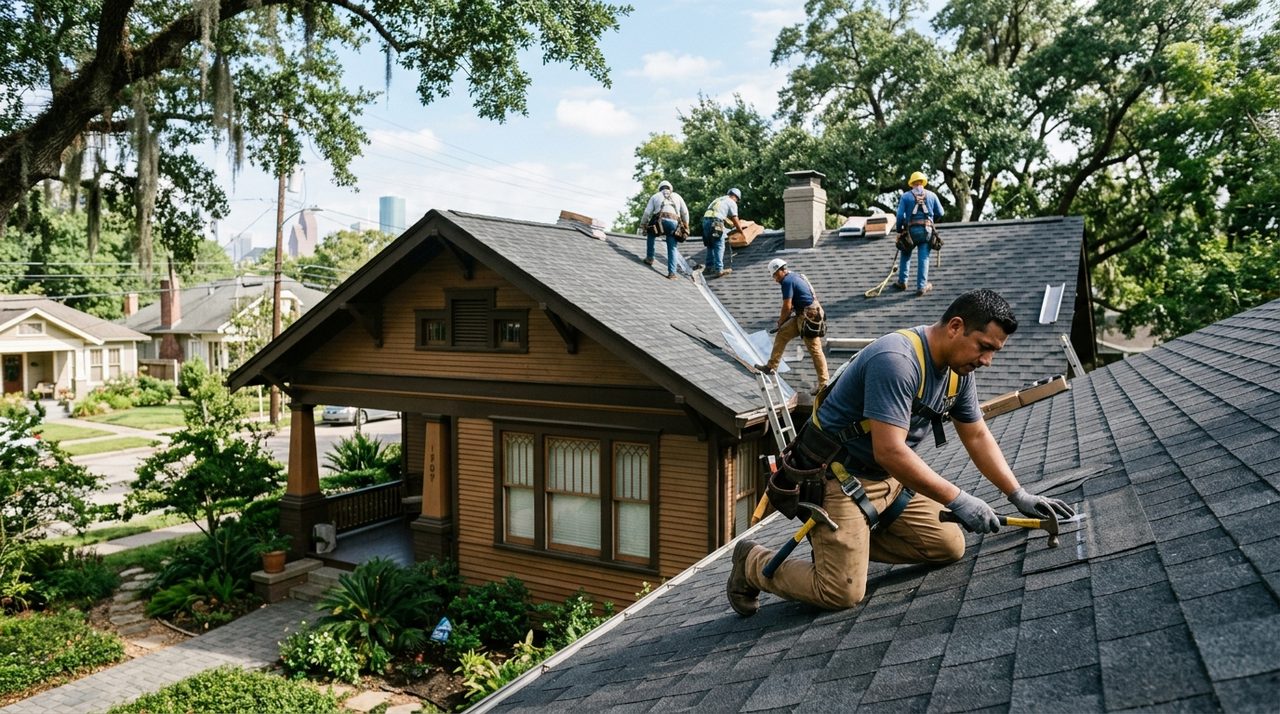
Third Ward's roofing picture is defined by two completely different building generations on the same block: 1920s–1940s pier-and-beam bungalows whose original wood-sheathed decks have absorbed a century of Houston humidity, and post-2000 slab-on-grade townhomes whose thin-profile roofs were rushed to market during the infill boom. Both types sit under the jurisdiction of the Houston Permitting Center, and neither benefits from a neighborhood-wide HOA to enforce material standards — meaning quality varies widely and the homeowner carries the full burden of vetting every decision.
Ranked by verified Google rating × review volume × verification tier. How we rank →
Some highly-rated pros serve Third Ward from nearby and may not keep a Third Ward street address. Those are listed under "Also serving Third Ward" with their real city and distance, so you always know where each business is based.
Highly-rated pros based nearby who cover Third Ward. Distance shown from the Third Ward area.
Serving Third Ward Based in Midtown · 0.2 mi away
Serving Third Ward Based in Midtown · 0.9 mi away
Serving Third Ward Based in Midtown · 1.4 mi away
Serving Third Ward Based in Midtown · 1.4 mi away
Serving Third Ward Based in EaDo · 1.7 mi away
Serving Third Ward Based in EaDo · 1.9 mi away
Serving Third Ward Based in River Oaks · 2.2 mi away
Serving Third Ward Based in Upper Kirby · 2.5 mi away
Serving Third Ward Based in EaDo · 2.9 mi away
Serving Third Ward Based in Lazybrook / Timbergrove · 3.1 mi away
Why it matters to you
Third Ward's pre-1960s frame bungalows were built with original board sheathing or early plywood that has spent decades absorbing Houston's 75%-plus average annual relative humidity — and many still rely solely on gable or box vents that provide nowhere near the balanced ridge-to-soffit airflow the IRC requires. When a roofer strips shingles on these homes, it is common to find soft, delaminated decking that cannot hold fasteners, meaning the cost of a re-roof can escalate significantly before the first shingle is laid. Homeowners on blocks between Elgin and Blodgett, where canopy trees shade roofs and slow surface drying, face an especially elevated risk.
What a good pro does
A thorough contractor will probe and moisture-meter the deck before providing a final bid, not after tear-off, so surprises are priced rather than invoiced as change orders. Deck replacement should be quoted per sheet with IRC R806-compliant ridge-and-soffit ventilation installed simultaneously — without that correction, replacement decking will begin to delaminate within five to eight years regardless of shingle quality. The City of Houston requires a building permit for structural deck replacement work, pulled through the Houston Permitting Center.
Sources: International Residential Code (as adopted by City of Houston), City of Houston Permitting Center
Why it matters to you
Third Ward's post-2000 townhome boom produced thousands of units clad in standard Class 3 architectural shingles — the minimum specification that was common during that construction wave. Harris County averages three to five significant hail events per year according to NOAA SPC records, and shingles from that era absorb granule loss and fiberglass mat bruising that is invisible from the street but voids manufacturer warranties and accelerates UV breakdown under Houston's 2,700-plus annual cooling degree days. With owner-occupancy at roughly 38 percent in Third Ward, many of these townhomes are rental units whose absentee owners may not realize damage has accumulated across multiple storm seasons.
What a good pro does
An inspection after any hail event should include close-up examination of ridge caps, valley metal, and at least one shingle sample removed for mat inspection — ground-level assessment alone will miss subsurface bruising. Upgrading to Class 4 impact-resistant shingles at replacement time adds an estimated $1,500–$3,500 to a standard re-roof cost but can reduce future insurance premiums; homeowners should confirm eligibility with their carrier and verify that any product used meets TWIA's published approved-products requirements if the policy is TWIA-backed.
Sources: Texas Windstorm Insurance Association (TWIA), ENERGY STAR / U.S. Dept. of Energy
Why it matters to you
Many of Third Ward's renovated bungalows have rear additions, enclosed back porches, or carport-cover conversions finished under flat or low-slope (under 2:12 pitch) modified bitumen or built-up roofs. Houston's rainfall intensity — illustrated most dramatically by Harvey's 60-inch four-day total — overwhelms scuppers and interior drains on these sections, causing prolonged ponding that accelerates membrane delamination and, on pier-and-beam homes especially, allows moisture to wick into wood framing that is already at grade level. Even in Third Ward's predominantly FEMA Zone X blocks, flash-flood events routinely push water onto these low surfaces.
What a good pro does
Any flat or low-slope section over roughly 100 square feet warrants a drain-flow audit before new membrane is installed: the contractor should confirm that scuppers are properly sized, unobstructed, and pitched to drain within 48 hours of a rain event per industry best practice. Modified bitumen or TPO replacement on these sections runs approximately $4.50–$7.50 per square foot installed; a contractor who skips the drain audit is setting the homeowner up for a callback within two to three rain seasons. For blocks immediately adjacent to Brays Bayou where flood risk increases sharply parcel by parcel, homeowners should cross-reference their specific address against FEMA flood-map data before selecting membrane thickness.
Sources: FEMA National Flood Hazard Layer (NFHL), International Residential Code (as adopted by City of Houston)
Why it matters to you
Third Ward has no single mandatory neighborhood HOA, which simplifies exterior work compared to master-planned suburbs — but the dozens of small, project-specific mandatory HOAs attached to post-2000 townhome clusters do govern material changes and color selections on shared-wall and shared-driveway developments. A homeowner on a fee-simple townhome lot near the University of Houston corridor who upgrades to metal roofing or changes shingle color without ARC sign-off risks fines and a forced re-roof at personal expense. Simultaneously, the City of Houston's permit rules are frequently misunderstood: a full tear-off and re-deck requires a permit from the Houston Permitting Center, but a like-for-like shingle repair on a non-structural scope generally does not.
What a good pro does
Before signing a contract, confirm in writing whether your specific property sits within a project HOA's jurisdiction — the HOA documents recorded with Harris County Clerk's office will show this — and budget 10 to 30 days for ARC review if a material or color change is involved. For any work requiring a City of Houston permit, the contractor must hold a current Houston Permitting Center Contractor Registration; Texas issues no state roofing license through TDLR, so that registration is the primary accountability mechanism available to homeowners. Request a copy of the contractor's general liability and workers' compensation certificates before work begins.
Sources: City of Houston Permitting Center, Local HOA / deed restrictions (see area profile), Municipal permit office (see area profile)
Hiring roofers in Third Ward? Third Ward presents contractors with a split housing stock: early 20th-century pier-and-beam bungalows requiring foundation, plumbing, and electrical upgrades alongside modern slab-on-grade townhomes with contemporary systems. Proximity to Brays Bayou means flood-related remediation and drainage work remain ongoing concerns. The absence of a single mandatory HOA simplifies permitting but project-specific HOAs on newer townhome developments may impose architectural and material requirements.
Building era
1920s–1960s legacy homes with significant 2000s–2020s infill townhome construction.
Typical style
Early 20th-century frame bungalows and cottages; contemporary 2- to 3-story townhomes with attached garages; some student-oriented multifamily near UH and TSU.
Foundations
Mixed — older bungalows predominantly pier-and-beam; newer townhomes and infill predominantly slab-on-grade.
Common systems
Older homes: galvanized or cast-iron plumbing, 60–100 amp electrical panels, window units or aging central HVAC. Newer townhomes: PEX or copper plumbing, 200 amp panels, modern central HVAC with multi-zone capability.
What that means for repairs
Gut renovations and full-system upgrades of pre-1960s bungalows are common as the neighborhood gentrifies. Electrical panel upgrades, re-plumbing from galvanized to PEX, and pier-and-beam foundation leveling are frequent scopes. Newer townhomes see comparatively less renovation but occasional warranty-period repairs and cosmetic upgrades.
Permit jurisdiction
Houston Permitting Center (City of Houston).
HOA & deed restrictions
No single mandatory HOA covers the neighborhood. Multiple voluntary civic clubs operate including Canfield Oaks Civic Association, Third Ward is Home Civic Club, and University Village Civic Club. Newer townhome and condo developments commonly have small, project-specific mandatory HOAs governing shared driveways and common areas.
Historic districts
No City of Houston historic district designation confirmed for Third Ward as a whole. Individual structures may have landmark status — check HAHC records for specific addresses.
Contractor note
Houston has no citywide zoning, so building controls depend on subdivision-level deed restrictions that vary block by block. Contractors working on older homes should verify whether the lot is in a deed-restricted subdivision before proposing accessory structures or lot modifications.
FEMA flood zone
FEMA Zone X (low flood risk) per official NFHL data. However, Third Ward sits directly north of Brays Bayou and includes low-lying areas near bayou tributaries and older storm sewer infrastructure, which can create localized flooding risk not fully captured by Zone X designation.
Hurricane Harvey impact
Third Ward lies within the broader Brays Bayou watershed, which experienced significant flooding during Hurricane Harvey in 2017. However, no neighborhood-specific documentation was found quantifying the extent of Harvey damage or identifying specific flooded streets within Third Ward. Property-level Harvey impact should be verified through FEMA Harvey inundation layers, Harris County Flood Control District mapping tools, and seller's disclosure for any individual address.
Heat & humidity load
Older pier-and-beam bungalows with aging insulation and single-pane windows face extreme summer cooling loads; HVAC systems in these homes are frequently undersized or failing. High humidity under pier-and-beam homes can accelerate subfloor rot and encourage pest infestations. Newer townhomes perform better thermally but three-story designs can struggle with uneven cooling between floors, making multi-zone HVAC balancing a common summer service call.
Working with contractors here
Contractors in Third Ward most commonly handle two categories of work: full-system renovations of pre-1960s bungalows and routine maintenance on post-2000 townhomes. On older homes, pier-and-beam foundation leveling, galvanized plumbing replacement, electrical panel upgrades from 60 to 200 amps, and HVAC installation are the most frequent scopes. Newer townhomes generate calls for HVAC zone balancing, minor foundation settling on slab construction, and cosmetic remodels. Proximity to Brays Bayou means flood damage remediation—including drywall removal, mold treatment, and flooring replacement—remains a recurring need after heavy rain events. Job scoping should account for the wide variance in building age and condition even within a single block, and contractors should verify project-specific HOA requirements on newer developments before beginning exterior work.
Local Tip
Always ask for a written estimate before work begins. Texas contractors are required to provide one on jobs over $1,000.
Third Ward presents contractors with a split housing stock: early 20th-century pier-and-beam bungalows requiring foundation, plumbing, and electrical upgrades alongside modern slab-on-grade townhomes with contemporary systems. Proximity to Brays Bayou means flood-related remediation and drainage work remain ongoing concerns. The absence of a single mandatory HOA simplifies permitting but project-specific HOAs on newer townhome developments may impose architectural and material requirements.
Source: U.S. Census Bureau, ACS 5-Year 2023
Most of Third Ward maps to FEMA Zone X (low mapped flood risk), but Houston's flash-flood reality means even low-risk blocks benefit from smart drainage and storm-hardened installs; risk climbs sharply on blocks nearest Brays Bayou, where it varies parcel to parcel.
Source: FEMA National Flood Hazard Layer (NFHL). Flood zones vary by parcel — verify your individual FIRM panel.
Wind uplift at the roof-to-wall connection is the structural failure mode that matters most in Third Ward since flooding is not the primary risk here. Ask your roofer to inspect the starter-course fastening pattern and, if your home was built before the 2009 IRC updates, discuss installing supplemental ring-shank nails along all perimeter rows before the next major storm. Because Third Ward drains toward Brays Bayou, block-level runoff can differ sharply from the mapped zone.
Hail damage to roofs in Third Ward is often invisible from the ground but destroys the granule layer that blocks UV degradation, cutting shingle life by half without a single active leak. Ask a TDLR-licensed roofer to inspect after any storm that produced hail an inch or larger in diameter and document findings for your insurer before the one-year claim deadline passes. Confirm the current FEMA panel for your Third Ward parcel — the area maps to Zone X, but adjacent lots can differ.
Even in lower-flood-risk Third Ward, a hard freeze following a rainstorm can trap water under lifted perimeter shingles and expand it into cracks in the decking, a failure mode that became widespread during Uri 2021. Ask a roofer to hand-seal any perimeter shingles showing daylight beneath them before December so freeze-water expansion does not open your deck to spring rains. With a median build year of 1983, the older building stock here is more exposed to hard-freeze damage than newer construction. Because Third Ward drains toward Brays Bayou, block-level runoff can differ sharply from the mapped zone.
Sources: FEMA National Flood Hazard Layer (NFHL), Ready.gov -- Hurricanes, CenterPoint Energy -- Storm Center, City of Houston -- Emergency Preparedness, Ready.gov -- Winter Weather, Harris County Flood Control District
Houston-specific estimators to plan your project before you call a pro. All results are planning estimates — a licensed local pro confirms the details on site.
Estimated design wind speed for your zone
Outside the TDI catastrophe area, so a WPI-8 is generally not mandated — but Houston still sees hurricane-force gusts (Beryl, 2024). Insist on properly rated shingles installed to the manufacturer's high-wind nailing pattern (6 nails) and starter strips, or a wind claim can be denied for improper installation.
Find a Houston roofer →This is a planning estimate only — actual requirements depend on an on-site assessment by a licensed Houston pro. Wind-speed zones are approximate; your exact TDI/WPI-8 obligation depends on your address's designation. Verify with the Texas Department of Insurance before contracting.
Disconnect & drain every outdoor hose bib
Remove hoses, drain the spigots, and cover each with an insulated faucet sock. Un-drained hose bibs are the #1 burst point in a Houston freeze.
Insulate exposed pipes in the attic & garage
Wrap any pipe in an unconditioned space (attic runs, garage walls) with foam sleeves. Houston homes rarely insulate these because they only matter a few nights a year — which is exactly why they burst.
Open cabinet doors & keep a pencil-width drip
On hard-freeze nights, open kitchen/bath cabinets so warm air reaches the pipes and let faucets on exterior walls drip to relieve pressure.
Protect the attic/garage water heater & its lines
An attic or garage tank sits in unconditioned space. Insulate the cold-inlet and hot-outlet lines and confirm the emergency drain pan is clear so a leak doesn't reach the ceiling.
This is a planning estimate only — actual requirements depend on an on-site assessment by a licensed Houston pro. If a pipe has already burst, shut off your main water supply and call a licensed Houston plumber immediately — freeze bursts flood fast.
Sources: City of Houston Permitting CenterMunicipal permit office (see area profile)
Sources: EPA Lead Renovation, Repair and Painting (RRP) Rule
Sources: Local HOA / deed restrictions (see area profile)
Sources: International Residential Code (as adopted by City of Houston)