5449 W Orem Dr, Houston, TX 77045
Best Roofers in Westbury
Westbury's roughly 5,000 mid-century ranch homes — most built between 1950 and 1965 and sitting on concrete slabs in southwest Houston — carry roof decks that are now 60-plus years old, often with original hipped or low-slope geometry that was never engineered for Houston's modern storm load. Because Westbury falls entirely within City of Houston limits, roofing permits and contractor registrations run through the City of Houston Permitting Center, and the Westbury Civic Club's Architectural Review Committee adds a separate material-approval layer that can stall storm repairs if you skip it. This page walks through the specific roofing vulnerabilities that matter most for a 1950s slab ranch on a wide, relatively open lot in SW Harris County.
Verified against Google Business data
Updated 2026
See the 10 Roofers Serving Westbury 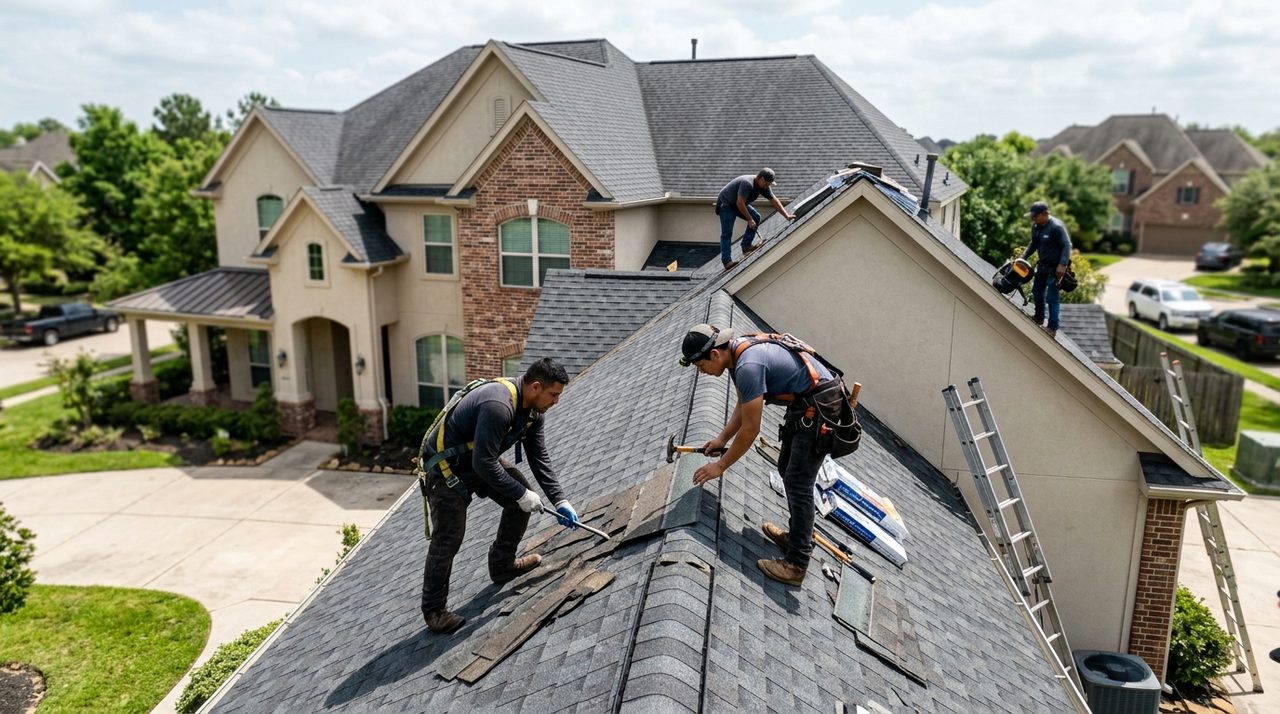
- Median home built
- 1977
- Median home value
- $257,773
- FEMA flood zone
- X (low)
- Typical re-roof cost (est.)
- $9,000–$16,000
- Most common local issue
- Heat-degraded shingles on low-slope hipped roofs with inadequate attic ventilation
Ranked by verified Google rating × review volume × verification tier. How we rank →
Some highly-rated pros serve Westbury from nearby and may not keep a Westbury street address. Those are listed under "Also serving Westbury" with their real city and distance, so you always know where each business is based.
Min rating:
10 resultsBased in Westbury
Open Now
4818 Trail Lake Dr, Houston, TX 77045
Also serving Westbury
Highly-rated pros based nearby who cover Westbury. Distance shown from the Westbury area.
Serving Westbury Based in Meyerland · 0.4 mi away
Open Now
Serving Westbury Based in Meyerland · 0.4 mi away
Serving Westbury Based in Braeswood · 1.6 mi away
Open Now
Serving Westbury Based in Meyerland · 2 mi away
Closed
Serving Westbury Based in Bellaire · 3.2 mi away
Open Now
Serving Westbury Based in Medical Center · 3.3 mi away
Closed
Serving Westbury Based in Braeswood · 3.3 mi away
Serving Westbury Based in Bellaire · 3.4 mi away
Roofers in Westbury: What You Should Know
Low-Slope Hipped Roofs and 60-Year-Old Decking Rotting Silently
Why it matters to you
Westbury's signature one-story ranch homes typically feature shallow hipped roofs with pitches in the 3:12–4:12 range — geometries that drain slowly, trap humidity, and put enormous stress on aging OSB or plywood decking. Houston's average annual relative humidity exceeds 75%, and homes built in the 1950s and 1960s relied on gable vents or simple box vents that do not come close to the balanced ridge-and-soffit ventilation ratios required under IRC R806. The result is moisture-laden attic air condensing on decking year-round, silently delaminating the boards beneath shingles that may still look intact at ground level.
What a good pro does
A thorough roofer should probe and sound the decking during any inspection, not just assess shingle surface condition. When decking replacement is needed, the same job should install a continuous ridge vent and clear soffit vents to achieve proper IRC R806 net free area ratios — skipping that step means new decking can begin rotting within five to eight years. Under City of Houston rules, structural deck replacement triggers a building permit, so confirm your contractor is registered with the City of Houston Permitting Center and pulling the required permit before demo begins.
Sources: International Residential Code (as adopted by City of Houston), City of Houston Permitting Center
Extreme UV and Heat Cycling Burning Through Standard Shingles Faster Than the Warranty Suggests
Why it matters to you
Houston roofs accumulate more than 2,700 cooling degree days annually, and south- and west-facing roof planes on Westbury's wide, largely treeless lots bake under direct sun from May through September with attic deck temperatures that can exceed 160°F. Standard 30-year architectural shingles installed on these exposures realistically degrade in 15 to 18 years due to asphalt binder oxidation and constant thermal expansion at ridge and hip lines — a fact that matters acutely in a neighborhood where many homes carry original or first-replacement roofs from the 1990s or early 2000s. The census median year built for Westbury is 1977, suggesting a significant share of roofs are well into their second half-life.
What a good pro does
Homeowners replacing aging shingles should ask for Class 4 impact-resistant shingles that also carry a cool-roof Solar Reflectance Index rating; Energy Star-qualified products can reduce surface temperatures measurably and may qualify for utility rebates. The Class 4 upgrade typically adds $1,500–$3,500 to a full re-roof estimate but extends effective service life and can improve TWIA wind-pool eligibility. Before committing to a shingle color, check with the Westbury Civic Club's Architectural Review Committee — deed restrictions specify approved exterior colors and materials, and non-compliant installs can result in forced replacement at the homeowner's expense.
Sources: ENERGY STAR / U.S. Dept. of Energy, Texas Windstorm Insurance Association (TWIA), Local HOA / deed restrictions (see area profile)
Westbury Civic Club ARC Approval Creating Dangerous Gaps in Storm Repair
Why it matters to you
When the May 2024 derecho tore ridge caps and lifted shingle tabs across SW Harris County with straight-line winds exceeding 100 mph, Westbury homeowners faced a specific bind: the Westbury Civic Club's deed restrictions require Architectural Review Committee approval before any roofing material change — including upgrading from 3-tab to architectural shingles, switching manufacturers, or altering shingle color — yet exposed decking cannot wait 10 to 30 days for ARC processing. Contractors rushing post-storm repairs without checking deed restriction compliance have left homeowners with fines and re-roofing demands that dwarf the original repair cost.
What a good pro does
The practical workaround is an emergency temporary covering (heavy-duty tarp or peel-and-stick underlayment over damaged sections) filed with the City of Houston under an emergency permit while the ARC submittal is in process. Pull the Harris County Clerk records for your specific lot to confirm which deed restriction section applies before any contract is signed. A contractor who hands you a complete ARC submittal packet — product spec sheet, color sample, and installation scope — at the same time as their estimate is demonstrating they understand Westbury's compliance environment.
Sources: Local HOA / deed restrictions (see area profile), City of Houston Permitting Center
Post-Uri Membrane Failures on Flat-Roof Additions and Carport Enclosures
Why it matters to you
A common upgrade cycle in Westbury's mid-century ranch stock involved enclosing original carports or adding rear patio covers under low-slope or fully flat modified bitumen membrane sections — the same membrane type that suffered freeze-thaw cracking during Winter Storm Uri in February 2021. Ice sat on Houston roofs for days, a condition the region's standard membranes are not detailed for, and many of the resulting micro-cracks in aged TPO and modified bitumen are only now presenting as interior ceiling stains three-plus years later. Homes with these flat additions near Willow Waterhole already face elevated moisture risk from the surrounding drainage corridor, and a slow membrane leak compounds that risk quickly.
What a good pro does
Flat and low-slope sections should be inspected with an infrared moisture scan rather than a visual-only assessment, since delaminated membrane sections retain heat differently and show up clearly on a thermal image. Replacement with a fully-adhered, heat-welded TPO or two-ply modified bitumen system — installed to NRCA and manufacturer specs with all scupper drains cleared to handle Houston's extreme rainfall intensity — is typically more cost-effective than repeated patching on membranes over 15 years old. Installed cost for a flat-section replacement in the current Houston market runs approximately $4.50–$7.50 per square foot, and the City of Houston requires a permit for any flat-roof system replacement that involves structural deck work.
Sources: International Residential Code (as adopted by City of Houston), City of Houston Permitting Center, FEMA National Flood Hazard Layer (NFHL)
Roofers in Westbury: What You Should Know
Hiring roofers in Westbury? Westbury is a large 1950s-era subdivision of roughly 5,000 single-family homes plus thousands of multifamily units in southwest Houston. Homeowners here contend with aging slab foundations, original-era plumbing and electrical systems, and flood risk in sections near Willow Waterhole and Brays Bayou. Deed restrictions enforced by the Westbury Civic Club/HOA require architectural review for exterior modifications, making pre-project compliance checks essential.
- Housing era
- 1950s–1960s (original subdivision), with later multifamily and infill development
- Foundation
- Predominantly concrete slab-on-grade
- Flood zone
- FEMA Zone X (low flood risk) per official NFHL data
- Permits
- City of Houston Permitting Center (Westbury is within Houston city limits)
Housing stock & systems
Building era
1950s–1960s (original subdivision), with later multifamily and infill development.
Typical style
One-story mid-century ranch homes with brick veneer, low-sloped or hipped roofs, attached garages or carports, and wide lots.
Foundations
Predominantly concrete slab-on-grade; some pier-and-beam may exist in earliest sections but slab is clearly prevalent in listings.
Common systems
Original homes likely have galvanized steel or early copper supply lines, cast iron drain lines, 100-amp electrical panels, and older forced-air HVAC systems or window units later converted to central air. Many systems are 50–70 years old and approaching or past end of life.
What that means for repairs
Kitchen and bathroom remodels are common as owners update mid-century layouts. Whole-house replumbing (replacing galvanized and cast iron), electrical panel upgrades to 200-amp service, and HVAC replacements are frequent due to system age. Some lots see teardown-rebuild activity as land values support new construction.
Permits & restrictions
Permit jurisdiction
City of Houston Permitting Center (Westbury is within Houston city limits).
HOA & deed restrictions
Westbury Civic Club, Inc. operates as the primary neighborhood association (Super Neighborhood 37). Deed restrictions with an Architectural Review/Control Committee are described as mandatory for compliance. The exact legal status of dues (mandatory vs. voluntary for each section) is not fully verifiable from public sources alone — check Harris County Clerk deed restriction records for your specific lot.
Historic districts
No City of Houston historic district designation confirmed.
Contractor note
Contractors must obtain City of Houston permits for structural, mechanical, electrical, and plumbing work, and should verify Westbury's deed restriction and ARC/ACC requirements before beginning any exterior modifications including fencing, roofing material changes, or additions.
Flood & weather
FEMA flood zone
FEMA Zone X (low flood risk) per official NFHL data. However, Westbury is adjacent to Brays Bayou and Willow Waterhole, and portions of the neighborhood — especially lower-lying southern and eastern sections near these drainage features — have documented histories of flooding. Parcel-level flood risk can vary significantly; an elevation certificate and HCFCD inundation maps should be consulted for individual addresses.
Hurricane Harvey impact
Significant flooding occurred in portions of Westbury during Hurricane Harvey (2017), particularly in lower-lying sections closest to Willow Waterhole, Brays Bayou, and drainage corridors near US 90A and South Post Oak. Post-Harvey flood mitigation projects were implemented around Willow Waterhole. Block-by-block impact data is not available in text sources; homeowners should request seller's disclosure, prior flood claim history, and Harris County Flood Control District high-water-mark data for specific addresses.
Heat & humidity load
1950s slab homes with original insulation and single-pane windows put heavy loads on HVAC systems during Houston summers. Aging ductwork in unconditioned attics degrades efficiency. Foundation movement on expansive clay soils accelerates during summer drought cycles, making seasonal watering programs and foundation monitoring important for these older slabs.
Working with contractors here
The dominant work in Westbury involves updating 1950s–1960s building systems: whole-house replumbing from galvanized and cast iron to PEX/PVC, electrical panel upgrades from 100-amp to 200-amp service, and HVAC replacement with modern high-efficiency equipment. Slab foundation repair is common due to the age of the homes and Houston's expansive clay soils. Contractors should be aware that the Westbury Architectural Review Committee requires compliance with deed restrictions for exterior work, so scope proposals for roofing, siding, fencing, or additions should account for review and approval timelines. Flood-damaged properties near Willow Waterhole and Brays Bayou may require remediation work including mold abatement, drywall replacement, and elevated mechanical equipment installation.
Local Tip
Always ask for a written estimate before work begins. Texas contractors are required to provide one on jobs over $1,000.
About Westbury
Westbury is a large 1950s-era subdivision of roughly 5,000 single-family homes plus thousands of multifamily units in southwest Houston. Homeowners here contend with aging slab foundations, original-era plumbing and electrical systems, and flood risk in sections near Willow Waterhole and Brays Bayou. Deed restrictions enforced by the Westbury Civic Club/HOA require architectural review for exterior modifications, making pre-project compliance checks essential.
- Median year built
- 1977
- Median home value
- $257,773
- Owner-occupied
- 52.8%
- Population
- 148,525
- Housing units
- 57,470
- Median income
- $67,468
Source: U.S. Census Bureau, ACS 5-Year 2023
Flood & storm risk
FEMA Zone XLow flood riskMost of Westbury maps to FEMA Zone X (low mapped flood risk), but Houston's flash-flood reality means even low-risk blocks benefit from smart drainage and storm-hardened installs; risk climbs sharply on blocks nearest Brays Bayou, where it varies parcel to parcel.
Source: FEMA National Flood Hazard Layer (NFHL). Flood zones vary by parcel — verify your individual FIRM panel.
Houston Storm Readiness in Westbury
Hurricane & flooding
Even in lower-risk Westbury, a Gulf hurricane can drive 130-mph gusts that peel ridge caps and send shingles airborne, so have a TDLR-licensed roofer apply additional hand-sealing to all perimeter and hip shingles with roofing cement before the season opens. A two-hour prep visit is far less disruptive than a post-storm emergency tarp call when every roofer in Houston is booked. Because Westbury drains toward Brays Bayou, block-level runoff can differ sharply from the mapped zone.
Severe storms & hail
Hail damage to roofs in Westbury is often invisible from the ground but destroys the granule layer that blocks UV degradation, cutting shingle life by half without a single active leak. Ask a TDLR-licensed roofer to inspect after any storm that produced hail an inch or larger in diameter and document findings for your insurer before the one-year claim deadline passes. In-city Westbury work falls under City of Houston floodplain and permitting rules.
Ice storms & freezes
Winter Storm Uri 2021 showed that ice-covered roofs across the Houston metro lost shingles when the freeze-thaw cycle broke the adhesion seal on standard three-tab and architectural shingles never designed for sustained below-freezing temperatures. Have a TDLR-licensed roofer inspect your shingle tab adhesion in Westbury each autumn and apply supplemental roofing cement to any tabs that no longer lie flat. With a median build year of 1977, the older building stock here is more exposed to hard-freeze damage than newer construction. Confirm the current FEMA panel for your Westbury parcel — the area maps to Zone X, but adjacent lots can differ.
Sources: FEMA National Flood Hazard Layer (NFHL), Ready.gov -- Hurricanes, CenterPoint Energy -- Storm Center, City of Houston -- Emergency Preparedness, Ready.gov -- Winter Weather, Harris County Flood Control District
Free Westbury Tools & Calculators
Houston-specific estimators to plan your project before you call a pro. All results are planning estimates — a licensed local pro confirms the details on site.
Hurricane Roof Wind-Load & TDI/WPI-8 Estimator
Open full tool & FAQ →115–120 mph
Estimated design wind speed for your zone
Outside the TDI catastrophe area, so a WPI-8 is generally not mandated — but Houston still sees hurricane-force gusts (Beryl, 2024). Insist on properly rated shingles installed to the manufacturer's high-wind nailing pattern (6 nails) and starter strips, or a wind claim can be denied for improper installation.
Find a Houston roofer →This is a planning estimate only — actual requirements depend on an on-site assessment by a licensed Houston pro. Wind-speed zones are approximate; your exact TDI/WPI-8 obligation depends on your address's designation. Verify with the Texas Department of Insurance before contracting.
Houston Freeze Prep & Pipe Insulation Checklist
Open full tool & FAQ →Your freeze checklist — 4 tasks
- 1
Disconnect & drain every outdoor hose bib
Remove hoses, drain the spigots, and cover each with an insulated faucet sock. Un-drained hose bibs are the #1 burst point in a Houston freeze.
- 2
Insulate exposed pipes in the attic & garage
Wrap any pipe in an unconditioned space (attic runs, garage walls) with foam sleeves. Houston homes rarely insulate these because they only matter a few nights a year — which is exactly why they burst.
- 3
Open cabinet doors & keep a pencil-width drip
On hard-freeze nights, open kitchen/bath cabinets so warm air reaches the pipes and let faucets on exterior walls drip to relieve pressure.
- 4
Protect the attic/garage water heater & its lines
An attic or garage tank sits in unconditioned space. Insulate the cold-inlet and hot-outlet lines and confirm the emergency drain pan is clear so a leak doesn't reach the ceiling.
This is a planning estimate only — actual requirements depend on an on-site assessment by a licensed Houston pro. If a pipe has already burst, shut off your main water supply and call a licensed Houston plumber immediately — freeze bursts flood fast.
Frequently Asked Questions
Does my Westbury re-roof require a permit from the City of Houston, and does my contractor need anything special to pull it?
A full tear-off and re-roof in Westbury requires a building permit from the City of Houston Permitting Center; a like-for-like shingle repair without structural work generally does not, but any deck replacement or structural modification does. Before the permit is issued, the contractor must hold a current City of Houston Contractor Registration — Texas issues no state roofing license, so that registration is the primary accountability mechanism available to you. Confirm your roofer's registration number through the Permitting Center before signing a contract.
Sources: City of Houston Permitting CenterMunicipal permit office (see area profile)
My Westbury home was built in 1958 and still has the original OSB-era roof deck. What should I realistically expect when roofers tear off the old shingles?
Homes of that era actually predate OSB — your deck is almost certainly original 1x6 or 1x8 tongue-and-groove board sheathing, which is durable but prone to cracking, cupping, and rot at low-slope hipped sections where standing water historically sits. Roofers working on 1950s Westbury ranches routinely find sections of rotted or delaminated board sheathing that must be replaced or overlaid with new plywood before new underlayment can be installed, so build a contingency of roughly $500–$1,500 (estimate) for partial deck repairs into your budget from the start.
Sources: International Residential Code (as adopted by City of Houston)
Do I need Westbury Civic Club ARC approval before my roofer can start, even if I'm just replacing shingles with the same color and style?
The Westbury Civic Club's Architectural Review Committee requires approval for exterior modifications, and a material or color change on your roof clearly qualifies — but even a like-for-like replacement is worth submitting if your deed restriction language is broad, because a dispute after the fact is far more costly than a short approval delay. Approval timelines can run 10–30 days, so contact the Civic Club before signing a roofing contract, not after, especially if your repair is storm-urgent. Your specific lot's deed restriction language controls, so pull that document from Harris County Clerk records to confirm the exact scope of ACC authority.
Sources: Local HOA / deed restrictions (see area profile)
My Westbury home is in FEMA Zone X, so do I need to worry about storm-related roofing issues near Brays Bayou affecting my insurance or repair requirements?
Zone X designation means your parcel is mapped outside the 100-year floodplain, so federal flood insurance is not mandatory and most standard homeowners policies cover wind and hail damage without a separate flood rider. However, parcels closest to Brays Bayou can sit in Zone AE on a parcel-by-parcel basis, so verify your specific address on FEMA's Flood Map Service Center before assuming Zone X applies. For roofing purposes, the more actionable concern on any Westbury block is ensuring your drip edge, flashing, and scupper details can handle Houston's extreme rainfall intensity, since a roof that sheds water poorly will stress even a well-drained lot.
Is there a worst time of year to schedule a roof replacement in Westbury, and how far out are contractors typically booked after a major storm?
June through September is Houston's peak hurricane and severe-thunderstorm season, so scheduling a full replacement during that window means your home may be partially exposed during active weather — most experienced Westbury roofers will work around daily forecasts, but it adds risk. After a wide-impact event like the May 2024 derecho, local contractor backlogs in southwest Houston stretched to 3–6 months for full replacements, and material costs ran an estimated 15–25 percent above baseline during that surge period. If your damage is limited to a few damaged sections, a documented temporary repair with photographs for your insurance adjuster is a reasonable bridge while you wait for a reputable crew.
Are there Energy Star cool-roof shingle options that qualify for rebates and make sense on a Westbury home given the extreme summer heat?
Yes — Energy Star-rated reflective shingles can meaningfully reduce attic temperatures on Westbury's south- and west-facing roof planes, where ambient temps already push 100°F-plus from May through September, and the EPA's Energy Star program maintains a certified products list you can cross-reference with your roofer's shingle options. Some utility programs in the CenterPoint Energy service territory have offered rebates for cool-roof products, though availability changes seasonally, so ask your roofer to pull the current program list before you finalize shingle selection. On Westbury's low-slope hipped geometry, lighter-colored or specially coated shingles also tend to show granule retention longer than standard dark architectural shingles, giving you a compound benefit beyond any rebate.
Sources: ENERGY STAR / U.S. Dept. of Energy