Best Solar Installers in Jersey Village, TX
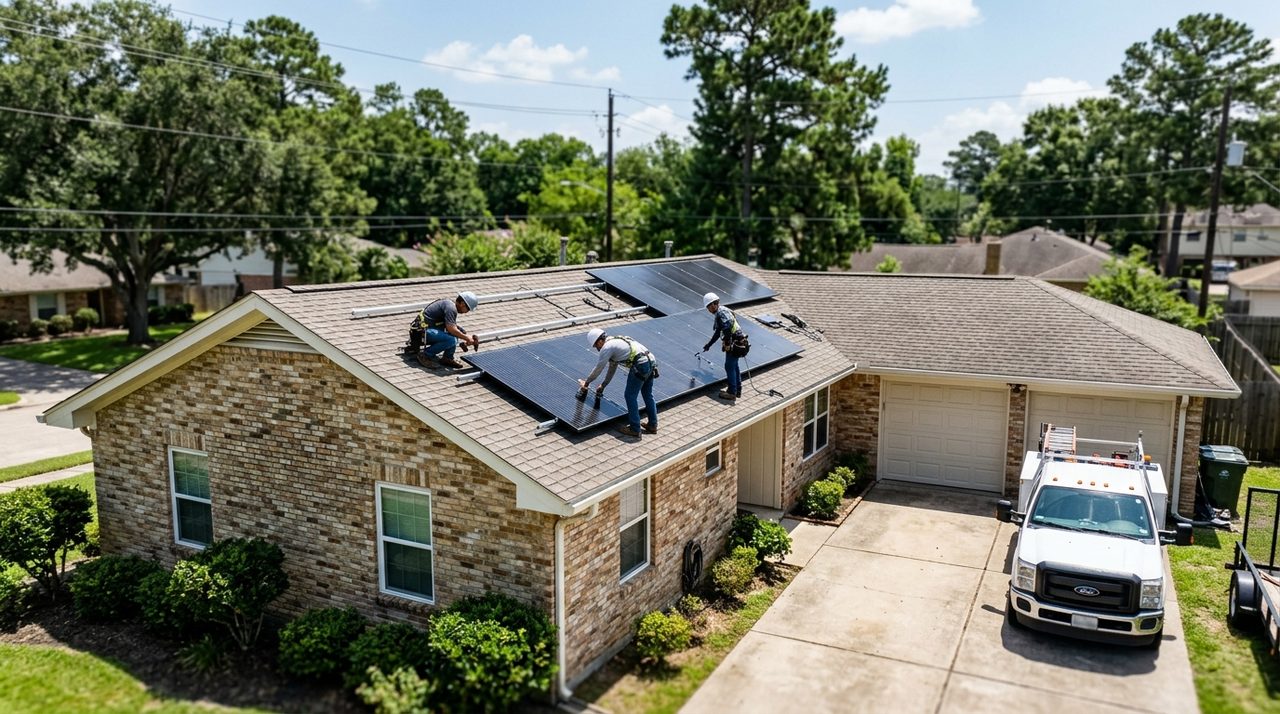
Jersey Village's 1960s–1980s ranch-style brick homes on concrete slabs sit squarely inside FEMA Zone AE — high flood risk territory along White Oak Bayou — which shapes every solar decision from roof condition to battery placement. The city runs its own permitting office separate from Houston Permitting Center and Harris County, so installers who don't know Jersey Village's specific process will cost you time and money before a single panel goes up. If your home is among the area's aging stock with original 100-amp electrical panels and shingles installed around the time of Harvey repairs, this page will tell you what to verify before you sign anything.
- Median home built
- 1991
- Median home value
- $326,700
- FEMA flood zone
- AE (high)
- Typical system cost (est.)
- $15,400–$24,500 after 30% ITC (8–10 kW)
- Most common local issue
- Aging 100–150A panels and post-Harvey budget reroof shingles requiring work before solar can mount
Ranked by verified Google rating × review volume × verification tier. How we rank →
Some highly-rated pros serve Jersey Village from nearby and may not keep a Jersey Village street address. Those are listed under "Also serving Jersey Village" with their real city and distance, so you always know where each business is based.
Based in Jersey Village
11450 FM 1960 W Ste 214, Houston, TX 77065
11755 W Little York Rd, Houston, TX 77041
12655 West Rd Suite 2, Houston, TX 77041
Also serving Jersey Village
Highly-rated pros based nearby who cover Jersey Village. Distance shown from the Jersey Village area.
Serving Jersey Village Based in NW Houston · 2.9 mi away
Serving Jersey Village Based in NW Houston · 4.3 mi away
Serving Jersey Village Based in Cypress · 5.1 mi away
Serving Jersey Village Based in Champions Forest · 5.7 mi away
Solar Installers in Jersey Village: What You Should Know
Post-Harvey Roofs and 40-Year-Old Shingles Are a Hidden Solar Time Bomb
Why it matters to you
A large share of Jersey Village's ranch-style homes received emergency roof repairs between 2017 and 2019 after Hurricane Harvey, and those budget shingles are now approaching end of life on top of original decks that may already be 40–50 years old. Houston's UV index of 10–11 and relentless summer heat cycles degrade standard asphalt shingles in 12–15 years rather than the rated 20–25, meaning a panel array mounted today on a compromised 2017 emergency repair roof will almost certainly require a $8,000–$14,000 remove-and-reinstall within 5 years — a cost rarely disclosed upfront.
What a good pro does
A qualified installer should pull the city permit record to confirm the last roofing permit date and require a licensed roofer's written assessment before racking goes up. If the shingles are within 8 years of estimated end-of-life, replacing the roof first — even if it adds $8,000–$18,000 to the project — protects a 25-year panel investment and prevents a far costlier mid-system teardown. The installer must pull both the roofing and electrical permits through the City of Jersey Village's own permitting office, not through Houston Permitting Center.
Sources: Municipal permit office (see area profile), International Residential Code (as adopted by City of Houston)
100–150A Original Panels Block Battery Backup — and Jersey Village Homes Need Backup
Why it matters to you
Homes built in Jersey Village during the 1960s–1980s commonly shipped with 100- to 150-amp electrical panels, which lack the capacity headroom required to safely integrate a battery storage system like a Tesla Powerwall alongside a solar array. This matters acutely here because Jersey Village's FEMA Zone AE designation means flood-driven power outages are a recurring reality — exactly the scenario where battery backup pays for itself — yet an undersized panel forces an upgrade before any storage can be wired in, adding cost and timeline that many installers fail to quote upfront.
What a good pro does
Before accepting any solar-plus-storage proposal, ask the installer for a written load calculation showing your existing panel's available capacity and a line-itemized cost for any panel upgrade to 200A. CenterPoint Energy's interconnection application for storage-paired systems requires a separate metering submittal that can add 6–10 weeks to the project timeline; a credible installer will factor that into the schedule they quote you. All electrical work must be permitted through the City of Jersey Village and pulled by a TDLR-licensed master electrician.
Sources: Texas Department of Licensing & Regulation, Municipal permit office (see area profile)
Houston's 9-Month Cooling Season Demands Honest System Sizing — Especially in Older Jersey Village Homes
Why it matters to you
Jersey Village's 1960s–1980s ranch homes were built decades before modern energy codes, and many still have minimal attic insulation, single-pane windows, and HVAC systems originally designed for R-22 refrigerant — all of which drive cooling loads well above Houston's already-high regional average of 1,400–1,800 kWh per month in peak summer months. Installers who size a system using national averages rather than your actual CenterPoint billing history routinely deliver arrays that offset only 40–50% of real load instead of the 80–100% they quote during the sales pitch.
What a good pro does
Require the installer to pull at least 12 months of your CenterPoint account's interval data — not a utility-average estimate — before finalizing system size. For a Jersey Village home with an aging envelope, a properly sized system will likely land at 10–12 kW rather than the entry-level 6–8 kW commonly pitched. NABCEP-certified installers are trained to perform site-specific production modeling; ask to see the PVWATTS or comparable output report with your actual address and shading inputs before signing.
Sources: North American Board of Certified Energy Practitioners (NABCEP), ENERGY STAR / U.S. Dept. of Energy
FEMA Zone AE Means Battery and Inverter Placement Is a Flood Code Question, Not Just a Convenience Decision
Why it matters to you
Most of Jersey Village falls within FEMA Zone AE, where base flood elevations are formally established and repeated flood events — Harvey in 2017 and Beryl in 2024 among them — have inundated garages and lower utility spaces in ranch-style homes. String inverters and battery systems installed at standard floor height in an attached garage are at real risk of flood damage, and unlike rooftop panels, flooded electrical equipment is generally not covered under flood insurance as a structural component.
What a good pro does
A knowledgeable installer will review FEMA flood map panel data for your specific parcel and spec inverters and battery enclosures at an elevation above the published base flood elevation for your address — typically meaning wall-mounted at least 12–18 inches above the documented BFE rather than floor-mounted. The City of Jersey Village's building code enforces floodplain management standards locally, so the permit submittal must include equipment elevation documentation; an installer unfamiliar with the city's floodplain requirements may not include this in their standard drawings.
Sources: FEMA National Flood Hazard Layer (NFHL), Municipal permit office (see area profile), International Residential Code (as adopted by City of Houston)
Solar Installers in Jersey Village: What You Should Know
Hiring solar installers in Jersey Village? Jersey Village is an independent municipality with a housing stock predominantly built between the 1960s and 1980s, featuring ranch-style and traditional brick homes on concrete slab foundations. Homeowners face significant flood risk due to proximity to White Oak Bayou and tributaries, making drainage, foundation maintenance, and flood mitigation among the most critical home service needs. The city handles its own code enforcement and permitting, so contractors must work through the City of Jersey Village rather than Houston or Harris County offices.
- Housing era
- 1960s–1980s, with some later infill construction
- Foundation
- Slab-on-grade (dominant)
- Flood zone
- FEMA Zone AE (high flood risk) — source
- Permits
- City of Jersey Village Permitting (independent municipality – permits are not issued through Houston…
Housing stock & systems
Building era
1960s–1980s, with some later infill construction.
Typical style
Ranch-style and traditional two-story brick homes with attached garages; suburban production architecture typical of northwest Houston.
Foundations
Slab-on-grade (dominant); pier-and-beam may exist on rare older or custom structures but is not documented.
Common systems
Original homes likely have copper or galvanized steel plumbing (transitioning to CPVC/PEX in later builds), R-22 refrigerant HVAC systems nearing or past end of life, and 100–200 amp electrical panels. Many systems in this era are candidates for full replacement.
What that means for repairs
Kitchen and bathroom remodels are common as homeowners update 40–60-year-old finishes. Re-piping from galvanized to PEX, HVAC upgrades to modern refrigerant systems, and flood-related restoration work (raised electrical panels, moisture-resistant materials) are frequent renovation drivers.
Permits & restrictions
Permit jurisdiction
City of Jersey Village Permitting (independent municipality – permits are not issued through Houston Permitting Center or Harris County).
HOA & deed restrictions
No mandatory city-wide HOA for core Jersey Village neighborhoods; property standards are enforced through city code enforcement and deed restrictions. The Park at Jersey Village HOA exists but appears to be a separate, newer subdivision not located in the traditional Jersey Village city limits. Specific section-level deed restrictions may exist but were not confirmed in public records.
Historic districts
No City of Houston historic district designation confirmed. Jersey Village is an independent city and not subject to HAHC review.
Contractor note
Contractors must obtain permits through the City of Jersey Village, which has its own building codes, inspections, and zoning requirements separate from both Houston and Harris County. Familiarity with the city's specific permit process and code enforcement standards is essential.
Flood & weather
FEMA flood zone
FEMA Zone AE (high flood risk) — source: fema_nfhl. Jersey Village is situated near White Oak Bayou and associated tributaries, placing much of the community in a designated high-risk floodplain with base flood elevations established.
Hurricane Harvey impact
Jersey Village is in a bayou-adjacent northwest Harris County area that experienced flooding during Hurricane Harvey, though a precise street-by-street damage assessment specific to the City of Jersey Village was not confirmed in available public records. The White Oak Bayou corridor and tributaries in this area flooded significantly. Homeowners should check HCFCD flood layers, FEMA FIRM maps, and property-level flood loss history (CLUE reports) for individual address risk.
Heat & humidity load
Houston's extreme summer heat and humidity place heavy demand on aging HVAC systems common in 1960s–80s homes, often triggering emergency repairs or full system replacements. Slab foundations in clay-heavy soils can shift with summer drought cycles, and prolonged moisture from summer storms combined with Zone AE flood risk can lead to mold, moisture intrusion, and recurring drainage issues.
Working with contractors here
Contractors in Jersey Village most commonly work on HVAC replacement, re-piping, foundation repair, and flood damage restoration driven by the aging 1960s–80s housing stock and high flood risk. Slab foundation repair is a frequent need as expansive clay soils shift seasonally, and many homes still have original galvanized plumbing requiring full re-pipes. Flood mitigation work—including raising electrical panels, installing sump systems, and replacing flood-damaged drywall and flooring with moisture-resistant materials—is a significant segment of the local market. Because Jersey Village is an incorporated city with its own permitting authority, contractors unfamiliar with the area should budget time for the city's specific inspection and permit processes rather than defaulting to Houston or Harris County procedures. Roofing and exterior work on 40–60-year-old brick veneer homes is also common, particularly after severe weather events.
Local Tip
Always ask for a written estimate before work begins. Texas contractors are required to provide one on jobs over $1,000.
About Jersey Village
Jersey Village is an independent municipality with a housing stock predominantly built between the 1960s and 1980s, featuring ranch-style and traditional brick homes on concrete slab foundations. Homeowners face significant flood risk due to proximity to White Oak Bayou and tributaries, making drainage, foundation maintenance, and flood mitigation among the most critical home service needs. The city handles its own code enforcement and permitting, so contractors must work through the City of Jersey Village rather than Houston or Harris County offices.
- Median year built
- 1991
- Median home value
- $326,700
- Owner-occupied
- 52.2%
- Population
- 7,817
- Housing units
- 3,658
- Median income
- $93,983
Source: U.S. Census Bureau, ACS 5-Year 2023
Flood & storm risk
FEMA Zone AEHigh flood riskMuch of Jersey Village maps to FEMA Zone AE (high flood risk), so flood-resilient detailing -- elevated equipment, water-tolerant materials, and drainage-first thinking -- is essential here, not optional.
Source: FEMA National Flood Hazard Layer (NFHL). Flood zones vary by parcel — verify your individual FIRM panel.
Houston Storm Readiness in Jersey Village
Hurricane & flooding
Battery backup systems installed in flood-prone Jersey Village, TX should be mounted at least one foot above the Base Flood Elevation shown on FEMA Zone AE maps — ask your installer to relocate ground-level units now, before the next Harvey-scale event. A rapid-shutdown-compliant system also lets first responders safely de-energize your roof array if rising water forces evacuation. Confirm the current FEMA panel for your Jersey Village parcel — the area maps to Zone AE, but adjacent lots can differ.
Severe storms & hail
Hail stones above one inch in diameter, common in Houston severe thunderstorm outbreaks, can micro-crack solar panel glass without immediately shattering it; homeowners in Jersey Village, TX should have a licensed inspector check for delamination and internal cell damage after any significant hail report. Your installer can also confirm whether your specific panel model's hail-impact rating matches the size of hail that struck your neighborhood. Confirm the current FEMA panel for your Jersey Village parcel — the area maps to Zone AE, but adjacent lots can differ.
Ice storms & freezes
Winter Storm Uri 2021 proved that the Houston grid can fail for days in a freeze, and for homeowners in Jersey Village, TX where FEMA Zone AE inside the 100-year floodplain already complicates recovery, a solar-plus-battery system with a properly sized critical-load panel can sustain heat, lighting, and medical devices when CenterPoint cannot deliver power. Have your TDLR-licensed installer verify the battery bank's cold-temperature discharge rating, since lithium-ion capacity drops noticeably below 32°F. Confirm the current FEMA panel for your Jersey Village parcel — the area maps to Zone AE, but adjacent lots can differ.
Sources: FEMA National Flood Hazard Layer (NFHL), Ready.gov -- Hurricanes, CenterPoint Energy -- Storm Center, City of Houston -- Emergency Preparedness, Ready.gov -- Winter Weather, Harris County Flood Control District
Free Jersey Village Tools & Calculators
Houston-specific estimators to plan your project before you call a pro. All results are planning estimates — a licensed local pro confirms the details on site.
Houston Freeze Prep & Pipe Insulation Checklist
Open full tool & FAQ →Your freeze checklist — 4 tasks
- 1
Disconnect & drain every outdoor hose bib
Remove hoses, drain the spigots, and cover each with an insulated faucet sock. Un-drained hose bibs are the #1 burst point in a Houston freeze.
- 2
Insulate exposed pipes in the attic & garage
Wrap any pipe in an unconditioned space (attic runs, garage walls) with foam sleeves. Houston homes rarely insulate these because they only matter a few nights a year — which is exactly why they burst.
- 3
Open cabinet doors & keep a pencil-width drip
On hard-freeze nights, open kitchen/bath cabinets so warm air reaches the pipes and let faucets on exterior walls drip to relieve pressure.
- 4
Protect the attic/garage water heater & its lines
An attic or garage tank sits in unconditioned space. Insulate the cold-inlet and hot-outlet lines and confirm the emergency drain pan is clear so a leak doesn't reach the ceiling.
This is a planning estimate only — actual requirements depend on an on-site assessment by a licensed Houston pro. If a pipe has already burst, shut off your main water supply and call a licensed Houston plumber immediately — freeze bursts flood fast.
Frequently Asked Questions
Do I need to pull a permit through the City of Jersey Village for solar, or can my installer file with Houston Permitting Center?
Sources: Municipal permit office (see area profile)
My Jersey Village home was built in the 1970s — do solar installers here need to do anything differently for the utility interconnection?
Sources: Municipal permit office (see area profile)Texas Department of Licensing & Regulation
Because Jersey Village is in FEMA Zone AE, are there code requirements that dictate where my inverter and battery have to be mounted?
Sources: FEMA National Flood Hazard Layer (NFHL)International Residential Code (as adopted by City of Houston)
What time of year should Jersey Village homeowners plan to start the solar permitting and installation process to avoid seasonal delays?
Does Jersey Village have any HOA rules I need to navigate before my solar installer submits plans?
Sources: Local HOA / deed restrictions (see area profile)
My Jersey Village home flooded during Harvey — should I disclose that to a solar installer, and does it affect what they'll recommend?
Sources: FEMA National Flood Hazard Layer (NFHL)Municipal permit office (see area profile)