Closed
Serving Memorial Based in Tanglewood · 0.8 mi away
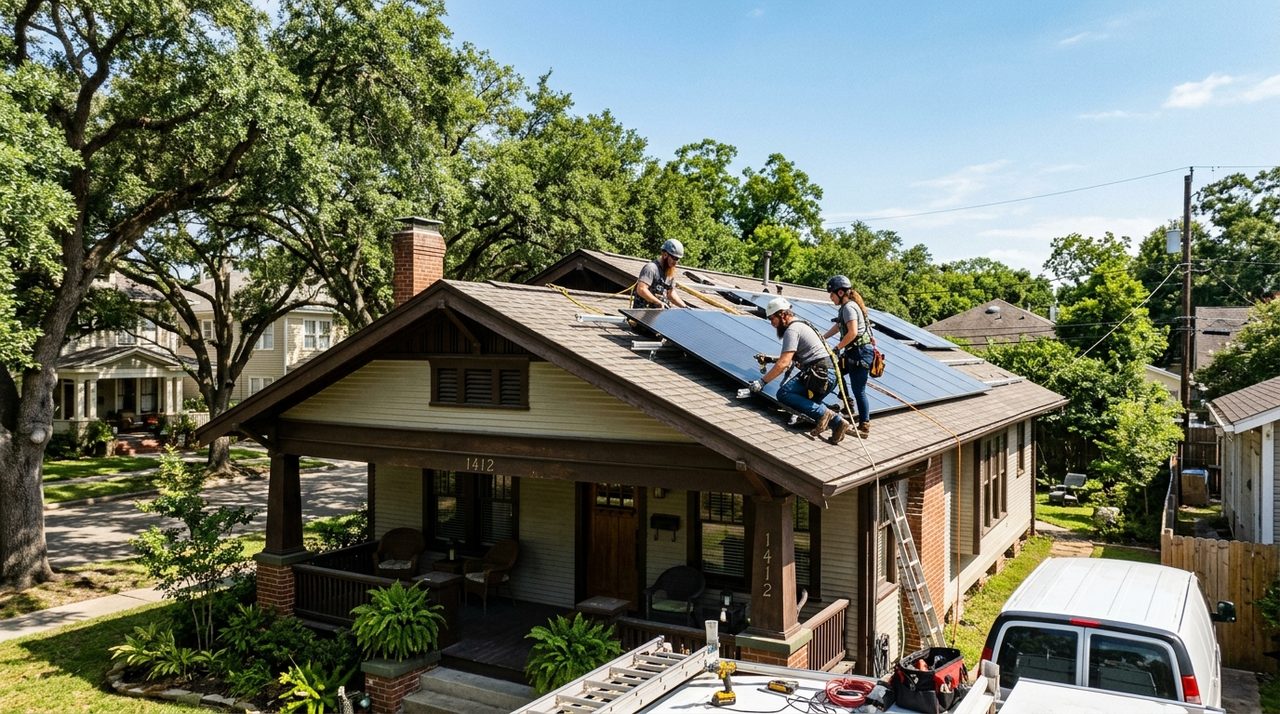
Memorial's block-by-block patchwork of 1950s–70s ranch homes, 1990s–2020s custom teardown-rebuilds, and subdivision-level deed restrictions creates a genuinely uneven solar landscape — an original ranch on a 100-amp panel and a 2015 custom rebuild on the same street face completely different installation paths. Add Houston's 9-month cooling season, Harris County clay soil under the slab, and City of Houston permit jurisdiction, and getting a system sized and installed correctly demands more homework than most metro neighborhoods. This page explains the four issues that actually drive cost and timeline surprises for Memorial homeowners going solar.
Ranked by verified Google rating × review volume × verification tier. How we rank →
Some highly-rated pros serve Memorial from nearby and may not keep a Memorial street address. Those are listed under "Also serving Memorial" with their real city and distance, so you always know where each business is based.
Highly-rated pros based nearby who cover Memorial. Distance shown from the Memorial area.
Serving Memorial Based in Tanglewood · 0.8 mi away
Serving Memorial Based in Bellaire · 2.2 mi away
Serving Memorial Based in Upper Kirby · 2.4 mi away
Serving Memorial Based in Spring Branch · 2.6 mi away
Serving Memorial Based in Lazybrook / Timbergrove · 2.7 mi away
Serving Memorial Based in Bellaire · 3 mi away
Serving Memorial Based in Lazybrook / Timbergrove · 3.7 mi away
Serving Memorial Based in Bellaire · 4 mi away
Serving Memorial Based in Brookhollow · 4.2 mi away
Why it matters to you
A significant share of Memorial's retained 1950s–70s ranch homes still carry 100- or 150-amp electrical service with aging panels that cannot safely support a solar inverter, battery system, or the interconnection equipment CenterPoint requires. On a block where the neighbor's 2018 custom rebuild has a 200-amp panel standard, it's easy to assume your home is ready — but if you're in an original structure, it almost certainly is not. Skipping the panel evaluation means the City of Houston inspector will flag the installation before it can be energized, adding weeks and cost mid-project.
What a good pro does
A qualified installer must pull your Harris County Appraisal District records and do a physical panel inspection before quoting. If an upgrade is needed, the electrical contractor must be TDLR-licensed and pull a separate electrical permit at the Houston Permitting Center — this work cannot be bundled invisibly into the solar permit. Budget $2,500–$5,000 for a 200-amp service upgrade as a line item, not a surprise change order.
Sources: Texas Department of Licensing & Regulation, Municipal permit office (see area profile), City of Houston Permitting Center
Why it matters to you
Memorial inside the Loop is not one neighborhood; it is a corridor of dozens of distinct subdivisions, each with its own deed restrictions recorded separately with the Harris County Clerk. Some subdivisions have active Architectural Control Committees that must approve exterior modifications including solar panels, and Texas Property Code §202.010 allows those HOAs to require placement where panels are 'not visible from the street.' On Memorial's typical street-facing south or west roof slopes, that restriction can force a rear or east placement that cuts estimated annual production by 15–25% compared to an optimal south-facing array — a difference that a generic online quote tool will never reflect.
What a good pro does
Before finalizing any array layout, your installer should obtain and review the recorded deed restrictions for your specific subdivision through Harris County Clerk records — not assume Memorial-wide uniformity. If an ACC exists, get written approval in hand before City of Houston permits are filed. A reputable installer will model production scenarios for both the optimal and the deed-restriction-compliant orientations so you can make an informed decision.
Sources: Local HOA / deed restrictions (see area profile), Municipal permit office (see area profile), North American Board of Certified Energy Practitioners (NABCEP)
Why it matters to you
Memorial's original ranch homes — many with minimal attic insulation, single-pane windows, and aging HVAC systems running on R-22 refrigerant — can easily exceed 1,600–1,800 kWh per month in peak summer. An installer who plugs a national average consumption figure into a sizing calculator will almost always quote a system that offsets 40–50% of your actual load rather than the 80–100% most homeowners expect. Memorial's median home value of roughly $807,000 (ACS 2023) reflects the prevalence of large custom rebuilds that also carry high cooling loads from high ceilings and extensive glazing.
What a good pro does
Demand that your installer size the system from 12–24 months of your actual CenterPoint billing history, not a ZIP-code average. For retained ranch homes, a pre-solar air sealing and insulation assessment often reduces the required system size enough to offset its own cost. NABCEP-certified designers are trained to run Houston-specific load profiles; ask to see the kWh offset calculation, not just the panel count.
Sources: North American Board of Certified Energy Practitioners (NABCEP), ENERGY STAR / U.S. Dept. of Energy
Why it matters to you
Memorial homeowners in original structures — many with pre-2000 panels and older wiring — face the highest complexity when adding battery backup like a Tesla Powerwall or Enphase IQ Battery alongside a new solar array. CenterPoint's interconnection tariff for storage-paired systems requires a separate metering application that routinely adds 6–10 weeks to the project timeline on top of normal City of Houston permit processing. On top of that, Houston-area AHJs have inconsistent requirements for battery enclosure fire separation distances, which means a submittal that passes in one part of the metro may be flagged in the Houston Permitting Center queue.
What a good pro does
If battery storage is a priority — and post-Uri, it often is — start the CenterPoint interconnection application at the same time as the City of Houston permit filing, not after. The master electrician pulling the permit (required by TDLR) must be familiar with CenterPoint's storage-specific tariff documents. For homes where the panel upgrade and battery enclosure are both needed, get a combined electrical scope quoted upfront so permitting can proceed in a single submittal rather than staged re-inspections.
Sources: Texas Department of Licensing & Regulation, Municipal permit office (see area profile), City of Houston Permitting Center
Hiring solar installers in Memorial? Memorial inside the Loop is a corridor of multiple smaller subdivisions rather than one unified neighborhood, meaning deed restrictions, HOA rules, and housing conditions vary block by block. Homeowners deal with a mix of original 1950s–70s ranch homes needing major system updates and newer custom construction from the 1990s–2020s. Proximity to Buffalo Bayou makes drainage management and foundation monitoring critical home service priorities.
Building era
1950s–1970s original stock with significant 1990s–2020s teardown-and-rebuild activity.
Typical style
Original ranch and mid-century traditional homes alongside newer traditional brick, Mediterranean, soft contemporary, modern farmhouse, and fee-simple townhomes.
Foundations
Predominantly slab-on-grade; some pier-and-beam in the oldest remaining structures.
Common systems
Original homes often have galvanized or early copper plumbing, aging R-22 HVAC systems, and 100–150 amp electrical panels; newer rebuilds feature modern PEX plumbing, high-efficiency HVAC, and 200+ amp panels.
What that means for repairs
Teardown-and-rebuild is the dominant renovation pattern, driven by lot values exceeding the value of original structures. Where original homes are retained, whole-house repiping, electrical panel upgrades, and HVAC replacement are the most common major projects.
Permit jurisdiction
City of Houston — Houston Permitting Center.
HOA & deed restrictions
No single area-wide mandatory HOA. The corridor is governed by multiple subdivision-level organizations—some with mandatory HOAs (e.g., specific townhome and condo developments), others with voluntary civic clubs or property owners associations. Deed restrictions are common but must be confirmed per subdivision through Harris County Clerk records.
Historic districts
No City of Houston historic district designation confirmed for the Memorial inside-the-Loop corridor.
Contractor note
Contractors must verify deed restrictions and architectural review requirements on a per-subdivision basis before exterior work begins. Some subdivisions require Architectural Control Committee (ACC) approval for additions, fencing, and material changes.
FEMA flood zone
FEMA Zone X (low flood risk) per official NFHL data. However, the corridor's proximity to Buffalo Bayou means individual parcels closer to the bayou may carry higher risk; homeowners should verify flood zone status at the parcel level, as conditions vary significantly within the corridor.
Hurricane Harvey impact
Specific block-by-block Harvey impact data for the Memorial inside-the-Loop corridor was not confirmed in research. Buffalo Bayou experienced historic flooding during Harvey, and properties nearest the bayou along Memorial Drive were likely affected. Homeowners should check individual property flood history through Harris County Flood Control District records.
Heat & humidity load
Original 1950s–70s homes with aging insulation and single-pane windows place heavy demands on HVAC systems during Houston summers. Slab-on-grade foundations on the expansive clay soils near Buffalo Bayou are susceptible to shifting during summer drought cycles, making foundation monitoring and consistent watering programs important.
Working with contractors here
Contractors working in Memorial inside the Loop most commonly handle full teardown-and-rebuild projects on lots where original ranch homes are being replaced with larger custom homes. For retained original structures, whole-house repiping (replacing galvanized lines), electrical panel upgrades from 100 to 200 amps, and HVAC system replacements are the highest-demand services. The subdivision-by-subdivision deed restriction landscape means contractors must scope exterior projects carefully—confirming setbacks, height limits, and material requirements with the specific neighborhood association before bidding. Drainage and grading work is common given proximity to Buffalo Bayou, and foundation repair contractors see steady demand due to the clay soil conditions and mature tree root systems throughout the corridor.
Local Tip
Always ask for a written estimate before work begins. Texas contractors are required to provide one on jobs over $1,000.
Memorial inside the Loop is a corridor of multiple smaller subdivisions rather than one unified neighborhood, meaning deed restrictions, HOA rules, and housing conditions vary block by block. Homeowners deal with a mix of original 1950s–70s ranch homes needing major system updates and newer custom construction from the 1990s–2020s. Proximity to Buffalo Bayou makes drainage management and foundation monitoring critical home service priorities.
Source: U.S. Census Bureau, ACS 5-Year 2023
Most of Memorial maps to FEMA Zone X (low mapped flood risk), but Houston's flash-flood reality means even low-risk blocks benefit from smart drainage and storm-hardened installs; risk climbs sharply on blocks nearest Buffalo Bayou, where it varies parcel to parcel.
Source: FEMA National Flood Hazard Layer (NFHL). Flood zones vary by parcel — verify your individual FIRM panel.
After extended outages during past Gulf storms, homeowners in Memorial discovered that grid-tied solar without battery storage goes dark the moment CenterPoint cuts power for line-worker safety. Ask your licensed solar installer about adding a code-compliant rapid-shutdown device and a battery backup that can island critical loads during a multi-day outage. Confirm the current FEMA panel for your Memorial parcel — the area maps to Zone X, but adjacent lots can differ.
Wind uplift from severe thunderstorm straight-line winds — not just hurricanes — is the most common cause of panel dislodgement in Memorial; confirm with your TDLR-licensed installer that your racking was installed with hurricane-rated lag screws into verified rafter locations, not just into decking. The May 2024 derecho demonstrated that 80-plus-mph gusts arrive with little warning and no opportunity for last-minute hardware checks. Because Memorial drains toward Buffalo Bayou, block-level runoff can differ sharply from the mapped zone.
Ice accumulation temporarily cuts solar panel output in Memorial, but the larger freeze-related risk for solar homeowners is an inverter or battery enclosure mounted in an uninsulated garage or attic space exposed to sub-freezing temperatures — equipment manufacturers specify minimum operating temperatures, and falling below them can cause shutdowns or permanent damage. Ask your installer to confirm all system components are within their rated temperature range before the next hard freeze. Confirm the current FEMA panel for your Memorial parcel — the area maps to Zone X, but adjacent lots can differ.
Sources: FEMA National Flood Hazard Layer (NFHL), Ready.gov -- Hurricanes, CenterPoint Energy -- Storm Center, City of Houston -- Emergency Preparedness, Ready.gov -- Winter Weather, Harris County Flood Control District
Houston-specific estimators to plan your project before you call a pro. All results are planning estimates — a licensed local pro confirms the details on site.
Disconnect & drain every outdoor hose bib
Remove hoses, drain the spigots, and cover each with an insulated faucet sock. Un-drained hose bibs are the #1 burst point in a Houston freeze.
Insulate exposed pipes in the attic & garage
Wrap any pipe in an unconditioned space (attic runs, garage walls) with foam sleeves. Houston homes rarely insulate these because they only matter a few nights a year — which is exactly why they burst.
Open cabinet doors & keep a pencil-width drip
On hard-freeze nights, open kitchen/bath cabinets so warm air reaches the pipes and let faucets on exterior walls drip to relieve pressure.
Protect the attic/garage water heater & its lines
An attic or garage tank sits in unconditioned space. Insulate the cold-inlet and hot-outlet lines and confirm the emergency drain pan is clear so a leak doesn't reach the ceiling.
This is a planning estimate only — actual requirements depend on an on-site assessment by a licensed Houston pro. If a pipe has already burst, shut off your main water supply and call a licensed Houston plumber immediately — freeze bursts flood fast.
Sources: City of Houston Permitting CenterMunicipal permit office (see area profile)
Sources: FEMA National Flood Hazard Layer (NFHL)Texas Windstorm Insurance Association (TWIA)
Sources: Local HOA / deed restrictions (see area profile)
Sources: City of Houston Permitting Center
Sources: Texas Department of Licensing & RegulationNorth American Board of Certified Energy Practitioners (NABCEP)City of Houston Permitting Center