11620 Jones Rd, Houston, TX 77070
Best Tree Removal in Champions Forest
Champions Forest's mid-1970s through late-1980s brick homes sit under a mature canopy of live oaks, water oaks, and opportunistic Chinese tallow trees that have had 40-plus years to push roots into aging slab-on-grade foundations and clay sewer laterals — all on the expansive Beaumont Black clay that underlies northwest Harris County. Add the neighborhood's FEMA Zone AE flood designation near Cypress Creek, mandatory ACC approval requirements from multiple section HOAs, and Harris County Engineering's permit jurisdiction (not the City of Houston), and tree removal here involves layers that a simple weekend quote call won't uncover. Read on for the specific sequencing and cost realities Champions Forest homeowners face.
Verified against Google Business data
Updated 2026
See the 10 Tree Removal Serving Champions Forest 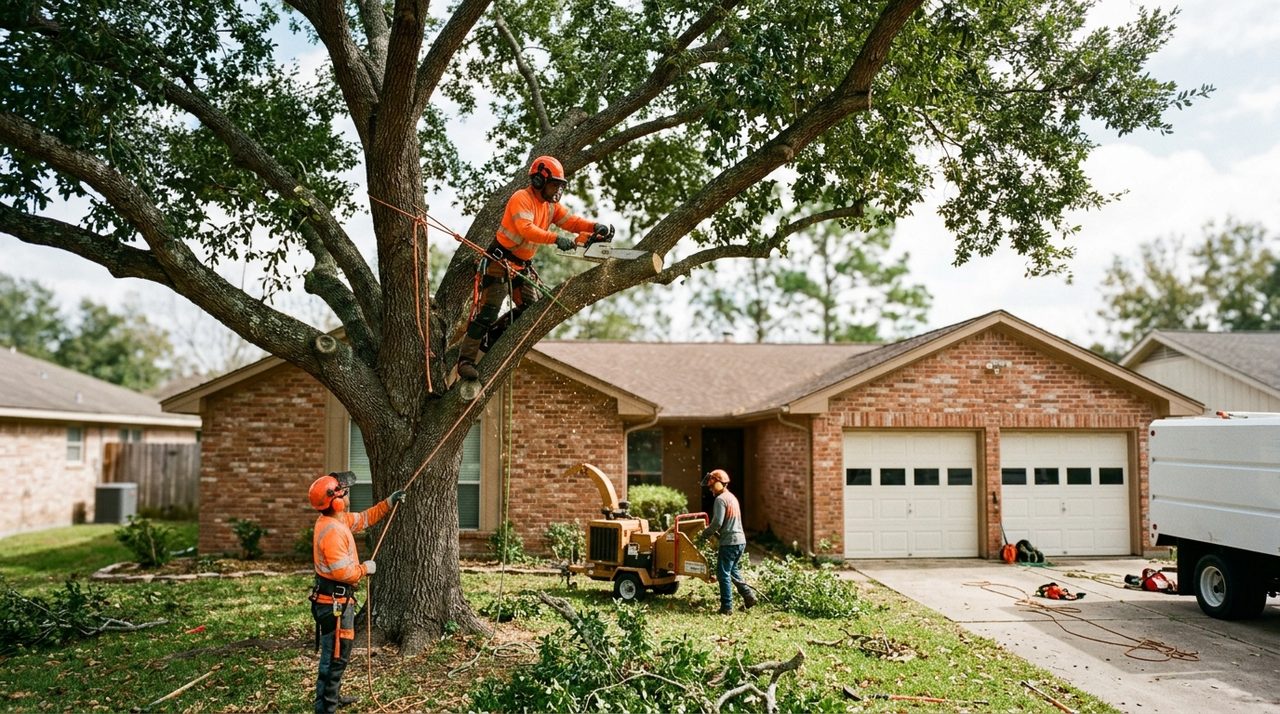
- Median home built
- 1993
- Median home value
- $293,572
- FEMA flood zone
- AE (high)
- Typical removal cost (est.)
- $750–$5,000+
- Most common local issue
- Mature oaks within 20 ft of 1970s–80s slabs on expansive clay
Ranked by verified Google rating × review volume × verification tier. How we rank →
Some highly-rated pros serve Champions Forest from nearby and may not keep a Champions Forest street address. Those are listed under "Also serving Champions Forest" with their real city and distance, so you always know where each business is based.
Min rating:
10 resultsBased in Champions Forest
7075 Farm to Market 1960 Road West Suite 1045, Houston, TX 77069
8300 FM 1960 W #450, Houston, TX 77070
Closed
9603 Largs Dr, Spring, TX 77379
Closed
11835 Bammel North Houston Rd, Houston, TX 77066
Also serving Champions Forest
Highly-rated pros based nearby who cover Champions Forest. Distance shown from the Champions Forest area.
Closed
Serving Champions Forest Based in Tomball · 3.4 mi away
Closed
Serving Champions Forest Based in Tomball · 3.8 mi away
Serving Champions Forest Based in Jersey Village · 3.9 mi away
Open Now
Serving Champions Forest Based in Jersey Village · 4.4 mi away
Closed
Serving Champions Forest Based in Tomball · 5 mi away
Tree Removal in Champions Forest: What You Should Know
ACC Approval Must Come Before the Crew Arrives
Why it matters to you
Every section of Champions Forest operates under a mandatory property owners association — Champion Forest Fund, Inc. for Sections 1–10, plus separate HOAs governing Sections 11, 12, and the Villas — and each requires Architectural Control Committee approval before any exterior tree work begins. Removing a mature oak or large tallow without that sign-off can trigger fines and mandatory replanting requirements that cost more than the removal itself.
What a good pro does
Before scheduling a crew, submit your removal request to the correct section's ACC with photos, the tree's diameter at breast height, and the arborist's written justification (root damage to slab, documented disease, storm hazard). Build two to four weeks of ACC review time into your project schedule before the removal date, and have the contractor hold the work order until written approval is in hand. Texas does not require a state license for tree removal, but hiring an ISA Certified Arborist to document the tree's condition strengthens your ACC application significantly.
Sources: Local HOA / deed restrictions (see area profile)
Forty-Year-Old Slab Edges and Roots Don't Mix on Clay Soil
Why it matters to you
The production homes built across Champions Forest between the mid-1970s and late 1980s sit on slab-on-grade foundations over expansive Beaumont Black clay — a combination that is already sensitive to Houston's wet-dry moisture swings. Water oaks and live oaks planted at the same time as these homes are now at full size, with surface-feeding roots that can run well past the drip line and exploit clay shrink-swell movement along slab edges. Homes of this era also commonly have original clay sewer laterals that roots penetrate once any hairline crack opens.
What a good pro does
A qualified arborist should probe the soil within 15 to 20 feet of any large oak before removal to assess root spread and then recommend full stump grinding — not just a flush cut — to eliminate regrowth and allow the clay to stabilize. If you suspect lateral sewer intrusion, schedule a camera inspection of the line before and after removal; remedying a root-invaded clay lateral while the stump grinder is already on site is far cheaper than a separate excavation later. Stump grinding in Champions Forest typically runs $150–$400 per stump as an estimate.
Sources: Harris County Flood Control District
Chinese Tallow Near Cypress Creek Drainage Requires Aggressive Stump Treatment
Why it matters to you
Champions Forest's proximity to Cypress Creek and its tributary drainage channels creates ideal reseeding conditions for Chinese tallow (Triadica sebifera), a state-listed invasive that grows five or more feet per year and whose stumps vigorously resprout if simply cut. Post-Harvey and post-Beryl 2024 flood events disturbed soil along drainage corridors throughout this part of northwest Harris County, and disturbed, wet soil is exactly where tallow volunteers most aggressively.
What a good pro does
A simple cut-and-leave approach will result in a multi-stem resprouting tallow within one growing season. Proper removal requires immediate cut-stump herbicide treatment — typically a concentrated triclopyr product applied within minutes of the final cut — or full stump grinding below grade. Because tallow wood is often refused at standard green-waste recycling facilities, confirm with the contractor upfront how the wood will be disposed of; responsible crews haul it to an approved facility rather than chipping it on-site and leaving inoculated mulch near drainage areas. TCEQ designates Chinese tallow as an invasive species in Texas.
Sources: Texas Commission on Environmental Quality, Harris County Flood Control District
Zone AE Designation Adds a Layer to Post-Storm Debris Decisions
Why it matters to you
Significant portions of Champions Forest carry a FEMA Zone AE designation tied to Cypress Creek flood risk, meaning the neighborhood has experienced federally declared disaster events and will again. After a named storm — the May 2024 derecho tracked through the northwest Houston corridor, and Hurricane Beryl 2024 hit the broader metro — regional demand for tree crews surges immediately, pricing typically runs 40 to 80 percent above normal rates as an estimate, and out-of-state operators with no local accountability appear quickly. In an AE flood zone, storm-downed trees that fall into drainage easements or block sheet flow can compound flood damage for adjacent homes.
What a good pro does
In any post-disaster period, verify that the tree company carries adequate general liability insurance before signing anything, and check whether the work falls within a FEMA-declared disaster window that affects curbside debris pickup scheduling in unincorporated Harris County. Debris placed in the right-of-way outside the county's announced pickup windows may not be collected and can attract fines. For trees actually blocking drainage easements, Harris County Flood Control District has jurisdiction over those corridors and homeowners should report obstructions rather than attempting unauthorized clearing that could shift flood liability.
Sources: FEMA National Flood Hazard Layer (NFHL), Harris County Flood Control District
Tree Removal in Champions Forest: What You Should Know
Hiring tree removal in Champions Forest? Champions Forest is a large, multi-section subdivision in the Klein ISD area of northwest Harris County, built primarily from the mid-1970s through the late 1980s. Homeowners here deal with aging slab-on-grade foundations, original-era HVAC and plumbing systems that are reaching or past their expected lifespan, and FEMA AE flood zone designations that affect insurance requirements and exterior renovation planning. Multiple mandatory HOAs with architectural control committees govern exterior modifications, so contractors must factor in ACC approval timelines.
- Housing era
- Primarily mid-1970s through late 1980s, with some later sections extending into the early 1990s
- Foundation
- Slab-on-grade (regional inference for 1970s–1980s production homes in NW Harris County
- Flood zone
- FEMA Zone AE (high flood risk) — source
- Permits
- Harris County Engineering (unincorporated Harris County, Klein area — not within City of Houston…
Housing stock & systems
Building era
Primarily mid-1970s through late 1980s, with some later sections extending into the early 1990s.
Typical style
Traditional brick two-story homes with Colonial and Georgian influences; some single-story ranch-style homes and occasional Tudor and French traditional elevations.
Foundations
Slab-on-grade (regional inference for 1970s–1980s production homes in NW Harris County; confirm via HCAD or individual inspection).
Common systems
Original homes likely have R-22 refrigerant HVAC systems nearing or past replacement age, copper or galvanized steel supply plumbing transitioning to PEX in renovated homes, and 100–200 amp electrical panels that may need upgrading for modern loads.
What that means for repairs
Kitchen and bathroom remodels are common as homes from this era are updated to modern standards. HVAC full-system replacements are frequent due to age. Foundation repair and re-leveling are periodic needs given expansive clay soils and slab-on-grade construction. Post-Harvey flood damage repairs drove significant interior renovation activity in affected sections.
Permits & restrictions
Permit jurisdiction
Harris County Engineering (unincorporated Harris County, Klein area — not within City of Houston limits).
HOA & deed restrictions
Mandatory property owners associations govern all sections. Sections 1–10 are governed by Champion Forest Fund, Inc. (Champion Forest HOA). Additional mandatory HOAs include Champion Forest Eleven HOA (161 lots), Champion Forest Twelve Homeowners Association Inc., and Champion Forest Villas HOA. All require Architectural Control Committee (ACC) approval for exterior modifications.
Historic districts
No City of Houston historic district designation confirmed.
Contractor note
Contractors must obtain Harris County permits for structural, mechanical, and electrical work and should coordinate ACC approval from the applicable section's HOA before beginning any exterior modifications. Work in the FEMA AE flood zone may require elevation certificates and floodplain development permits.
Flood & weather
FEMA flood zone
FEMA Zone AE (high flood risk) — source: fema_nfhl. Champions Forest is situated in northwest Harris County near Cypress Creek, a major drainage corridor that has historically been associated with significant flooding events.
Hurricane Harvey impact
No official neighborhood-wide flood impact summary was found in available HOA or public records. Areas near Cypress Creek in northwest Harris County experienced significant Harvey flooding and subsequent buyout activity, but specific street-level impact within Champions Forest is not clearly documented in available sources. Homeowners should check Harris County Flood Control District records and individual property flood history for confirmation.
Heat & humidity load
Homes from the 1970s–80s with original insulation and single-pane windows face high cooling costs during Houston summers. Aging HVAC systems are under maximum stress from May through September, making this the peak period for emergency AC repair calls. Humidity management is critical to prevent mold in homes that experienced prior flooding or have insufficient attic ventilation.
Working with contractors here
Contractors working in Champions Forest most commonly handle HVAC replacements, foundation leveling, and plumbing re-pipes — all driven by the 40–50-year age of the housing stock. Kitchen and bath remodels are a strong secondary market as homeowners modernize dated interiors. Flood mitigation work, including elevated electrical panels, moisture barriers, and drainage improvements, is relevant given the AE flood zone designation. All exterior work requires ACC approval from the applicable section's HOA (Champion Forest Fund for Sections 1–10, or the respective section HOA), so contractors should build approval lead time into project schedules. Harris County permitting applies rather than City of Houston permits, which affects inspection scheduling and code requirements.
Local Tip
Always ask for a written estimate before work begins. Texas contractors are required to provide one on jobs over $1,000.
About Champions Forest
Champions Forest is a large, multi-section subdivision in the Klein ISD area of northwest Harris County, built primarily from the mid-1970s through the late 1980s. Homeowners here deal with aging slab-on-grade foundations, original-era HVAC and plumbing systems that are reaching or past their expected lifespan, and FEMA AE flood zone designations that affect insurance requirements and exterior renovation planning. Multiple mandatory HOAs with architectural control committees govern exterior modifications, so contractors must factor in ACC approval timelines.
- Median year built
- 1993
- Median home value
- $293,572
- Owner-occupied
- 65.5%
- Population
- 212,347
- Housing units
- 79,382
- Median income
- $89,514
Source: U.S. Census Bureau, ACS 5-Year 2023
Flood & storm risk
FEMA Zone AEHigh flood riskMuch of Champions Forest maps to FEMA Zone AE (high flood risk), so flood-resilient detailing -- elevated equipment, water-tolerant materials, and drainage-first thinking -- is essential here, not optional.
Source: FEMA National Flood Hazard Layer (NFHL). Flood zones vary by parcel — verify your individual FIRM panel.
Houston Storm Readiness in Champions Forest
Hurricane & flooding
Saturated ground in FEMA Zone AE inside the 100-year floodplain areas like Champions Forest means even healthy trees can topple under hurricane-force winds, so have a TDLR-licensed tree removal contractor evaluate canopy weight and root health each May. Harvey 2017 showed that standing water for even 24 hours before landfall was enough to loosen root plates and bring down trees that looked perfectly healthy. Confirm the current FEMA panel for your Champions Forest parcel — the area maps to Zone AE, but adjacent lots can differ.
Severe storms & hail
Straight-line wind events like the May 2024 derecho give no warning and target trees weakened by repeated flood-stress cycles common in Champions Forest, so have a TDLR-licensed arborist assess any tree showing crown dieback, fungal conks, or soil heave near the base. Removing those specimens before severe storm season reduces the single largest source of sudden structural damage in FEMA Zone AE inside the 100-year floodplain neighborhoods. In-city Champions Forest work falls under City of Houston floodplain and permitting rules.
Ice storms & freezes
The hidden aftermath of Uri 2021 was the wave of structurally compromised trees left standing across Champions Forest that became hazards in the following storm seasons, so a post-freeze inspection by a licensed arborist is as important as the immediate debris cleanup. Contractors can identify freeze-cracked bark, split scaffold branches, and root damage that will lead to failure during the next severe weather event. In-city Champions Forest work falls under City of Houston floodplain and permitting rules.
Sources: FEMA National Flood Hazard Layer (NFHL), Ready.gov -- Hurricanes, CenterPoint Energy -- Storm Center, City of Houston -- Emergency Preparedness, Ready.gov -- Winter Weather, Harris County Flood Control District
Free Champions Forest Tools & Calculators
Houston-specific estimators to plan your project before you call a pro. All results are planning estimates — a licensed local pro confirms the details on site.
Houston Soil & Tree Proximity Risk Calculator
Open full tool & FAQ →Grouped by mature root aggression & water demand.
Trunk center to the nearest exterior wall.
Moderate risk
The root zone likely reaches your foundation's soil during Houston's dry summers, when clay shrinks most. Watch for sticking doors and diagonal cracks, keep soil moisture even with a soaker hose during drought, and have a foundation pro evaluate if you see any movement.
Find a Houston foundation pro →This is a planning estimate only — actual requirements depend on an on-site assessment by a licensed Houston pro. Guidance is based on general species root behavior in expansive clay, not a soil test.
Houston Freeze Prep & Pipe Insulation Checklist
Open full tool & FAQ →Your freeze checklist — 4 tasks
- 1
Disconnect & drain every outdoor hose bib
Remove hoses, drain the spigots, and cover each with an insulated faucet sock. Un-drained hose bibs are the #1 burst point in a Houston freeze.
- 2
Insulate exposed pipes in the attic & garage
Wrap any pipe in an unconditioned space (attic runs, garage walls) with foam sleeves. Houston homes rarely insulate these because they only matter a few nights a year — which is exactly why they burst.
- 3
Open cabinet doors & keep a pencil-width drip
On hard-freeze nights, open kitchen/bath cabinets so warm air reaches the pipes and let faucets on exterior walls drip to relieve pressure.
- 4
Protect the attic/garage water heater & its lines
An attic or garage tank sits in unconditioned space. Insulate the cold-inlet and hot-outlet lines and confirm the emergency drain pan is clear so a leak doesn't reach the ceiling.
This is a planning estimate only — actual requirements depend on an on-site assessment by a licensed Houston pro. If a pipe has already burst, shut off your main water supply and call a licensed Houston plumber immediately — freeze bursts flood fast.
Frequently Asked Questions
Do I need a permit from Harris County to remove a tree in Champions Forest, and is it different from what City of Houston homeowners do?
Because Champions Forest sits in unincorporated Harris County — not within City of Houston limits — your permit authority is Harris County Engineering, not the City of Houston Permitting Center. Harris County does not require a homeowner permit for routine tree removal on private residential property, but you still need ACC approval from your section's HOA before any work begins, and any concurrent work affecting drainage or grade in the FEMA Zone AE floodplain may trigger a Harris County floodplain development review.
Sources: Municipal permit office (see area profile)FEMA National Flood Hazard Layer (NFHL)
My Champions Forest section HOA hasn't responded to my ACC request in two weeks — can the tree company start work if the tree looks hazardous?
Mandatory ACC approval from your applicable section association (Champion Forest Fund for Sections 1–10, or your section-specific HOA) is required before exterior work proceeds, but a genuinely imminent hazard — a cracked trunk leaning over a roof, for example — is a different situation that most ACC governing documents address with an emergency provision. Contact your HOA in writing, document the hazard with photos and a written assessment from an ISA Certified Arborist, and request emergency approval; that paper trail protects you if a fine dispute arises later.
Sources: Local HOA / deed restrictions (see area profile)
After Beryl 2024 knocked down a large water oak in my Champions Forest backyard near Cypress Creek, how do I know whether FEMA debris pickup covers it or whether it's all out of pocket?
In a FEMA-declared disaster, Harris County and Houston coordinate curbside public right-of-way debris collection for storm-generated material placed at the curb by homeowners — but tree debris still on your private property (not blocking a public road or right-of-way) is typically your financial responsibility and not covered under FEMA Public Assistance programs. Because Champions Forest carries a Zone AE designation near Cypress Creek, also check with your NFIP or private flood insurer to see whether storm-damaged tree removal is listed as a covered expense under your specific policy.
Sources: FEMA National Flood Hazard Layer (NFHL)Harris County Flood Control District
How much should I budget to remove a large live oak near my 1970s slab in Champions Forest, and should I expect post-storm pricing right now?
Removing a mature live oak over 60 feet close to a structure in normal market conditions is estimated at $2,000–$5,000 or more, with stump grinding typically an additional $150–$400 — all estimates that can shift based on access, lean, and condition. In the weeks following a major named event like Beryl 2024 or a derecho, regional demand surges routinely push prices 40–80% above those baseline estimates, so budgeting toward the upper end is prudent if you're scheduling work during a post-storm period.
Are there southern pine beetle-killed trees in Champions Forest I should be worried about, or is that mostly a problem farther northeast?
Southern pine beetle damage is most concentrated in Humble, Kingwood, and the Piney Woods transition zone to the northeast, but Champions Forest's 1970s–80s subdivisions do include mature loblolly pines in some sections, and those trees are susceptible if stressed by drought or root disturbance. A dead-standing pine becomes significantly more dangerous and costly to remove than a live one — brittle wood fails unpredictably during climbing — so if you have a pine with no green needles or with pitch tubes and sawdust on the bark, get an ISA Certified Arborist assessment promptly rather than waiting for the next storm season.
If I remove the large oak shading my west wall to solve a root problem, what should I expect on my summer electric bill in Champions Forest?
Houston's northwest suburbs log roughly 3,500 or more cooling degree days annually, and a mature tree shading a west or southwest wall can measurably reduce cooling load — some estimates put the saving at 15–25% of cooling costs for that exposure. Champions Forest homes built in the mid-1970s through late 1980s already carry aging HVAC systems that may be working harder than newer equipment, so losing a significant shade tree can push those systems closer to their limits during July and August. Before committing to removal for root concerns alone, ask your arborist whether strategic root pruning with a root barrier, combined with foundation monitoring, could reduce the conflict without eliminating the canopy.