Open Now
1337 N 7th St, Conroe, TX 77301
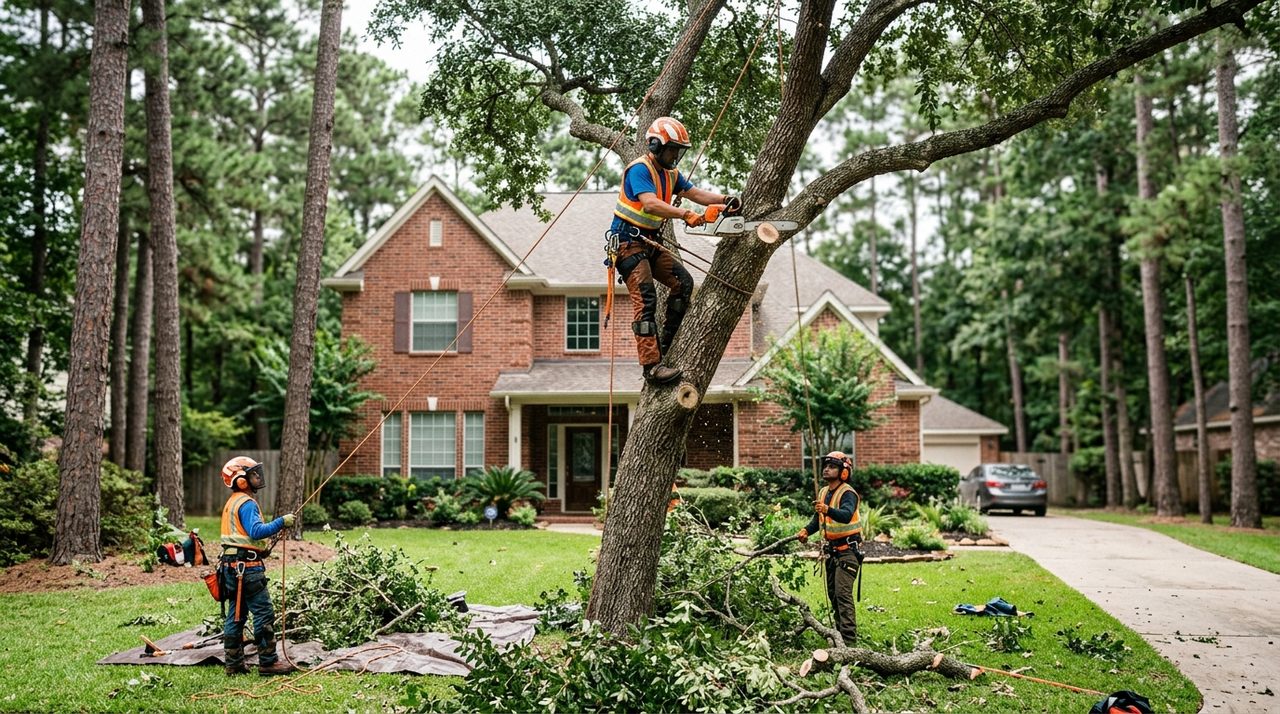
Conroe's tree canopy ranges from decades-old pines and live oaks shading 1960s in-town ranch homes to younger Chinese tallow volunteers crowding newer master-planned subdivisions built on Montgomery County's clay-heavy soils. The City of Conroe and unincorporated Montgomery County run separate permit offices, and individual subdivision HOAs add another layer of approval requirements that vary block by block. Getting the sequencing right — HOA sign-off, correct permit jurisdiction, and a vetted contractor — before a chainsaw starts is the single most important thing a Conroe homeowner can do.
Ranked by verified Google rating × review volume × verification tier. How we rank →
Some highly-rated pros serve Conroe from nearby and may not keep a Conroe street address. Those are listed under "Also serving Conroe" with their real city and distance, so you always know where each business is based.
1337 N 7th St, Conroe, TX 77301
2401 E Davis St, Conroe, TX 77301
503 Dogwood Cluster Ct, Conroe, TX 77301
900 Holly Dr #5, Conroe, TX 77301
1504 S Frazier St Suite B, Conroe, TX 77301
Highly-rated pros based nearby who cover Conroe. Distance shown from the Conroe area.
Serving Conroe Based in The Woodlands · 4.6 mi away
Serving Conroe Based in Porter · 5 mi away
Serving Conroe Based in Porter · 5.4 mi away
Serving Conroe Based in The Woodlands · 6.3 mi away
Serving Conroe Based in The Woodlands · 7 mi away
Why it matters to you
Conroe sits at the edge of the Piney Woods transition zone, and established neighborhoods built in the 1960s through 1990s still carry significant loblolly pine canopy. Southern pine beetle pressure, amplified by drought stress common to Montgomery County's hot summers, has left many of these trees dead standing. A pine killed by beetle activity becomes structurally unpredictable within 12 to 18 months as the wood dries and decays at uneven rates, making climbing and rigging far more dangerous — and expensive — than removing a live tree.
What a good pro does
Hire an ISA Certified Arborist who has specific experience with dead-wood rigging and can assess whether a failing pine needs sectional dismemberment from a bucket truck rather than climbing. Expect hazard premiums of 25 to 50 percent above standard rates for dead specimens, and budget $1,800 to $4,000 for a large pine over 50 feet near a structure. Texas does not require a state license for tree removal through TDLR, so ISA certification and verified liability insurance are the two credentials to confirm before work begins.
Sources: Municipal permit office (see area profile)
Why it matters to you
Unlike a city with a single unified tree ordinance, Conroe's master-planned communities each carry their own recorded deed restrictions. A subdivision like Kellyn Oaks may require Architectural Control Committee approval before removing any tree above a specified trunk diameter, while a neighboring unplatted in-town street has no such covenant at all. Homeowners who skip the ACC step risk fines and mandatory replanting orders that can easily exceed the cost of the removal itself.
What a good pro does
Before scheduling any contractor walkthrough, pull your subdivision's recorded deed restrictions through the Montgomery County Clerk's office and confirm whether an ACC submission is required. Your tree-removal contractor should not schedule a start date until you have written ACC approval in hand. Good contractors operating regularly in Conroe already know which subdivisions carry these requirements and can flag the issue during the initial estimate.
Sources: Local HOA / deed restrictions (see area profile), Municipal permit office (see area profile)
Why it matters to you
Montgomery County's clay-dominant soils swell and contract with seasonal moisture swings, and large surface-feeding roots from mature live oaks, water oaks, and pines on Conroe's older slab-on-grade homes — particularly those built in the 1960s through 1980s — exploit that movement to heave driveway edges and stress slab perimeters. Homes from that era also commonly used clay sewer laterals that roots can penetrate, a problem that worsens once a tree begins to decline and sends out stress roots seeking moisture.
What a good pro does
When removing a large tree within 20 feet of a foundation or driveway on a pre-1985 home, ask the contractor to include stump grinding to a depth of at least 12 inches and to trench-cut any visible surface roots running toward the structure. Budget $150 to $400 for stump grinding separately from the removal quote. If the property has original cast-iron or clay sewer lines, scheduling a camera inspection of the lateral after removal is worthwhile, since root intrusion is often most visible once the source tree is gone.
Sources: Harris County Flood Control District
Why it matters to you
The May 2024 derecho tracked straight-line winds through the Houston metro's northern corridors, and Hurricane Beryl followed in July 2024 — both events generated a regional backlog that pushed qualified tree companies weeks out across Montgomery County. During that window, Conroe homeowners faced out-of-state crews with no local track record, storm-inflated pricing running 40 to 80 percent above normal rates, and pressure to sign contracts before an estimate could be verified. Conroe's median home value of approximately $283,100 (ACS 2023) means that a poorly executed emergency removal damaging a roof or fence can represent a significant share of the home's equity.
What a good pro does
In the weeks following any named storm or declared event, verify that any contractor you're considering carries current liability insurance and workers' compensation before work begins — request certificates directly from the insurer, not just a copy from the contractor. Get at least two written itemized estimates even if scheduling is tight. If a tree is damaged but not immediately threatening a structure, wait out the post-storm surge: prices typically normalize within four to six weeks and the risk of hiring an unqualified crew drops sharply.
Sources: FEMA National Flood Hazard Layer (NFHL), Municipal permit office (see area profile)
Hiring tree removal in Conroe? Conroe's housing stock ranges from 1960s-era in-town neighborhoods to modern master-planned communities, creating diverse home service needs across the area. Contractors must verify HOA and deed restriction status on a per-subdivision basis, as requirements vary widely. The mix of older and newer construction means service providers encounter everything from aging HVAC and galvanized plumbing to contemporary builder-grade systems.
Building era
Mixed: 1960s–1980s in older in-town areas; significant growth in 1990s–2010s suburban subdivisions; ongoing 2020s new construction.
Typical style
Texas Traditional brick ranch, contemporary two-story suburban homes, and some custom/farmhouse-influenced builds near rural and lake-adjacent areas.
Foundations
Predominantly slab-on-grade for post-1970 subdivision homes; pier-and-beam found in some older, custom, or flood-prone/lakefront properties.
Common systems
Older homes (1960s–1980s): original galvanized or copper plumbing, aging R-22 HVAC systems, and 100–150 amp electrical panels. Newer homes (2000s–2020s): PEX or CPVC plumbing, R-410A HVAC, and 200 amp electrical service. Central HVAC is standard across all eras.
What that means for repairs
Older in-town Conroe homes frequently need HVAC replacement, re-plumbing from galvanized to PEX, and electrical panel upgrades. Newer subdivision homes see cosmetic remodeling and builder-grade fixture upgrades within 10–15 years of construction.
Permit jurisdiction
City of Conroe Permits & Inspections Department for properties within city limits; Montgomery County Engineering for unincorporated areas.
HOA & deed restrictions
No single mandatory HOA covers all of Conroe. Individual subdivisions vary widely: many master-planned communities (e.g., Kellyn Oaks HOA) have mandatory HOAs with recorded covenants and assessments; other areas have no HOA or only voluntary associations. HOA status must be verified per subdivision.
Historic districts
No historic district designation confirmed for Conroe. Conroe is not within the City of Houston and would not have HAHC oversight.
Contractor note
Contractors must confirm whether a property is within Conroe city limits or unincorporated Montgomery County, as permit requirements and inspection processes differ. Many subdivisions require Architectural Control Committee approval for exterior work before a permit is even pulled.
FEMA flood zone
FEMA Zone X (low flood risk) per official NFHL data. However, Conroe includes areas near the San Jacinto River, Lake Conroe, and various creeks; properties closer to waterways may carry higher flood risk that should be verified on a parcel-by-parcel basis.
Hurricane Harvey impact
Not confirmed with specific Conroe-area damage data from research. Montgomery County experienced flooding during Harvey (2017), particularly in areas near the San Jacinto River and downstream of Lake Conroe dam releases. Specific impact to individual Conroe neighborhoods should be checked via Montgomery County Flood Control District records.
Heat & humidity load
Extended Houston-area summers with sustained 95°F+ temperatures and high humidity stress HVAC systems heavily. Older units in 1960s–1980s homes are particularly failure-prone during peak summer. Slab foundations in the expansive clay soils of Montgomery County are susceptible to movement during prolonged drought cycles, causing door/window alignment issues and potential plumbing stress.
Working with contractors here
Conroe's diverse housing stock means contractors frequently handle HVAC replacements and duct work in older homes, along with re-plumbing projects to replace deteriorating galvanized lines. In newer master-planned subdivisions, work tends toward warranty-era repairs, cosmetic upgrades, and fence/patio additions that require HOA architectural approval. Foundation repair is a recurring need across all eras due to Montgomery County's clay-heavy soils and seasonal moisture swings. Contractors should always confirm permit jurisdiction (City of Conroe vs. Montgomery County) and whether an ACC submission is required before scheduling exterior work. The geographic spread of the area means job scoping should account for potentially significant drive times between subdivisions.
Local Tip
Always ask for a written estimate before work begins. Texas contractors are required to provide one on jobs over $1,000.
Conroe's housing stock ranges from 1960s-era in-town neighborhoods to modern master-planned communities, creating diverse home service needs across the area. Contractors must verify HOA and deed restriction status on a per-subdivision basis, as requirements vary widely. The mix of older and newer construction means service providers encounter everything from aging HVAC and galvanized plumbing to contemporary builder-grade systems.
Source: U.S. Census Bureau, ACS 5-Year 2023
Most of Conroe maps to FEMA Zone X (low mapped flood risk), but Houston's flash-flood reality means even low-risk blocks benefit from smart drainage and storm-hardened installs; risk climbs sharply on blocks nearest the West Fork San Jacinto River and Lake Conroe, where it varies parcel to parcel.
Source: FEMA National Flood Hazard Layer (NFHL). Flood zones vary by parcel — verify your individual FIRM panel.
Wind is the primary tree hazard in lower-risk Conroe, TX neighborhoods during a Gulf hurricane, so focus pre-storm efforts on removing dead or structurally weak trees that could reach your roof line or power drop. A TDLR-licensed contractor can perform a hazard assessment and complete removal well before a storm's 72-hour watch window, when crews become unavailable across the Houston metro. Confirm the current FEMA panel for your Conroe parcel — the area maps to Zone X, but adjacent lots can differ.
After any severe thunderstorm drops large limbs in your yard in Conroe, TX, have a licensed contractor assess the parent tree for hidden decay before assuming the remaining structure is sound. Snap failures during the May 2024 derecho frequently involved trees that had experienced prior lightning strikes or previous partial limb loss that had gone uninspected. Because Conroe drains toward the West Fork San Jacinto River and Lake Conroe, block-level runoff can differ sharply from the mapped zone.
Wind loading on ice-coated canopies in Conroe, TX during a hard freeze creates the same failure risk as a severe windstorm, and lower flood-risk areas are just as exposed to ice-storm tree damage as any other part of the Houston metro. Uri 2021 left neighborhoods across the city dealing with fallen trees on homes and vehicles for weeks, primarily because no pre-storm removal of structurally weak specimens had been completed. As a Montgomery County community, Conroe may follow county rather than City of Houston storm rebuild rules.
Sources: FEMA National Flood Hazard Layer (NFHL), Ready.gov -- Hurricanes, CenterPoint Energy -- Storm Center, City of Houston -- Emergency Preparedness, Ready.gov -- Winter Weather, Harris County Flood Control District
Houston-specific estimators to plan your project before you call a pro. All results are planning estimates — a licensed local pro confirms the details on site.
Grouped by mature root aggression & water demand.
Trunk center to the nearest exterior wall.
The root zone likely reaches your foundation's soil during Houston's dry summers, when clay shrinks most. Watch for sticking doors and diagonal cracks, keep soil moisture even with a soaker hose during drought, and have a foundation pro evaluate if you see any movement.
Find a Houston foundation pro →This is a planning estimate only — actual requirements depend on an on-site assessment by a licensed Houston pro. Guidance is based on general species root behavior in expansive clay, not a soil test.
Disconnect & drain every outdoor hose bib
Remove hoses, drain the spigots, and cover each with an insulated faucet sock. Un-drained hose bibs are the #1 burst point in a Houston freeze.
Insulate exposed pipes in the attic & garage
Wrap any pipe in an unconditioned space (attic runs, garage walls) with foam sleeves. Houston homes rarely insulate these because they only matter a few nights a year — which is exactly why they burst.
Open cabinet doors & keep a pencil-width drip
On hard-freeze nights, open kitchen/bath cabinets so warm air reaches the pipes and let faucets on exterior walls drip to relieve pressure.
Protect the attic/garage water heater & its lines
An attic or garage tank sits in unconditioned space. Insulate the cold-inlet and hot-outlet lines and confirm the emergency drain pan is clear so a leak doesn't reach the ceiling.
This is a planning estimate only — actual requirements depend on an on-site assessment by a licensed Houston pro. If a pipe has already burst, shut off your main water supply and call a licensed Houston plumber immediately — freeze bursts flood fast.
Sources: Municipal permit office (see area profile)Local HOA / deed restrictions (see area profile)
Sources: Local HOA / deed restrictions (see area profile)
Sources: Texas Commission on Environmental QualityLocal HOA / deed restrictions (see area profile)