Serving Magnolia Based in The Woodlands · 0.2 mi away
Best Tree Removal in Magnolia, TX
Magnolia, TX sits in a heavily wooded corridor of Montgomery County where loblolly pines, water oaks, and fast-colonizing Chinese tallow trees grow aggressively on the same expansive clay soils that heave slab foundations and swallow old clay sewer laterals. Whether your property is a master-planned lot in NorthGrove with HOA oversight or an unrestricted five-acre ranch tract governed only by Montgomery County Engineering, the rules — and the risks — for tree removal are completely different, and getting that wrong costs money before a chainsaw even starts. This page cuts through both scenarios so Magnolia homeowners know exactly what to expect.
Verified against Google Business data
Updated 2026
See the 5 Tree Removal Serving Magnolia 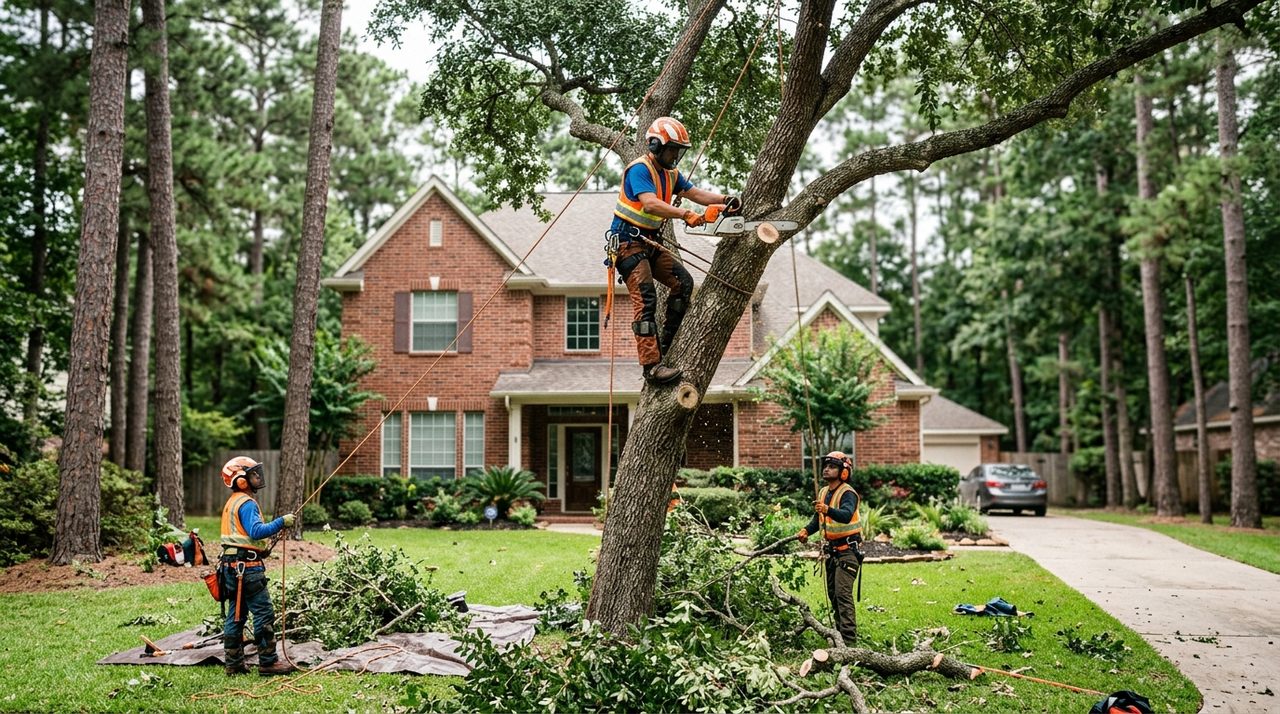
- Median home built
- 2002
- Median home value
- $285,200
- FEMA flood zone
- X (low)
- Typical removal cost (est.)
- $750–$5,000+
- Most common local issue
- Pine beetle-killed standing hazard trees near wooded acreage lots
Ranked by verified Google rating × review volume × verification tier. How we rank →
Some highly-rated pros serve Magnolia from nearby and may not keep a Magnolia street address. Those are listed under "Also serving Magnolia" with their real city and distance, so you always know where each business is based.
Min rating:
5 resultsAlso serving Magnolia
Highly-rated pros based nearby who cover Magnolia. Distance shown from the Magnolia area.
Serving Magnolia Based in The Woodlands · 2.8 mi away
Open Now
Serving Magnolia Based in The Woodlands · 3.3 mi away
Open Now
Serving Magnolia Based in The Woodlands · 4.9 mi away
Open Now
Serving Magnolia Based in Waller · 5.1 mi away
Tree Removal in Magnolia: What You Should Know
Dead Standing Pines on Wooded Acreage — a Hazard Tree Premium Most Homeowners Don't Budget For
Why it matters to you
Magnolia's location on the southern edge of the Piney Woods transition zone means many acreage properties and the wooded buffers between older ranch-style subdivisions carry a significant population of loblolly pines. Southern pine beetle pressure has killed large numbers of these trees across Montgomery County, and a dead loblolly becomes structurally unpredictable within 12–18 months of decline — the brittle wood can fail mid-cut without warning. Homeowners on older 1970s–1990s acreage tracts often discover three or four dead pines clustered together, and the removal cost reflects the hazard premium: expect 25–50% above the base price of a live tree of similar height.
What a good pro does
A qualified contractor should walk the entire property before quoting, not just assess the tree already flagged by the homeowner — dead pines cluster because beetle pressure spreads. Verify that any crew working near structures carries adequate liability insurance and ask specifically about their dead-tree rigging protocol, since aerial work on brittle wood requires sectional takedown rather than felling. For acreage parcels outside Magnolia city limits, work is governed by Montgomery County Engineering, which currently does not require a residential tree-removal permit, but utility coordination with the relevant provider is still the contractor's responsibility if lines are within fall distance.
Sources: Municipal permit office (see area profile)
HOA Approval in NorthGrove and Magnolia Reserve — Before the Chainsaw, Not After
Why it matters to you
Magnolia has no area-wide HOA, but the newer master-planned subdivisions built in the 2010s and 2020s — NorthGrove, Magnolia Reserve, Magnolia Ridge, and similar communities — each carry their own mandatory HOA with architectural review committee authority over tree removal. Many of these covenants require written ARC approval before removing any tree above a specified trunk diameter, commonly six to eight inches DBH, and removing a tree without that approval can trigger fines and a forced replanting requirement at the homeowner's expense. Critically, this applies even when the tree is dead or storm-damaged, because the HOA's process is separate from any safety emergency determination.
What a good pro does
Before contacting any tree company, Magnolia homeowners in platted subdivisions should pull their specific deed restrictions from Montgomery County Clerk records and contact their HOA management company to confirm the current ARC submission requirements and turnaround time — some committees meet only monthly. A reputable contractor working in these communities will ask for proof of ARC approval before scheduling, not after showing up. If urgency is genuine (a tree actively threatening a structure), document the hazard condition with photos and notify the HOA in writing simultaneously so you have a record if timeline disputes arise.
Sources: Local HOA / deed restrictions (see area profile), Municipal permit office (see area profile)
Chinese Tallow on Acreage and Near Drainage Ditches — Stump Grinding Is Not Optional
Why it matters to you
Magnolia's mix of undeveloped lots, drainage channels, and post-flood disturbed soil along Montgomery County's creek corridors creates ideal conditions for Chinese tallow (Triadica sebifera), a state-listed invasive in Texas. This tree grows five or more feet per year, reseeds prolifically from neighboring properties, and develops aggressive surface root systems that crack driveways and hardscape on both older ranch-style slab-on-grade homes and newer subdivision lots alike. The stump is the sleeper problem: without proper grinding, a tallow stump vigorously resprouts multiple new stems within a single growing season, effectively replacing one tree with a dense shrub cluster.
What a good pro does
When removing Chinese tallow, insist that stump grinding to at least eight inches below grade is included in the quoted scope — not offered as an upsell after the fact. Because some wood recycling facilities in the Houston metro refuse Chinese tallow material due to its invasive classification, ask the contractor upfront how they plan to dispose of the wood and confirm it will not simply be chipped and left on-site where seeds can spread. On acreage properties with multiple tallow volunteers, a good contractor will also identify resprout-prone areas and may recommend a follow-up herbicide application to the cut surface, which is legal for a licensed applicator in Texas under TCEQ-governed pesticide rules.
Sources: Texas Commission on Environmental Quality, Local HOA / deed restrictions (see area profile)
Post-Derecho and Post-Beryl Pricing Surge — Acreage Properties Pay a Double Premium
Why it matters to you
The May 2024 derecho and Hurricane Beryl in July 2024 hit the greater Houston-metro region hard, and demand surges following both events pushed tree removal pricing 40–80% above normal rates as regional capacity was overwhelmed and out-of-state crews flooded the market. Magnolia acreage homeowners face a compounding issue: large rural lots with long driveways, dense canopy, and multiple downed trees require more crew time and equipment repositioning, so base prices already run toward the high end of the Houston metro range — $2,000–$5,000-plus for mature pines or water oaks — before any surge premium. Fly-by-night operators who arrive post-storm rarely carry adequate insurance, which means a dropped limb on your roof or fence becomes entirely your problem.
What a good pro does
Before committing post-storm, verify that the contractor holds a current certificate of liability insurance naming your address and showing coverage adequate for the job scope — a phone call to the insurer to confirm the policy is active takes five minutes. ISA Certified Arborist credentials, while voluntary in Texas (TDLR does not license tree work), are a meaningful signal that the crew has formal training rather than opportunistic post-storm operation. Magnolia homeowners on unincorporated Montgomery County parcels should also keep in mind that curbside storm-debris pickup rules and timelines are set by the county, not the City of Houston, so confirm current collection schedules directly with Montgomery County before staging debris at the roadside.
Sources: Municipal permit office (see area profile), FEMA National Flood Hazard Layer (NFHL)
Tree Removal in Magnolia: What You Should Know
Hiring tree removal in Magnolia? Magnolia spans a wide range of housing types, from newer master-planned communities like NorthGrove and Magnolia Reserve to older ranch homes and custom builds on rural acreage. Homeowners here face a split landscape: HOA-governed subdivisions with strict approval processes alongside unrestricted parcels where homeowners have broad latitude. Contractors must be comfortable working with both Montgomery County permitting and varied subdivision-specific deed restrictions.
- Housing era
- Mixed — older stock from the 1970s–1990s in the original town area, significant 2000s…
- Foundation
- Predominantly slab-on-grade in post-1980 subdivisions
- Flood zone
- FEMA Zone X (low flood risk) per official NFHL data
- Permits
- City of Magnolia for properties within city limits
Housing stock & systems
Building era
Mixed — older stock from the 1970s–1990s in the original town area, significant 2000s infill, and heavy new construction concentration in the 2010s–2020s in master-planned communities.
Typical style
Texas traditional with brick and stone veneers in newer subdivisions; Craftsman-influenced and modern farmhouse elements in recent builds; ranch-style brick or siding homes on older acreage tracts.
Foundations
Predominantly slab-on-grade in post-1980 subdivisions; pier-and-beam may be found in older or custom acreage homes.
Common systems
Newer homes feature high-efficiency HVAC systems, PEX plumbing, and modern electrical panels; older 1970s–1990s stock may have original HVAC units, copper or CPVC plumbing, and smaller electrical panels that may need upgrades.
What that means for repairs
Older ranch-style homes on acreage are common renovation targets for kitchen and bathroom modernization, HVAC replacement, and electrical panel upgrades. Newer master-planned homes see less renovation but frequent cosmetic upgrades and outdoor living additions.
Permits & restrictions
Permit jurisdiction
City of Magnolia for properties within city limits; Montgomery County Engineering for unincorporated areas and ETJ parcels.
HOA & deed restrictions
No single area-wide HOA. Platted subdivisions each have their own mandatory HOA (e.g., Magnolia Reserve HOA, Magnolia Ridge HOA, NorthGrove HOA). Many acreage parcels and older subdivisions have no HOA. Deed restrictions may still apply on non-HOA lots — check Montgomery County Clerk records for specific parcels.
Historic districts
No historic district designation confirmed. Magnolia is not within the City of Houston and has no known HAHC-designated districts.
Contractor note
Contractors must verify whether a property falls within Magnolia city limits or unincorporated Montgomery County, as permitting requirements and inspections differ. HOA-governed subdivisions often require architectural review committee approval before exterior work begins.
Flood & weather
FEMA flood zone
FEMA Zone X (low flood risk) per official NFHL data. Much of the Magnolia area sits at higher elevations in upstream Montgomery County, away from major bayou floodplains.
Hurricane Harvey impact
No documented widespread structural flooding in the Magnolia area during Hurricane Harvey. None of the major Magnolia HOA or community sources reference Harvey-related rebuilding or large-scale flood damage. Central Montgomery County generally fared better than downstream Harris County bayou corridors, though localized drainage issues on individual properties cannot be ruled out — check specific property history for any claims.
Heat & humidity load
Extended Houston-area summers with high heat and humidity stress HVAC systems year-round. Newer homes with high-efficiency units handle the load well, but older 1970s–1990s stock may need HVAC replacement or duct sealing. Slab foundations on expansive clay soils can shift during summer drought cycles, making foundation monitoring and proper drainage critical.
Working with contractors here
Magnolia's diverse housing stock creates demand for a wide range of services. In newer master-planned communities, contractors frequently handle warranty-related repairs, outdoor living additions (patios, pools, outdoor kitchens), and fence installations that must meet HOA specifications. Older ranch-style homes on acreage generate steady demand for HVAC replacement, roof replacement, electrical panel upgrades, and kitchen/bath remodels. Foundation work is common across all eras due to the expansive clay soils in Montgomery County. Contractors working in HOA subdivisions should budget time for architectural review committee approvals and plan for potentially longer driveways and access considerations on rural acreage properties.
Local Tip
Always ask for a written estimate before work begins. Texas contractors are required to provide one on jobs over $1,000.
About Magnolia
Magnolia spans a wide range of housing types, from newer master-planned communities like NorthGrove and Magnolia Reserve to older ranch homes and custom builds on rural acreage. Homeowners here face a split landscape: HOA-governed subdivisions with strict approval processes alongside unrestricted parcels where homeowners have broad latitude. Contractors must be comfortable working with both Montgomery County permitting and varied subdivision-specific deed restrictions.
- Median year built
- 2002
- Median home value
- $285,200
- Owner-occupied
- 52.3%
- Population
- 3,230
- Housing units
- 1,380
- Median income
- $70,516
Source: U.S. Census Bureau, ACS 5-Year 2023
Flood & storm risk
FEMA Zone XLow flood riskMost of Magnolia maps to FEMA Zone X (low mapped flood risk), but Houston's flash-flood reality means even low-risk blocks benefit from smart drainage and storm-hardened installs.
Source: FEMA National Flood Hazard Layer (NFHL). Flood zones vary by parcel — verify your individual FIRM panel.
Houston Storm Readiness in Magnolia
Hurricane & flooding
Wind is the primary tree hazard in lower-risk Magnolia, TX neighborhoods during a Gulf hurricane, so focus pre-storm efforts on removing dead or structurally weak trees that could reach your roof line or power drop. A TDLR-licensed contractor can perform a hazard assessment and complete removal well before a storm's 72-hour watch window, when crews become unavailable across the Houston metro. As a Montgomery County community, Magnolia may follow county rather than City of Houston storm rebuild rules.
Severe storms & hail
Wind and lightning are the dominant tree hazards in Magnolia, TX during severe Houston thunderstorms, and the May 2024 derecho proved that low-flood-risk areas are not insulated from widespread tree-on-structure damage when straight-line winds exceed 75 mph. A pre-season inspection by a licensed tree removal contractor focused on dead wood, weak branch attachments, and trees leaning toward structures is the most direct mitigation step available. Confirm the current FEMA panel for your Magnolia parcel — the area maps to Zone X, but adjacent lots can differ.
Ice storms & freezes
Freeze-cracked bark and split branch unions caused by Uri 2021 left thousands of Houston-area trees with compromised structural integrity that persisted well into subsequent years, so Magnolia, TX homeowners should request a post-freeze assessment even if no immediate failure occurred. A licensed contractor can identify cold-induced damage that will accelerate decay and create a hazard within one to three growing seasons. Confirm the current FEMA panel for your Magnolia parcel — the area maps to Zone X, but adjacent lots can differ.
Sources: FEMA National Flood Hazard Layer (NFHL), Ready.gov -- Hurricanes, CenterPoint Energy -- Storm Center, City of Houston -- Emergency Preparedness, Ready.gov -- Winter Weather, Harris County Flood Control District
Free Magnolia Tools & Calculators
Houston-specific estimators to plan your project before you call a pro. All results are planning estimates — a licensed local pro confirms the details on site.
Houston Soil & Tree Proximity Risk Calculator
Open full tool & FAQ →Grouped by mature root aggression & water demand.
Trunk center to the nearest exterior wall.
Moderate risk
The root zone likely reaches your foundation's soil during Houston's dry summers, when clay shrinks most. Watch for sticking doors and diagonal cracks, keep soil moisture even with a soaker hose during drought, and have a foundation pro evaluate if you see any movement.
Find a Houston foundation pro →This is a planning estimate only — actual requirements depend on an on-site assessment by a licensed Houston pro. Guidance is based on general species root behavior in expansive clay, not a soil test.
Houston Freeze Prep & Pipe Insulation Checklist
Open full tool & FAQ →Your freeze checklist — 4 tasks
- 1
Disconnect & drain every outdoor hose bib
Remove hoses, drain the spigots, and cover each with an insulated faucet sock. Un-drained hose bibs are the #1 burst point in a Houston freeze.
- 2
Insulate exposed pipes in the attic & garage
Wrap any pipe in an unconditioned space (attic runs, garage walls) with foam sleeves. Houston homes rarely insulate these because they only matter a few nights a year — which is exactly why they burst.
- 3
Open cabinet doors & keep a pencil-width drip
On hard-freeze nights, open kitchen/bath cabinets so warm air reaches the pipes and let faucets on exterior walls drip to relieve pressure.
- 4
Protect the attic/garage water heater & its lines
An attic or garage tank sits in unconditioned space. Insulate the cold-inlet and hot-outlet lines and confirm the emergency drain pan is clear so a leak doesn't reach the ceiling.
This is a planning estimate only — actual requirements depend on an on-site assessment by a licensed Houston pro. If a pipe has already burst, shut off your main water supply and call a licensed Houston plumber immediately — freeze bursts flood fast.
Frequently Asked Questions
Do I need a permit from Montgomery County or the City of Magnolia to remove a large tree on my acreage property?
For most unincorporated acreage parcels in Magnolia, Montgomery County Engineering does not require a standalone tree-removal permit for work on private property, and the City of Magnolia similarly does not impose a municipal tree-preservation ordinance the way suburbs like Bellaire or Sugar Land do. However, if your property is inside Magnolia's city limits rather than the unincorporated ETJ, you should confirm with City of Magnolia directly, since requirements can differ. Your first step is to verify your parcel's exact jurisdiction — city limits versus unincorporated Montgomery County — before any work is scheduled.
Sources: Municipal permit office (see area profile)
My NorthGrove HOA says I need architectural committee approval before removing a tree — how long does that review usually take, and can the tree company start while I wait?
HOA architectural review committee timelines in master-planned communities like NorthGrove and Magnolia Reserve typically run 10 to 30 days depending on the board's meeting schedule, and most committees require the request in writing with a site plan or photo documentation of the tree's location and size. Reputable tree companies will not start work on a platted HOA lot without written approval in hand, because homeowners — not the contractor — bear the fines and mandatory replanting costs if the removal proceeds without it. Submit your ARC request as soon as you identify the tree for removal, and ask the HOA administrator for the next meeting date so you can time your contractor booking accordingly.
Sources: Local HOA / deed restrictions (see area profile)
I have an older ranch home from the 1980s on a large lot near a drainage ditch — does removing a big water oak near my slab create more foundation risk than leaving it?
On Magnolia's expansive Montgomery County clay soils, this is a genuinely two-sided question: a large water oak within 15–20 feet of your slab can draw moisture from the soil and contribute to differential shrinkage that shifts a slab edge, but removing it abruptly can allow the clay to rehydrate and heave in the opposite direction over the following wet season. A qualified ISA Certified Arborist combined with a structural engineer assessment — particularly on 1980s slab-on-grade homes where soil movement is already a known issue — is the right sequence before committing to removal. The drainage ditch proximity also matters because disturbed soil near drainage corridors is prime reseeding territory for Chinese tallow, so plan stump grinding and replacement planting simultaneously.
Magnolia is mapped FEMA Zone X, so is storm-damaged tree debris pickup handled differently here than in Harris County after a named storm?
Zone X status means Magnolia-area properties carry low FEMA-mapped flood risk, but it does not exempt homeowners from navigating debris rules after a declared disaster — and Montgomery County's curbside storm debris collection programs operate separately from Harris County's and are strictly time-limited windows that vary by event. After the May 2024 derecho and Hurricane Beryl, Montgomery County coordinated its own debris pickup schedule, and homeowners who missed the window were responsible for private hauling at their own cost. In a post-disaster scenario, monitor Montgomery County's official communications immediately after a storm declaration and get tree debris to the curb within the published window rather than waiting for your tree company to coordinate it.
What time of year is best to schedule non-emergency tree removal in Magnolia so I can avoid the post-storm price surge and get a shorter wait time?
Late fall through early spring — roughly November through February — is historically the slowest period for Houston-area tree companies and the best window to get competitive estimates and faster scheduling in Magnolia, since storm season demand has eased and summer heat work is months away. Booking loblolly pine removals in this window is especially useful because the cooler, drier air reduces the physical hazard of working near beetle-killed standing timber and gives crews better footing on rural acreage lots. If you know a tree is in decline or structurally suspect, do not wait for a post-hurricane or post-derecho market — regional pricing in the weeks after a named storm regularly runs 40 to 80 percent above normal rates by estimate, and Magnolia's wooded acreage lots draw crews from across the region competing for the same backlog.
My deed says I'm in a 'non-HOA' older subdivision near the original Magnolia town area — does that mean I'm free to remove trees without any approval?
Not necessarily — deed restrictions recorded in Montgomery County Clerk records can include tree-preservation language that runs with the land independently of any active HOA, meaning even a subdivision where the HOA dissolved or never actively enforced rules may still have enforceable deed covenants that neighbors can act on. Before removal, pull your property's deed restrictions from the Montgomery County Clerk's online records portal and scan for any language about tree diameter, canopy preservation, or site clearing. If the language is ambiguous, a real estate attorney familiar with Montgomery County deeds can give you a fast read — that's a much cheaper step than a neighbor-filed injunction or forced replanting after the fact.
Sources: Local HOA / deed restrictions (see area profile)