Closed
23420 I-45, Spring, TX 77373
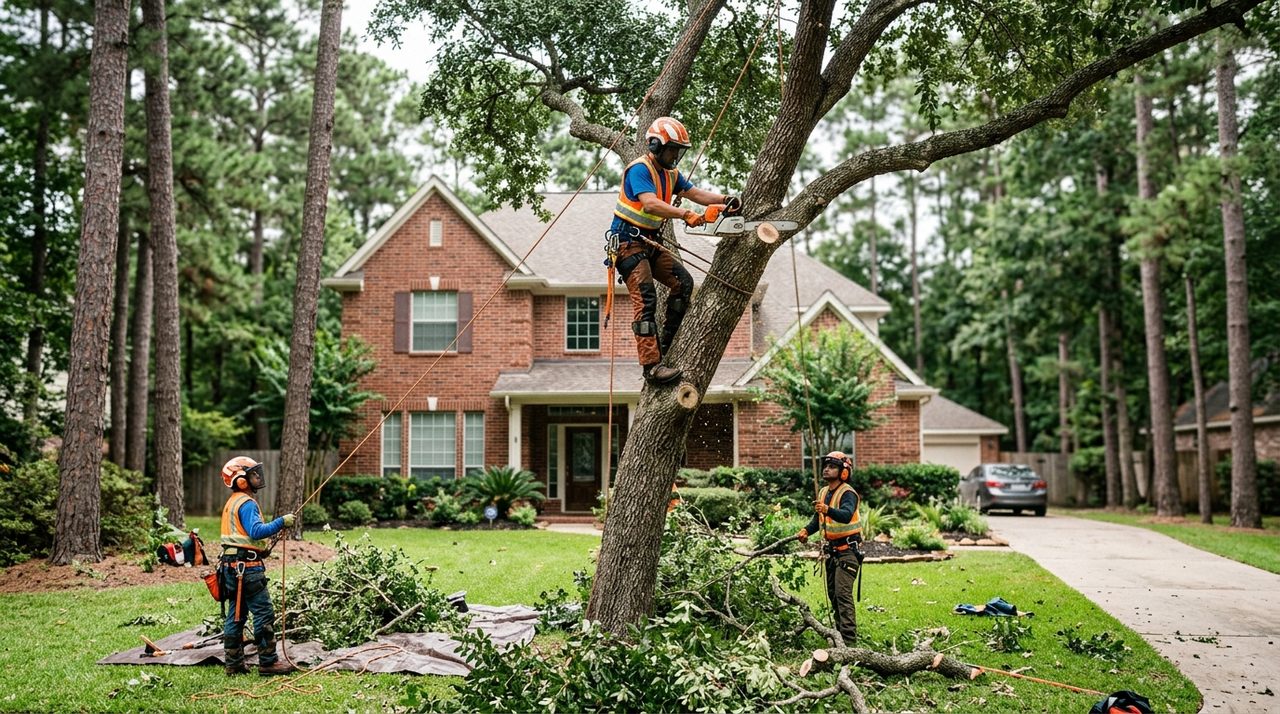
Spring's sprawling Harris County subdivisions — built mostly between the 1970s and early 2000s on expansive Beaumont clay — host a mature mix of water oaks, loblolly pines, and invasive Chinese tallow trees that have had decades to grow up against slab-on-grade foundations, driveways, and sewer laterals. Because most of Spring is unincorporated Harris County rather than inside any city limits, tree removal on private property requires no municipal permit — but the dozens of individual subdivision POAs scattered across the area each carry their own deed-restriction rules that can stop a chainsaw before it starts. This page explains the four tree-removal realities that actually matter for Spring homeowners.
Ranked by verified Google rating × review volume × verification tier. How we rank →
Some highly-rated pros serve Spring from nearby and may not keep a Spring street address. Those are listed under "Also serving Spring" with their real city and distance, so you always know where each business is based.
23420 I-45, Spring, TX 77373
18108 Bamwood Rd, Houston, TX 77090
506 Gateship Dr, Houston, TX 77073
19402 Pine Lock Ln, Spring, TX 77388
21511 Windsor Castle Dr, Spring, TX 77388
Highly-rated pros based nearby who cover Spring. Distance shown from the Spring area.
Serving Spring Based in The Woodlands · 2.3 mi away
Serving Spring Based in The Woodlands · 2.5 mi away
Serving Spring Based in The Woodlands · 3.1 mi away
Serving Spring Based in The Woodlands · 5.1 mi away
Serving Spring Based in Humble · 5.2 mi away
Why it matters to you
Because Spring sits almost entirely in unincorporated Harris County, Harris County Engineering — not a city — governs permits, and routine tree removal on your own lot requires no county permit. That sounds like freedom, but most of Spring's post-1970 subdivisions carry deed-tied mandatory property owners' associations whose architectural review committees require written approval before any tree above a specified trunk diameter (commonly 6–8 inches DBH) is removed. Ignoring that step has cost Spring homeowners fines and forced replanting expenses — costs that dwarf the original removal bill.
What a good pro does
Before signing any tree-removal contract, pull your subdivision's deed restrictions from the Harris County Clerk records or the TREC HOA Management Certificate Database to confirm the exact approval process for your POA. A reputable local tree company will ask for your POA approval letter before scheduling work, and responsible ones will not start without it. Because POA identities vary block by block across Spring, confirm your specific association — do not assume your neighbor's rules apply to your lot.
Sources: Local HOA / deed restrictions (see area profile), Municipal permit office (see area profile)
Why it matters to you
Spring's northern and eastern subdivisions — particularly those developed in the 1970s–1980s near Spring Creek — were landscaped with native loblolly pines that are now 40–50 feet tall and increasingly vulnerable to southern pine beetle. Drought stress during Texas heat waves accelerates infestation, and a beetle-killed pine loses structural integrity within 12–18 months, becoming unpredictable to climb and far more dangerous to fell toward structures. A dead 50-foot loblolly leaning over a brick-veneer slab home is a liability that compounds daily.
What a good pro does
Have any pine showing crown dieback, pitch-tube boring at the base, or blue-gray staining in the bark evaluated immediately by an ISA Certified Arborist — voluntary ISA certification is the recognized professional credential since Texas (through TDLR) does not license tree work as a regulated trade. Dead-standing trees carry a hazard premium typically adding 25–50% to the base removal price (estimate), so acting before a tree is fully dead almost always costs less. Confirm the crew carries adequate liability insurance before work begins near your home.
Sources: Municipal permit office (see area profile)
Why it matters to you
Spring's census median year built is 1991, meaning a large share of homes are now 25–40 years old — precisely the age when the live oaks and water oaks planted at construction have grown to canopy size and are pushing surface roots outward across the Beaumont clay. On slab-on-grade construction, these roots don't undermine the slab so much as exploit the moisture differential along slab edges, contributing to differential settlement on a soil that already shrinks and swells dramatically with seasonal dry-wet cycles. Cracked driveways and lifted sidewalks are early warning signs; heaved slab edges are the costly follow-on.
What a good pro does
A qualified arborist assessing a tree within 15–20 feet of your foundation should probe for root proximity and evaluate whether removal, root barrier installation, or strategic limb reduction gives the best outcome for both the tree and the slab. If removal is the right call, stump grinding to at least 12 inches below grade — quoted separately at roughly $150–$400 per stump (estimate) — is essential on clay soils where a decaying root mass continues to affect moisture distribution long after the trunk is gone.
Sources: Harris County Flood Control District
Why it matters to you
The May 2024 derecho tracked straight-line winds across Harris County, and Hurricane Beryl followed two months later, creating back-to-back regional demand spikes that pushed Spring-area tree-removal pricing 40–80% above normal rates (estimate) as legitimate crews booked out for weeks and out-of-state operators with no local track record moved in. Spring's proximity to Spring Creek and Cypress Creek tributaries adds a further wrinkle: lots in or near FEMA-mapped corridors may have storm debris that ends up in floodway areas, triggering Harris County Flood Control District guidelines on what can be staged or left curbside.
What a good pro does
In the weeks following a named storm or derecho, get at least two written quotes from companies you can verify have a local Harris County business history — check the Texas Secretary of State business search and request proof of liability insurance before any work begins. For debris near creek buffers, confirm with Harris County Flood Control District whether staging cut material in the drainage easement or right-of-way is permitted; violations can result in fines separate from any POA issues. Budgeting at the high end of the cost range immediately after a regional storm event is prudent.
Sources: Harris County Flood Control District, FEMA National Flood Hazard Layer (NFHL), Local HOA / deed restrictions (see area profile)
Hiring tree removal in Spring? Spring is a large, mostly unincorporated area of Harris County comprising dozens of distinct subdivisions, each with its own HOA rules and deed restrictions. Homeowners here primarily deal with maintaining 1970s–2000s era slab-on-grade suburban homes, with common needs including HVAC replacement, foundation monitoring on expansive clay soils, and roof repairs. Proximity to Spring Creek and Cypress Creek tributaries means flood risk varies dramatically by subdivision, making property-specific flood zone verification essential before any major renovation.
Building era
1970s–2000s, with continued new construction near Grand Parkway (SH-99) in the 2010s–2020s.
Typical style
One- and two-story brick veneer detached single-family homes in traditional, ranch, and contemporary suburban styles with attached two-car garages.
Foundations
Slab-on-grade (dominant); pier-and-beam is rare and limited to occasional older properties.
Common systems
Central HVAC systems (many original units in 1970s–1980s homes are past useful life), copper or CPVC plumbing with some polybutylene in 1980s–early 1990s builds, and 100–200 amp electrical panels typical of era.
What that means for repairs
Kitchen and bathroom remodels are common in 1970s–1990s homes. HVAC system replacements are frequent due to system age. Foundation repair is a recurring need due to expansive clay soils and seasonal moisture fluctuation. Roof replacements are common on 20+ year homes after hail events.
Permit jurisdiction
Harris County Engineering Department for unincorporated areas (most of Spring); some portions within City of Houston ETJ may require Houston Permitting Center coordination.
HOA & deed restrictions
No single area-wide HOA exists. Most post-1970 subdivisions have mandatory property owners' associations (POAs) with deed-tied membership. Some older pockets have voluntary civic clubs or no active HOA. Specific HOA identity must be confirmed via Harris County Clerk deed records or TREC HOA Management Certificate Database.
Historic districts
No City of Houston historic district designation confirmed. Spring is largely unincorporated Harris County with no known HAHC-designated historic districts.
Contractor note
Contractors must verify whether a property falls within an incorporated city or unincorporated Harris County, as permit requirements and inspections differ. HOA architectural review and approval is required in most subdivisions before exterior modifications.
FEMA flood zone
FEMA Zone X (low flood risk) per official NFHL data. However, Spring encompasses areas near Spring Creek and Cypress Creek tributaries where flood risk can vary significantly by subdivision and specific lot. Property-level FIRM verification is strongly recommended.
Hurricane Harvey impact
Hurricane Harvey caused widespread flooding across north Harris County in 2017, with neighborhoods along Spring Creek and Cypress Creek corridors experiencing varying degrees of inundation. A single authoritative list of affected Spring subdivisions is not publicly compiled — property-specific impact should be verified through Harris County Flood Control District mapping tools and seller disclosures.
Heat & humidity load
Sustained 95°F+ temperatures and high humidity stress HVAC systems heavily, especially aging units in 1970s–1980s homes. Expansive clay soils contract during summer drought, increasing foundation movement risk. Attic temperatures can exceed 150°F, accelerating roofing material degradation and making attic insulation upgrades a common summer-driven project.
Working with contractors here
Contractors in Spring most commonly handle HVAC replacements, foundation repair, roof replacements, and kitchen/bath remodels driven by the aging 1970s–2000s housing stock. Foundation work is particularly prevalent due to the area's expansive clay soils and seasonal moisture cycles. Job scoping must account for subdivision-specific HOA architectural guidelines, which frequently regulate exterior colors, materials, fencing, and even contractor work hours. Because Spring is largely unincorporated Harris County, permits are handled through county engineering rather than the City of Houston, and contractors should verify jurisdiction boundaries on a per-property basis. Properties near creek corridors may require additional floodplain development permits even if the lot itself is mapped Zone X.
Local Tip
Always ask for a written estimate before work begins. Texas contractors are required to provide one on jobs over $1,000.
Spring is a large, mostly unincorporated area of Harris County comprising dozens of distinct subdivisions, each with its own HOA rules and deed restrictions. Homeowners here primarily deal with maintaining 1970s–2000s era slab-on-grade suburban homes, with common needs including HVAC replacement, foundation monitoring on expansive clay soils, and roof repairs. Proximity to Spring Creek and Cypress Creek tributaries means flood risk varies dramatically by subdivision, making property-specific flood zone verification essential before any major renovation.
Source: U.S. Census Bureau, ACS 5-Year 2023
Most of Spring maps to FEMA Zone X (low mapped flood risk), but Houston's flash-flood reality means even low-risk blocks benefit from smart drainage and storm-hardened installs.
Source: FEMA National Flood Hazard Layer (NFHL). Flood zones vary by parcel — verify your individual FIRM panel.
Beryl 2024 left tens of thousands of trees down across the Houston area, and lower-flood-risk zones like Spring, TX were not spared from wind-throw damage that crushed vehicles, fences, and rooflines. Scheduling removal of any large tree with a cavity, dead crown, or proximity to your home now means you are not competing for post-storm crews when wait times stretch to weeks. As a Harris County community, Spring may follow county rather than City of Houston storm rebuild rules.
Proactive removal of trees with significant deadwood or structural defects in Spring, TX costs a fraction of the emergency extraction and roof repair that follows a thunderstorm failure. Severe storms in the Houston area can produce 70-plus mph gusts with almost no advance warning, which means the pre-storm window is the only realistic time to act before a low-flood-risk yard becomes a debris field. Confirm the current FEMA panel for your Spring parcel — the area maps to Zone X, but adjacent lots can differ.
The most actionable winter prep for tree removal in Spring, TX is removing any tree or large limb that hangs directly over a roofline, vehicle parking area, or power service drop before the first freeze advisory. Ice adds weight faster than most homeowners expect, and Houston trees that have never experienced sustained ice loading have no adaptive resilience to that stress. As a Harris County community, Spring may follow county rather than City of Houston storm rebuild rules.
Sources: FEMA National Flood Hazard Layer (NFHL), Ready.gov -- Hurricanes, CenterPoint Energy -- Storm Center, City of Houston -- Emergency Preparedness, Ready.gov -- Winter Weather, Harris County Flood Control District
Houston-specific estimators to plan your project before you call a pro. All results are planning estimates — a licensed local pro confirms the details on site.
Grouped by mature root aggression & water demand.
Trunk center to the nearest exterior wall.
The root zone likely reaches your foundation's soil during Houston's dry summers, when clay shrinks most. Watch for sticking doors and diagonal cracks, keep soil moisture even with a soaker hose during drought, and have a foundation pro evaluate if you see any movement.
Find a Houston foundation pro →This is a planning estimate only — actual requirements depend on an on-site assessment by a licensed Houston pro. Guidance is based on general species root behavior in expansive clay, not a soil test.
Disconnect & drain every outdoor hose bib
Remove hoses, drain the spigots, and cover each with an insulated faucet sock. Un-drained hose bibs are the #1 burst point in a Houston freeze.
Insulate exposed pipes in the attic & garage
Wrap any pipe in an unconditioned space (attic runs, garage walls) with foam sleeves. Houston homes rarely insulate these because they only matter a few nights a year — which is exactly why they burst.
Open cabinet doors & keep a pencil-width drip
On hard-freeze nights, open kitchen/bath cabinets so warm air reaches the pipes and let faucets on exterior walls drip to relieve pressure.
Protect the attic/garage water heater & its lines
An attic or garage tank sits in unconditioned space. Insulate the cold-inlet and hot-outlet lines and confirm the emergency drain pan is clear so a leak doesn't reach the ceiling.
This is a planning estimate only — actual requirements depend on an on-site assessment by a licensed Houston pro. If a pipe has already burst, shut off your main water supply and call a licensed Houston plumber immediately — freeze bursts flood fast.
Sources: Municipal permit office (see area profile)Local HOA / deed restrictions (see area profile)
Sources: FEMA National Flood Hazard Layer (NFHL)Harris County Flood Control District
Sources: Local HOA / deed restrictions (see area profile)