121 Circle Way St, Lake Jackson, TX 77566
Best Water & Flood Restoration in Lake Jackson, TX
Lake Jackson is a Brazoria County coastal city built around Dow Chemical's postwar campus, meaning its housing stock skews mid-century slab-on-grade construction sitting in FEMA Zone X — low mapped flood risk, but not zero risk when a Gulf tropical system or a stalled rainband pushes freshwater faster than the city's drainage can handle. Water and flood restoration here operates under City of Lake Jackson permits rather than Houston or Brazoria County offices, and the patchwork of subdivision HOAs managed by firms like Graham Management adds a procedural layer that can affect how quickly a contractor can set up drying equipment or stage a dumpster. Understanding those local realities before water enters a home is what separates a smooth claim from a months-long ordeal.
Verified against Google Business data
Updated 2026
See the 2 Water & Flood Restoration Serving Lake Jackson 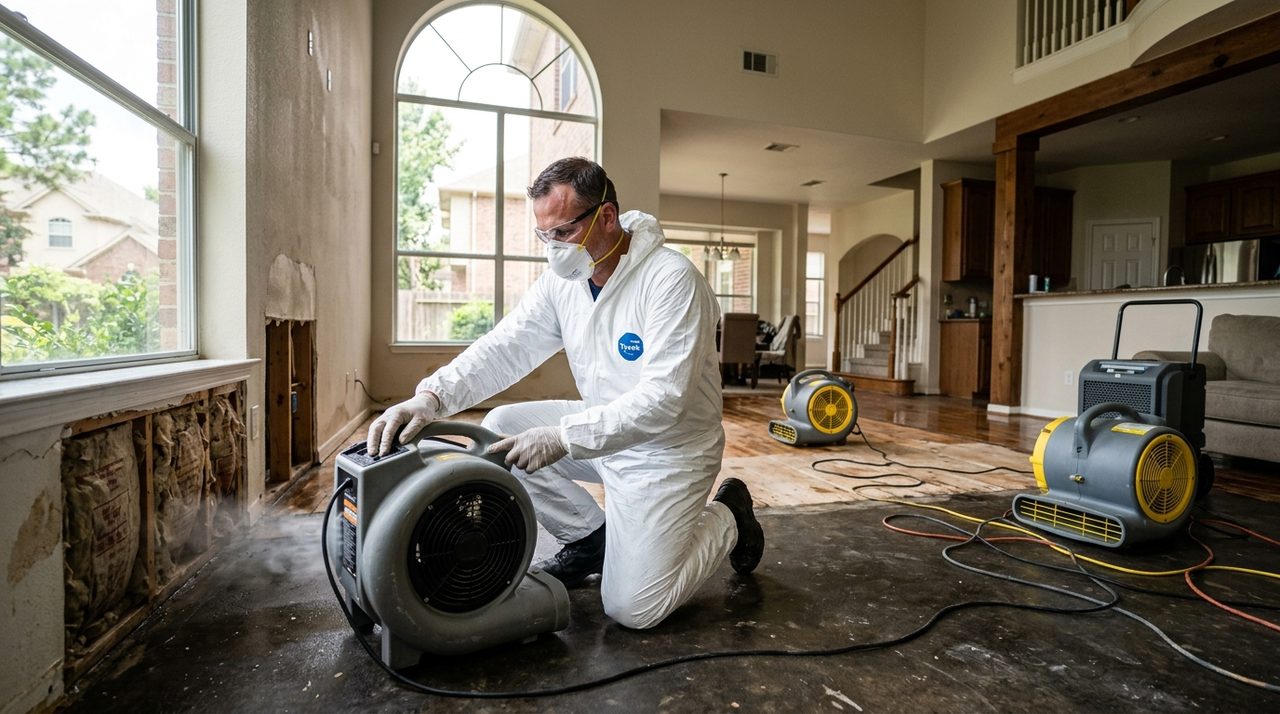
- Median home built
- 1983
- Median home value
- $248,900
- FEMA flood zone
- X (low)
- Typical mitigation cost (est.)
- $3,500–$40,000 depending on Category and scope
- Most common local issue
- Wind-driven rain envelope breach from Gulf tropical systems entering mid-century wall cavities
Ranked by verified Google rating × review volume × verification tier. How we rank →
Min rating:
2 results Open Now
110 Heather Ln #202, Lake Jackson, TX 77566
Water & Flood Restoration in Lake Jackson: What You Should Know
Gulf Wind and Rain Breaching Aging Wall Envelopes in Mid-Century Homes
Why it matters to you
Lake Jackson's median home was built around 1983, and homes closer to the original Dow-era neighborhoods predate modern window flashing and housewrap standards. When a tropical system or stalled Gulf rainband delivers sustained winds, water forces through brick veneer weep holes, aging window flanges, and soffit vents into wall cavities — with no visible interior flooding to alert the homeowner. Because Lake Jackson sits in Brazoria County's coastal wind corridor, this type of top-down, outside-in water intrusion is the damage pattern locals most commonly face rather than bayou overtopping.
What a good pro does
A qualified restoration contractor will use thermal imaging cameras and calibrated moisture meters to trace the intrusion path from the roof deck down through wall sheathing to the bottom plate — a very different drying strategy than bottom-up flood work. Any structural demolition or work that exposes electrical components requires permits pulled through the City of Lake Jackson's own permitting office; do not assume Houston or Brazoria County forms apply here. The contractor's drying plan should follow IICRC S500 timelines, targeting drying initiation within 24–48 hours of confirmed moisture detection to prevent secondary mold growth in wall cavities.
Sources: IICRC (water/mold restoration standards), Municipal permit office (see area profile)
Slab-Edge Moisture Wicking Long After Surface Water Recedes
Why it matters to you
Lake Jackson's Gulf Coast construction is almost certainly slab-on-grade — consistent with regional practice across Brazoria County — and any water intrusion event means floodwater or heavy rainwater can saturate the slab perimeter and wick into bottom plates and drywall for weeks after the floor looks dry. Even a brief inundation from a flash flood or plumbing failure can leave moisture trapped in the void between the concrete edge and interior finishes, invisible to the naked eye but measurable. Homeowners in the mid-century neighborhoods near the original Dow-era blocks face particular risk because those structures predate tighter slab edge detailing.
What a good pro does
A competent restoration contractor will place desiccant or refrigerant dehumidifiers and directional air movers in a drying configuration designed specifically for slab construction, not a generic layout. They should take moisture readings at the bottom plate, drywall baseboard zone, and slab edge on a documented daily log — IICRC S500 requires this documentation to support the insurance claim scope. If readings remain elevated beyond the standard drying window, the contractor should discuss with you and your adjuster whether bottom-plate demo and replacement is warranted rather than attempting to dry in place.
Sources: IICRC (water/mold restoration standards), FEMA National Flood Hazard Layer (NFHL)
Older HVAC Flex Duct Turning Into a Mold Incubator After Any Extended Moisture Event
Why it matters to you
Homes in Lake Jackson built before 2000 commonly used flex duct systems that run through unconditioned attic space, and that insulation-wrapped flex duct absorbs and retains moisture when water vapor is elevated for more than a day or two after a flood or leak. Lake Jackson's Brazoria County coastal climate — average relative humidity above 70% and summer temperatures that routinely push 95°F — creates conditions where Cladosporium and Aspergillus can establish within 48–72 hours inside a damp duct system. If the HVAC was running during or immediately after water entry, spores can be distributed through the entire living area before anyone realizes the duct is contaminated.
What a good pro does
Any restoration scope in a pre-2000 Lake Jackson home should explicitly include a duct inspection, not treat it as optional. If the duct insulation tested wet or visually shows microbial growth, replacement is typically more cost-effective than attempting to remediate flex duct in place. Any firm performing mold assessment or remediation in Texas must hold a TDLR-issued Mold Assessment Consultant (MAC) or Mold Remediation Contractor (MRC) license under Texas Occupations Code Chapter 1958 — verify this credential before allowing sampling or remediation work to begin.
Sources: Texas Department of Licensing & Regulation, IICRC (water/mold restoration standards), Texas Commission on Environmental Quality
Navigating City of Lake Jackson Permits and Subdivision HOA Rules Under Time Pressure
Why it matters to you
When water damage requires demo of drywall, exposure of plumbing, or any electrical work revealed during tearout, permits must be pulled through the City of Lake Jackson's own permitting office — not Houston's permit system and not Brazoria County. Contractors unfamiliar with Lake Jackson sometimes mis-route applications, delaying the Certificate of Completion that most insurers require to close a claim. Simultaneously, some Lake Jackson subdivisions carry HOA or deed-restriction requirements administered by management firms that may technically require approval before exterior dumpster placement or material removal — and waiting even 24–48 hours on that approval can push a Category 2 gray-water loss into more severe territory.
What a good pro does
Before any demo begins, confirm permit routing with the City of Lake Jackson and verify the specific subdivision's HOA or deed-restriction status through Brazoria County deed records. Most HOAs will expedite emergency approvals when damage documentation is provided upfront — a good contractor will draft that communication for you on day one rather than leaving it to the homeowner. Licensed electrical sub-trades pull their own permits under TDLR licensure, and any plumbing line repairs require a TSBPE-licensed plumber pulling a separate trade permit through the same City of Lake Jackson office.
Sources: Municipal permit office (see area profile), Local HOA / deed restrictions (see area profile), Texas Department of Licensing & Regulation, Texas State Board of Plumbing Examiners
Water & Flood Restoration in Lake Jackson: What You Should Know
Hiring water & flood restoration in Lake Jackson? Lake Jackson is an incorporated city in Brazoria County, originally developed as a residential community for the Dow Chemical complex. Homeowners here deal with city-level permitting rather than Houston or county jurisdiction, and HOA requirements vary widely by subdivision. The housing stock spans several decades, and Gulf Coast climate conditions drive ongoing maintenance needs for roofing, HVAC, and moisture management.
- Housing era
- Mid-20th century onward
- Foundation
- Likely predominantly slab-on-grade consistent with Gulf Coast construction practices, but not confirmed by Lake…
- Flood zone
- FEMA Zone X (low flood risk) per official NFHL data
- Permits
- City of Lake Jackson Permitting (independent incorporated city with its own Planning Commission and…
Housing stock & systems
Building era
Mid-20th century onward; specific dominant decade not confirmed in available records.
Typical style
Not confirmed - no authoritative city-wide architectural style survey available; likely a mix of ranch, traditional, and newer construction.
Foundations
Likely predominantly slab-on-grade consistent with Gulf Coast construction practices, but not confirmed by Lake Jackson-specific documentation.
Common systems
Expect a range of HVAC systems from older central units to modern high-efficiency systems; older homes may have galvanized or copper plumbing; electrical panels in mid-century homes may need updating.
What that means for repairs
Older mid-century homes near the original Dow-era neighborhoods are candidates for electrical panel upgrades, plumbing replacement, and HVAC modernization. Kitchen and bathroom remodels are common as homeowners update aging interiors.
Permits & restrictions
Permit jurisdiction
City of Lake Jackson Permitting (independent incorporated city with its own Planning Commission and development review process).
HOA & deed restrictions
No single city-wide mandatory HOA. Some subdivisions have mandatory HOAs/POAs managed by firms such as Graham Management and Spectrum Association Management, while other properties have only deed restrictions or no formal association. Confirm HOA status through Brazoria County deed records and TREC HOA Management Certificate database for any specific property.
Historic districts
No City of Houston historic district designation applies; Lake Jackson is a separate incorporated city. No local historic district designation confirmed in available research.
Contractor note
Contractors must obtain permits through the City of Lake Jackson, not the City of Houston or Brazoria County. Verify subdivision-specific deed restrictions before beginning exterior modifications, as enforcement varies by neighborhood.
Flood & weather
FEMA flood zone
FEMA Zone X (low flood risk) per official NFHL data. Brazoria County experienced significant Harvey-era flooding along the Brazos River and low-lying areas; site-specific flood risk should still be evaluated using Brazoria County FIRMs and city floodplain maps.
Hurricane Harvey impact
Brazoria County experienced significant flooding during Hurricane Harvey, particularly along the Brazos River corridor. However, no publicly available source was found that itemizes specific Lake Jackson neighborhoods or streets that flooded. Property-level Harvey impact should be verified through seller's disclosure, insurance claim history, and Brazoria County flood records.
Heat & humidity load
Extreme Gulf Coast heat and humidity place heavy demands on HVAC systems and increase risk of moisture intrusion, mold, and wood rot. Older homes without modern vapor barriers or adequate attic ventilation are especially vulnerable. Roof inspections and HVAC maintenance are critical before each summer season.
Working with contractors here
Contractors in Lake Jackson most commonly work on HVAC replacement and maintenance due to the demanding Gulf Coast climate and aging systems in mid-century homes. Plumbing repairs and re-pipes are frequent in older subdivisions where original galvanized lines have deteriorated. Roofing work is steady, driven by hurricane season exposure and general weathering. Because Lake Jackson is an independent city, contractors must navigate its own permitting process, which differs from both Houston and unincorporated Brazoria County procedures. Job scoping should always include verification of HOA or deed restriction requirements, as these vary significantly between subdivisions.
Local Tip
Always ask for a written estimate before work begins. Texas contractors are required to provide one on jobs over $1,000.
About Lake Jackson
Lake Jackson is an incorporated city in Brazoria County, originally developed as a residential community for the Dow Chemical complex. Homeowners here deal with city-level permitting rather than Houston or county jurisdiction, and HOA requirements vary widely by subdivision. The housing stock spans several decades, and Gulf Coast climate conditions drive ongoing maintenance needs for roofing, HVAC, and moisture management.
- Median year built
- 1983
- Median home value
- $248,900
- Owner-occupied
- 61.9%
- Population
- 27,902
- Housing units
- 11,416
- Median income
- $89,623
Source: U.S. Census Bureau, ACS 5-Year 2023
Flood & storm risk
FEMA Zone XLow flood riskMost of Lake Jackson maps to FEMA Zone X (low mapped flood risk), but Houston's flash-flood reality means even low-risk blocks benefit from smart drainage and storm-hardened installs; as a Brazoria County coastal community, tropical surge and wind add a layer generic guidance misses.
Source: FEMA National Flood Hazard Layer (NFHL). Flood zones vary by parcel — verify your individual FIRM panel.
Houston Storm Readiness in Lake Jackson
Hurricane & flooding
Zone X mapping offers no guarantee in Houston's flat topography, so have a water-restoration contractor identify the fastest flood-entry paths into your Lake Jackson, TX home — typically garage thresholds, HVAC closets, and exterior door sweeps — and pre-stage extraction equipment contacts. Acting in the first 24 hours after inundation is the difference between a dryout and a full mold remediation. As a Brazoria County community, Lake Jackson may follow county rather than City of Houston storm rebuild rules.
Severe storms & hail
Straight-line winds exceeding 80 mph, as recorded during the 2024 derecho, broke seals on sliding glass doors and drove water into flooring assemblies throughout Lake Jackson, TX neighborhoods with no prior flood history. Contact a licensed Texas restoration firm — TDLR regulates their mold-assessment and remediation work — to inspect and dry any affected areas before summer humidity accelerates microbial growth. Confirm the current FEMA panel for your Lake Jackson parcel — the area maps to Zone X, but adjacent lots can differ.
Ice storms & freezes
A hard freeze in Lake Jackson, TX can split a single supply line and deposit 50 or more gallons of water into a ceiling assembly before a homeowner locates the shutoff, and that volume requires more than fans and open windows to dry safely. Texas law under TDLR requires mold assessors and remediators to hold specific licenses, so verify your restoration contractor's credentials before you need them under emergency conditions. With a median build year of 1983, the older building stock here is more exposed to hard-freeze damage than newer construction. As a Brazoria County community, Lake Jackson may follow county rather than City of Houston storm rebuild rules.
Sources: FEMA National Flood Hazard Layer (NFHL), Ready.gov -- Hurricanes, CenterPoint Energy -- Storm Center, City of Houston -- Emergency Preparedness, Ready.gov -- Winter Weather, Harris County Flood Control District
Free Lake Jackson Tools & Calculators
Houston-specific estimators to plan your project before you call a pro. All results are planning estimates — a licensed local pro confirms the details on site.
Houston Freeze Prep & Pipe Insulation Checklist
Open full tool & FAQ →Your freeze checklist — 4 tasks
- 1
Disconnect & drain every outdoor hose bib
Remove hoses, drain the spigots, and cover each with an insulated faucet sock. Un-drained hose bibs are the #1 burst point in a Houston freeze.
- 2
Insulate exposed pipes in the attic & garage
Wrap any pipe in an unconditioned space (attic runs, garage walls) with foam sleeves. Houston homes rarely insulate these because they only matter a few nights a year — which is exactly why they burst.
- 3
Open cabinet doors & keep a pencil-width drip
On hard-freeze nights, open kitchen/bath cabinets so warm air reaches the pipes and let faucets on exterior walls drip to relieve pressure.
- 4
Protect the attic/garage water heater & its lines
An attic or garage tank sits in unconditioned space. Insulate the cold-inlet and hot-outlet lines and confirm the emergency drain pan is clear so a leak doesn't reach the ceiling.
This is a planning estimate only — actual requirements depend on an on-site assessment by a licensed Houston pro. If a pipe has already burst, shut off your main water supply and call a licensed Houston plumber immediately — freeze bursts flood fast.
Frequently Asked Questions
My Lake Jackson home is in FEMA Zone X — do I really need a full restoration scope after a flood, or can I just dry it out myself?
Zone X means your lot has a low mapped flood risk, but it does not change the physics of water damage once moisture enters a mid-century slab-on-grade home; IICRC S500 standards require moisture readings below threshold levels before any structural assembly is closed, regardless of flood zone designation. Houston-area flash events and stalled Gulf rainbands regularly push water into Zone X blocks without a declared federal disaster, meaning you may have no FEMA assistance but still need a full mitigation scope. DIY fan-drying without monitoring equipment almost always leaves residual moisture in Lake Jackson's clay-adjacent soils pressed against slab edges, setting up mold conditions within days in the coastal humidity.
Sources: IICRC (water/mold restoration standards)FEMA National Flood Hazard Layer (NFHL)
Who actually issues the demolition permit for flood demo work in Lake Jackson — Houston, Brazoria County, or someone else?
Permits for structural demolition, plumbing repairs, and any exposed electrical work are issued by the City of Lake Jackson's own permitting office — not the City of Houston Permitting Center and not Brazoria County. Lake Jackson is an independent incorporated city with its own Planning Commission and development review process, so your restoration contractor must route all permit applications there; submitting to any other jurisdiction will delay your Certificate of Completion and may stall your insurance claim closure. Ask your contractor to confirm they have pulled permits in Lake Jackson before, because the forms, fees, and inspection cadence differ from both Houston and unincorporated Brazoria County.
Sources: Municipal permit office (see area profile)
How long does structural drying typically take for a mid-century Lake Jackson slab home, and when can my family move back in?
For a 1,500–2,500 sq ft slab-on-grade home in Lake Jackson with a Category 2 (gray water) loss, expect an estimated 3–5 days of active drying using commercial dehumidifiers and air movers before moisture readings approach IICRC clearance thresholds, though homes built before the 1990s often run longer because original construction used thicker bottom plates and less vapor-resistant wall assemblies. The coastal humidity — Lake Jackson averages high relative humidity year-round as a Gulf Coast community — slows evaporation compared to drier climates, so contractors typically need daily moisture mapping to confirm progress. Move-back timing depends on the full scope: mitigation clearance is just the first gate, and reconstruction (drywall, flooring, cabinetry) in the current Houston-area labor market often adds another 4–8 weeks after demo is signed off.
My Lake Jackson subdivision is managed by Graham Management — can they really slow down emergency flood demo, and what's my recourse?
Some Lake Jackson HOAs and POAs managed by firms like Graham Management do have architectural review provisions that technically cover exterior work, dumpster placement, and visible material removal, even in emergencies. IICRC S500 calls for drying initiation within 24–48 hours of water intrusion; if HOA approval delays exterior demo or equipment staging, document every attempt to reach the management company in writing and photograph conditions with timestamps to defend your insurance scope. Many HOA governing documents include emergency carve-outs — your restoration contractor should request written emergency authorization and keep a copy in the claim file while work proceeds, then formalize the approval retroactively.
Sources: IICRC (water/mold restoration standards)Local HOA / deed restrictions (see area profile)
Does the bayou flooding that hits inner Houston apply to Lake Jackson, or is my flood risk mainly from tropical surge and local drainage?
Lake Jackson does not sit along Harris County's Buffalo, Brays, or Greens bayou corridors — those are Harris County systems managed by HCFCD — so repetitive bayou-overflow losses are not the primary local pattern here. Your primary flood threats are tropical surge from Gulf systems tracking into Brazoria County, extreme rainfall overwhelming the city's drainage infrastructure during stalled tropical bands, and wind-driven rain entering aging wall envelopes — all of which can produce serious interior water damage even when your FEMA Zone X designation stays intact. When you have a restoration contractor assess damage, make sure they're scoping for wind-driven intrusion through brick weep holes and soffit vents, not just bottom-up flood entry, because Gulf storm events hit Lake Jackson from a very different angle than bayou overflow hits inner Houston.
Sources: FEMA National Flood Hazard Layer (NFHL)Harris County Flood Control District
Should I schedule a mold inspection before or after hurricane season if I had any water intrusion last year — and does timing matter in Lake Jackson's climate?
In Lake Jackson's Gulf Coast climate, where summer relative humidity stays elevated from roughly May through October, any unresolved moisture from a prior water event will have had months of ideal conditions for mold colonization by the time the next hurricane season arrives. The practical answer is to schedule a TDLR-licensed Mold Assessment Consultant (MAC) inspection in late winter or early spring — February through March — before Gulf season ramps up, so any remediation scope can be completed and dried out before your HVAC system cycles moisture-laden air through the home all summer. Lake Jackson's mid-century housing stock, with its original insulation and older flex duct runs, is particularly prone to concealed microbial growth that a visual inspection alone will miss; a qualified MAC uses moisture meters and thermal imaging to find it.
Sources: Texas Department of Licensing & RegulationIICRC (water/mold restoration standards)