Open Now
3403 North Sam Houston Pkwy W #400, Houston, TX 77086
NW Houston's patchwork of 1970s–1990s slab-on-grade subdivisions sits in FEMA Zone X500—outside the 100-year floodplain but not immune to the slow-draining, heavy-rain events that routinely back water onto slabs sitting atop Houston Black clay. When water does enter these homes, it finds aging flex ductwork, polybutylene or early CPVC supply lines, and brick-veneer walls with original window installations—each one a moisture trap that extends drying timelines well beyond what newer construction faces. Add a permit jurisdiction that splits unpredictably between the Houston Permitting Center and the Harris County Engineering Department depending on your exact address, and restoration here demands local knowledge from the first phone call.
Ranked by verified Google rating × review volume × verification tier. How we rank →
Some highly-rated pros serve NW Houston from nearby and may not keep a NW Houston street address. Those are listed under "Also serving NW Houston" with their real city and distance, so you always know where each business is based.
3403 North Sam Houston Pkwy W #400, Houston, TX 77086
8345 W Little York Rd #2, Houston, TX 77040
14300 Northwest Fwy, Houston, TX 77040
13513 Ralph Culver Rd, Houston, TX 77086
TX-249, Houston, TX 77086
10060 W Gulf Bank Rd Suite 120, Houston, TX 77040
8815 Emmott Rd # 800, Houston, TX 77040
3403 North Sam Houston Pkwy W #300, Houston, TX 77086
Highly-rated pros based nearby who cover NW Houston. Distance shown from the NW Houston area.
Serving NW Houston Based in Jersey Village · 1.7 mi away
Why it matters to you
NW Houston's 1980s and 1990s tract homes sit on concrete slabs-on-grade poured directly over the same expansive Beaumont-series black clay that runs throughout Harris County. When a heavy-rain event or plumbing failure saturates the perimeter, that clay holds moisture against the slab edge for weeks, continuously wicking water into bottom plates and the lower 12–18 inches of drywall even after interior surfaces feel dry to the touch. Homeowners who start reconstruction too soon—or whose contractor uses only surface moisture readings—frequently face mold callbacks within 60 to 90 days.
What a good pro does
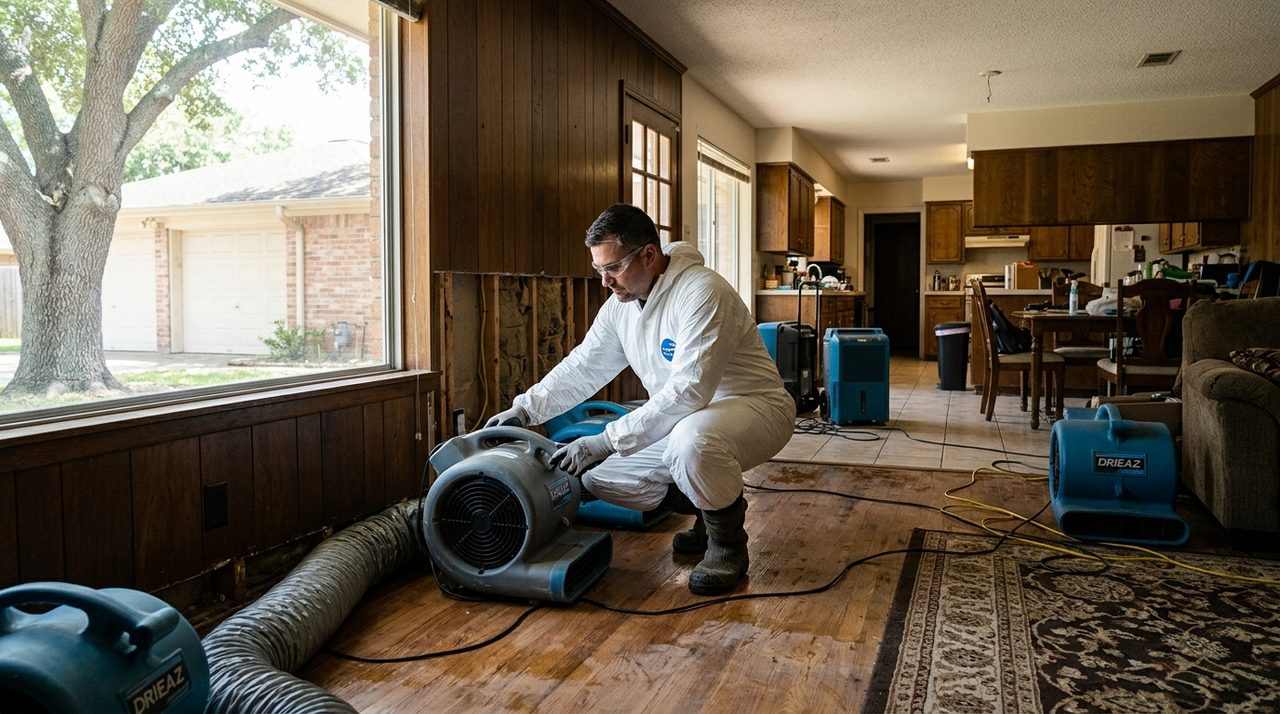
A qualified restoration contractor will use penetrating moisture meters and thermal imaging to map the slab-edge saturation profile, not just the visible waterline, and will establish drying goals measured in grain-per-pound readings rather than surface feel. IICRC S500 Standard for Professional Water Damage Restoration sets the accepted drying protocol; expect the drying phase to run 3–5 days minimum under commercial dehumidification before any reconstruction scope is finalized.
Sources: IICRC (water/mold restoration standards), Harris County Flood Control District
Why it matters to you
A large share of NW Houston homes built between 1980 and 1995 still have their original fiberglass-wrapped flex duct systems, which run through unconditioned attic space or, in some ranch-style homes from the era, below the slab. When floodwater or a burst CPVC supply line saturates these systems, the insulation blanket absorbs moisture that neither the homeowner nor an air-only drying setup can remove. Houston's average relative humidity of 74 percent and summer attic temperatures that routinely exceed 130°F create conditions for Cladosporium and Aspergillus growth within 48 to 72 hours—well before a restoration crew may arrive if the homeowner waits on an insurance adjuster.
What a good pro does
Restoration professionals should inspect ductwork with a moisture meter and borescope camera before any drying equipment is placed, because running an HVAC system through wet ducts spreads spore-laden air throughout the home. Any firm performing mold assessment or remediation in Texas must hold a TDLR-issued Mold Remediation Contractor (MRC) license under Texas Occupations Code Chapter 1958; ask for that license number before work begins. In many 1985-era NW Houston homes, full duct replacement is more cost-effective than attempted drying, and that scope should be documented for the insurance carrier from day one.
Sources: IICRC (water/mold restoration standards), Texas Department of Licensing & Regulation, Texas Commission on Environmental Quality
Why it matters to you
The May 2024 derecho and Hurricane Beryl (July 2024) both tracked through NW Houston with sustained winds that forced water through brick weep holes, original 1980s window flanges, and soffit vents on the two-story gable-and-garage homes that dominate subdivisions like Memorial Northwest and Meadows of Northwest Park. These homes show no standing water inside, so many homeowners assume there is no restoration need—but thermal imaging routinely reveals a column of wet sheathing, insulation, and bottom plate running from the roof deck to the slab that will grow mold within days if ignored. Because the water source is windborne rather than ground-borne, standard flood-mitigation assumptions about water classification and demo scope do not apply.
What a good pro does
The correct restoration approach begins with a full-envelope moisture scan using thermal infrared imaging during a temperature differential (early morning in summer), not a visual inspection alone. Drying strategy for top-down wind-driven intrusion is fundamentally different from bottom-up flood work: wall cavities must be accessed from the interior with drill-and-inject drying systems to reach the sheathing layer without removing exterior brick. Because this work touches the home's exterior cladding, NW Houston subdivision HOAs—including Memorial Northwest Homeowners Association—typically require written Architectural Committee approval before any visible exterior material is removed; build that review timeline into the emergency scope and do not wait to notify the HOA.
Sources: IICRC (water/mold restoration standards), Local HOA / deed restrictions (see area profile), City of Houston Permitting Center
Why it matters to you
Unlike Sugar Land or Pearland, which have a single municipal permit office, NW Houston homeowners cannot assume their address falls under one jurisdiction. Parcels within Houston city limits use the Houston Permitting Center for demolition, plumbing, and electrical permits; parcels in unincorporated Harris County—common throughout NW Houston's older subdivisions—route instead to the Harris County Engineering Department, which has different forms, fee schedules, and inspection cadences. Mis-filing a permit application to the wrong office is not a minor paperwork error: the Certificate of Completion or final inspection sign-off is what most carriers require to close the structural portion of a restoration claim, and refiling from scratch adds weeks to that timeline.
What a good pro does
Before pulling any permit, a competent restoration contractor confirms the property's municipal status by checking the City of Houston's address-lookup tool against Harris County Appraisal District records—these two sources together resolve most ambiguity. Demolition permits are typically pulled by the restoration contractor; any plumbing repair on lines exposed during flood demo requires a TSBPE-licensed master plumber pulling a separate trade permit, and electrical work exposed in the same scope requires a TDLR-licensed electrician doing the same. Homeowners should request copies of all permit applications and inspection records as part of their project file, because insurers and future buyers both ask for them.
Sources: City of Houston Permitting Center, Municipal permit office (see area profile), Texas State Board of Plumbing Examiners, Texas Department of Licensing & Regulation
Hiring water & flood restoration in NW Houston? NW Houston encompasses dozens of separate subdivisions spanning construction eras from the 1960s through the 2010s, each with its own HOA and deed restrictions. Homeowners here typically manage aging slab-on-grade foundations on expansive clay soils, production-era HVAC systems, and roofing exposed to severe summer heat. Permit jurisdiction varies between the City of Houston and Harris County depending on whether the specific parcel falls inside or outside city limits.
Building era
1970s–2000s, with the largest concentration in the 1980s–1990s.
Typical style
Traditional suburban brick or brick-and-siding one- and two-story homes, Texas traditional with gables and attached garages.
Foundations
Concrete slab-on-grade (predominant for post-1960 tract housing in Harris County).
Common systems
Central A/C with forced-air gas furnaces typical of 1980s–1990s production builds; copper or CPVC supply lines with cast iron or PVC drains; 200-amp electrical panels in newer sections, 100-amp in older 1970s-era homes.
What that means for repairs
Kitchen and bath remodels are common in 1970s–1980s homes reaching 40+ years. Foundation repair due to expansive clay soils is frequent. Roof replacements cycle every 15–20 years due to hail and heat exposure. HOA architectural review is typically required before exterior modifications.
Permit jurisdiction
Mixed — parcels within Houston city limits use the Houston Permitting Center; unincorporated Harris County parcels (common in NW Houston) use Harris County Engineering Department. Verify annexation status per address.
HOA & deed restrictions
Most platted subdivisions have mandatory HOAs or POAs. Notable examples include Memorial Northwest Homeowners Association (mandatory for all property owners) and Meadows of Northwest Park HOA (mandatory). Older unplatted acreage tracts may lack formal HOAs. Confirm HOA status per property via deed records and the TREC HOA Management Certificate Database.
Historic districts
No City of Houston historic district designation confirmed.
Contractor note
Contractors must verify whether a specific address is inside Houston city limits or unincorporated Harris County, as permit requirements and inspection processes differ. Most subdivision HOAs require architectural committee approval before exterior work begins.
FEMA flood zone
FEMA Zone X500 (moderate flood risk) — source: fema_nfhl. Portions of NW Houston near Cypress Creek, White Oak Bayou tributaries, and low-lying creek corridors may carry higher localized flood risk; confirm zone by specific address.
Hurricane Harvey impact
Harvey impact varied significantly across NW Houston. Areas near Cypress Creek and low-lying bayou tributaries experienced serious structural flooding, while higher-ground subdivisions saw little to no flooding. No single characterization applies area-wide. Some NW Houston subdivisions faced post-Harvey HOA disputes including foreclosure actions over unpaid dues and legal costs.
Heat & humidity load
Prolonged 95°F+ heat and high humidity stress aging HVAC systems in 1980s–1990s homes, accelerating compressor failures and ductwork degradation in unconditioned attic spaces. Slab movement peaks during summer drought cycles on expansive clay soils, causing doors to stick and drywall cracks to appear.
Working with contractors here
The most common service calls in NW Houston involve foundation leveling and pier installation on expansive clay soils, HVAC system replacement in 1980s–1990s production homes, and composition shingle roof replacements after hail events. Plumbing repiping is increasingly common as original polybutylene and CPVC lines in 1980s–1990s homes reach end of life. Contractors should plan for HOA architectural review timelines before scheduling exterior work—approval can take two to six weeks depending on the subdivision. Because permit jurisdiction is split between Houston and Harris County, job scoping must begin with confirming the property's municipal status to ensure correct permits and inspections.
Local Tip
Always ask for a written estimate before work begins. Texas contractors are required to provide one on jobs over $1,000.
NW Houston encompasses dozens of separate subdivisions spanning construction eras from the 1960s through the 2010s, each with its own HOA and deed restrictions. Homeowners here typically manage aging slab-on-grade foundations on expansive clay soils, production-era HVAC systems, and roofing exposed to severe summer heat. Permit jurisdiction varies between the City of Houston and Harris County depending on whether the specific parcel falls inside or outside city limits.
Source: U.S. Census Bureau, ACS 5-Year 2023
NW Houston carries FEMA Zone X500 (moderate flood risk): outside the 100-year floodplain but inside the 500-year, so heavy-rain events still reach homes and flood-aware work pays off.
Source: FEMA National Flood Hazard Layer (NFHL). Flood zones vary by parcel — verify your individual FIRM panel.
Harvey 2017 proved that moderate-risk zones in Houston metro are not immune to catastrophic inundation, so ask a licensed restoration firm to review your property's moisture history and identify entry points where floodwater could migrate into wall assemblies. Early documentation of dry conditions also strengthens insurance claims if a hurricane does strike NW Houston. In-city NW Houston work falls under City of Houston floodplain and permitting rules.
Wind-driven rain from the May 2024 derecho caused water intrusion through soffit vents and poorly sealed exterior wall penetrations in countless NW Houston homes that had never previously flooded. A water-restoration contractor can trace moisture migration paths with thermal imaging and place drying equipment specifically where building cavities are retaining water. In-city NW Houston work falls under City of Houston floodplain and permitting rules.
Uri 2021 showed that even well-built Houston homes in moderate-risk zones like NW Houston can absorb hundreds of gallons of water from a single burst supply line before the main shutoff is reached, making a fast-response extraction contract with a local IICRC firm valuable before any forecast hard freeze. Removing standing water within two hours and placing drying equipment within 24 hours is the threshold that separates a dryout from a full mold-remediation project. With a median build year of 1985, the older building stock here is more exposed to hard-freeze damage than newer construction. Confirm the current FEMA panel for your NW Houston parcel — the area maps to Zone X500, but adjacent lots can differ.
Sources: FEMA National Flood Hazard Layer (NFHL), Ready.gov -- Hurricanes, CenterPoint Energy -- Storm Center, City of Houston -- Emergency Preparedness, Ready.gov -- Winter Weather, Harris County Flood Control District
Houston-specific estimators to plan your project before you call a pro. All results are planning estimates — a licensed local pro confirms the details on site.
Disconnect & drain every outdoor hose bib
Remove hoses, drain the spigots, and cover each with an insulated faucet sock. Un-drained hose bibs are the #1 burst point in a Houston freeze.
Insulate exposed pipes in the attic & garage
Wrap any pipe in an unconditioned space (attic runs, garage walls) with foam sleeves. Houston homes rarely insulate these because they only matter a few nights a year — which is exactly why they burst.
Open cabinet doors & keep a pencil-width drip
On hard-freeze nights, open kitchen/bath cabinets so warm air reaches the pipes and let faucets on exterior walls drip to relieve pressure.
Protect the attic/garage water heater & its lines
An attic or garage tank sits in unconditioned space. Insulate the cold-inlet and hot-outlet lines and confirm the emergency drain pan is clear so a leak doesn't reach the ceiling.
This is a planning estimate only — actual requirements depend on an on-site assessment by a licensed Houston pro. If a pipe has already burst, shut off your main water supply and call a licensed Houston plumber immediately — freeze bursts flood fast.
Sources: Municipal permit office (see area profile)
Sources: IICRC (water/mold restoration standards)Local HOA / deed restrictions (see area profile)
Sources: IICRC (water/mold restoration standards)Texas Department of Licensing & Regulation