1630 Elmview Dr, Houston, TX 77080
Best AC Repair in Spring Branch
Spring Branch's 1950s–1960s brick ranch homes on slab foundations were built decades before modern cooling loads were a design consideration, and many still run original or early-replacement HVAC equipment that predates the 2010 R-22 phaseout—meaning a routine service call can quickly reveal a refrigerant dead end. Add Houston's expansive Beaumont clay soil shifting beneath those concrete slabs and the City of Houston's mechanical permit requirement for any equipment swap, and Spring Branch homeowners face a specific, layered set of HVAC decisions that differ meaningfully from newer master-planned suburbs.
Verified against Google Business data
Updated 2026
See the 10 AC Repair Serving Spring Branch 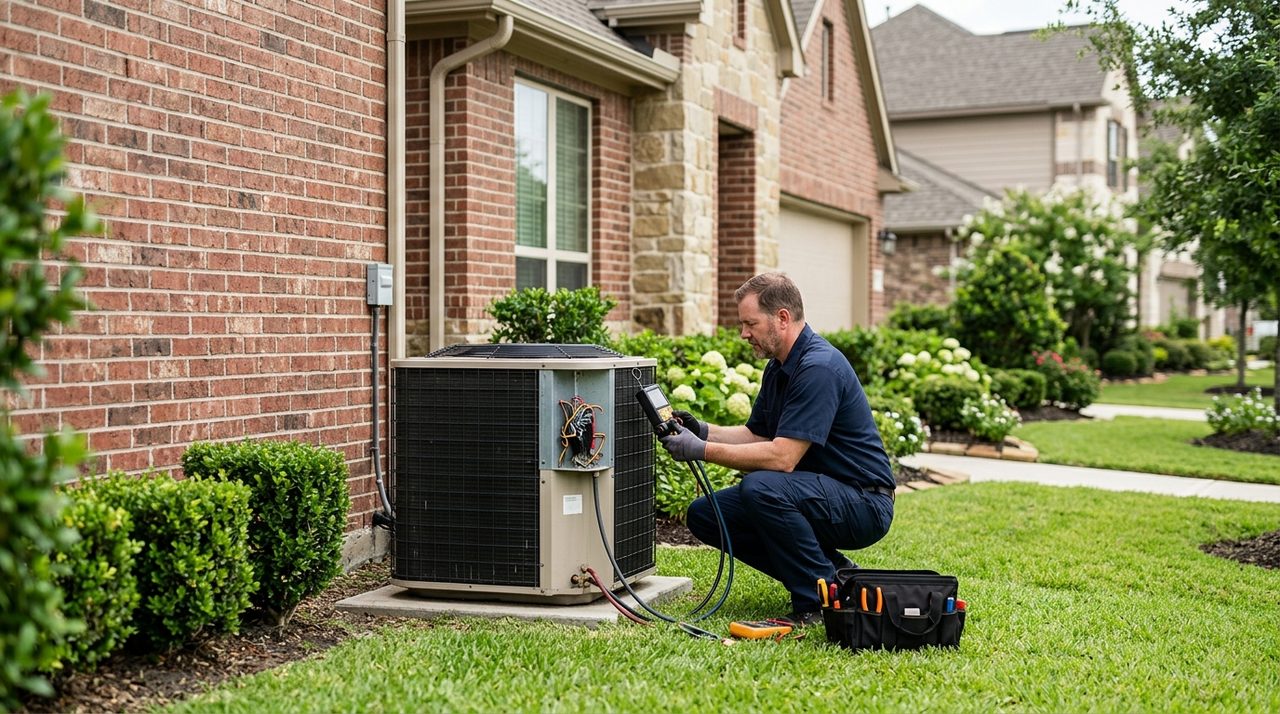
- Median home built
- 1978
- Median home value
- $640,789
- FEMA flood zone
- X (low)
- Typical system replacement cost (est.)
- $5,500–$9,500
- Most common local issue
- Aging R-22 systems in unrenovated 1950s–60s ranch homes
Ranked by verified Google rating × review volume × verification tier. How we rank →
Min rating:
10 results Open Now
1729 Brittmoore Rd B2, Houston, TX 77043
Open Now
1718 Elmview Dr, Houston, TX 77080
2015 Bauer Dr, Houston, TX 77080
Open Now
1811 Upland Dr C, Houston, TX 77043
1645 Brittmoore Rd, Houston, TX 77043
Open Now
1525 Wycliffe Dr, Houston, TX 77043
Open Now
710 N Post Oak Rd Suite 400, Houston, TX 77024
Closed
9050 Emnora Ln Ste. A, Houston, TX 77080
Closed
10216 Georgibelle Dr #900, Houston, TX 77043
AC Repair in Spring Branch: What You Should Know
R-22 Systems in Original Ranch Homes: When a Recharge Costs More Than It's Worth
Why it matters to you
A meaningful share of Spring Branch's unrenovated 1950s–1960s homes still run equipment that was installed or replaced before 2010 and uses R-22 refrigerant. Since January 2020, the EPA has banned new R-22 production, and reclaimed supplies in the Houston market have pushed prices to an estimated $80–$150 per pound—meaning a single refrigerant top-off on a leaking older system can run $600–$1,500 before any repair work is even started. For Spring Branch homeowners who deferred full HVAC replacement during prior renovations (re-plumbing galvanized lines, panel upgrades), that aging R-22 air handler is often the last original system still running.
What a good pro does
A qualified technician should perform a full leak test before adding any refrigerant; if the leak is at the evaporator coil or TXV, the math on R-22 repair almost never pencils out against a full system replacement. Replacement work requires a mechanical permit pulled through the City of Houston's permitting center by a TDLR-licensed contractor—homeowners cannot self-pull HVAC mechanical permits in Houston. Ask the contractor to document whether a retrofit refrigerant like R-407C is even compatible with your existing compressor before committing to anything short of full replacement.
Sources: Texas Department of Licensing & Regulation, City of Houston Permitting Center
Clay Soil Slab Movement Kinking Line Sets and Unlevel-ing Condenser Pads
Why it matters to you
Spring Branch sits on Houston's high-plasticity Beaumont clay, and the slab-on-grade foundations under those 1950s–1960s ranch homes move seasonally as the soil swells with rain and shrinks in drought—a pattern that has driven the neighborhood's well-documented foundation repair demand. That same soil movement affects the refrigerant line sets running from interior air handlers through or beneath the slab to outdoor condensers: over decades, differential settling can kink copper line sets, stress flare fittings, and tilt outdoor condenser pads enough to affect compressor oil return and drainage. Homes that have already had foundation leveling work are especially likely to have disturbed original line sets.
What a good pro does
During any service visit or system replacement on a Spring Branch original home, ask the technician to visually trace the full line set run, check pad levelness on the condenser, and pressure-test the lines before charging the new system. If the existing 1980s or earlier line sets are copper with multiple brazed joints, a reputable contractor will factor line set replacement into the scope rather than assume they're still sound after decades of soil movement. All of this work falls under the City of Houston mechanical permit, which requires a licensed TDLR contractor.
Sources: Texas Department of Licensing & Regulation, City of Houston Permitting Center
Condensate Drain Overflows Saturating Slab-on-Grade Floors in Houston's Humidity
Why it matters to you
Houston's humidity routinely tops 90 percent for extended stretches, and the evaporator coils in Spring Branch's interior closet air handlers—many of them installed in tight original utility closets without floor drains—pull enormous volumes of moisture out of the air every day during summer. Clogged condensate drain lines are one of the most common service calls in the Houston market, and on slab-on-grade homes like those throughout Spring Branch, a pan overflow has nowhere to drain: water backs up into the air handler cabinet, soaks the slab, and creates ideal conditions for microbial growth inside the unit. Older air handlers without secondary drain pans or float shutoffs are particularly vulnerable.
What a good pro does
A thorough annual tune-up for a Spring Branch home should always include flushing the condensate drain line with a wet-vac or pressurized nitrogen, treating the pan with an algaecide tablet, and verifying that a secondary pan and float switch are in place—especially on any original-closet install. Drain clearing typically runs $95–$225 as a standalone call (estimated). If mold is already present in the air handler cabinet, remediation needs to precede the season's first heavy-use period, not follow it. Any new air handler installation in these tight closets should be permitted through the City of Houston, which gives the mechanical inspector a chance to verify proper condensate routing.
Sources: City of Houston Permitting Center, Texas Department of Licensing & Regulation
Winter Storm Uri Damage Still Surfacing in Deferred Spring Branch Repairs
Why it matters to you
February 2021's Winter Storm Uri cracked refrigerant lines, split drain pans, and seized fan motors across Houston, and Spring Branch's high share of owner-occupied homes (about 52 percent per ACS 2023 data) combined with its aging original stock meant many residents patched what they could and kept aging systems running rather than doing full replacements during a difficult supply period. Three-plus years later, those partial fixes are showing up as slow refrigerant leaks at crimped lines, mold colonies in drain pans that froze and cracked, and TXVs (thermostatic expansion valves) that flutter and underperform because internal damage was never fully corrected. The problem is compounded on homes that still have the original air handler tucked in a hall closet where visual inspection is difficult.
What a good pro does
If your Spring Branch home's system was serviced during or shortly after Uri but hasn't had a comprehensive inspection since, ask a TDLR-licensed technician to pull the air handler access panel, inspect the drain pan for cracks and microbial staining, check refrigerant pressure against manufacturer specs, and test TXV superheat. A system that survived Uri on a band-aid repair may be one hot summer away from a full compressor failure. If full replacement is warranted, the City of Houston mechanical permit process is required—budget an estimated $75–$250 for permit fees on top of equipment costs.
Sources: Texas Department of Licensing & Regulation, City of Houston Permitting Center
AC Repair in Spring Branch: What You Should Know
Hiring ac repair in Spring Branch? Spring Branch's housing stock is dominated by 1950s–1960s single-family brick ranch homes on slab foundations, creating consistent demand for foundation repair, re-plumbing, and electrical upgrades. Ongoing teardown-and-rebuild activity means contractors regularly encounter both vintage systems and modern infill construction side by side. Deed restrictions and HOA rules vary subdivision by subdivision, so contractors should verify requirements on a per-project basis.
- Housing era
- Primarily 1950s–1960s, with significant infill and townhome construction from the 2000s onward
- Foundation
- Predominantly concrete slab-on-grade for original 1950s–1960s homes
- Flood zone
- FEMA Zone X (low flood risk) per the official NFHL API
- Permits
- City of Houston — Houston Permitting Center (Spring Branch is within Houston city limits)
Housing stock & systems
Building era
Primarily 1950s–1960s, with significant infill and townhome construction from the 2000s onward.
Typical style
One-story brick ranch houses (original stock); two-story contemporary/transitional homes and townhomes (infill).
Foundations
Predominantly concrete slab-on-grade for original 1950s–1960s homes; some pier-and-beam in earlier or custom structures. Confirm per-property via inspection or appraisal records.
Common systems
Original homes often have galvanized steel or cast-iron drain plumbing, older electrical panels (60–100 amp), and aging central HVAC units. Many properties have been partially updated but may still have legacy piping and wiring. Newer infill homes feature modern PEX plumbing, 200-amp panels, and high-efficiency HVAC systems.
What that means for repairs
Teardown-and-rebuild activity is very common as lot values support new construction. Remaining original homes frequently undergo whole-house renovations including re-plumbing (replacing galvanized lines), electrical panel upgrades, HVAC replacement, and kitchen/bath remodels. Foundation leveling is a recurring need on slab homes due to expansive clay soils.
Permits & restrictions
Permit jurisdiction
City of Houston — Houston Permitting Center (Spring Branch is within Houston city limits).
HOA & deed restrictions
No single area-wide mandatory HOA. Voluntary civic associations (e.g., Spring Branch Civic Association, Spring Branch Oaks Civic Association) cover much of the older residential area. Some platted subdivisions have mandatory HOAs with recorded deed restrictions and mandatory assessments (e.g., Spring Branch Estates, Spring Branch Estates II). At least six mandatory HOAs are registered in the broader Spring Branch area. Deed restrictions are common at the subdivision level but vary by plat—check Harris County Clerk records for each property.
Historic districts
No City of Houston historic district designation confirmed.
Contractor note
Because deed restrictions and HOA requirements vary by subdivision, contractors should confirm any architectural review, fence/accessory structure, and material restrictions before beginning work. The City of Houston permitting process applies to all structural, electrical, plumbing, and mechanical work.
Flood & weather
FEMA flood zone
FEMA Zone X (low flood risk) per the official NFHL API. However, Spring Branch is bisected by several tributaries of White Oak Bayou and Spring Branch Creek, and localized street flooding can still occur during heavy rain events. Property-level flood risk should be verified, especially for lots near drainage channels.
Hurricane Harvey impact
Research did not return specific Harvey damage documentation for this civic-association-defined area of Spring Branch. Broader media and City of Houston reporting indicate that portions of the Spring Branch area experienced significant flooding during Harvey, particularly near bayou tributaries and low-lying streets. Homeowners and contractors should check individual property flood claims history through FEMA and the Harris County Flood Control District for site-specific impact data.
Heat & humidity load
Extended Houston summers with sustained 95°F+ temperatures and high humidity stress aging HVAC systems and accelerate attic insulation degradation in 1950s–1960s ranch homes. Slab-on-grade foundations on expansive clay soils are vulnerable to differential settlement during summer drought cycles. Exterior paint and caulking on older brick veneer homes deteriorate quickly in UV-intense conditions.
Working with contractors here
The most common work in Spring Branch involves updating the mechanical and plumbing systems in 1950s–1960s ranch homes—re-plumbing galvanized supply lines, replacing cast-iron drains, upgrading electrical panels, and installing modern HVAC systems. Foundation repair is a perennial need due to expansive clay soils and slab-on-grade construction. Teardown-and-rebuild projects are frequent, requiring contractors familiar with City of Houston new-construction permitting and lot-specific deed restriction compliance. For renovation jobs on older homes, contractors should budget for potential asbestos abatement (siding, flooring, duct insulation) and lead paint remediation. Scoping should account for the wide variation between unrenovated originals and partially updated homes on the same block.
Local Tip
Always ask for a written estimate before work begins. Texas contractors are required to provide one on jobs over $1,000.
About Spring Branch
Spring Branch's housing stock is dominated by 1950s–1960s single-family brick ranch homes on slab foundations, creating consistent demand for foundation repair, re-plumbing, and electrical upgrades. Ongoing teardown-and-rebuild activity means contractors regularly encounter both vintage systems and modern infill construction side by side. Deed restrictions and HOA rules vary subdivision by subdivision, so contractors should verify requirements on a per-project basis.
- Median year built
- 1978
- Median home value
- $640,789
- Owner-occupied
- 52.3%
- Population
- 157,142
- Housing units
- 65,035
- Median income
- $90,513
Source: U.S. Census Bureau, ACS 5-Year 2023
Flood & storm risk
FEMA Zone XLow flood riskMost of Spring Branch maps to FEMA Zone X (low mapped flood risk), but Houston's flash-flood reality means even low-risk blocks benefit from smart drainage and storm-hardened installs.
Source: FEMA National Flood Hazard Layer (NFHL). Flood zones vary by parcel — verify your individual FIRM panel.
Houston Storm Readiness in Spring Branch
Hurricane & flooding
Even in lower-risk Spring Branch, hurricane-force winds from a storm like Beryl 2024 can topple or shift outdoor condenser units — verify that all condenser pad anchor bolts are torqued to manufacturer spec and that refrigerant line sets have enough slack to absorb minor movement. Post-storm, check that the unit is level before restarting, since a tilted compressor loses lubrication and fails prematurely. In-city Spring Branch work falls under City of Houston floodplain and permitting rules.
Severe storms & hail
Wind-driven rain during a severe thunderstorm can overwhelm attic ventilation in Spring Branch and soak fiberglass duct insulation, reducing system efficiency for weeks until the insulation dries — a post-storm attic check for wet duct wrap costs far less than the efficiency loss on your summer CenterPoint bill. A TDLR-licensed HVAC technician can re-wrap and seal affected sections during a single service visit. Confirm the current FEMA panel for your Spring Branch parcel — the area maps to Zone X, but adjacent lots can differ.
Ice storms & freezes
In lower-flood-risk areas like Spring Branch, the primary Uri 2021 HVAC failure mode was loss of heating entirely when heat-pump defrost boards were overwhelmed — verify that your backup heat strips are energized and pulling correct amperage with a quick licensed-technician check every fall, because a failed heat strip during a power-restored freeze night leaves the house unprotected. CenterPoint's rotating outage schedule during Uri meant systems that failed had no repair window for days. With a median build year of 1978, the older building stock here is more exposed to hard-freeze damage than newer construction. Confirm the current FEMA panel for your Spring Branch parcel — the area maps to Zone X, but adjacent lots can differ.
Sources: FEMA National Flood Hazard Layer (NFHL), Ready.gov -- Hurricanes, CenterPoint Energy -- Storm Center, City of Houston -- Emergency Preparedness, Ready.gov -- Winter Weather, Harris County Flood Control District
Free Spring Branch Tools & Calculators
Houston-specific estimators to plan your project before you call a pro. All results are planning estimates — a licensed local pro confirms the details on site.
Houston AC Tonnage & Sizing Estimator
Open full tool & FAQ →Living space you want cooled (400–10,000 sq ft).
5.0tons
Recommended nominal size
60,000 BTU/hr
Estimated cooling load
This is a planning estimate only — actual requirements depend on an on-site assessment by a licensed Houston pro. Houston's humidity and long cooling season make an oversized unit a common, costly mistake — it short-cycles and never dehumidifies. A licensed contractor confirms sizing with a full Manual J calculation.
Houston Freeze Prep & Pipe Insulation Checklist
Open full tool & FAQ →Your freeze checklist — 4 tasks
- 1
Disconnect & drain every outdoor hose bib
Remove hoses, drain the spigots, and cover each with an insulated faucet sock. Un-drained hose bibs are the #1 burst point in a Houston freeze.
- 2
Insulate exposed pipes in the attic & garage
Wrap any pipe in an unconditioned space (attic runs, garage walls) with foam sleeves. Houston homes rarely insulate these because they only matter a few nights a year — which is exactly why they burst.
- 3
Open cabinet doors & keep a pencil-width drip
On hard-freeze nights, open kitchen/bath cabinets so warm air reaches the pipes and let faucets on exterior walls drip to relieve pressure.
- 4
Protect the attic/garage water heater & its lines
An attic or garage tank sits in unconditioned space. Insulate the cold-inlet and hot-outlet lines and confirm the emergency drain pan is clear so a leak doesn't reach the ceiling.
This is a planning estimate only — actual requirements depend on an on-site assessment by a licensed Houston pro. If a pipe has already burst, shut off your main water supply and call a licensed Houston plumber immediately — freeze bursts flood fast.
Frequently Asked Questions
Do I need to pull a City of Houston mechanical permit just to replace my AC unit in Spring Branch?
Yes — Spring Branch falls within Houston city limits, so any equipment replacement (condenser, air handler, or full system swap) requires a mechanical permit pulled through the City of Houston Permitting Center, and it must be pulled by a TDLR-licensed contractor, not by you as the homeowner. Your contractor should provide you the permit number before work begins; an unpermitted swap can complicate a future sale or insurance claim. Permit fees are typically estimated at $75–$250 depending on the scope of the job.
Sources: City of Houston Permitting CenterTexas Department of Licensing & Regulation
My Spring Branch ranch home was built in 1962 and still has the original air handler in a closet — is that a problem when replacing the system?
It's a common scenario in Spring Branch's unrenovated original stock, and it does add scope: 1960s interior closets were sized for much smaller, non-insulated air handlers, so a modern unit may require ductwork reconfiguration or a closet modification to fit current equipment. More importantly, any disturbed insulation wrap on those original ducts or flex-duct connections should be tested for asbestos before work proceeds, since asbestos duct insulation was standard in that construction era. A contractor experienced with Spring Branch's pre-1970 homes will budget time for a pre-demo inspection rather than discovering surprises mid-install.
Sources: EPA Lead Renovation, Repair and Painting (RRP) Rule
Does my Spring Branch subdivision HOA have to approve where I put my new condenser unit?
It depends on which plat your property sits on — Spring Branch has no area-wide mandatory HOA, but at least six mandatory HOAs with recorded deed restrictions operate within the broader neighborhood, and voluntary civic associations may also have guidelines. Before placement is finalized, your contractor should check your subdivision's recorded deed restrictions through the Harris County Clerk's records, since some Spring Branch plats require equipment screening or restrict side-yard placement even without a formal architectural committee. The City of Houston permit does not substitute for HOA or deed-restriction compliance.
Sources: Local HOA / deed restrictions (see area profile)City of Houston Permitting Center
Spring Branch is FEMA Zone X — does that mean I don't need to worry about elevating my new condenser pad?
Zone X means your parcel carries low mapped flood risk, but Houston's bayou-fed flash flooding can send water across Zone X blocks during extreme rainfall events, as many Spring Branch residents learned during Harvey in 2017. While elevation is not a FEMA code requirement in Zone X, raising a new condenser pad 4–6 inches above grade on a compacted base is a low-cost precaution that protects a $2,000–$4,000 piece of equipment and is widely recommended for Houston slab-on-grade homes regardless of flood designation. Ask your contractor to confirm the final pad height relative to your yard's sheet-flow direction.
What time of year should I schedule a non-emergency AC replacement in Spring Branch to get the best turnaround?
The March–early May window is typically the fastest and most competitive time to schedule a planned replacement in Spring Branch — demand hasn't peaked yet, permit inspections at the City of Houston Permitting Center are less backed up, and you have a buffer before the June–September stretch when every crew in the market is running emergency calls. Waiting until July means lead times for equipment and permit inspections can stretch an estimated 5–10 business days beyond normal, and you're scheduling during the exact weeks your household can least afford downtime given Houston's 95°F-plus heat. If your system is limping heading into spring, a late-winter quote protects both your schedule and your negotiating position.
Sources: City of Houston Permitting Center
Several Spring Branch neighbors mentioned their AC company found mold inside the air handler during a tune-up — is that a Spring Branch-specific risk or general Houston concern?
It's a Houston-wide issue but hits Spring Branch's original-stock homes particularly hard: 1950s–1960s air handlers are often in interior closets without floor drains, meaning any condensate drain clog sends water directly onto a concrete slab with nowhere to go, and the resulting damp environment inside a metal air-handler cabinet breeds microbial growth quickly in Houston's 90%-plus summer humidity. Condensate drain clearing and pan treatment is one of the most common service calls in the area, running an estimated $95–$225, and it's worth adding annual drain-pan treatment to your maintenance contract rather than waiting for an overflow to reveal the problem. If mold is found inside the cabinet, remediation scope and air-handler replacement cost should be evaluated separately before the crew simply cleans and tapes.