9135 Spring Branch Dr UNIT 202, Houston, TX 77080
Best Electricians in Spring Branch
Spring Branch's blocks of 1950s–1960s brick ranch homes on slab foundations carry electrical infrastructure that is now 60-plus years old—60- and 100-amp panels, early aluminum branch-circuit wiring, and conduit runs stressed by Houston's expansive Beaumont clay—all of it permitted through the City of Houston's Houston Permitting Center. Teardown-and-rebuild activity on the same streets means electricians regularly work a vintage unrenovated ranch next door to a brand-new 200-amp infill townhome, so knowing which era you're dealing with before opening a panel is the first step toward a safe, code-compliant outcome.
Verified against Google Business data
Updated 2026
See the 10 Electricians Serving Spring Branch 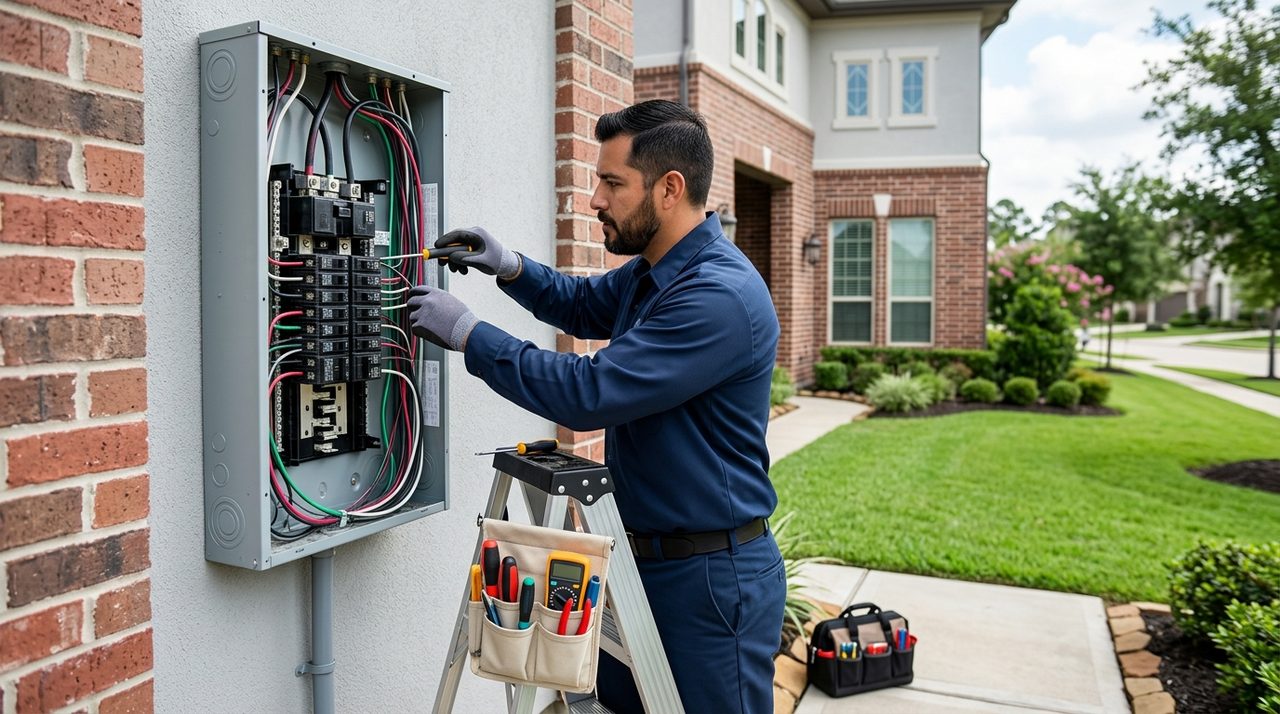
- Median home built
- 1978
- Median home value
- $640,789
- FEMA flood zone
- X (low)
- Panel upgrade estimate (100A → 200A)
- $1,800–$3,200
- Most common local issue
- Undersized 60–100A panels in original 1950s–60s ranch homes needing full upgrade
Ranked by verified Google rating × review volume × verification tier. How we rank →
Some highly-rated pros serve Spring Branch from nearby and may not keep a Spring Branch street address. Those are listed under "Also serving Spring Branch" with their real city and distance, so you always know where each business is based.
Min rating:
10 resultsBased in Spring Branch
1800 Sherwood Forest St # C4, Houston, TX 77043
Open Now
1708 Oak Tree Dr, Houston, TX 77080
Also serving Spring Branch
Highly-rated pros based nearby who cover Spring Branch. Distance shown from the Spring Branch area.
Closed
Serving Spring Branch Based in Lazybrook / Timbergrove · 2.6 mi away
Closed
Serving Spring Branch Based in Brookhollow · 2.8 mi away
Closed
Serving Spring Branch Based in Brookhollow · 3.1 mi away
Open Now
Serving Spring Branch Based in Brookhollow · 3.3 mi away
Serving Spring Branch Based in Brookhollow · 3.4 mi away
Open Now
Serving Spring Branch Based in NW Houston · 3.5 mi away
Open Now
Serving Spring Branch Based in Lazybrook / Timbergrove · 3.6 mi away
Electricians in Spring Branch: What You Should Know
Tiny Original Panels Overwhelmed by Modern Loads—and Post-Uri Heat Additions
Why it matters to you
Spring Branch's unrenovated ranch homes frequently still have their original 60- or 100-amp panels—sized for a 1960 household with window AC units and a gas range. After Winter Storm Uri in February 2021, many Spring Branch owners added plug-in electric heaters or heat-pump water heaters as gas-supply backups, quietly pushing those older services past their safe capacity. Nuisance tripping, warm breakers, and flickering lights under heavy load are the typical warning signs that a service already operating near its limit is being asked to do too much.
What a good pro does
A licensed Master Electrician (credentialed through TDLR) should perform a load calculation per NEC Article 220 before sizing the new service—200A is the current standard for a renovated ranch, while homes adding an EV charger or all-electric HVAC may warrant 400A. The work requires an electrical permit through the City of Houston's Houston Permitting Center, an inspection, and a CenterPoint reconnect appointment; the whole sequence typically takes one to three business days once the permit is approved.
Sources: Texas Department of Licensing & Regulation, City of Houston Permitting Center, International Residential Code (as adopted by City of Houston)
Aluminum Branch-Circuit Wiring in Spring Branch's 1965–1975 Ranch Homes
Why it matters to you
A subset of Spring Branch's older single-family homes—particularly those built or rewired between roughly 1965 and 1975—contain single-strand aluminum branch circuits. At receptacle and switch terminations, aluminum oxidizes and expands at a different rate than the brass or steel screws it contacts, creating a high-resistance connection that generates heat over time. Home inspectors consistently flag this issue in Spring Branch transactions, and it often surfaces during the whole-house renovations that are so common on this neighborhood's unrenovated originals.
What a good pro does
Proper remediation is not a coat of anti-oxidant paste—it requires either full replacement with copper conductors or, on a circuit-by-circuit basis, CO/ALR-rated devices and AlumiConn connectors at every termination. A TDLR-licensed Master Electrician must pull an electrical permit through the Houston Permitting Center for a whole-home remediation scope; homeowners preparing to sell should address this before listing, as Houston-area inspectors routinely call it out as a safety deficiency.
Sources: Texas Department of Licensing & Regulation, City of Houston Permitting Center
Clay-Soil Slab Movement Cracking Underground Conduit and Service Laterals
Why it matters to you
Spring Branch sits on Houston's expansive Beaumont clay, and the neighborhood's slab-on-grade ranch homes shift seasonally as the clay swells with rain and shrinks in drought. Foundation leveling is described as a perennial need here, and that same movement stresses any conduit embedded in or passing beneath the slab—including service lateral conduit, in-slab feeder runs to subpanels in garages or additions, and older direct-burial aluminum feeders common before 2000. A cracked conduit creates a fault path that is invisible until a breaker trips or an arc-fault detector activates.
What a good pro does
Diagnosing this problem typically requires a time-domain reflectometer test on the suspect conductor to localize the fault without opening the slab unnecessarily. When a conduit run must be replaced, a qualified electrician can often reroute overhead through the attic rather than trenching, avoiding additional slab disturbance. The repair requires an electrical permit from the Houston Permitting Center regardless of whether the run is rerouted or re-trenched.
Sources: City of Houston Permitting Center, International Residential Code (as adopted by City of Houston)
Attic Junction Box Corrosion in Aging Ranch Homes with High-Heat, High-Humidity Attics
Why it matters to you
Spring Branch's low-pitched ranch rooflines trap heat—attic temperatures can exceed 140°F in a Houston summer—and the metro's average relative humidity routinely exceeds 75%. In the original 1950s–1960s homes, decades of thermal cycling in those attics has oxidized wire-nut connections, degraded older THHN insulation, and corroded the aluminum neutral conductors that were standard in that era. Homeowners typically don't discover the problem until a breaker trips for no obvious reason or a thermal-imaging scan during a renovation reveals a hot splice.
What a good pro does
A thorough attic inspection during any panel upgrade or renovation project should include probing accessible junction boxes for oxidation, loose connections, and degraded insulation. Where corrosion is found, replacing wire nuts with rated lever-nut connectors in sealed weatherproof boxes reduces the re-oxidation risk. Adding attic insulation to bring the assembly toward current energy-code levels (Energy Star benchmarks) moderates the thermal swing that accelerates corrosion—making it a logical companion investment when the electrician is already in the attic.
Sources: International Residential Code (as adopted by City of Houston), ENERGY STAR / U.S. Dept. of Energy, Texas Department of Licensing & Regulation
Electricians in Spring Branch: What You Should Know
Hiring electricians in Spring Branch? Spring Branch's housing stock is dominated by 1950s–1960s single-family brick ranch homes on slab foundations, creating consistent demand for foundation repair, re-plumbing, and electrical upgrades. Ongoing teardown-and-rebuild activity means contractors regularly encounter both vintage systems and modern infill construction side by side. Deed restrictions and HOA rules vary subdivision by subdivision, so contractors should verify requirements on a per-project basis.
- Housing era
- Primarily 1950s–1960s, with significant infill and townhome construction from the 2000s onward
- Foundation
- Predominantly concrete slab-on-grade for original 1950s–1960s homes
- Flood zone
- FEMA Zone X (low flood risk) per the official NFHL API
- Permits
- City of Houston — Houston Permitting Center (Spring Branch is within Houston city limits)
Housing stock & systems
Building era
Primarily 1950s–1960s, with significant infill and townhome construction from the 2000s onward.
Typical style
One-story brick ranch houses (original stock); two-story contemporary/transitional homes and townhomes (infill).
Foundations
Predominantly concrete slab-on-grade for original 1950s–1960s homes; some pier-and-beam in earlier or custom structures. Confirm per-property via inspection or appraisal records.
Common systems
Original homes often have galvanized steel or cast-iron drain plumbing, older electrical panels (60–100 amp), and aging central HVAC units. Many properties have been partially updated but may still have legacy piping and wiring. Newer infill homes feature modern PEX plumbing, 200-amp panels, and high-efficiency HVAC systems.
What that means for repairs
Teardown-and-rebuild activity is very common as lot values support new construction. Remaining original homes frequently undergo whole-house renovations including re-plumbing (replacing galvanized lines), electrical panel upgrades, HVAC replacement, and kitchen/bath remodels. Foundation leveling is a recurring need on slab homes due to expansive clay soils.
Permits & restrictions
Permit jurisdiction
City of Houston — Houston Permitting Center (Spring Branch is within Houston city limits).
HOA & deed restrictions
No single area-wide mandatory HOA. Voluntary civic associations (e.g., Spring Branch Civic Association, Spring Branch Oaks Civic Association) cover much of the older residential area. Some platted subdivisions have mandatory HOAs with recorded deed restrictions and mandatory assessments (e.g., Spring Branch Estates, Spring Branch Estates II). At least six mandatory HOAs are registered in the broader Spring Branch area. Deed restrictions are common at the subdivision level but vary by plat—check Harris County Clerk records for each property.
Historic districts
No City of Houston historic district designation confirmed.
Contractor note
Because deed restrictions and HOA requirements vary by subdivision, contractors should confirm any architectural review, fence/accessory structure, and material restrictions before beginning work. The City of Houston permitting process applies to all structural, electrical, plumbing, and mechanical work.
Flood & weather
FEMA flood zone
FEMA Zone X (low flood risk) per the official NFHL API. However, Spring Branch is bisected by several tributaries of White Oak Bayou and Spring Branch Creek, and localized street flooding can still occur during heavy rain events. Property-level flood risk should be verified, especially for lots near drainage channels.
Hurricane Harvey impact
Research did not return specific Harvey damage documentation for this civic-association-defined area of Spring Branch. Broader media and City of Houston reporting indicate that portions of the Spring Branch area experienced significant flooding during Harvey, particularly near bayou tributaries and low-lying streets. Homeowners and contractors should check individual property flood claims history through FEMA and the Harris County Flood Control District for site-specific impact data.
Heat & humidity load
Extended Houston summers with sustained 95°F+ temperatures and high humidity stress aging HVAC systems and accelerate attic insulation degradation in 1950s–1960s ranch homes. Slab-on-grade foundations on expansive clay soils are vulnerable to differential settlement during summer drought cycles. Exterior paint and caulking on older brick veneer homes deteriorate quickly in UV-intense conditions.
Working with contractors here
The most common work in Spring Branch involves updating the mechanical and plumbing systems in 1950s–1960s ranch homes—re-plumbing galvanized supply lines, replacing cast-iron drains, upgrading electrical panels, and installing modern HVAC systems. Foundation repair is a perennial need due to expansive clay soils and slab-on-grade construction. Teardown-and-rebuild projects are frequent, requiring contractors familiar with City of Houston new-construction permitting and lot-specific deed restriction compliance. For renovation jobs on older homes, contractors should budget for potential asbestos abatement (siding, flooring, duct insulation) and lead paint remediation. Scoping should account for the wide variation between unrenovated originals and partially updated homes on the same block.
Local Tip
Always ask for a written estimate before work begins. Texas contractors are required to provide one on jobs over $1,000.
About Spring Branch
Spring Branch's housing stock is dominated by 1950s–1960s single-family brick ranch homes on slab foundations, creating consistent demand for foundation repair, re-plumbing, and electrical upgrades. Ongoing teardown-and-rebuild activity means contractors regularly encounter both vintage systems and modern infill construction side by side. Deed restrictions and HOA rules vary subdivision by subdivision, so contractors should verify requirements on a per-project basis.
- Median year built
- 1978
- Median home value
- $640,789
- Owner-occupied
- 52.3%
- Population
- 157,142
- Housing units
- 65,035
- Median income
- $90,513
Source: U.S. Census Bureau, ACS 5-Year 2023
Flood & storm risk
FEMA Zone XLow flood riskMost of Spring Branch maps to FEMA Zone X (low mapped flood risk), but Houston's flash-flood reality means even low-risk blocks benefit from smart drainage and storm-hardened installs.
Source: FEMA National Flood Hazard Layer (NFHL). Flood zones vary by parcel — verify your individual FIRM panel.
Houston Storm Readiness in Spring Branch
Hurricane & flooding
In Spring Branch, your primary hurricane electrical risk is extended outage and surge damage rather than panel flooding, so have a licensed electrician install a transfer switch and whole-house surge arrester before the season peaks in August. When Beryl 2024 knocked out power to 900,000 CenterPoint customers in July heat, homes with interlock kits and generators were the ones that stayed livable. In-city Spring Branch work falls under City of Houston floodplain and permitting rules.
Severe storms & hail
In Spring Branch, severe thunderstorm season runs nearly year-round, and repeated lightning strikes on the distribution grid gradually degrade unprotected electronics in your home — have a TDLR-licensed electrician install whole-house surge protection and verify that your panel's main breaker is torqued to specification, since loose connections are a documented cause of post-storm arc fires. The May 2024 derecho's surge damage hit homes miles from the actual storm track, confirming that low-mapped-flood areas are not low-risk when it comes to electrical hazards. Confirm the current FEMA panel for your Spring Branch parcel — the area maps to Zone X, but adjacent lots can differ.
Ice storms & freezes
In Spring Branch, the primary ice-storm electrical risk is the same one that paralyzed Houston during Uri 2021: extended outage combined with unsafe generator use inside or near the home. A TDLR-licensed electrician can install a transfer switch or interlock kit that lets you run your furnace blower, well pump, and essential circuits from a portable generator safely, without the back-feed risk that puts CenterPoint lineworkers in danger during restoration. With a median build year of 1978, the older building stock here is more exposed to hard-freeze damage than newer construction. Confirm the current FEMA panel for your Spring Branch parcel — the area maps to Zone X, but adjacent lots can differ.
Sources: FEMA National Flood Hazard Layer (NFHL), Ready.gov -- Hurricanes, CenterPoint Energy -- Storm Center, City of Houston -- Emergency Preparedness, Ready.gov -- Winter Weather, Harris County Flood Control District
Free Spring Branch Tools & Calculators
Houston-specific estimators to plan your project before you call a pro. All results are planning estimates — a licensed local pro confirms the details on site.
Houston Freeze Prep & Pipe Insulation Checklist
Open full tool & FAQ →Your freeze checklist — 4 tasks
- 1
Disconnect & drain every outdoor hose bib
Remove hoses, drain the spigots, and cover each with an insulated faucet sock. Un-drained hose bibs are the #1 burst point in a Houston freeze.
- 2
Insulate exposed pipes in the attic & garage
Wrap any pipe in an unconditioned space (attic runs, garage walls) with foam sleeves. Houston homes rarely insulate these because they only matter a few nights a year — which is exactly why they burst.
- 3
Open cabinet doors & keep a pencil-width drip
On hard-freeze nights, open kitchen/bath cabinets so warm air reaches the pipes and let faucets on exterior walls drip to relieve pressure.
- 4
Protect the attic/garage water heater & its lines
An attic or garage tank sits in unconditioned space. Insulate the cold-inlet and hot-outlet lines and confirm the emergency drain pan is clear so a leak doesn't reach the ceiling.
This is a planning estimate only — actual requirements depend on an on-site assessment by a licensed Houston pro. If a pipe has already burst, shut off your main water supply and call a licensed Houston plumber immediately — freeze bursts flood fast.
Frequently Asked Questions
Do I need a permit from the City of Houston to upgrade the electrical panel in my Spring Branch ranch home?
Yes. Spring Branch sits within Houston city limits, so all electrical panel work—including a service upgrade from 60A or 100A to 200A—requires a permit pulled through the Houston Permitting Center, and only a TDLR-licensed Master Electrician can pull that permit on your behalf. After work is complete, a city inspector must sign off before CenterPoint Energy will reconnect the service. Budget a few extra days in your project timeline for the inspection queue, which can run 3–7 business days depending on workload.
Sources: City of Houston Permitting CenterTexas Department of Licensing & Regulation
My Spring Branch home is in FEMA Zone X—do electricians still need to elevate new panels or meter bases above a certain height?
Zone X is a low mapped flood risk, so FEMA does not mandate elevation of electrical equipment as a permit condition the way it does in AE zones along Brays or Buffalo Bayou. That said, Houston's flash-flood reality means many Spring Branch electricians voluntarily recommend mounting new subpanels and meter bases at least 12 inches above finished floor as a practical resilience measure, especially in garages near grade. Confirm the specific install height with your electrician and the Houston Permitting Center inspector at the time of permit application.
Sources: FEMA National Flood Hazard Layer (NFHL)City of Houston Permitting Center
How long does a whole-panel replacement typically take in a Spring Branch 1950s ranch, from pulling the permit to CenterPoint reconnection?
Most Spring Branch panel upgrades run 1–2 days of actual labor, but total elapsed time is typically 1–2 weeks once you account for the Houston Permitting Center permit issuance (often 2–5 business days for standard electrical permits filed online) and the CenterPoint reconnect appointment after inspection. If the job uncovers a deteriorated meter base or weatherhead mast that also needs replacement—common on 60-year-old ranch homes—add another day of work and a separate CenterPoint coordination step. Ask your electrician upfront whether they will manage the CenterPoint scheduling or whether that coordination falls to you.
Sources: City of Houston Permitting Center
I'm adding an EV charger to my Spring Branch home—do I also need HOA approval before the electrician runs conduit on the exterior?
Spring Branch has no single area-wide mandatory HOA, but some platted subdivisions such as Spring Branch Estates have recorded deed restrictions that may govern exterior equipment placement and exposed conduit routing on the home's façade. Before scheduling the install, pull up your property's deed restrictions through the Harris County Clerk's records to check for architectural review requirements. Regardless of HOA status, a City of Houston electrical permit is required for the Level 2 EVSE supply circuit, and the permit must be finaled before the charger is energized.
Sources: Local HOA / deed restrictions (see area profile)City of Houston Permitting Center
What questions should I ask an electrician before hiring them to rewire or remediate aluminum branch circuits in my 1960s Spring Branch home?
Ask specifically whether they will replace devices with UL-listed CO/ALR-rated receptacles and switches or install AlumiConn connectors at every termination—not just apply anti-oxidant paste, which is not a standalone fix. Confirm the electrician holds an active TDLR Master Electrician license (verifiable on the TDLR public lookup) so they can legally pull the Houston Permitting Center permit that this scope requires. Also ask whether they carry out a thermal-imaging scan after remediation to verify all terminations are cool under load, which is the practical confirmation that the work is complete.
Sources: Texas Department of Licensing & RegulationCity of Houston Permitting Center
Is summer or winter a better time to schedule attic electrical work—like new circuits or junction box inspections—in a Spring Branch ranch home?
Fall and early winter (October through December) are meaningfully more comfortable for attic work in Spring Branch because attic temperatures that routinely exceed 140°F in June through September create genuine safety risks for electricians and can cause wire insulation to soften, making it harder to handle conductors properly. Scheduling attic circuit work or junction box inspections in cooler months also tends to reduce labor time because crews can work continuously without mandatory heat-break intervals, which in practice can shave cost off an hourly-billed job. If the work is urgent in summer, ask whether the electrician staggers start times to the early morning hours before attic temperatures peak.