Open Now
5250 Gulfton St Suite 1A-C, Houston, TX 77081
Bellaire's near-total FEMA AE flood-zone footprint means every electrical project here — from a simple panel swap to a whole-home rebuild — intersects with floodplain elevation requirements, post-inundation equipment replacement, and the City of Bellaire's own permitting office, which operates independently of both Houston Permitting Center and Harris County. The census median year built of 1981 masks two very different housing realities on the same block: original 1950s–60s slab-on-grade ranches running on 100-amp panels and aging aluminum branch wiring, and post-Harvey teardown-rebuilds wired to current code with 200-amp services. Understanding which situation you're in before any electrical contractor sets foot in your attic is the most useful thing this page can do for you.
Ranked by verified Google rating × review volume × verification tier. How we rank →
Some highly-rated pros serve Bellaire from nearby and may not keep a Bellaire street address. Those are listed under "Also serving Bellaire" with their real city and distance, so you always know where each business is based.
5250 Gulfton St Suite 1A-C, Houston, TX 77081
7320 Ashcroft Dr #214, Houston, TX 77081
5200 W Loop S, Bellaire, TX 77401
Highly-rated pros based nearby who cover Bellaire. Distance shown from the Bellaire area.
Serving Bellaire Based in Tanglewood · 2 mi away
Serving Bellaire Based in Upper Kirby · 2.5 mi away
Serving Bellaire Based in Braeswood · 3 mi away
Serving Bellaire Based in Tanglewood · 3.4 mi away
Serving Bellaire Based in Upper Kirby · 3.9 mi away
Serving Bellaire Based in Meyerland · 4.2 mi away
Serving Bellaire Based in Westbury · 4.8 mi away
Why it matters to you
Bellaire sits almost entirely in FEMA Zone AE, and a significant share of its original 1950s–60s slab-on-grade ranch homes took water during Harvey 2017 and again during Beryl 2024. A panel that was submerged even briefly suffers internal corrosion that compromises breaker contact ratings and voids UL listings — yet many of these panels were dried out and put back in service without replacement because owners didn't know better or couldn't afford it at the time. If your home flooded and the panel was never formally inspected and documented after the event, you may be operating equipment that no longer meets its rated performance.
What a good pro does
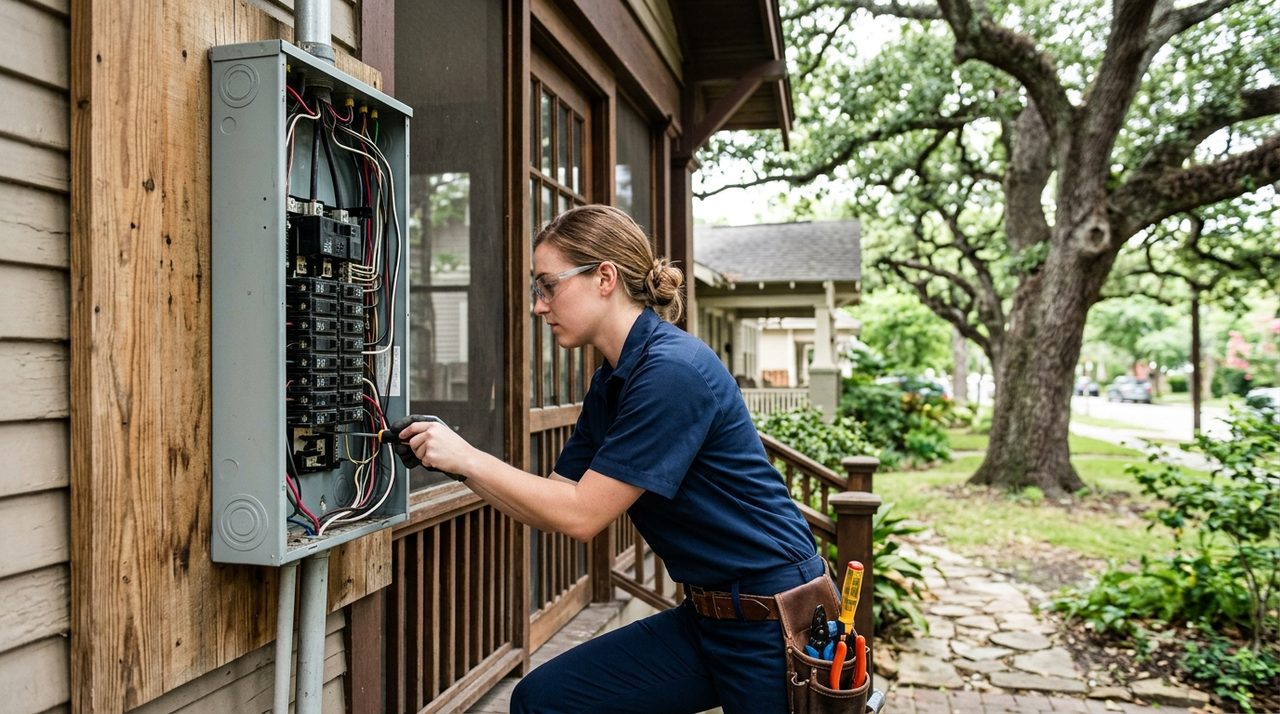
A licensed Texas Master Electrician — required to pull any permit in Bellaire — should perform a thermal-imaging and visual inspection of the panel interior and meter base before any other electrical work begins on a post-flood home. If replacement is warranted, Bellaire's floodplain regulations require that the new panel and meter base be elevated above the base flood elevation; your electrician must coordinate the elevation certificate with the City of Bellaire Building Department before scheduling the inspection. Panel replacement from 100A to 200A runs an estimated $1,800–$3,200 installed including permit fees, but floodplain compliance detailing (elevated mounting, weatherproof enclosures) can add cost depending on how much the equipment must be raised.
Sources: FEMA National Flood Hazard Layer (NFHL), Municipal permit office (see area profile), Texas Department of Licensing & Regulation
Why it matters to you
Bellaire's original housing wave — the brick ranches built from roughly 1955 through the mid-1970s — falls squarely within the national aluminum-branch-wiring era (1965–1975). Single-strand aluminum branch circuits oxidize at every receptacle and switch termination over time, and that oxidation creates resistance heating that is a documented fire risk. Because so many of these homes survived Harvey intact or were repaired rather than replaced, a notable number still carry this original wiring, and it tends to surface during the sale inspection process — a stressful moment to learn about a $3,500–$8,000 remediation estimate.
What a good pro does
Proper remediation is not a coat of anti-oxidant paste: it requires either full copper replacement throughout or installation of CO/ALR-rated devices and AlumiConn connectors at every termination point. A TDLR-licensed Master Electrician must pull a permit with the City of Bellaire Building Department for this scope; the city's independent permit office has its own inspection pipeline separate from Houston's, so don't assume Houston timelines apply. If your 1960s Bellaire ranch is approaching sale or you've had any nuisance breaker trips at receptacles, prioritize a whole-home wiring assessment before the inspector flags it for your buyer.
Sources: Texas Department of Licensing & Regulation, Municipal permit office (see area profile), International Residential Code (as adopted by City of Houston)
Why it matters to you
Winter Storm Uri in February 2021 knocked out natural gas supply across much of Houston for days, and many Bellaire homeowners responded by adding electric space heaters, heat-pump water heaters, or mini-split systems as backup or permanent replacements — typically without touching the main service. A 100-amp panel that was correctly sized for an all-gas 1960s ranch is not safely adequate once you add even two or three 240V resistance heaters or a heat-pump water heater drawing 4,500 watts continuously. Nuisance tripping is the early warning; overheated conductors and breaker failure are the consequence if the load mismatch isn't corrected.
What a good pro does
The fix is a service upgrade, and in Bellaire that means a permit pulled with the City of Bellaire Building Department — not Houston's online portal — by a TDLR-licensed Master Electrician. Upgrading from 100A to 200A runs an estimated $1,800–$3,200 installed; if the home also has EV charging ambitions or solar-plus-storage on the horizon, scoping to 400A at the same mobilization costs an estimated $3,500–$6,000 and avoids a second permit and CenterPoint reconnect appointment later. Ask your electrician to document the new load calculation so it's on file with the city if a future buyer or insurance adjuster asks.
Sources: Texas Department of Licensing & Regulation, Municipal permit office (see area profile), International Residential Code (as adopted by City of Houston)
Why it matters to you
Bellaire's building department requires that new construction and substantial improvements meet or exceed the 500-year floodplain elevation — a stricter standard than FEMA's minimum AE-zone requirement. In practice, this means that when a post-Harvey teardown-rebuild or a major remodel triggers a substantial-improvement threshold, all new electrical equipment (panels, subpanels, meter bases, and any HVAC disconnect equipment) must be installed at the code-required elevation, with documentation tied to an elevation certificate. Many homeowners on tight post-flood budgets tried to shortcut this step and are now discovering, during a sale or a second-round Beryl claim, that their permitted work has an open inspection or a non-compliant equipment elevation.
What a good pro does
Before scoping any electrical work on a Bellaire property that has a prior flood history or that is undergoing renovation work valued at more than 50% of the structure's assessed value, pull the elevation certificate from the City of Bellaire Building Department and confirm the required finished-floor and equipment elevation with the building official. Your TDLR-licensed electrician must incorporate those elevations into the permit drawings and installation scope; a CenterPoint reconnect will not be scheduled until the city issues a final inspection sign-off, so sequencing matters. Budget for elevated panel mounting hardware and weatherproof riser details as part of the base project cost, not as a change order.
Sources: FEMA National Flood Hazard Layer (NFHL), Municipal permit office (see area profile), Texas Department of Licensing & Regulation
Hiring electricians in Bellaire? Bellaire is an incorporated city almost entirely within the FEMA AE high-risk flood zone, which means elevation requirements, floodplain permitting, and post-Harvey rebuilds dominate the home service landscape. Housing stock ranges from 1950s slab-on-grade ranches to elevated new-construction traditionals, so contractors must be prepared for both legacy and modern systems on the same block. The city runs its own permitting office, and deed restrictions vary by subdivision, making pre-project due diligence essential.
Building era
1950s–1960s (original ranch stock) with a major wave of teardown/rebuild infill from the 1990s–2020s, accelerated after Hurricane Harvey.
Typical style
Traditional brick two-story (newer builds), single-story brick ranch (original 1950s–60s stock), transitional/Mediterranean customs, and remaining bungalows/cottages from the 1920s–1940s.
Foundations
Mixed — older homes are commonly slab-on-grade; post-Harvey new construction and major remodels are typically elevated on pier-and-beam or raised structural piers to meet floodplain requirements.
Common systems
Older ranches: original copper or galvanized plumbing, single-stage HVAC, 100–150 amp electrical panels. Newer builds: PEX plumbing, high-efficiency multi-stage HVAC, 200+ amp panels with whole-home surge protection. Tankless water heaters increasingly standard in post-2010 construction.
What that means for repairs
The dominant renovation activity is full teardown-and-rebuild or substantial elevation of existing structures to comply with the city's requirement that permitted construction be above the 500-year floodplain. Post-Harvey, many 1950s–60s ranches were demolished and replaced with larger two-story homes on elevated foundations.
Permit jurisdiction
City of Bellaire Building Department (Bellaire is an incorporated city with its own permitting office, independent of Houston Permitting Center and Harris County).
HOA & deed restrictions
No single city-wide mandatory HOA. Bellaire is composed of individual subdivisions, each with its own recorded deed restrictions. Some subdivisions have mandatory HOAs with dues and architectural controls; others rely on voluntary civic clubs or deed-restriction committees for enforcement. HOA status is lot-specific — check recorded CC&Rs via Harris County property records.
Historic districts
No City of Houston historic district designation confirmed. Bellaire is an independent incorporated city and does not fall under the Houston Archaeological and Historical Commission (HAHC).
Contractor note
Bellaire's floodplain regulations require an elevation certificate for most permitted work, and new construction or substantial improvements must meet or exceed the 500-year floodplain elevation. Contractors should confirm current BFE requirements and any deed-restriction architectural controls with the Bellaire Building Department before scoping work.
FEMA flood zone
FEMA Zone AE (high flood risk) — source: fema_nfhl. Virtually the entire city of Bellaire sits within the 100-year floodplain. Brays Bayou runs along Bellaire's northern boundary, and localized drainage issues compound flood risk throughout the city.
Hurricane Harvey impact
Hurricane Harvey (2017) caused significant flooding across Bellaire, inundating a large number of homes — particularly the older slab-on-grade ranch stock. The storm accelerated an already-active teardown cycle, with many flooded homes demolished and replaced by elevated new construction. Post-Harvey, the city enforces strict elevation requirements for permitted work, requiring structures to be built above the 500-year floodplain.
Heat & humidity load
Houston's extreme summer heat and humidity stress older HVAC systems in 1950s–60s ranches, many of which have limited insulation and single-pane windows. Elevated pier-and-beam homes require attention to moisture management and ventilation beneath the structure. Seasonal thunderstorms can overwhelm aging drainage infrastructure, making sump pumps and proper grading critical even for elevated homes.
Working with contractors here
Contractors in Bellaire most commonly handle full teardown-and-rebuild projects, structural elevation of existing homes, and flood damage remediation — all driven by the city's AE flood zone status and post-Harvey rebuilding activity. Older 1950s–60s ranches frequently need complete plumbing re-pipes (galvanized-to-PEX), electrical panel upgrades, and HVAC replacement. Because Bellaire is an incorporated city with its own building department, contractors must pull permits through the City of Bellaire rather than Harris County or Houston, and must navigate subdivision-specific deed restrictions that can impose setback, height, and material requirements. Job scoping should always begin with an elevation certificate review and a check of the property's specific deed restrictions and HOA status, as these vary block by block.
Local Tip
Always ask for a written estimate before work begins. Texas contractors are required to provide one on jobs over $1,000.
Bellaire is an incorporated city almost entirely within the FEMA AE high-risk flood zone, which means elevation requirements, floodplain permitting, and post-Harvey rebuilds dominate the home service landscape. Housing stock ranges from 1950s slab-on-grade ranches to elevated new-construction traditionals, so contractors must be prepared for both legacy and modern systems on the same block. The city runs its own permitting office, and deed restrictions vary by subdivision, making pre-project due diligence essential.
Source: U.S. Census Bureau, ACS 5-Year 2023
Much of Bellaire maps to FEMA Zone AE (high flood risk), so flood-resilient detailing -- elevated equipment, water-tolerant materials, and drainage-first thinking -- is essential here, not optional.
Source: FEMA National Flood Hazard Layer (NFHL). Flood zones vary by parcel — verify your individual FIRM panel.
After Harvey 2017 left Bellaire residents without power for weeks, the lesson for FEMA Zone AE inside the 100-year floodplain zones became clear: install a code-compliant manual transfer switch now so a licensed electrician can safely connect a portable generator without back-feeding CenterPoint's lines. Schedule that work before any named storm enters the Gulf, because licensed electricians book out fast once a watch is posted. Confirm the current FEMA panel for your Bellaire parcel — the area maps to Zone AE, but adjacent lots can differ.
The May 2024 derecho that ripped through Houston with 100-mph straight-line winds downed transformers and sent destructive voltage surges through the grid the moment power was restored — in Bellaire, where FEMA Zone AE inside the 100-year floodplain already stresses your electrical system, a whole-house surge arrester at the meter base is the single highest-value electrician upgrade you can make this season. Have a TDLR-licensed electrician install one before the June–September severe-storm peak. In-city Bellaire work falls under City of Houston floodplain and permitting rules.
Winter Storm Uri 2021 exposed a critical vulnerability for Bellaire homeowners in FEMA Zone AE inside the 100-year floodplain zones: sump pumps and flood-mitigation circuits that had never been tested under load failed when the freeze hit, leaving homes unprotected when pipes burst. Before the next hard freeze, have a TDLR-licensed electrician load-test your sump-pump circuits, verify GFCI functionality in below-grade spaces, and confirm your panel is rated for the draw of any portable heat source you plan to use. With a median build year of 1981, the older building stock here is more exposed to hard-freeze damage than newer construction. In-city Bellaire work falls under City of Houston floodplain and permitting rules.
Sources: FEMA National Flood Hazard Layer (NFHL), Ready.gov -- Hurricanes, CenterPoint Energy -- Storm Center, City of Houston -- Emergency Preparedness, Ready.gov -- Winter Weather, Harris County Flood Control District
Houston-specific estimators to plan your project before you call a pro. All results are planning estimates — a licensed local pro confirms the details on site.
Disconnect & drain every outdoor hose bib
Remove hoses, drain the spigots, and cover each with an insulated faucet sock. Un-drained hose bibs are the #1 burst point in a Houston freeze.
Insulate exposed pipes in the attic & garage
Wrap any pipe in an unconditioned space (attic runs, garage walls) with foam sleeves. Houston homes rarely insulate these because they only matter a few nights a year — which is exactly why they burst.
Open cabinet doors & keep a pencil-width drip
On hard-freeze nights, open kitchen/bath cabinets so warm air reaches the pipes and let faucets on exterior walls drip to relieve pressure.
Protect the attic/garage water heater & its lines
An attic or garage tank sits in unconditioned space. Insulate the cold-inlet and hot-outlet lines and confirm the emergency drain pan is clear so a leak doesn't reach the ceiling.
This is a planning estimate only — actual requirements depend on an on-site assessment by a licensed Houston pro. If a pipe has already burst, shut off your main water supply and call a licensed Houston plumber immediately — freeze bursts flood fast.
Sources: Municipal permit office (see area profile)Texas Department of Licensing & Regulation
Sources: FEMA National Flood Hazard Layer (NFHL)Municipal permit office (see area profile)
Sources: Municipal permit office (see area profile)
Sources: FEMA National Flood Hazard Layer (NFHL)Municipal permit office (see area profile)
Sources: Local HOA / deed restrictions (see area profile)Municipal permit office (see area profile)