Serving West University Based in Upper Kirby · 1 mi away
Best Electricians in West University
West University Place's electrical landscape is split between surviving 1930s–1950s bungalows carrying decades-old wiring and the wave of teardown-rebuilds that have reshaped the city since the 1980s—two very different scopes that both require permits pulled through West University Place's own independent permit office, not Houston's Permitting Center. With a Census median year built of 1993 and median home values exceeding $1.35 million, homeowners here face both preservation-era electrical hazards in remaining cottages and modern upgrade demands in custom homes now entering their first major service cycle.
Verified against Google Business data
Updated 2026
See the 10 Electricians Serving West University 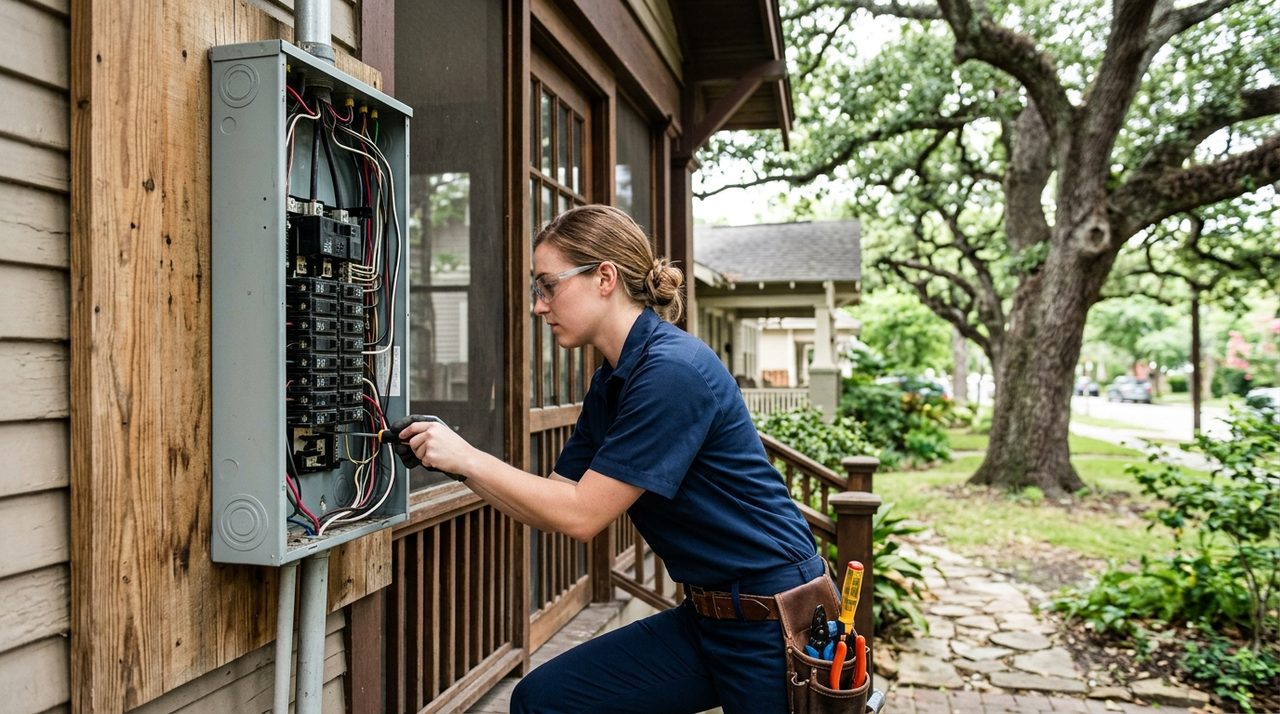
- Median home built
- 1993
- Median home value
- $1,354,300
- FEMA flood zone
- X500 (moderate)
- Panel upgrade cost (est.)
- $1,800–$3,200
- Most common local issue
- Aluminum branch-circuit wiring in original 1940s–1950s bungalows
Ranked by verified Google rating × review volume × verification tier. How we rank →
Some highly-rated pros serve West University from nearby and may not keep a West University street address. Those are listed under "Also serving West University" with their real city and distance, so you always know where each business is based.
Min rating:
10 resultsAlso serving West University
Highly-rated pros based nearby who cover West University. Distance shown from the West University area.
Serving West University Based in Bellaire · 1.8 mi away
Closed
Serving West University Based in Tanglewood · 2.1 mi away
Open Now
Serving West University Based in Upper Kirby · 2.2 mi away
Open Now
Serving West University Based in Bellaire · 2.4 mi away
Open Now
Serving West University Based in Tanglewood · 3.8 mi away
Closed
Serving West University Based in Bellaire · 3.8 mi away
Open Now
Serving West University Based in Braeswood · 3.9 mi away
Open Now
Serving West University Based in Lazybrook / Timbergrove · 5 mi away
Closed
Serving West University Based in Lazybrook / Timbergrove · 5.1 mi away
Electricians in West University: What You Should Know
Aluminum Branch-Circuit Wiring in West U's Surviving 1950s–1970s Cottages
Why it matters to you
A meaningful share of West University's original bungalows and early post-war cottages that have not yet been torn down were wired during the aluminum branch-circuit era (roughly 1965–1975), and some pre-1965 homes later had additions wired with aluminum as prices spiked. Single-strand aluminum oxidizes at every receptacle, switch, and fixture termination, creating resistance heat that is a recognized fire hazard—a concern that surfaces sharply during pre-sale inspections on these high-value lots. Given that West U lots routinely transact near or above the $1.35 million median, buyers' inspectors scrutinize electrical systems closely.
What a good pro does
A qualified Master Electrician—licensed through TDLR and pulling a permit through the City of West University Place's own permit office—should evaluate every termination point and either replace branch circuits with copper or install CO/ALR-rated devices with AlumiConn connectors at each connection. Applying anti-oxidant paste alone does not meet current remediation standards. Whole-home remediation estimates run $3,500–$8,000 depending on square footage and circuit count; get a written scope before committing.
Sources: Texas Department of Licensing & Regulation, Municipal permit office (see area profile), International Residential Code (as adopted by City of Houston)
Undersized 100-Amp Service in Older Homes After Post-Uri Electrical Additions
Why it matters to you
The original cottages that remain in West University were built in an era when 60-to-100-amp services were standard for all-gas homes; after Winter Storm Uri's February 2021 gas disruptions, many owners added electric space heaters, heat-pump water heaters, or mini-split backup systems without a service upgrade. A 100-amp main that was adequate for a 1,400-square-foot all-gas bungalow cannot safely carry simultaneous loads from a heat pump, an electric water heater, and a full central AC system during Houston's extreme summer cooling season—nuisance tripping and overheated conductors are the first symptoms homeowners notice.
What a good pro does
A Master Electrician permitted through the City of West University Place should perform a load calculation per the NEC before specifying the upgrade path; most older West U cottages need at least a 200-amp service ($1,800–$3,200 estimated installed, including permit), and homes planning concurrent EV charger or solar additions should discuss a 400-amp service ($3,500–$6,000 estimated) at the same time to avoid a second cut later. West U's independent permit office runs its own inspection schedule—confirm turnaround times before scheduling CenterPoint's reconnect appointment.
Sources: Texas Department of Licensing & Regulation, Municipal permit office (see area profile), International Residential Code (as adopted by City of Houston)
Attic Junction Box Corrosion in Both Vintage and 1990s–2000s Custom Homes
Why it matters to you
Houston's average relative humidity exceeds 75% year-round, and West University's dense tree canopy keeps ambient moisture elevated even after rain events. Attic spaces in both the city's remaining 1940s–1950s bungalows and its 1990s–2000s custom rebuilds routinely exceed 140°F in summer, accelerating oxidation of wire nuts and aluminum neutral conductors and degrading insulation on older THHN wiring. Homeowners typically discover the damage only after a breaker trips repeatedly or a thermal-imaging scan during a home inspection flags a hot spot—at which point the repair scope in an occupied custom home can be substantial.
What a good pro does
A licensed electrician should perform a thermal-imaging walkthrough in any West U home that is 20-plus years old or that has had roof or insulation work disturb attic wiring runs. Corroded junction boxes must be replaced and re-covered per NEC (not taped and abandoned), and aluminum neutral conductors showing pitting should be evaluated for full replacement rather than re-termination. All work in West University Place requires a permit pulled with the city's own permit office—not Houston's Permitting Center—so contractors unfamiliar with West U's jurisdiction should confirm local requirements before starting.
Sources: Municipal permit office (see area profile), Texas Department of Licensing & Regulation, International Residential Code (as adopted by City of Houston)
EV Charger Circuits in Custom Homes with Already-Loaded Panels
Why it matters to you
West University's 1990s–2000s custom homes were built with 200-amp services sized for high-end gas-appliance packages, but two decades of additions—home offices, bonus rooms, wine refrigerators, and pool equipment—have consumed much of that headroom. Homeowners now adding Level 2 EV chargers discover their panel has little or no spare capacity, turning a $400–$900 charger circuit install into a concurrent panel evaluation and potentially a service upgrade. Because West U is an independent municipality, the electrical permit goes through the City of West University Place's permit office, not Houston's, and inspection scheduling timelines can differ from what contractors experienced elsewhere in the metro.
What a good pro does
Before any EVSE circuit work begins, a TDLR-licensed Master Electrician should pull the existing load calculation and determine whether the panel supports a 50-amp dedicated circuit without a service upgrade; if the panel is borderline, adding a load-management device (car-charger demand control) may defer a full upgrade. All permits must be filed with West University Place directly—contractors should verify the city's current fee schedule and inspection availability as part of the bid process, since turnaround times differ from the Houston Permitting Center.
Sources: Texas Department of Licensing & Regulation, Municipal permit office (see area profile), International Residential Code (as adopted by City of Houston)
Electricians in West University: What You Should Know
Hiring electricians in West University? West University Place is an independent municipality within the Inner Loop featuring a mix of original 1930s–1950s bungalows and larger custom homes built from the 1980s onward as teardown-rebuild cycles reshaped the neighborhood. Homeowners here navigate the city's own permitting process—separate from Houston's—and must account for aging systems in older homes alongside modern construction standards in newer builds. The tree-lined streets and high property values drive demand for premium finishes and careful code compliance.
- Housing era
- Mixed
- Foundation
- Not confirmed from available sources - likely mixed pier-and-beam on older pre-1950s homes and…
- Flood zone
- FEMA Zone X500 (moderate flood risk) per official NFHL data
- Permits
- City of West University Place (independent municipality - own permit office, not City of…
Housing stock & systems
Building era
Mixed: original homes from 1930s–1950s with significant infill and teardown-rebuild construction from the 1980s–2000s and continuing today.
Typical style
Traditional brick, Georgian/Colonial-influenced, neo-traditional custom homes (2-story), with some remaining early-20th-century bungalows and cottages.
Foundations
Not confirmed from available sources - likely mixed pier-and-beam on older pre-1950s homes and slab-on-grade on newer construction. Verify on a per-property basis.
Common systems
Older homes (1930s–1950s) may have original galvanized or cast-iron plumbing, outdated electrical panels, and window AC or early central HVAC. Newer construction (1980s–present) typically features copper or PEX plumbing, modern electrical, and high-efficiency central HVAC systems.
What that means for repairs
Teardown-and-rebuild activity has been the dominant renovation pattern for decades, replacing smaller original cottages with larger custom homes. Remaining older homes frequently undergo full-gut renovations including electrical rewiring, plumbing replacement, foundation repair, and HVAC modernization to meet current standards and market expectations.
Permits & restrictions
Permit jurisdiction
City of West University Place (independent municipality - own permit office, not City of Houston Permitting Center and not Harris County).
HOA & deed restrictions
No mandatory city-wide master HOA. West U functions as an independent municipality with its own zoning and code enforcement. Individual condo and townhome associations exist (e.g., The Oaks at West University Condominium Association), but most single-family homes have no HOA. Deed restrictions may exist on individual plats—check Harris County Clerk records for specific lots.
Historic districts
No City of Houston historic district designation applies. West University Place is an independent municipality outside Houston city limits, so HAHC Certificates of Appropriateness are not required. West U may have its own local design or zoning controls—check with the City of West University Place directly.
Contractor note
Contractors must pull permits through the City of West University Place, not through Houston or Harris County. West U's own inspectors enforce local codes, and the city's zoning and building requirements may differ from Houston's, so contractors unfamiliar with the jurisdiction should review local ordinances before bidding.
Flood & weather
FEMA flood zone
FEMA Zone X500 (moderate flood risk) per official NFHL data. West University Place sits between Brays Bayou to the south and Rice University to the east, with drainage flowing into Harris County Flood Control District channels.
Hurricane Harvey impact
Specific Harvey 2017 flood impact data for West University Place streets was not available in the research provided. The moderate flood risk zone designation and proximity to Brays Bayou suggest potential vulnerability, but confirmed street-level flooding details and repetitive-loss areas should be verified through HCFCD inundation maps and City of West University Place floodplain reports.
Heat & humidity load
Houston's extreme summer heat and humidity stress HVAC systems across all housing eras. Older pier-and-beam homes may experience moisture-related subfloor issues, while the mature tree canopy—a signature feature of West U—creates ongoing gutter maintenance demands and potential root intrusion into aging sewer lines.
Working with contractors here
Contractors in West University most commonly handle full-home renovations and teardown-rebuilds, driven by buyers acquiring older cottages on valuable lots and replacing them with larger custom homes. For surviving 1930s–1950s homes, foundation repair, whole-house repiping (replacing galvanized with copper or PEX), electrical panel upgrades, and HVAC replacement are frequent scopes. Newer 1990s–2000s homes generate demand for roof replacements, exterior paint, and kitchen/bath remodels as they reach their first major maintenance cycles. Job scoping must account for West University Place's independent permitting process, which can differ from Houston's in turnaround times and inspection requirements. The high-end market expectations in West U mean contractors should budget for premium materials and meticulous finish work.
Local Tip
Always ask for a written estimate before work begins. Texas contractors are required to provide one on jobs over $1,000.
About West University
West University Place is an independent municipality within the Inner Loop featuring a mix of original 1930s–1950s bungalows and larger custom homes built from the 1980s onward as teardown-rebuild cycles reshaped the neighborhood. Homeowners here navigate the city's own permitting process—separate from Houston's—and must account for aging systems in older homes alongside modern construction standards in newer builds. The tree-lined streets and high property values drive demand for premium finishes and careful code compliance.
- Median year built
- 1993
- Median home value
- $1,354,300
- Owner-occupied
- 72.4%
- Population
- 28,231
- Housing units
- 10,564
- Median income
- $215,708
Source: U.S. Census Bureau, ACS 5-Year 2023
Flood & storm risk
FEMA Zone X500Moderate flood riskWest University carries FEMA Zone X500 (moderate flood risk): outside the 100-year floodplain but inside the 500-year, so heavy-rain events still reach homes and flood-aware work pays off.
Source: FEMA National Flood Hazard Layer (NFHL). Flood zones vary by parcel — verify your individual FIRM panel.
Houston Storm Readiness in West University
Hurricane & flooding
Even in West University's moderate-risk FEMA Zone X500 in the 500-year floodplain zone, heavy tropical rainfall can back-flood garages and utility rooms, so ask a TDLR-licensed electrician to raise any sub-grade outlets, sump-pump receptacles, and low-mounted panels to a height that keeps them dry in a 10-inch rain event. Beryl 2024 proved that tropical systems don't have to stall over Houston to produce damaging localized flooding. Confirm the current FEMA panel for your West University parcel — the area maps to Zone X500, but adjacent lots can differ.
Severe storms & hail
The May 2024 derecho proved that severe thunderstorms don't need to be hurricanes to cause multi-day outages across West University, so a generator interlock kit installed by a TDLR-licensed electrician is a practical moderate-investment upgrade that pays for itself the first time the grid goes down for 48 hours. An interlock lets you safely connect a portable generator to your existing panel without violating CenterPoint's back-feed prohibitions. In-city West University work falls under City of Houston floodplain and permitting rules.
Ice storms & freezes
Winter Storm Uri 2021 left millions of Texans running extension cords from portable generators through windows — a practice CenterPoint and Ready.gov both flag as a carbon-monoxide and fire risk; in West University, a properly installed generator interlock by a TDLR-licensed electrician eliminates that improvisation and lets you safely power your furnace blower, refrigerator, and phone chargers during an extended freeze-driven outage. Book the installation in October, before the first hard-freeze watches appear on the National Weather Service. In-city West University work falls under City of Houston floodplain and permitting rules.
Sources: FEMA National Flood Hazard Layer (NFHL), Ready.gov -- Hurricanes, CenterPoint Energy -- Storm Center, City of Houston -- Emergency Preparedness, Ready.gov -- Winter Weather, Harris County Flood Control District
Free West University Tools & Calculators
Houston-specific estimators to plan your project before you call a pro. All results are planning estimates — a licensed local pro confirms the details on site.
Houston Freeze Prep & Pipe Insulation Checklist
Open full tool & FAQ →Your freeze checklist — 4 tasks
- 1
Disconnect & drain every outdoor hose bib
Remove hoses, drain the spigots, and cover each with an insulated faucet sock. Un-drained hose bibs are the #1 burst point in a Houston freeze.
- 2
Insulate exposed pipes in the attic & garage
Wrap any pipe in an unconditioned space (attic runs, garage walls) with foam sleeves. Houston homes rarely insulate these because they only matter a few nights a year — which is exactly why they burst.
- 3
Open cabinet doors & keep a pencil-width drip
On hard-freeze nights, open kitchen/bath cabinets so warm air reaches the pipes and let faucets on exterior walls drip to relieve pressure.
- 4
Protect the attic/garage water heater & its lines
An attic or garage tank sits in unconditioned space. Insulate the cold-inlet and hot-outlet lines and confirm the emergency drain pan is clear so a leak doesn't reach the ceiling.
This is a planning estimate only — actual requirements depend on an on-site assessment by a licensed Houston pro. If a pipe has already burst, shut off your main water supply and call a licensed Houston plumber immediately — freeze bursts flood fast.
Frequently Asked Questions
Do I need to pull an electrical permit through the City of West University Place or the City of Houston Permitting Center for a panel upgrade?
West University Place is an independent municipality with its own permit office entirely separate from the City of Houston Permitting Center and from Harris County—your electrician must apply directly through West U's building department. Contractors who routinely work Houston proper sometimes default to the wrong jurisdiction, so confirm before any work begins that permit applications are filed with the City of West University Place. Turnaround times and inspection schedules at West U's smaller office can differ from Houston's, so ask your electrician specifically how many business days they expect between permit submission and first inspection.
Sources: Municipal permit office (see area profile)
My West University home is a 1940s pier-and-beam bungalow—does the foundation type change how an electrician routes new circuits?
Pre-1950s homes in West U are likely pier-and-beam, which actually simplifies new circuit runs compared to slab-on-grade: electricians can route conductors through the crawl space rather than trenching or surface-mounting conduit. The trade-off is that the crawl space environment under Houston's humidity can accelerate insulation degradation on older wiring already in place, so a good electrician will inspect accessible runs beneath the floor while they're down there. If your cottage still has original knob-and-tube or early rubber-insulated wiring, budget for remediation as a likely companion scope.
West University is in FEMA Zone X500—does that moderate flood risk affect where an electrician places a new subpanel or transfer switch?
Zone X500 means your property sits outside the 100-year floodplain but inside the 500-year boundary, so mandatory elevation requirements that apply in AE zones don't automatically kick in—but heavy rainfall events do still reach West U homes. A prudent electrician will avoid placing a new subpanel or generator transfer switch in a finished garage or at floor grade in a low-lying utility room, even without a code mandate, because a few inches of water can destroy a panel and void equipment warranties. Discuss finished-floor elevation with your electrician before finalizing the subpanel location, especially on the older bungalows where the original panel may already be sitting close to grade.
What's a realistic cost estimate and timeline for a whole-house rewire on a surviving 1940s West University cottage, and what does the West U permit process add?
A full rewire on a 1,200–1,800 sq ft vintage cottage in the Houston metro typically runs $8,000–$18,000 installed as an estimate, depending on whether the home is pier-and-beam or has been slab-added, the number of circuits, and finish-out complexity—West U's high-end market expectations often push labor and material choices toward the upper range. The City of West University Place will require an electrical permit, and you should budget for multiple inspections (rough-in and final at minimum) with scheduling lead times that can add one to three weeks to the overall project timeline. Get a line-item proposal that separates permit fees, panel replacement, and branch-circuit labor so you can compare bids accurately.
Sources: Municipal permit office (see area profile)Texas Department of Licensing & Regulation
We're adding a solar-plus-battery system to our 2000s custom home in West University—who handles the permits and the CenterPoint interconnection?
Solar-plus-storage installations in West U require both an electrical permit from the City of West University Place and a separate CenterPoint Energy interconnection application—these run on parallel tracks and both must be complete before the utility will authorize net-metering. The electrical work must be supervised by a TDLR-licensed Master Electrician, and NABCEP certification, while not legally required, is the recognized quality credential for the solar-specific scope and is worth asking for when vetting installers. Missteps like installing a battery without a permitted transfer switch are a documented failure point—confirm your installer has experience coordinating the West U permit office and CenterPoint's interconnection queue simultaneously.
Sources: Texas Department of Licensing & RegulationNorth American Board of Certified Energy Practitioners (NABCEP)Municipal permit office (see area profile)
Is summer or fall a better time to schedule a major electrical project in West University, given how busy contractors get after storms?
Late spring and early summer are the riskiest scheduling windows: the Atlantic hurricane season opens June 1, and storm-driven demand from events like the May 2024 derecho and Hurricane Beryl can pull licensed electricians into emergency weatherhead and meter-base repairs for weeks at a time, stretching lead times for planned projects. Late fall through February is generally the most predictable window in the Houston metro—contractor availability is higher, permit office turnaround at West U tends to be faster, and you're clear of the peak storm surge. If your project is tied to a home sale or teardown timeline, book electrical work at least six to eight weeks out regardless of season, and have your electrician confirm their permit submission date in writing.