Closed
Serving West University Based in Bellaire · 3 mi away
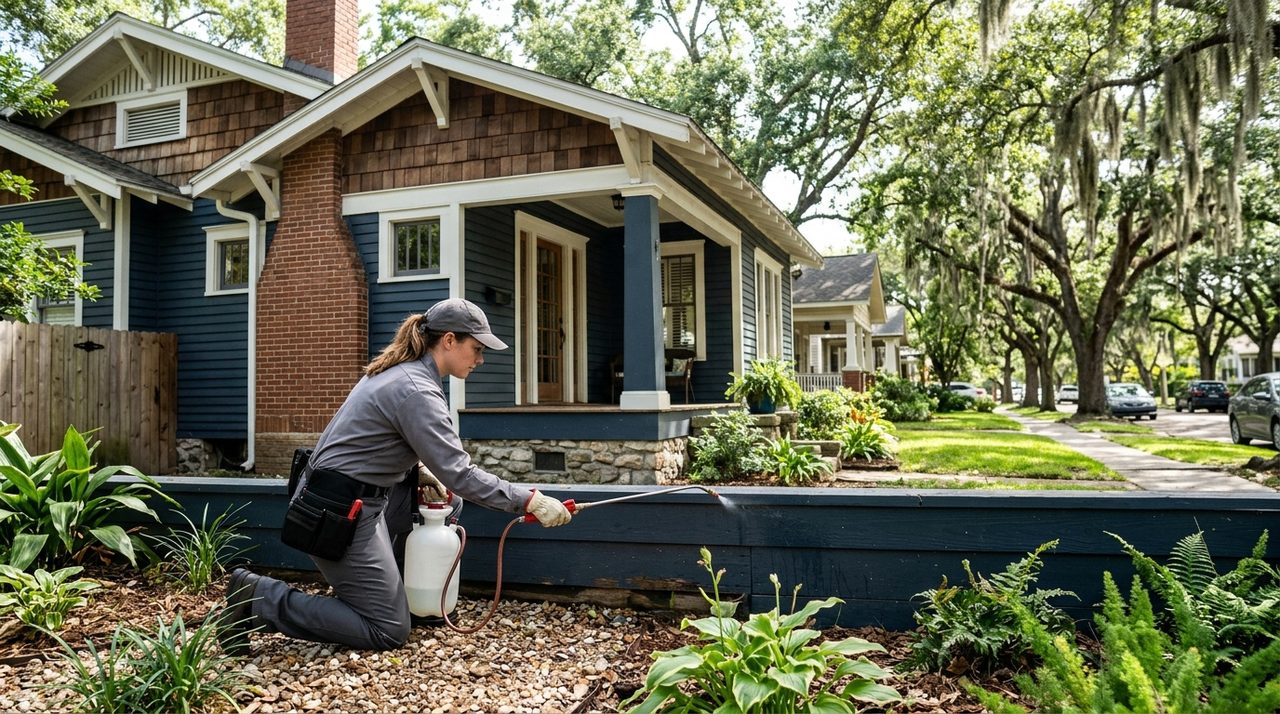
West University Place's unusual housing mix — pre-1950s pier-and-beam bungalows sitting lot-to-lot with post-1980s slab-on-grade custom rebuilds — creates two entirely different pest-entry profiles on the same tree-lined block, and the city's independent permitting office means service protocols that work in Houston proper don't automatically translate here. Houston sits in USDA's highest-pressure termite zone, and West U's mature oak canopy, irrigated turf, and mix of cast-iron drain lines in older cottages alongside post-tension slab expansions in newer homes give Formosan and native subterranean termites, American cockroaches, and roof rats multiple, distinct entry strategies depending on which decade your house was built.
Ranked by verified Google rating × review volume × verification tier. How we rank →
Some highly-rated pros serve West University from nearby and may not keep a West University street address. Those are listed under "Also serving West University" with their real city and distance, so you always know where each business is based.
Highly-rated pros based nearby who cover West University. Distance shown from the West University area.
Serving West University Based in Bellaire · 3 mi away
Serving West University Based in Tanglewood · 3.2 mi away
Serving West University Based in Tanglewood · 4.1 mi away
Serving West University Based in Lazybrook / Timbergrove · 4.3 mi away
Serving West University Based in Tanglewood · 4.4 mi away
Serving West University Based in Briargrove · 4.4 mi away
Serving West University Based in Briargrove · 4.6 mi away
Serving West University Based in Meyerland · 4.7 mi away
Serving West University Based in Midtown · 4.7 mi away
Serving West University Based in Briargrove · 5.2 mi away
Why it matters to you
West University's remaining 1930s–1950s bungalows sit on pier-and-beam foundations — giving Formosan and Reticulitermes termites direct soil-to-wood access through the open crawlspace and wooden sill plates, where infestations can go undetected for years under original hardwood flooring. The post-1980s teardown-rebuild custom homes next door present a different but equally serious profile: expansion joints, post-tension cable sleeves, and plumbing penetrations in slab-on-grade construction serve as soil-to-wood highways, especially where mulched landscaping is tight against the foundation — common in West U's heavily landscaped lots.
What a good pro does
A TDLR-licensed termite applicator should perform a whole-structure Wood-Destroying Insect report that documents both foundation types, probing crawlspace sill plates and slab perimeter separately. For pier-and-beam homes, a soil-applied liquid barrier (Termidor-type, estimated $800–$1,800 depending on linear footage) is typically combined with subfloor inspections; for slab homes, bait station installation (estimated $1,200–$2,000 plus $300–$500/year monitoring) addresses expansion joint exposure without soil disruption to established landscaping. Confirm the technician holds a Category 2 (Subterranean Termite) endorsement on their TDLR license.
Why it matters to you
West University's original 1930s–1950s homes that haven't yet gone through a full gut renovation frequently retain cast-iron drain lines, which crack and gap with age and Houston's clay-driven soil movement — creating direct sewer-to-slab pathways for Periplaneta americana. These 'waterbugs' exploit floor drains, weep holes in brick veneer, and unsealed plumbing penetrations, surging indoors after heavy rain events displace them from storm sewers — a recurring pattern in West U given its X500 flood designation and poorly draining clay soils.
What a good pro does
Effective control in these older homes requires exterior exclusion — sealing weep holes with pest-rated mesh, caulking plumbing penetrations at the slab — combined with interior drain treatments using appropriately labeled gel baits or enzyme-based products, not just perimeter spraying. A TDLR-licensed general household pest applicator should walk the exterior and map every potential entry point before treating; interior spraying alone consistently fails in cast-iron drain scenarios. Homeowners considering full repiping (a common West U renovation scope) should coordinate pest control inspection before and after plumbing replacement to ensure penetrations are properly resealed.
Sources: Texas Department of Licensing & Regulation, FEMA National Flood Hazard Layer (NFHL)
Why it matters to you
West University's signature tree-lined streets — with mature live oaks and pecans arching over rooflines — give Rattus rattus (roof rats) easy limb-to-roofline access year-round, and the neighborhood's high rate of older wood-soffit construction on surviving pre-1980 homes means storm damage from events like the May 2024 derecho (100+ mph gusts) or Beryl's July 2024 passage can open attic entry points within hours. Even on newer custom homes, construction gaps around roofline HVAC penetrations and uncapped ridge vents are exploited rapidly once surrounding trees funnel rats toward the structure.
What a good pro does
Rodent exclusion — physically sealing all openings 1/4 inch or larger with hardware cloth or metal flashing — must precede any baiting or trapping program; without it, new rats replace trapped ones within weeks. A TDLR-licensed rodent control operator should conduct a roofline inspection, ideally from a ladder, identifying live-oak limb overhangs within 4–6 feet of the roofline and documenting soffit condition. Post-storm exclusion work in West University Place requires permits pulled through the City of West University Place's own permit office, not Houston's Permitting Center — contractors unfamiliar with the jurisdiction should confirm local building requirements before repairing storm-damaged fascia or soffit that requires a building permit.
Sources: Texas Department of Licensing & Regulation, Local HOA / deed restrictions (see area profile)
Why it matters to you
West University's FEMA X500 designation and Harris County clay soil mean that even moderate rain events — not just named storms — leave standing water in low spots, planter beds, and compacted turf for 72+ hours, creating prime Aedes aegypti and Culex quinquefasciatus breeding habitat. The Harris County Mosquito Control District aerially treats public rights-of-way but does not treat private yards, so West U homeowners with dense landscaping (a hallmark of the neighborhood's premium lots) are on their own for source reduction and barrier treatment on their property.
What a good pro does
A licensed barrier spray program (estimated $75–$150 per application, monthly during peak season April–October) should be paired with a property-specific source-reduction assessment identifying clogged gutters, ornamental pots, and low-drainage planting beds — all common in West U's heavily landscaped lots. The applicator must hold a TDLR General Pest Control license with appropriate pesticide category endorsement; products applied near West U's mature trees and irrigated turf should be reviewed against label requirements for proximity to landscape plants. Larviciding standing water with BTI (Bacillus thuringiensis israelensis) is a low-toxicity complement that TDLR-licensed operators can apply to areas where draining isn't practical.
Sources: Texas Department of Licensing & Regulation, Harris County Flood Control District, FEMA National Flood Hazard Layer (NFHL)
Hiring pest control in West University? West University Place is an independent municipality within the Inner Loop featuring a mix of original 1930s–1950s bungalows and larger custom homes built from the 1980s onward as teardown-rebuild cycles reshaped the neighborhood. Homeowners here navigate the city's own permitting process—separate from Houston's—and must account for aging systems in older homes alongside modern construction standards in newer builds. The tree-lined streets and high property values drive demand for premium finishes and careful code compliance.
Building era
Mixed: original homes from 1930s–1950s with significant infill and teardown-rebuild construction from the 1980s–2000s and continuing today.
Typical style
Traditional brick, Georgian/Colonial-influenced, neo-traditional custom homes (2-story), with some remaining early-20th-century bungalows and cottages.
Foundations
Not confirmed from available sources - likely mixed pier-and-beam on older pre-1950s homes and slab-on-grade on newer construction. Verify on a per-property basis.
Common systems
Older homes (1930s–1950s) may have original galvanized or cast-iron plumbing, outdated electrical panels, and window AC or early central HVAC. Newer construction (1980s–present) typically features copper or PEX plumbing, modern electrical, and high-efficiency central HVAC systems.
What that means for repairs
Teardown-and-rebuild activity has been the dominant renovation pattern for decades, replacing smaller original cottages with larger custom homes. Remaining older homes frequently undergo full-gut renovations including electrical rewiring, plumbing replacement, foundation repair, and HVAC modernization to meet current standards and market expectations.
Permit jurisdiction
City of West University Place (independent municipality - own permit office, not City of Houston Permitting Center and not Harris County).
HOA & deed restrictions
No mandatory city-wide master HOA. West U functions as an independent municipality with its own zoning and code enforcement. Individual condo and townhome associations exist (e.g., The Oaks at West University Condominium Association), but most single-family homes have no HOA. Deed restrictions may exist on individual plats—check Harris County Clerk records for specific lots.
Historic districts
No City of Houston historic district designation applies. West University Place is an independent municipality outside Houston city limits, so HAHC Certificates of Appropriateness are not required. West U may have its own local design or zoning controls—check with the City of West University Place directly.
Contractor note
Contractors must pull permits through the City of West University Place, not through Houston or Harris County. West U's own inspectors enforce local codes, and the city's zoning and building requirements may differ from Houston's, so contractors unfamiliar with the jurisdiction should review local ordinances before bidding.
FEMA flood zone
FEMA Zone X500 (moderate flood risk) per official NFHL data. West University Place sits between Brays Bayou to the south and Rice University to the east, with drainage flowing into Harris County Flood Control District channels.
Hurricane Harvey impact
Specific Harvey 2017 flood impact data for West University Place streets was not available in the research provided. The moderate flood risk zone designation and proximity to Brays Bayou suggest potential vulnerability, but confirmed street-level flooding details and repetitive-loss areas should be verified through HCFCD inundation maps and City of West University Place floodplain reports.
Heat & humidity load
Houston's extreme summer heat and humidity stress HVAC systems across all housing eras. Older pier-and-beam homes may experience moisture-related subfloor issues, while the mature tree canopy—a signature feature of West U—creates ongoing gutter maintenance demands and potential root intrusion into aging sewer lines.
Working with contractors here
Contractors in West University most commonly handle full-home renovations and teardown-rebuilds, driven by buyers acquiring older cottages on valuable lots and replacing them with larger custom homes. For surviving 1930s–1950s homes, foundation repair, whole-house repiping (replacing galvanized with copper or PEX), electrical panel upgrades, and HVAC replacement are frequent scopes. Newer 1990s–2000s homes generate demand for roof replacements, exterior paint, and kitchen/bath remodels as they reach their first major maintenance cycles. Job scoping must account for West University Place's independent permitting process, which can differ from Houston's in turnaround times and inspection requirements. The high-end market expectations in West U mean contractors should budget for premium materials and meticulous finish work.
Local Tip
Always ask for a written estimate before work begins. Texas contractors are required to provide one on jobs over $1,000.
West University Place is an independent municipality within the Inner Loop featuring a mix of original 1930s–1950s bungalows and larger custom homes built from the 1980s onward as teardown-rebuild cycles reshaped the neighborhood. Homeowners here navigate the city's own permitting process—separate from Houston's—and must account for aging systems in older homes alongside modern construction standards in newer builds. The tree-lined streets and high property values drive demand for premium finishes and careful code compliance.
Source: U.S. Census Bureau, ACS 5-Year 2023
West University carries FEMA Zone X500 (moderate flood risk): outside the 100-year floodplain but inside the 500-year, so heavy-rain events still reach homes and flood-aware work pays off.
Source: FEMA National Flood Hazard Layer (NFHL). Flood zones vary by parcel — verify your individual FIRM panel.
Houston-specific estimators to plan your project before you call a pro. All results are planning estimates — a licensed local pro confirms the details on site.
| Pest | Cadence | Active window |
|---|---|---|
Mosquito control A standard 4-week barrier treatment holds a typical suburban lot through Houston's core mosquito season. | Every 28 days | April – October |
Termite (subterranean) A once-a-year spring inspection is the baseline for a drier, sunnier Houston lot — catch mud tubes and swarmer wings before damage compounds. | Annual inspection | Spring |
General pest guard (roaches, ants, spiders) Houston's year-round warmth means general pests never fully die off — a quarterly perimeter treatment is the standard maintenance rhythm. | Quarterly | Mar · Jun · Sep · Dec |
This is a planning estimate only — actual requirements depend on an on-site assessment by a licensed Houston pro. Texas requires an SPCB-licensed applicator for chemical treatment — ask for the technician's license number.
Sources: FEMA National Flood Hazard Layer (NFHL)Harris County Flood Control District
Sources: Local HOA / deed restrictions (see area profile)