23013 Volga Dr, Porter, TX 77365
Best Electricians in Porter, TX
Porter is an unincorporated patchwork of Montgomery County subdivisions—ranging from 1970s acreage lots to brand-new Valley Ranch production homes—where every electrical project runs through Montgomery County Engineering rather than any city permit office, and where HOA architectural review can add weeks to an exterior job before a single wire is pulled. The area's median build year of 2001 masks a wide range: original 100-amp panels in older plats sit alongside modern 200-amp installs in master-planned communities, and the difference determines what your home can safely power today.
Verified against Google Business data
Updated 2026
See the 9 Electricians Serving Porter 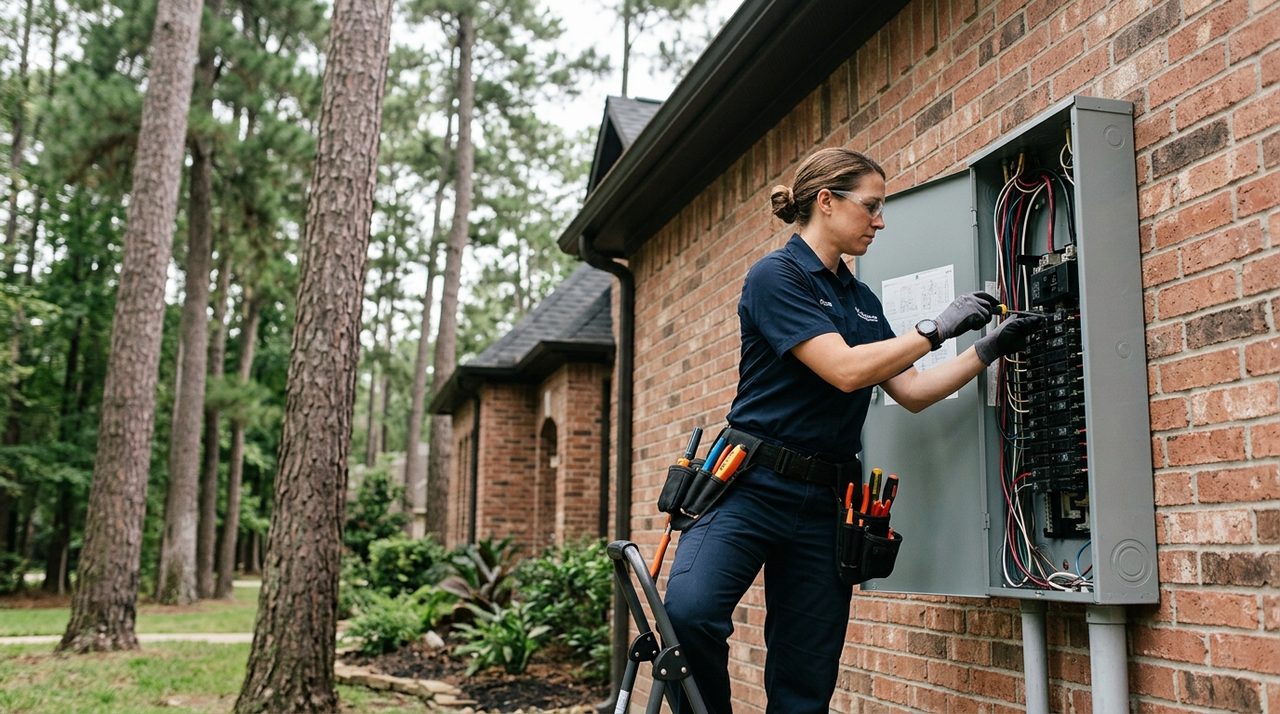
- Median home built
- 2001
- Median home value
- $226,053
- FEMA flood zone
- X (low)
- Panel upgrade cost (est.)
- $1,800–$3,200 (100A→200A)
- Most common local issue
- Undersized 100–150A panels in 1970s–1990s-era plats straining under added heat and EV loads
Ranked by verified Google rating × review volume × verification tier. How we rank →
Some highly-rated pros serve Porter from nearby and may not keep a Porter street address. Those are listed under "Also serving Porter" with their real city and distance, so you always know where each business is based.
Min rating:
9 resultsBased in Porter
Closed
22672 Ford Rd, Porter, TX 77365
Open Now
3677 Karissa Rd, Conroe, TX 77306
Open Now
23010 Gabriel, New Caney, TX 77357
21322 Lexor Dr, Porter, TX 77365
Open Now
21420 Surrey Glen Ct, Porter, TX 77365
Open Now
23575 US-59, Porter, TX 77365
Also serving Porter
Highly-rated pros based nearby who cover Porter. Distance shown from the Porter area.
Serving Porter Based in Kingwood · 4.2 mi away
Serving Porter Based in Humble · 5.4 mi away
Electricians in Porter: What You Should Know
Aging 100-Amp Panels in Porter's Older Plats Can't Keep Up With Modern Loads
Why it matters to you
Porter's older subdivisions—built from the 1970s through the early 1990s—commonly retain their original 100- or 150-amp service panels, which were sized for all-gas homes with minimal appliance loads. After Winter Storm Uri drove many Montgomery County homeowners to add electric space heaters, heat-pump water heaters, or mini-splits as gas-backup alternatives, these undersized services began nuisance-tripping under the new demand. If your home also has a well pump or a subpanel feeding an outbuilding or barndominium on an acreage lot—both common in Porter's unrestricted tracts—the risk of overloaded conductors is compounded further.
What a good pro does
A TDLR-licensed Master Electrician should perform a load calculation per current code to determine whether a service upgrade to 200A is warranted before adding any new circuit. In Montgomery County, that upgrade requires a permit pulled through Montgomery County Engineering—not a city permit office—with a county inspection scheduled before CenterPoint restores service. Estimated cost for a 100A-to-200A upgrade in the Houston metro runs $1,800–$3,200 installed, including permit fees, though site conditions on older Porter lots can push that higher.
Sources: Texas Department of Licensing & Regulation, Municipal permit office (see area profile)
EV Charger Installs in HOA Communities Like Valley Ranch Require Two Approval Tracks
Why it matters to you
Level 2 EV charger installations in Porter's master-planned communities—Valley Ranch being the largest—are complicated by the fact that the Valley Ranch HOA's architectural review committee must approve exterior equipment placement and visible conduit routing before any physical work begins, and separately, a Montgomery County electrical permit is required for the supply circuit itself. Homeowners who skip the HOA step first risk having the ACC demand removal of an already-installed charger, burning both time and money. For homes with original 100- to 150-amp panels, the charger circuit may also trigger a concurrent service upgrade.
What a good pro does
Before scheduling an electrician, pull the Valley Ranch or North Country HOA's current ACC guidelines and submit the equipment location and conduit routing plan for written approval—this step alone can take two to four weeks. Once HOA approval is in hand, a TDLR-licensed Master Electrician can pull the county electrical permit and perform the load calculation; if the panel is undersized, a service upgrade must be permitted and inspected before the EVSE circuit is energized. A standalone Level 2 charger circuit (when the panel already has capacity) typically runs $400–$900 installed in this market, as an estimate.
Sources: Texas Department of Licensing & Regulation, Local HOA / deed restrictions (see area profile), Municipal permit office (see area profile)
Aluminum Branch-Circuit Wiring in Porter's 1970s Homes Creates Termination Fire Risk
Why it matters to you
Homes built in Porter during the 1965–1975 aluminum-wiring era—concentrated in the area's older plats on larger acreage lots—frequently have single-strand aluminum branch circuits that oxidize at every outlet, switch, and fixture termination. This oxidation increases resistance, generates heat, and over decades can create a fire hazard that is invisible from the panel. As these homes approach sale, home inspectors routinely flag aluminum wiring, and buyers' lenders sometimes require remediation as a closing condition.
What a good pro does
Proper remediation is not simply coating connections with No-Ox paste; it requires either full copper replacement or the installation of CO/ALR-rated devices and UL-listed AlumiConn connectors at every single termination in the home. A TDLR-licensed Master Electrician familiar with Montgomery County permitting should scope the work—whole-home remediation on a typical Porter-era home of 1,500–2,500 square feet typically costs $3,500–$8,000 as an estimate, depending on circuit count and accessibility. Because many older Porter lots include detached garages or outbuildings on the same service, those structures must be checked for aluminum wiring as well.
Sources: Texas Department of Licensing & Regulation, Municipal permit office (see area profile), International Residential Code (as adopted by City of Houston)
Service Entrance and Weatherhead Damage From Derecho and Beryl Wind Events
Why it matters to you
The May 2024 derecho and Hurricane Beryl brought sustained winds exceeding 80 mph across the greater Houston metro, and Porter's older subdivisions—many featuring overhead utility drops rather than underground laterals—saw mast risers bent, weatherheads torn free, and meter bases pulled from wood-framed walls. Even on newer Porter production homes, mature trees throughout the area's wooded tracts create ongoing limb-on-wire contact that degrades service entrance cables over time. CenterPoint Energy will restore the utility drop, but the weatherhead, mast, and meter base are entirely the homeowner's financial and logistical responsibility.
What a good pro does
After any major wind event, visually inspect the point where the service drop attaches to your home—if the mast leans, the weatherhead is cracked, or the meter can shows separation from the exterior wall, do not attempt a DIY repair. A TDLR-licensed Master Electrician must assess and replace the damaged components, pull a Montgomery County electrical permit for the repair, and coordinate a CenterPoint reconnect appointment once the county inspection is passed. Budgeting $600–$1,400 for a weatherhead and mast replacement (estimate) is reasonable; if the meter base or main disconnect also needs replacement, costs rise accordingly.
Sources: Texas Department of Licensing & Regulation, Municipal permit office (see area profile), FEMA National Flood Hazard Layer (NFHL)
Electricians in Porter: What You Should Know
Hiring electricians in Porter? Porter is a sprawling, unincorporated Montgomery County area composed of dozens of individual subdivisions—some master-planned with mandatory HOAs, others completely unrestricted rural tracts. Housing ranges from 1970s-era homes on acreage to brand-new production builds in communities like Valley Ranch. Homeowners must navigate county-level permitting and widely varying deed restrictions, making it essential to verify rules at the subdivision level before any project.
- Housing era
- 1970s–2020s, with significant growth from the 1990s through 2010s and ongoing new construction
- Foundation
- Predominantly concrete slab-on-grade for post-1960 construction
- Flood zone
- FEMA Zone X (low flood risk) per official NFHL data
- Permits
- Montgomery County Engineering and applicable special utility districts (MUDs)
Housing stock & systems
Building era
1970s–2020s, with significant growth from the 1990s through 2010s and ongoing new construction.
Typical style
Mix of traditional single-family brick and frame homes in older plats, and newer production-style traditional homes in master-planned communities.
Foundations
Predominantly concrete slab-on-grade for post-1960 construction; some pier-and-beam in older or custom rural builds — specific subdivision data not confirmed.
Common systems
Newer homes typically feature central HVAC with high-SEER units, PEX or copper plumbing, and 200-amp electrical panels; older 1970s–1990s homes may have original R-22 HVAC systems, galvanized or CPVC plumbing, and 100–150-amp panels.
What that means for repairs
Older subdivisions see HVAC replacements, re-plumbing from galvanized to PEX, and kitchen/bath remodels. Unrestricted acreage tracts attract new construction, additions, and outbuilding projects. Master-planned communities focus on cosmetic updates and energy efficiency upgrades.
Permits & restrictions
Permit jurisdiction
Montgomery County Engineering and applicable special utility districts (MUDs). Not within City of Houston or any incorporated city permit jurisdiction.
HOA & deed restrictions
Varies widely by subdivision. Valley Ranch HOA is mandatory for all property owners. North Country Homeowners Association, Inc. operates as a subdivision HOA. The Highlands is governed by a mandatory HOA. Many properties in broader Porter have no HOA at all. Confirm for any specific property via deed records or TREC HOA management-certificate database.
Historic districts
No historic district designation confirmed. Porter is in unincorporated Montgomery County with no City of Houston HAHC jurisdiction.
Contractor note
Contractors must obtain permits through Montgomery County rather than a city permit office. Additionally, many subdivisions require separate HOA architectural review committee (ACC) approval before exterior work begins, so contractors should verify both county and private-covenant requirements for each job.
Flood & weather
FEMA flood zone
FEMA Zone X (low flood risk) per official NFHL data. However, properties near the East Fork of the San Jacinto River and its tributaries may carry higher risk; confirm flood zone at the parcel level as conditions vary across this large unincorporated area.
Hurricane Harvey impact
Parts of Montgomery County, including areas along the San Jacinto River and its tributaries, experienced flooding during Hurricane Harvey. Subdivision-specific or street-level Harvey impact data for the broader Porter area was not confirmed in available sources. Property-specific flood history should be verified through FEMA NFIP records and the Montgomery County floodplain administrator.
Heat & humidity load
Extreme summer heat and humidity drive heavy HVAC demand; older 1970s–1990s systems may struggle with efficiency. Slab foundations on expansive clay soils can shift during prolonged dry spells, and homes on rural lots with septic systems face additional stress during saturated-soil conditions in late summer storms.
Working with contractors here
Porter's wide range of housing ages means contractors encounter everything from 1970s-era galvanized re-pipes and aging R-22 HVAC changeouts to warranty work in brand-new master-planned communities. Unrestricted acreage properties frequently generate new-build, barndominium, and accessory-structure projects that require Montgomery County permitting and septic coordination. In HOA-governed subdivisions like Valley Ranch and North Country, exterior projects require ACC approval in addition to county permits, and contractors should budget time for that review process. The area's rapid growth means utility infrastructure varies—some neighborhoods are served by MUDs with specific tap and connection standards that affect plumbing and site work. Job scoping should always include verifying the specific subdivision's HOA status, applicable deed restrictions, and whether the property is on municipal water/sewer or septic.
Local Tip
Always ask for a written estimate before work begins. Texas contractors are required to provide one on jobs over $1,000.
About Porter
Porter is a sprawling, unincorporated Montgomery County area composed of dozens of individual subdivisions—some master-planned with mandatory HOAs, others completely unrestricted rural tracts. Housing ranges from 1970s-era homes on acreage to brand-new production builds in communities like Valley Ranch. Homeowners must navigate county-level permitting and widely varying deed restrictions, making it essential to verify rules at the subdivision level before any project.
- Median year built
- 2001
- Median home value
- $226,053
- Owner-occupied
- 79.5%
- Population
- 109,578
- Housing units
- 38,772
- Median income
- $83,660
Source: U.S. Census Bureau, ACS 5-Year 2023
Flood & storm risk
FEMA Zone XLow flood riskMost of Porter maps to FEMA Zone X (low mapped flood risk), but Houston's flash-flood reality means even low-risk blocks benefit from smart drainage and storm-hardened installs.
Source: FEMA National Flood Hazard Layer (NFHL). Flood zones vary by parcel — verify your individual FIRM panel.
Houston Storm Readiness in Porter
Hurricane & flooding
In Porter, TX, your primary hurricane electrical risk is extended outage and surge damage rather than panel flooding, so have a licensed electrician install a transfer switch and whole-house surge arrester before the season peaks in August. When Beryl 2024 knocked out power to 900,000 CenterPoint customers in July heat, homes with interlock kits and generators were the ones that stayed livable. As a Montgomery County community, Porter may follow county rather than City of Houston storm rebuild rules.
Severe storms & hail
Whole-house surge protection is the critical electrician upgrade for Porter, TX residents whose primary storm risk is power-quality damage rather than flooding; a surge arrester at the meter base absorbs the voltage spikes that destroy HVAC control boards, smart-home hubs, and refrigerator compressors every time CenterPoint restores a faulted circuit after a derecho. A licensed electrician can add this protection to virtually any modern meter base in under two hours. Confirm the current FEMA panel for your Porter parcel — the area maps to Zone X, but adjacent lots can differ.
Ice storms & freezes
In Porter, TX, the primary ice-storm electrical risk is the same one that paralyzed Houston during Uri 2021: extended outage combined with unsafe generator use inside or near the home. A TDLR-licensed electrician can install a transfer switch or interlock kit that lets you run your furnace blower, well pump, and essential circuits from a portable generator safely, without the back-feed risk that puts CenterPoint lineworkers in danger during restoration. As a Montgomery County community, Porter may follow county rather than City of Houston storm rebuild rules.
Sources: FEMA National Flood Hazard Layer (NFHL), Ready.gov -- Hurricanes, CenterPoint Energy -- Storm Center, City of Houston -- Emergency Preparedness, Ready.gov -- Winter Weather, Harris County Flood Control District
Free Porter Tools & Calculators
Houston-specific estimators to plan your project before you call a pro. All results are planning estimates — a licensed local pro confirms the details on site.
Houston Freeze Prep & Pipe Insulation Checklist
Open full tool & FAQ →Your freeze checklist — 4 tasks
- 1
Disconnect & drain every outdoor hose bib
Remove hoses, drain the spigots, and cover each with an insulated faucet sock. Un-drained hose bibs are the #1 burst point in a Houston freeze.
- 2
Insulate exposed pipes in the attic & garage
Wrap any pipe in an unconditioned space (attic runs, garage walls) with foam sleeves. Houston homes rarely insulate these because they only matter a few nights a year — which is exactly why they burst.
- 3
Open cabinet doors & keep a pencil-width drip
On hard-freeze nights, open kitchen/bath cabinets so warm air reaches the pipes and let faucets on exterior walls drip to relieve pressure.
- 4
Protect the attic/garage water heater & its lines
An attic or garage tank sits in unconditioned space. Insulate the cold-inlet and hot-outlet lines and confirm the emergency drain pan is clear so a leak doesn't reach the ceiling.
This is a planning estimate only — actual requirements depend on an on-site assessment by a licensed Houston pro. If a pipe has already burst, shut off your main water supply and call a licensed Houston plumber immediately — freeze bursts flood fast.
Frequently Asked Questions
Do I need a permit to upgrade my electrical panel in Porter, TX, and who issues it?
Yes, an electrical permit is required for a panel upgrade in Porter, and it comes from Montgomery County Engineering — not the City of Houston Permitting Center, which has no jurisdiction in unincorporated Montgomery County. Your electrician must hold a Texas TDLR Master Electrician license to pull the permit and supervise the work. If your home sits inside an HOA-governed subdivision like Valley Ranch or North Country, check whether the ACC also requires written approval before exterior meter-base or mast work begins, since that review runs on a separate track from the county permit.
Sources: Texas Department of Licensing & RegulationLocal HOA / deed restrictions (see area profile)
Porter is mapped FEMA Zone X, so do I still need to worry about elevating a new electrical panel?
Zone X means your property is outside the mapped Special Flood Hazard Area, so Montgomery County will not impose FEMA-based elevation requirements on electrical equipment as a permit condition the way an AE-zone parish would. That said, even Zone X blocks in the Houston metro experience intense localized flash flooding because the regional clay soils shed water quickly, so most experienced electricians will still recommend mounting a replacement panel at least 24 inches above finished floor as a practical precaution. Ask your electrician to document the proposed mounting height before the county inspection to avoid any back-and-forth.
My 1970s Porter home on an acreage lot still has its original wiring — can a Porter electrician tell whether I have aluminum branch circuits without tearing into the walls?
A licensed electrician can identify aluminum branch-circuit wiring at the panel by inspecting the conductors entering breakers — aluminum 15- and 20-amp branch wires are silver-colored and often stamped 'AL' on the insulation jacket, versus copper's reddish tone. For a more thorough assessment without major demolition, a thermal-imaging scan of outlets, switches, and junction boxes under load can reveal hot spots at oxidized terminations, which are the primary fire risk with single-strand aluminum. If your home was built between 1965 and 1975, budget for full CO/ALR device replacement or AlumiConn connectors at every termination; whole-home remediation on a typical acreage-era Porter home is estimated at $3,500–$8,000 depending on square footage and circuit count.
How long does the Montgomery County electrical permit and inspection process typically take for a panel upgrade in Porter?
As a general estimate, Montgomery County Engineering permit review for a straightforward panel upgrade often runs three to seven business days for approval, with inspection scheduling typically adding another three to five business days after rough-in. Total calendar time from permit application to final inspection is commonly two to three weeks, though that can stretch during periods of high construction activity given Porter's rapid growth. Your Master Electrician handles the application and is responsible for scheduling the county inspection; CenterPoint Energy must also disconnect and reconnect service at the meter, which adds a separate appointment that your electrician coordinates.
Is summer or winter a better time to schedule a major electrical project in Porter?
Late fall through early spring — roughly October through March — tends to be the easier window for scheduling in Porter because demand for HVAC-related electrical upgrades drops and contractor backlogs thin out. Summer is the busiest season: extreme cooling loads push homeowners to upgrade panels or add circuits for window units and portable coolers, and post-storm surges after summer derecho or tropical events can back up electricians for weeks as crews prioritize service-entrance and weatherhead repairs. If your project is non-emergency, locking in a fall appointment and ordering any long-lead equipment like a 200-amp or 400-amp panel early helps avoid the summer crunch.
What should I ask a Porter electrician before hiring them for work in my Valley Ranch or North Country subdivision?
Confirm that they hold an active Texas TDLR Master Electrician license and that they are familiar with Montgomery County Engineering's permit and inspection process specifically — not just City of Houston procedures, since those differ in fee structure and inspection pipeline. Ask whether they will handle both the county permit application and the CenterPoint Energy reconnect coordination, or whether that falls to you. For any exterior work in Valley Ranch or North Country, also ask whether they have experience submitting ACC documentation, since HOA architectural review must be approved before visible exterior conduit, mast, or meter-base changes begin.
Sources: Texas Department of Licensing & RegulationLocal HOA / deed restrictions (see area profile)