Closed
24706 TX-494 Loop Suite 2, Porter, TX 77365
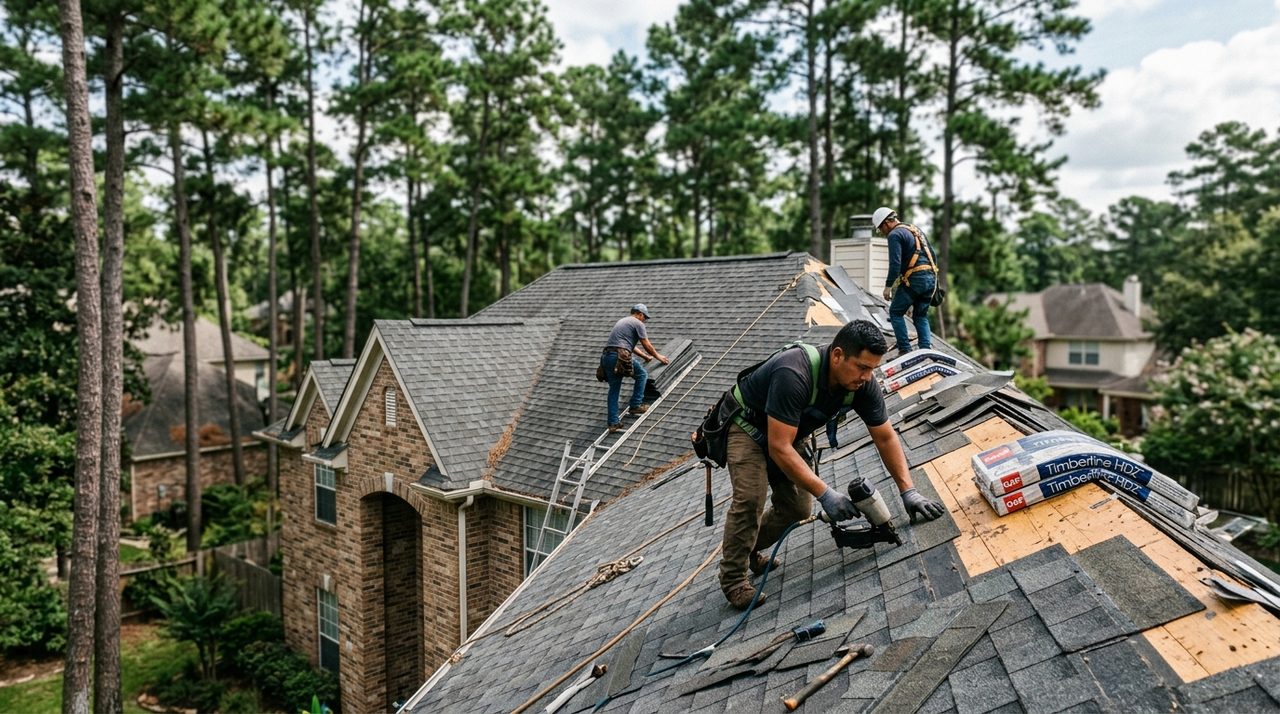
Porter's sprawling unincorporated Montgomery County footprint spans housing stock from 1970s acreage homes to brand-new Valley Ranch production builds, meaning a roofing contractor here may replace a 50-year-old original shake-to-shingle conversion on one street and file a warranty claim on a 3-year-old architectural shingle in an HOA-governed master-planned community on the next. The May 2024 derecho that raked Harris and Montgomery counties, combined with Porter's wide open subdivisions and limited tree canopy in newer plats, left thousands of roofs with wind-lifted tabs and hidden hail bruising that demand systematic inspection rather than cosmetic patching. This page cuts through the permit confusion—Montgomery County Engineering, not the City of Houston—and the subdivision-level HOA maze so Porter homeowners can move from storm damage to signed contract without costly missteps.
Ranked by verified Google rating × review volume × verification tier. How we rank →
Some highly-rated pros serve Porter from nearby and may not keep a Porter street address. Those are listed under "Also serving Porter" with their real city and distance, so you always know where each business is based.
24706 TX-494 Loop Suite 2, Porter, TX 77365
19474 Riverwalk Dr, Porter, TX 77365
21635 Lexor Dr, Porter, TX 77365
25139 Colette St, Porter, TX 77365
21559 Market Pl Dr, New Caney, TX 77357
11917 TX-105, Cut and Shoot, TX 77306
25397 Lamar Ln, Porter, TX 77365
23941 Cicada Cir E, New Caney, TX 77357
24816 Wayne Rd unit d, Porter, TX 77365
Highly-rated pros based nearby who cover Porter. Distance shown from the Porter area.
Serving Porter Based in Kingwood · 2.4 mi away
Why it matters to you
Porter's rapid post-1990 growth produced dozens of subdivisions—Valley Ranch among the newest—built on cleared land with minimal mature tree wind breaks. When the May 2024 derecho drove 100-plus mph straight-line winds across Montgomery County, homes in these open plats had no natural buffering, and roofs originally installed to pre-2006 IRC wind-resistance standards suffered lifted ridge caps, blown shingle tabs, and in some cases full field-section delamination. Homes built between roughly 1990 and 2005 are statistically likely to carry original 3-tab or early architectural shingles that fall short of current IRC nail-pattern requirements, making wind damage more extensive than it appears from the ground.
What a good pro does
A qualified roofer serving Porter should perform a full slope-by-slope inspection—not just a drive-by assessment—documenting nail pull-through, lifted tab adhesive strips, and exposed underlayment using close-up photos you receive as part of your estimate package. If a full replacement is warranted, the contractor must pull a permit through Montgomery County Engineering before work begins; Texas carries no state roofing license, so confirming the contractor holds general liability and workers' compensation insurance is the primary consumer protection tool available. Upgrading to a Class 4 impact-resistant shingle with a six-nail attachment pattern now costs an estimated $1,500–$3,500 more than standard but substantially reduces repeat claim exposure in Montgomery County's storm-active corridor.
Sources: International Residential Code (as adopted by City of Houston), Texas Windstorm Insurance Association (TWIA), Municipal permit office (see area profile)
Why it matters to you
Porter's census median year-built of 2001 means a large share of its housing stock is carrying 20-plus-year-old asphalt shingles that fall squarely in the sweet spot for accumulated hail damage. NOAA records show Harris and adjacent Montgomery counties average three to five significant hail events per year, and fiberglass mat bruising from golf-ball-sized stones is functionally invisible at street level while actively voiding manufacturer warranties and accelerating UV binder breakdown during Houston's sustained 95–105°F summer heat. A homeowner who had their roof 'checked out fine' after a storm several years ago may be living with compromised shingles that are now past warranty protection without knowing it.
What a good pro does
Request an inspection that includes physical tab manipulation and granule collection from downspout discharge, not just a visual scan from a ladder. A roofer familiar with Montgomery County's storm history can match your address against NOAA hail-track records to build a defensible insurance timeline. If shingles show mat fracture or significant granule loss, a full tear-off and replacement with dimensional architectural or Class 4 impact-resistant product—rather than a layer-over—allows the installer to inspect the OSB decking for delamination before the new system goes down, a critical step in a climate where attic humidity routinely exceeds 75 percent year-round.
Sources: International Residential Code (as adopted by City of Houston), Texas Windstorm Insurance Association (TWIA), ENERGY STAR / U.S. Dept. of Energy
Why it matters to you
Porter homeowners are often surprised to learn they face two separate approval tracks before a roofer can legally begin: a building permit from Montgomery County Engineering and, if their subdivision has an active HOA, an Architectural Control Committee (ACC) review that can take 10 to 30 days on its own. Valley Ranch, North Country, and The Highlands all carry mandatory HOA covenants, and an ACC rejection for an unapproved shingle color or material upgrade—say, switching from asphalt to metal—can force a redo at the homeowner's expense even after county permit approval is in hand. Many of Porter's older or unrestricted rural tracts have no HOA at all, creating a completely different compliance picture on the same road.
What a good pro does
Before signing any contract, confirm your specific parcel's HOA status through Montgomery County deed records or the TREC HOA management-certificate database—do not rely on neighbor reports or subdivision marketing materials. If ACC approval is required, build that review window into your project timeline explicitly, and submit your shingle manufacturer, color code, and product data sheet to the ACC simultaneously with your county permit application to minimize total delay. A contractor experienced in Porter should be prepared to pull the Montgomery County permit themselves rather than asking the homeowner to do it; verify this before awarding the work.
Sources: Local HOA / deed restrictions (see area profile), Municipal permit office (see area profile), International Residential Code (as adopted by City of Houston)
Why it matters to you
Porter's 1970s-through-1990s homes—particularly the older acreage properties and early subdivisions on the west side of the area—frequently retain original box or gable-only ventilation systems that predate IRC R806 balanced ridge-and-soffit ratio requirements. Houston metro's average annual relative humidity exceeds 75 percent, and an unventilated or underventilated attic in Porter's climate generates year-round condensation on OSB decking that silently causes delamination over five to eight years. Installing a new $12,000 shingle system over a deck that is already moisture-compromised—without correcting ventilation—means the homeowner effectively pre-pays for a second replacement.
What a good pro does
Any full re-roof estimate on a Porter home built before the mid-1990s should include an attic ventilation audit as a standard line item, not an upsell. The installer should calculate your net free area ratio per IRC R806 and document whether your current soffit-to-ridge balance meets minimum code before the first shingle comes off. If ridge vents are being added as part of the project, they require inclusion in the Montgomery County permit scope; do not accept a verbal assurance that ventilation additions are 'minor repairs' that skip the permit counter.
Sources: International Residential Code (as adopted by City of Houston), Municipal permit office (see area profile), FEMA National Flood Hazard Layer (NFHL)
Hiring roofers in Porter? Porter is a sprawling, unincorporated Montgomery County area composed of dozens of individual subdivisions—some master-planned with mandatory HOAs, others completely unrestricted rural tracts. Housing ranges from 1970s-era homes on acreage to brand-new production builds in communities like Valley Ranch. Homeowners must navigate county-level permitting and widely varying deed restrictions, making it essential to verify rules at the subdivision level before any project.
Building era
1970s–2020s, with significant growth from the 1990s through 2010s and ongoing new construction.
Typical style
Mix of traditional single-family brick and frame homes in older plats, and newer production-style traditional homes in master-planned communities.
Foundations
Predominantly concrete slab-on-grade for post-1960 construction; some pier-and-beam in older or custom rural builds — specific subdivision data not confirmed.
Common systems
Newer homes typically feature central HVAC with high-SEER units, PEX or copper plumbing, and 200-amp electrical panels; older 1970s–1990s homes may have original R-22 HVAC systems, galvanized or CPVC plumbing, and 100–150-amp panels.
What that means for repairs
Older subdivisions see HVAC replacements, re-plumbing from galvanized to PEX, and kitchen/bath remodels. Unrestricted acreage tracts attract new construction, additions, and outbuilding projects. Master-planned communities focus on cosmetic updates and energy efficiency upgrades.
Permit jurisdiction
Montgomery County Engineering and applicable special utility districts (MUDs). Not within City of Houston or any incorporated city permit jurisdiction.
HOA & deed restrictions
Varies widely by subdivision. Valley Ranch HOA is mandatory for all property owners. North Country Homeowners Association, Inc. operates as a subdivision HOA. The Highlands is governed by a mandatory HOA. Many properties in broader Porter have no HOA at all. Confirm for any specific property via deed records or TREC HOA management-certificate database.
Historic districts
No historic district designation confirmed. Porter is in unincorporated Montgomery County with no City of Houston HAHC jurisdiction.
Contractor note
Contractors must obtain permits through Montgomery County rather than a city permit office. Additionally, many subdivisions require separate HOA architectural review committee (ACC) approval before exterior work begins, so contractors should verify both county and private-covenant requirements for each job.
FEMA flood zone
FEMA Zone X (low flood risk) per official NFHL data. However, properties near the East Fork of the San Jacinto River and its tributaries may carry higher risk; confirm flood zone at the parcel level as conditions vary across this large unincorporated area.
Hurricane Harvey impact
Parts of Montgomery County, including areas along the San Jacinto River and its tributaries, experienced flooding during Hurricane Harvey. Subdivision-specific or street-level Harvey impact data for the broader Porter area was not confirmed in available sources. Property-specific flood history should be verified through FEMA NFIP records and the Montgomery County floodplain administrator.
Heat & humidity load
Extreme summer heat and humidity drive heavy HVAC demand; older 1970s–1990s systems may struggle with efficiency. Slab foundations on expansive clay soils can shift during prolonged dry spells, and homes on rural lots with septic systems face additional stress during saturated-soil conditions in late summer storms.
Working with contractors here
Porter's wide range of housing ages means contractors encounter everything from 1970s-era galvanized re-pipes and aging R-22 HVAC changeouts to warranty work in brand-new master-planned communities. Unrestricted acreage properties frequently generate new-build, barndominium, and accessory-structure projects that require Montgomery County permitting and septic coordination. In HOA-governed subdivisions like Valley Ranch and North Country, exterior projects require ACC approval in addition to county permits, and contractors should budget time for that review process. The area's rapid growth means utility infrastructure varies—some neighborhoods are served by MUDs with specific tap and connection standards that affect plumbing and site work. Job scoping should always include verifying the specific subdivision's HOA status, applicable deed restrictions, and whether the property is on municipal water/sewer or septic.
Local Tip
Always ask for a written estimate before work begins. Texas contractors are required to provide one on jobs over $1,000.
Porter is a sprawling, unincorporated Montgomery County area composed of dozens of individual subdivisions—some master-planned with mandatory HOAs, others completely unrestricted rural tracts. Housing ranges from 1970s-era homes on acreage to brand-new production builds in communities like Valley Ranch. Homeowners must navigate county-level permitting and widely varying deed restrictions, making it essential to verify rules at the subdivision level before any project.
Source: U.S. Census Bureau, ACS 5-Year 2023
Most of Porter maps to FEMA Zone X (low mapped flood risk), but Houston's flash-flood reality means even low-risk blocks benefit from smart drainage and storm-hardened installs.
Source: FEMA National Flood Hazard Layer (NFHL). Flood zones vary by parcel — verify your individual FIRM panel.
For homeowners in Porter, TX: beryl 2024 stripped unsealed ridge vents and attic ventilators off roofs across low-flood-risk Houston neighborhoods, creating interior soaking before homeowners even knew there was an opening. Have a roofer install hurricane-rated ridge vent covers or temporarily cap off-ridge ventilators if a storm is within 72 hours of landfall. As a Montgomery County community, Porter may follow county rather than City of Houston storm rebuild rules.
After a severe thunderstorm, the first thing a roofer should check in Porter, TX is whether wind-driven rain has pushed up under any low-slope transition sections—areas where a steep roof meets a flatter porch or addition—because these joints separate under gust pressure and rarely reseal on their own. Sealing those transitions with a peel-and-stick modified bitumen patch costs far less than replacing the framing they protect. Confirm the current FEMA panel for your Porter parcel — the area maps to Zone X, but adjacent lots can differ.
Ice loading in Porter, TX is infrequent but disproportionately damaging because Houston roofs and their fastening systems are designed for wind, not sustained dead weight. Ask a licensed roofer to inspect your ridge board connections and confirm that collar ties or rafter ties are present in the attic, since Uri 2021 produced several ridge-sag failures in well-maintained Houston homes where the framing had no freeze-load margin. As a Montgomery County community, Porter may follow county rather than City of Houston storm rebuild rules.
Sources: FEMA National Flood Hazard Layer (NFHL), Ready.gov -- Hurricanes, CenterPoint Energy -- Storm Center, City of Houston -- Emergency Preparedness, Ready.gov -- Winter Weather, Harris County Flood Control District
Houston-specific estimators to plan your project before you call a pro. All results are planning estimates — a licensed local pro confirms the details on site.
Estimated design wind speed for your zone
Outside the TDI catastrophe area, so a WPI-8 is generally not mandated — but Houston still sees hurricane-force gusts (Beryl, 2024). Insist on properly rated shingles installed to the manufacturer's high-wind nailing pattern (6 nails) and starter strips, or a wind claim can be denied for improper installation.
Find a Houston roofer →This is a planning estimate only — actual requirements depend on an on-site assessment by a licensed Houston pro. Wind-speed zones are approximate; your exact TDI/WPI-8 obligation depends on your address's designation. Verify with the Texas Department of Insurance before contracting.
Disconnect & drain every outdoor hose bib
Remove hoses, drain the spigots, and cover each with an insulated faucet sock. Un-drained hose bibs are the #1 burst point in a Houston freeze.
Insulate exposed pipes in the attic & garage
Wrap any pipe in an unconditioned space (attic runs, garage walls) with foam sleeves. Houston homes rarely insulate these because they only matter a few nights a year — which is exactly why they burst.
Open cabinet doors & keep a pencil-width drip
On hard-freeze nights, open kitchen/bath cabinets so warm air reaches the pipes and let faucets on exterior walls drip to relieve pressure.
Protect the attic/garage water heater & its lines
An attic or garage tank sits in unconditioned space. Insulate the cold-inlet and hot-outlet lines and confirm the emergency drain pan is clear so a leak doesn't reach the ceiling.
This is a planning estimate only — actual requirements depend on an on-site assessment by a licensed Houston pro. If a pipe has already burst, shut off your main water supply and call a licensed Houston plumber immediately — freeze bursts flood fast.
Sources: Municipal permit office (see area profile)Local HOA / deed restrictions (see area profile)
Sources: Local HOA / deed restrictions (see area profile)
Sources: International Residential Code (as adopted by City of Houston)
Sources: Texas Windstorm Insurance Association (TWIA)Municipal permit office (see area profile)