304 Walnut St A, Waller, TX 77484
Best Electricians in Waller, TX
Waller, TX presents electricians with a split market unlike anywhere else in the Houston metro: older rural properties along FM roads with aging 100-amp services and decades of DIY wiring sit just miles from Beacon Hill and other 2010s–2020s subdivisions where new homeowners are adding EV chargers and whole-home generators. Permit jurisdiction here is genuinely uncertain parcel by parcel—City of Waller properties use the City's permit office, while unincorporated Waller County parcels fall under the county's limited engineering authority—so getting that answer wrong before a panel upgrade or generator hookup can mean a failed inspection or unpermitted work that surfaces at resale. This page explains the four electrical challenges that actually affect Waller homeowners given the area's mixed housing stock, expansive Waller County clay soils, and its position in FEMA Zone X.
Verified against Google Business data
Updated 2026
See the 2 Electricians Serving Waller 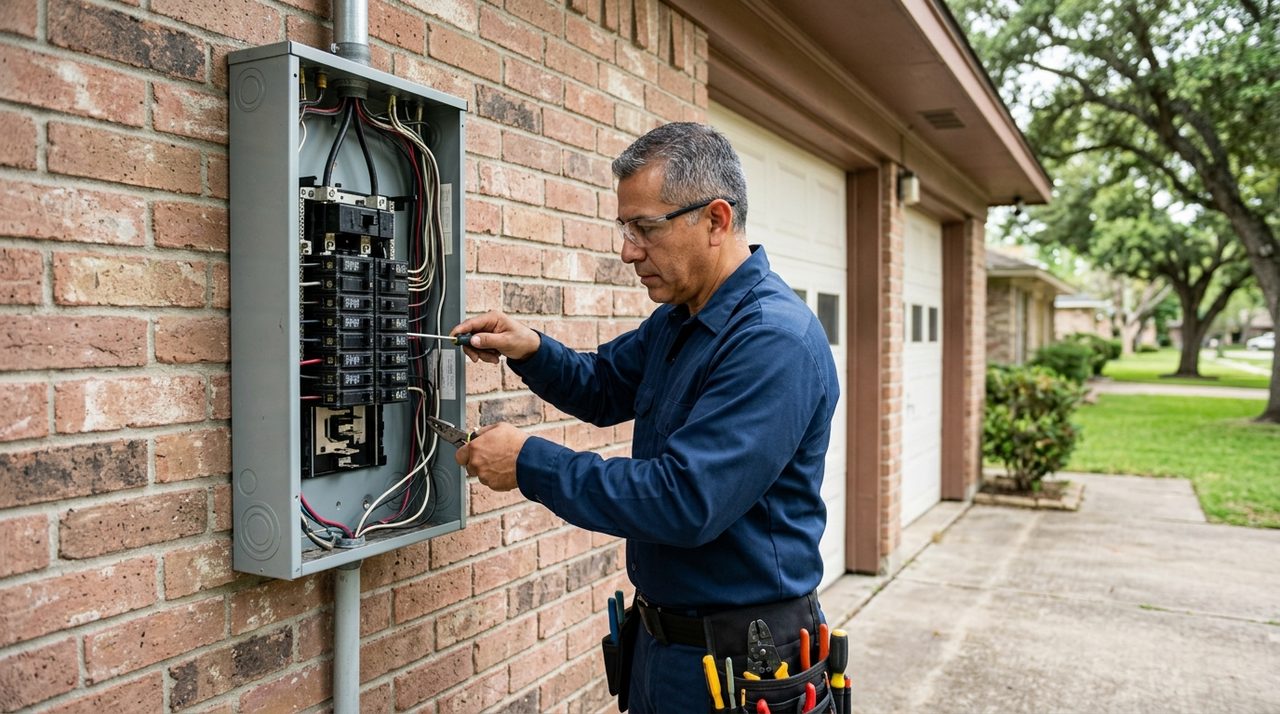
- Median home built
- 1987
- Median home value
- $115,100
- FEMA flood zone
- X (low)
- Typical panel upgrade cost (est.)
- $1,800–$3,200 (100A→200A)
- Most common local issue
- Undersized 100A services on older rural properties unable to carry added electric heat or EV loads
Ranked by verified Google rating × review volume × verification tier. How we rank →
Some highly-rated pros serve Waller from nearby and may not keep a Waller street address. Those are listed under "Also serving Waller" with their real city and distance, so you always know where each business is based.
Min rating:
2 resultsBased in Waller
Also serving Waller
Highly-rated pros based nearby who cover Waller. Distance shown from the Waller area.
Open Now
Serving Waller Based in Hempstead · 9.5 mi away
Electricians in Waller: What You Should Know
Undersized Rural Services Pushed Past Limit by Post-Uri Electrical Additions
Why it matters to you
Older rural properties in Waller County—many with a census median year built of 1987 or earlier—were wired for modest all-gas households on 100-amp services. After Winter Storm Uri in February 2021, owners across northwest Harris and Waller counties added electric space heaters, heat-pump water heaters, or mini-split systems as backup against future gas supply failures. That extra load on an original 100-amp service causes nuisance breaker trips, warm panel covers, and—in worst cases—overheated aluminum feeder conductors running beneath the slab.
What a good pro does
A licensed Master Electrician (credential issued by TDLR) should perform a load calculation per NEC Article 220 before any new electric heating equipment is energized. If the math shows the service is undersized, a 200-amp upgrade runs approximately $1,800–$3,200 installed including permit fees—estimates vary with site conditions. The electrician must pull a permit from either the City of Waller permit office or, for unincorporated parcels, confirm Waller County's applicable authority before scheduling the CenterPoint disconnect and reconnect.
Sources: Texas Department of Licensing & Regulation, Municipal permit office (see area profile), International Residential Code (as adopted by City of Houston)
Clay Soil Movement Cracking Underground Conduit on Slab-on-Grade Homes
Why it matters to you
Waller County sits on the same expansive Beaumont/Houston Black clay formation that causes foundation movement across the northwest Houston suburbs. Newer slab-on-grade subdivisions like Beacon Hill and older ranch homes on slabs both share this risk: as the clay cycles between wet expansion and dry contraction through Waller's boom-and-bust rainfall seasons, PVC conduit runs and direct-burial aluminum feeders embedded beneath or within the slab can shear at fittings or develop fault paths. Homeowners typically notice the problem as a mysterious ground-fault trip or a partial loss of power to a circuit that has no obvious upstream cause.
What a good pro does
Diagnosis requires a licensed electrician to perform conduit continuity testing and, if needed, time-domain reflectometry to locate the break without unnecessary trenching. If a buried feeder is confirmed damaged, rerouting overhead through the attic or exterior rigid conduit is often less disruptive than concrete cutting. For newer post-tension slabs in Waller subdivisions, any concrete work near the slab edge must be coordinated carefully to avoid cutting tension cables—a factor that affects how the electrician prices and scopes the reroute.
Sources: Texas Department of Licensing & Regulation, International Residential Code (as adopted by City of Houston), Municipal permit office (see area profile)
Weatherhead and Service Entrance Damage from Beryl and the May 2024 Derecho
Why it matters to you
Waller County sits roughly 40 miles northwest of central Houston, directly in the track of both Hurricane Beryl (July 2024) and the May 2024 derecho that produced sustained winds above 80 mph across the metro. Many older Waller rural properties carry overhead service drops through large oak or pecan tree canopies, making limb-on-wire contact and mast riser failures common after both events. CenterPoint Energy restores utility power to the transformer, but the weatherhead, mast, and meter base on the homeowner's side are entirely the homeowner's financial and logistical responsibility.
What a good pro does
Repairs require a TDLR-licensed Master Electrician to replace or resecure the mast, weatherhead, and meter base, then submit for inspection before CenterPoint will schedule a reconnect appointment. Homeowners should not attempt temporary repairs with tape or tie-wire—CenterPoint's inspection crew will refuse reconnection if the equipment does not meet current NEC standards. If the damaged service is on an unincorporated Waller County parcel, confirm permit requirements with the county engineering office before work begins, since the inspection process differs from City of Waller procedures.
Sources: Texas Department of Licensing & Regulation, Municipal permit office (see area profile), International Residential Code (as adopted by City of Houston)
EV Charger Installs Complicated by Waller's Parcel-by-Parcel Permit Landscape
Why it matters to you
Waller's newer subdivisions—including master-planned communities with active POAs or HOAs—are attracting younger families who commute to the Energy Corridor or Katy, making Level 2 EV charger demand real and growing. The permit path, however, is not uniform: a property inside the City of Waller limits needs an electrical permit from the City of Waller permit office, while a property in unincorporated Waller County requires a different process through the county. Additionally, some subdivision POAs in the Waller area govern where exterior equipment and visible conduit runs can be located, adding an approval layer before installation begins.
What a good pro does
Before ordering equipment, homeowners should pull their county appraisal district record to confirm municipal boundaries, then contact either the City of Waller or Waller County engineering to get the correct permit application. If the home has an original 100-amp or 150-amp panel—common in late-1980s construction that makes up much of Waller's median housing stock—a concurrent service upgrade to 200 amps may be required, pushing total project cost to an estimated $2,200–$4,100 including the charger circuit and panel work. A TDLR Master Electrician must pull the permit; homeowners should also check HOA or POA deed restrictions recorded at the Waller County Clerk before approving any conduit routing plan.
Sources: Texas Department of Licensing & Regulation, Municipal permit office (see area profile), Local HOA / deed restrictions (see area profile)
Electricians in Waller: What You Should Know
Hiring electricians in Waller? Waller sits in unincorporated and incorporated areas of Waller County northwest of Houston, featuring a mix of older rural properties and newer subdivision development. Homeowners here benefit from relatively low flood risk but should verify deed restrictions and permit jurisdiction on a parcel-by-parcel basis, as the regulatory landscape varies significantly across the area.
- Housing era
- Not confirmed - housing stock spans multiple decades, with newer construction (2010s–2020s) appearing in…
- Foundation
- Not confirmed - slab-on-grade is typical for newer construction in the region
- Flood zone
- FEMA Zone X (low flood risk) - source
- Permits
- Not confirmed with certainty
Housing stock & systems
Building era
Not confirmed - housing stock spans multiple decades, with newer construction (2010s–2020s) appearing in subdivisions like Beacon Hill alongside older rural properties.
Typical style
Not confirmed - likely a mix of ranch-style homes on larger lots and newer suburban construction in master-planned communities.
Foundations
Not confirmed - slab-on-grade is typical for newer construction in the region; older properties may include pier-and-beam.
Common systems
Not confirmed - newer homes likely feature modern central HVAC and PEX plumbing; older rural properties may have aging systems requiring updates.
What that means for repairs
Not confirmed - older rural properties in the area likely drive demand for system upgrades (HVAC, plumbing, electrical), while newer subdivision homes may require cosmetic updates and outdoor living additions.
Permits & restrictions
Permit jurisdiction
Not confirmed with certainty. Properties within the City of Waller would use the City of Waller permit office; properties in unincorporated Waller County would fall under Waller County engineering. Verify jurisdiction by parcel address.
HOA & deed restrictions
Not confirmed - some subdivisions in the Waller area may have mandatory HOAs or POAs, but no specific HOA was identified for the broader Waller community. Check deed and Waller County real property records or the TREC HOA Management Certificate database.
Historic districts
No City of Houston historic district designation confirmed. Waller is outside the City of Houston and HAHC jurisdiction.
Contractor note
Contractors should verify whether each job site falls within the City of Waller or unincorporated Waller County, as permit requirements and inspection processes differ. Deed restrictions, if any, should be confirmed through Waller County Clerk records before beginning exterior modifications.
Flood & weather
FEMA flood zone
FEMA Zone X (low flood risk) - source: fema_nfhl. Specific bayou or creek proximity for individual parcels should be verified, but the overall area carries minimal federally designated flood risk.
Hurricane Harvey impact
Not confirmed - no street-level flood data or Harvey inundation records were found for the specific Waller neighborhood area. Check Harris County and Waller County flood claim records for parcel-specific Harvey impact.
Heat & humidity load
Houston-area summers bring sustained high heat and humidity. Homes in Waller, particularly older rural structures, may experience increased HVAC strain, moisture intrusion issues, and foundation movement during prolonged dry spells. Newer subdivision homes benefit from modern insulation and drainage but still require regular HVAC maintenance and attic ventilation checks.
Working with contractors here
Contractors working in Waller encounter a split market: newer subdivision homes needing warranty-era repairs, outdoor living additions, and fence installations, alongside older rural properties requiring full system overhauls including HVAC replacement, re-plumbing, and electrical panel upgrades. The low flood risk reduces demand for flood mitigation work, but foundation monitoring remains important given the expansive clay soils common across Waller County. Job scoping should account for potentially longer material delivery times given the area's distance from central Houston supply hubs, and contractors must confirm the applicable permit jurisdiction before starting work.
Local Tip
Always ask for a written estimate before work begins. Texas contractors are required to provide one on jobs over $1,000.
About Waller
Waller sits in unincorporated and incorporated areas of Waller County northwest of Houston, featuring a mix of older rural properties and newer subdivision development. Homeowners here benefit from relatively low flood risk but should verify deed restrictions and permit jurisdiction on a parcel-by-parcel basis, as the regulatory landscape varies significantly across the area.
- Median year built
- 1987
- Median home value
- $115,100
- Owner-occupied
- 27.6%
- Population
- 3,062
- Housing units
- 1,300
- Median income
- $37,163
Source: U.S. Census Bureau, ACS 5-Year 2023
Flood & storm risk
FEMA Zone XLow flood riskMost of Waller maps to FEMA Zone X (low mapped flood risk), but Houston's flash-flood reality means even low-risk blocks benefit from smart drainage and storm-hardened installs.
Source: FEMA National Flood Hazard Layer (NFHL). Flood zones vary by parcel — verify your individual FIRM panel.
Houston Storm Readiness in Waller
Hurricane & flooding
Beryl 2024 demonstrated that Houston's above-ground distribution grid fails even in areas well away from surge zones, leaving Waller, TX residents in dangerous July heat without a way to power fans or refrigeration. Protect your home's sensitive electronics — smart panels, EV chargers, and variable-speed HVAC controls — with a whole-house surge protector installed by a licensed electrician before the next storm forms in the Gulf. As a Waller County community, Waller may follow county rather than City of Houston storm rebuild rules.
Severe storms & hail
Whole-house surge protection is the critical electrician upgrade for Waller, TX residents whose primary storm risk is power-quality damage rather than flooding; a surge arrester at the meter base absorbs the voltage spikes that destroy HVAC control boards, smart-home hubs, and refrigerator compressors every time CenterPoint restores a faulted circuit after a derecho. A licensed electrician can add this protection to virtually any modern meter base in under two hours. As a Waller County community, Waller may follow county rather than City of Houston storm rebuild rules.
Ice storms & freezes
After a hard freeze, check every outdoor GFCI receptacle and reset it before assuming the circuit is dead — thermal cycling can trip GFCI devices without triggering the breaker, and in Waller, TX that can leave your garage door opener, exterior lighting, and holiday-season outdoor circuits mysteriously dark. If a GFCI won't reset after a freeze, call a TDLR-licensed electrician rather than bypassing it, because moisture intrusion from the freeze may have compromised the device or the wiring behind it. Confirm the current FEMA panel for your Waller parcel — the area maps to Zone X, but adjacent lots can differ.
Sources: FEMA National Flood Hazard Layer (NFHL), Ready.gov -- Hurricanes, CenterPoint Energy -- Storm Center, City of Houston -- Emergency Preparedness, Ready.gov -- Winter Weather, Harris County Flood Control District
Free Waller Tools & Calculators
Houston-specific estimators to plan your project before you call a pro. All results are planning estimates — a licensed local pro confirms the details on site.
Houston Freeze Prep & Pipe Insulation Checklist
Open full tool & FAQ →Your freeze checklist — 4 tasks
- 1
Disconnect & drain every outdoor hose bib
Remove hoses, drain the spigots, and cover each with an insulated faucet sock. Un-drained hose bibs are the #1 burst point in a Houston freeze.
- 2
Insulate exposed pipes in the attic & garage
Wrap any pipe in an unconditioned space (attic runs, garage walls) with foam sleeves. Houston homes rarely insulate these because they only matter a few nights a year — which is exactly why they burst.
- 3
Open cabinet doors & keep a pencil-width drip
On hard-freeze nights, open kitchen/bath cabinets so warm air reaches the pipes and let faucets on exterior walls drip to relieve pressure.
- 4
Protect the attic/garage water heater & its lines
An attic or garage tank sits in unconditioned space. Insulate the cold-inlet and hot-outlet lines and confirm the emergency drain pan is clear so a leak doesn't reach the ceiling.
This is a planning estimate only — actual requirements depend on an on-site assessment by a licensed Houston pro. If a pipe has already burst, shut off your main water supply and call a licensed Houston plumber immediately — freeze bursts flood fast.
Frequently Asked Questions
My property is in the Beacon Hill subdivision outside Waller city limits — do I need a permit for an electrical panel upgrade, and who inspects it?
If your parcel falls in unincorporated Waller County rather than within the City of Waller's incorporated limits, the City of Waller permit office has no authority over your job — Waller County engineering handles the permit side, and its inspection infrastructure is more limited than a full municipal building department. Before any electrician pulls a permit, have them confirm your parcel's jurisdiction using the Waller County Appraisal District or the county clerk's records, because pulling a city permit on a county-jurisdiction property — or skipping the permit entirely — can create title and insurance problems at resale. A Texas Master Electrician license issued through TDLR is required to pull any electrical permit regardless of which jurisdiction applies.
Sources: Texas Department of Licensing & RegulationMunicipal permit office (see area profile)
Our Waller home was built in the late 1960s and we're planning to sell. Should we be worried about aluminum branch-circuit wiring during the buyer's inspection?
Homes built between roughly 1965 and 1975 in the Houston metro — including older rural and in-town properties in Waller County — frequently have single-strand aluminum branch circuits, and buyers' inspectors flag this consistently. Proper remediation means either replacing those circuits with copper or installing CO/ALR-rated devices and AlumiConn connectors at every termination; a surface coat of anti-oxidant paste alone does not meet the standard and will not satisfy a knowledgeable inspector. Given Waller's census median year built of 1987, homes on the older end of the local housing stock are the most likely candidates, so an electrician's pre-listing assessment is a practical first step.
Waller is FEMA Zone X, so do I still need to worry about where my electrician places a new subpanel or backup generator transfer switch?
Zone X means your property is outside the mapped high-risk flood area, so FEMA-mandated elevation requirements for new electrical equipment do not apply the way they would in an AE zone, but that does not mean placement is irrelevant. Waller County's clay soils and the area's documented flash-flood episodes — even on nominally low-risk parcels — mean a subpanel or transfer switch installed low on an exterior wall or in a low-lying garage can still be reached by sheet-flow water during an intense storm event. Ask your electrician to mount any new equipment at least 12 inches above the finished floor or exterior grade as a practical precaution, even when no code elevation requirement is triggered.
What's a realistic cost estimate and timeline for adding a 50-amp generator inlet and manual interlock to a Waller rural property, and does the remoteness of the area affect either?
A manual interlock with a 50-amp inlet typically runs $600–$1,400 installed as an estimate, depending on how far the inlet needs to be run from the panel and whether the existing panel has a suitable breaker slot — figures that apply broadly across the Houston metro. In Waller, factor in that electricians based in Cypress, Katy, or Tomball who serve the area may charge a trip-cost premium for the roughly 30–45-mile haul from central Houston supply hubs, and material delivery lead times can add a day or two compared to inner-loop jobs. Permitting in unincorporated Waller County can also run longer than a suburban city with a dedicated inspection queue, so plan for one to two extra business days before final inspection sign-off.
Sources: Municipal permit office (see area profile)
A lot of Waller's newer subdivision homes were built in the 2010s — is there anything specific those homeowners should ask an electrician about before adding a Level 2 EV charger?
Newer Beacon Hill-era homes typically came with 150- or 200-amp services, which usually have enough headroom for a 40–50-amp EVSE circuit without a service upgrade, but the electrician still needs to perform a load calculation to confirm available capacity before pulling a permit. If your subdivision has an HOA or POA, verify whether deed restrictions govern where exterior conduit can be run or where the charger unit itself can be mounted — some Waller-area master-planned communities have rules about garage-facing versus side-yard installations. A Level 2 charger supply circuit (assuming panel capacity exists) runs roughly $400–$900 installed as an estimate, and the permit must be pulled through whichever jurisdiction — City of Waller or Waller County — covers your parcel.
Sources: Local HOA / deed restrictions (see area profile)Municipal permit office (see area profile)
Is summer or fall a better time to schedule electrical work on attic-run wiring in a Waller home, given how hot attics get here?
Houston-area attics routinely exceed 140°F from late May through September, making any attic electrical work physically punishing and potentially dangerous for the crew — heat stress is a real job-site risk, and a conscientious electrician may decline to work in those conditions mid-afternoon. If you need junction boxes re-pulled, new circuits run through an unconditioned attic, or old THHN insulation assessed for heat degradation, scheduling in October through early March gives crews workable temperatures and typically faster scheduling windows since it is off-peak for HVAC-driven electrical calls. Waller's chronic high humidity accelerates wire-nut oxidation and neutral-conductor corrosion year-round, so do not wait indefinitely if a thermal-imaging inspection has already flagged a hot spot.